Blog
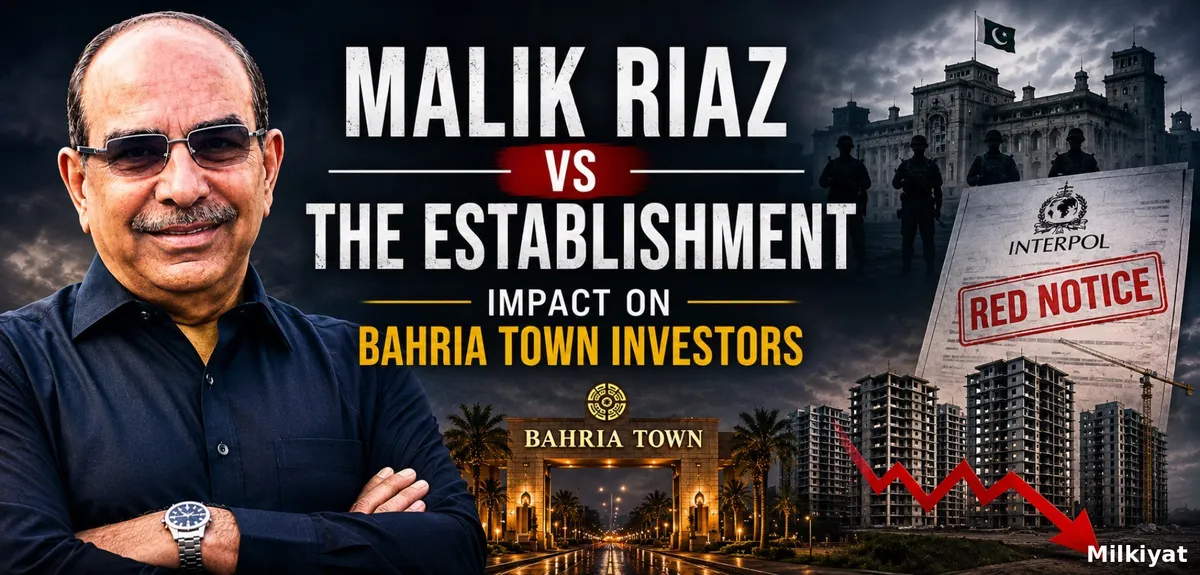
Malik Riaz vs The Establishment: How the Stand-Off Impacts Bahria Town Investors

By wajahat Ali
Real Estate Analyst
Updated 7 min read
ShareWhatsApp
Blog
By wajahat Ali
Real Estate Analyst
Updated 7 min read
Blog
By wajahat Ali
Real Estate Analyst
Updated 7 min read
For over two decades, Malik Riaz Hussain was widely considered the undisputed king of Pakistani real estate. His company, Bahria Town, did not just build housing societies; it constructed a parallel infrastructure of flawless roads, round-the-clock electricity, and gated security. For millions of domestic and overseas buyers, a Bahria Town file was the safest asset in the country. However, the real estate landscape has shifted dramatically. The intricate web of political and military patronage that once protected the tycoon has completely unraveled. Today, the ongoing Malik Riaz establishment problem has escalated into an unprecedented legal and financial confrontation. If you are an investor or property holder, understanding this conflict is critical. Here is a breakdown of why this stand-off happened and how it is actively impacting the market value and legal standing of Bahria Town properties.
The shift from being a protected partner of the state to a targeted adversary stems from high-profile anti-graft crackdowns and shifting political dynamics within Pakistan.
The core of the current legal onslaught dates back to a 2019 civil settlement with Britain’s National Crime Agency (NCA), where the Riaz family forfeited £190 million in unexplained wealth. When the funds were repatriated, they were allegedly adjusted against Bahria Town’s Supreme Court liabilities instead of entering the national treasury. This transaction became the center of a massive corruption reference involving former Prime Minister Imran Khan. The current administration views this arrangement as a direct financial loss to the state.
Historically, Malik Riaz maintained deep ties across the political spectrum, frequently acting as a mediator between major political parties and military leadership. However, the current establishment's directive has pivoted toward absolute accountability. By choosing self-exile in the UAE and publicly appealing for a "dignified solution" rather than surrendering to the courts, Riaz has crossed a definitive line, leading the state to deploy its full regulatory machinery.
The National Accountability Bureau (NAB) and federal agencies have shifted from simple inquiries to a direct squeeze on Bahria Town's core operational assets.
The aggressive maneuvers to isolate the property tycoon have sent shockwaves through the real estate market, leaving ordinary middle-class families and overseas Pakistanis caught in the crossfire.
The legal uncertainty has deeply damaged investor confidence. Across various phases—especially in newer sectors of Bahria Town Karachi and Bahria Town Rawalpindi—property values have faced steep market corrections ranging from 15% to 40%. Buyers looking for liquidity are struggling, as secondary market transactions have slowed down due to the fear of sudden state land confiscations.
With corporate accounts scrutinized and development teams panicking, day-to-day management is showing visible strain. The acquisition of necessary state utility connections (gas pipelines, grid stations, and water infrastructure) has faced bureaucratic delays by government departments, leaving some newer blocks difficult to inhabit.
The state’s declaration that major chunks of land were built on contested or altered government land has thrown land titles into limbo. Even residents holding valid possession certificates face the risk of dealing with local development authorities stepping in as state-appointed legal "receivers" or caretakers of the land.
For long-term investors, the core infrastructure of developed phases (like Phase 1-8 in Rawalpindi or the fully developed precincts in Karachi) remains physically secure and heavily populated. The state is highly unlikely to demolish built-up residential areas, as doing so would cause extreme public backlash. However, buying un-developed files, disputed blocks, or entering speculative trading in Bahria Town projects carries higher risk under the current political climate. Investors are advised to focus strictly on fully developed, on-ground properties with clear possession histories.
Q1: What is the primary reason behind the stand-off between Malik Riaz and the establishment?
The conflict is rooted in a major shift away from the traditional patronage system toward aggressive financial accountability. Specifically, it stems from the fallout of the 2019 UK National Crime Agency (NCA) £190 million settlement and the subsequent Al-Qadir Trust corruption reference. The current state authorities view the adjustment of those repatriated funds against Bahria Town’s Supreme Court liabilities as a massive loss to the national exchequer, leading them to dismantle the tycoon's political and legal buffers.
Q2: What does the Interpol Red Notice mean for Malik Riaz and his son?
The National Accountability Bureau (NAB) secured an Interpol Red Notice against Malik Riaz and his son, Ali Riaz. A Red Notice is an international request sent to law enforcement agencies worldwide to locate and provisionally arrest a person pending extradition or similar legal action. While it is not an automatic international arrest warrant, it severely restricts their international mobility and signals that Pakistani authorities are actively pushing the UAE government for their physical extradition to face trial.
Q3: Why did accountability courts issue lifetime arrest warrants for Malik Riaz?
Accountability courts issued perpetual (lifetime), non-bailable arrest warrants against Malik Riaz and his family members after declaring them "proclaimed offenders" for failing to appear before the courts. These warrants legally oblige Pakistani law enforcement to arrest him on sight if he enters the country, and have triggered executive orders to block his national identity documents, passports, and domestic bank accounts.
Q4: Which specific Bahria Town land assets have been frozen by the government?
The state's legal squeeze has targeted large tracts of land across multiple projects under allegations of illegal acquisition. Most notably, NAB froze over 3,150 acres of land designated for the Bahria Town Karachi 2 (BTK-2) project in Jamshoro, under claims that valuable public forest property was fraudulently transferred and consolidated into the private development.
Q5: Is it still safe to buy or hold property in older, developed phases of Bahria Town?
Yes, on-ground, heavily populated, and fully developed phases—such as Phases 1 to 8 in Rawalpindi/Islamabad or established, occupied precincts in Karachi—remain physically secure. The state is highly unlikely to intervene against built-up residential areas due to the extreme public backlash it would cause among ordinary citizens. For these phases, properties are safe to hold for long-term rental income or residence.
Q6: What types of Bahria Town investments carry the highest risk right now?
The highest-risk assets are un-developed files, disputed blocks, and projects facing active land title litigation (like BTK-2). Because the secondary trading market has experienced price drops between 15% and 40%, buying non-possession files or engaging in speculative trading is highly discouraged until the legal stand-off between the developer and the state reaches a formal resolution. For a detailed media broadcast breaking down the international legal mechanisms behind these current warrants, watch this Samaa TV Report on Bahria Town Karachi Land Freezes. This video provides concrete background on the specific properties and acreage impacted by the National Accountability Bureau's recent directives.
For over two decades, Malik Riaz Hussain was widely considered the undisputed king of Pakistani real estate. His company, Bahria Town, did not just build housing societies; it constructed a parallel infrastructure of flawless roads, round-the-clock electricity, and gated security. For millions of domestic and overseas buyers, a Bahria Town file was the safest asset in the country. However, the real estate landscape has shifted dramatically. The intricate web of political and military patronage that once protected the tycoon has completely unraveled. Today, the ongoing Malik Riaz establishment problem has escalated into an unprecedented legal and financial confrontation. If you are an investor or property holder, understanding this conflict is critical. Here is a breakdown of why this stand-off happened and how it is actively impacting the market value and legal standing of Bahria Town properties.
The shift from being a protected partner of the state to a targeted adversary stems from high-profile anti-graft crackdowns and shifting political dynamics within Pakistan.
The core of the current legal onslaught dates back to a 2019 civil settlement with Britain’s National Crime Agency (NCA), where the Riaz family forfeited £190 million in unexplained wealth. When the funds were repatriated, they were allegedly adjusted against Bahria Town’s Supreme Court liabilities instead of entering the national treasury. This transaction became the center of a massive corruption reference involving former Prime Minister Imran Khan. The current administration views this arrangement as a direct financial loss to the state.
Historically, Malik Riaz maintained deep ties across the political spectrum, frequently acting as a mediator between major political parties and military leadership. However, the current establishment's directive has pivoted toward absolute accountability. By choosing self-exile in the UAE and publicly appealing for a "dignified solution" rather than surrendering to the courts, Riaz has crossed a definitive line, leading the state to deploy its full regulatory machinery.
The National Accountability Bureau (NAB) and federal agencies have shifted from simple inquiries to a direct squeeze on Bahria Town's core operational assets.
The aggressive maneuvers to isolate the property tycoon have sent shockwaves through the real estate market, leaving ordinary middle-class families and overseas Pakistanis caught in the crossfire.
The legal uncertainty has deeply damaged investor confidence. Across various phases—especially in newer sectors of Bahria Town Karachi and Bahria Town Rawalpindi—property values have faced steep market corrections ranging from 15% to 40%. Buyers looking for liquidity are struggling, as secondary market transactions have slowed down due to the fear of sudden state land confiscations.
With corporate accounts scrutinized and development teams panicking, day-to-day management is showing visible strain. The acquisition of necessary state utility connections (gas pipelines, grid stations, and water infrastructure) has faced bureaucratic delays by government departments, leaving some newer blocks difficult to inhabit.
The state’s declaration that major chunks of land were built on contested or altered government land has thrown land titles into limbo. Even residents holding valid possession certificates face the risk of dealing with local development authorities stepping in as state-appointed legal "receivers" or caretakers of the land.
For long-term investors, the core infrastructure of developed phases (like Phase 1-8 in Rawalpindi or the fully developed precincts in Karachi) remains physically secure and heavily populated. The state is highly unlikely to demolish built-up residential areas, as doing so would cause extreme public backlash. However, buying un-developed files, disputed blocks, or entering speculative trading in Bahria Town projects carries higher risk under the current political climate. Investors are advised to focus strictly on fully developed, on-ground properties with clear possession histories.
Q1: What is the primary reason behind the stand-off between Malik Riaz and the establishment?
The conflict is rooted in a major shift away from the traditional patronage system toward aggressive financial accountability. Specifically, it stems from the fallout of the 2019 UK National Crime Agency (NCA) £190 million settlement and the subsequent Al-Qadir Trust corruption reference. The current state authorities view the adjustment of those repatriated funds against Bahria Town’s Supreme Court liabilities as a massive loss to the national exchequer, leading them to dismantle the tycoon's political and legal buffers.
Q2: What does the Interpol Red Notice mean for Malik Riaz and his son?
The National Accountability Bureau (NAB) secured an Interpol Red Notice against Malik Riaz and his son, Ali Riaz. A Red Notice is an international request sent to law enforcement agencies worldwide to locate and provisionally arrest a person pending extradition or similar legal action. While it is not an automatic international arrest warrant, it severely restricts their international mobility and signals that Pakistani authorities are actively pushing the UAE government for their physical extradition to face trial.
Q3: Why did accountability courts issue lifetime arrest warrants for Malik Riaz?
Accountability courts issued perpetual (lifetime), non-bailable arrest warrants against Malik Riaz and his family members after declaring them "proclaimed offenders" for failing to appear before the courts. These warrants legally oblige Pakistani law enforcement to arrest him on sight if he enters the country, and have triggered executive orders to block his national identity documents, passports, and domestic bank accounts.
Q4: Which specific Bahria Town land assets have been frozen by the government?
The state's legal squeeze has targeted large tracts of land across multiple projects under allegations of illegal acquisition. Most notably, NAB froze over 3,150 acres of land designated for the Bahria Town Karachi 2 (BTK-2) project in Jamshoro, under claims that valuable public forest property was fraudulently transferred and consolidated into the private development.
Q5: Is it still safe to buy or hold property in older, developed phases of Bahria Town?
Yes, on-ground, heavily populated, and fully developed phases—such as Phases 1 to 8 in Rawalpindi/Islamabad or established, occupied precincts in Karachi—remain physically secure. The state is highly unlikely to intervene against built-up residential areas due to the extreme public backlash it would cause among ordinary citizens. For these phases, properties are safe to hold for long-term rental income or residence.
Q6: What types of Bahria Town investments carry the highest risk right now?
The highest-risk assets are un-developed files, disputed blocks, and projects facing active land title litigation (like BTK-2). Because the secondary trading market has experienced price drops between 15% and 40%, buying non-possession files or engaging in speculative trading is highly discouraged until the legal stand-off between the developer and the state reaches a formal resolution. For a detailed media broadcast breaking down the international legal mechanisms behind these current warrants, watch this Samaa TV Report on Bahria Town Karachi Land Freezes. This video provides concrete background on the specific properties and acreage impacted by the National Accountability Bureau's recent directives.
CDA sector or private housing society? Compare approvals, NOCs, tenure, possession timelines, risks, and investment potential before buying property in Islamabad or Rawalpindi.
G-11 is a CDA sector, so ownership does not move through a patwari's intkal. This guide covers the full CDA transfer procedure, file verification, NDC, the 1% transfer fee, advance tax, biometrics and deed registration, plus the documents you need, the real 2026 cost stack, and how long a clean file actually takes.
G-11 is CDA-allotted land, so ownership is proved through CDA records and the Islamabad sub-registrar, not a Punjab patwari. This guide walks through the documents to demand, the checks to run in order, the fraud patterns that repeat in G-11, and what to do if a defect shows up mid-deal.
A complete look at flats for rent in G-11 Islamabad, pricing by bed count, the best sub-sectors, furnished vs unfurnished options, and what the rental agreement process actually involves.
CDA sector or private housing society? Compare approvals, NOCs, tenure, possession timelines, risks, and investment potential before buying property in Islamabad or Rawalpindi.
G-11 is a CDA sector, so ownership does not move through a patwari's intkal. This guide covers the full CDA transfer procedure, file verification, NDC, the 1% transfer fee, advance tax, biometrics and deed registration, plus the documents you need, the real 2026 cost stack, and how long a clean file actually takes.
G-11 is CDA-allotted land, so ownership is proved through CDA records and the Islamabad sub-registrar, not a Punjab patwari. This guide walks through the documents to demand, the checks to run in order, the fraud patterns that repeat in G-11, and what to do if a defect shows up mid-deal.
A complete look at flats for rent in G-11 Islamabad, pricing by bed count, the best sub-sectors, furnished vs unfurnished options, and what the rental agreement process actually involves.