News
Only 2% of Pakistani Women Own Land as Property Ownership Gap Remains Severe

By Mariam Khan
Real Estate Analyst
5 min read
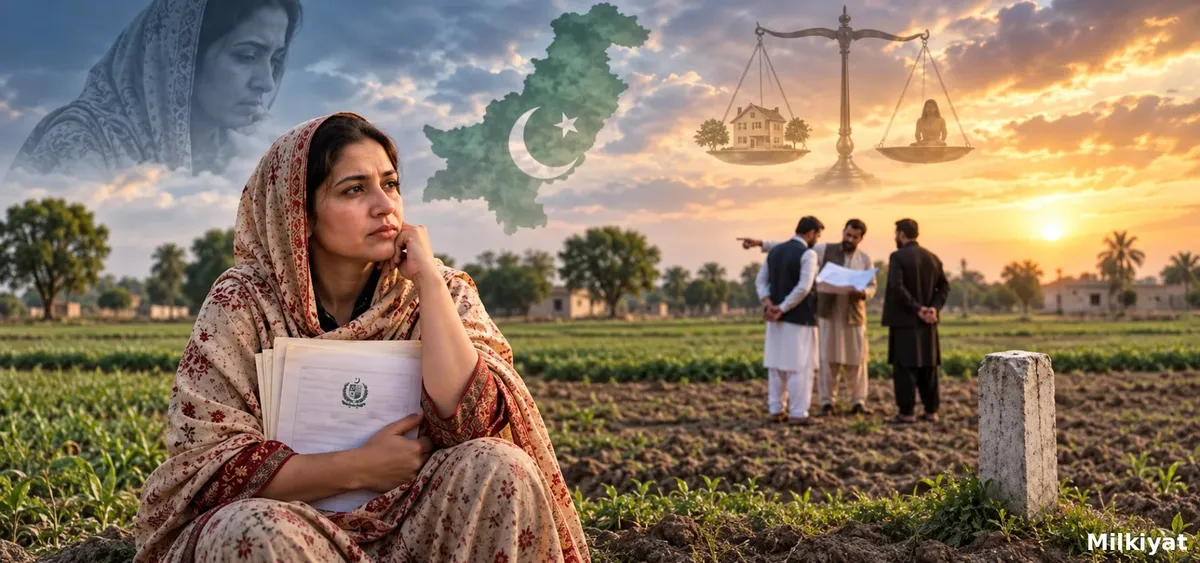
Only about 2 percent of ever married women aged 15 to 49 in Pakistan own land either independently or jointly, while 97.2 percent have never inherited a house or land, according to a study by the Sustainable Development Policy Institute. The gap is even starker in Sindh specifically, where 99.1 percent of women do not own land alone or jointly.
The Agriculture Paradox at the Centre of This Finding
The study's most striking finding is the direct contradiction it exposes between women's actual labour contribution and their formal ownership stake in that same sector. Some 67 percent of Pakistan's employed women work in agriculture, yet only 1.5 percent of agricultural households are formally recorded as female headed. Women are, in the study's own framing, doing the agricultural work and absorbing climate shocks directly, while the formal financial and land ownership system does not reflect that reality in any proportionate way.
Why This Extends Beyond Land Into Broader Financial Exclusion
This ownership gap does not exist in isolation, and the same study documents a compounding financial and digital divide running alongside it. Only 14 percent of women have a full service financial account compared with 56 percent of men, and mobile wallet ownership stands at just 11 percent among women against 48 percent among men. The study's authors describe this exclusion as structural, arguing that financial products themselves are designed around assumptions of land ownership, individual mobility, and digital access, none of which reflect the actual lived reality of most women farmers.
Why Land Ownership Specifically Matters So Much
Land functions differently from other forms of wealth precisely because of what it enables. Compared to more liquid assets like jewellery or livestock, land ownership provides women considerably more stable, durable financial security, and critically, functions as the collateral base most formal lending systems require. Existing academic research on this same gap in Pakistan has found that women's land ownership is directly associated with better child food and nutrition security outcomes, reflecting land's role not just as a financial asset but as a foundation for household level resilience and decision making authority more broadly. Globally, women are estimated to own only 1 to 2 percent of land, meaning Pakistan's own findings, while severe, reflect a documented pattern extending well beyond the country's borders.
The Legal Right Versus Actual Practice Gap
Under Islamic jurisprudence and Pakistan's own constitutional framework, women are formally entitled to acquire land through gift, inheritance, will, and direct purchase. The SDPI findings make clear that this formal legal entitlement and actual, exercised ownership are two entirely different realities, with the vast majority of women who are legally entitled to inherit land or property never actually receiving or retaining it in practice.
Why Climate Vulnerability Makes This More Urgent
The study frames this gap as an increasingly urgent problem given Pakistan's standing as one of the world's most climate vulnerable countries. More than nine in ten women farmers surveyed had experienced an extreme climate related event, including heatwaves, flooding, heavy rainfall, or drought like conditions, over the preceding five years, with more than 80 percent reporting crop losses as a direct result. Without land ownership or the collateral and financial access it typically enables, women farmers absorbing these repeated climate shocks have structurally limited ability to recover, rebuild, or access the kind of climate responsive financial products the study argues are urgently needed.
What This Means for Pakistan's Land Record System
This finding points directly to a structural weakness in how inheritance and property transfers actually function on the ground in Pakistan, distinct from what formal law provides for. A legal entitlement to inherit land means little if the underlying land record, mutation, and transfer process does not result in women's names actually being recorded as owners, whether due to social pressure, administrative barriers, lack of awareness of legal rights, or informal family arrangements that bypass formal documentation entirely. Addressing this gap meaningfully would require not just legal reform but genuine attention to how inheritance transfers are actually processed and recorded at the land record authority level in each province.
What This Means for Access to Property Backed Finance
Given that land remains the primary collateral base for most formal lending in Pakistan, this ownership gap directly explains a meaningful share of the broader financial exclusion the same study documents. Without land in their own name, women farmers and rural households more broadly are structurally excluded from the kind of property backed credit that could otherwise support agricultural investment, climate recovery, and household resilience. Financial institutions, regulators, and development finance institutions seeking to close this gap would need to look specifically at land titling and inheritance transfer reform as a precondition for any broader gender responsive financial product design, rather than treating access to finance and land ownership as separate problems.