News
Pakistan Stock Market Loses Nearly 2,000 Points as Political Uncertainty Weighs on Investors

By Mariam Khan
Real Estate Analyst
3 min read
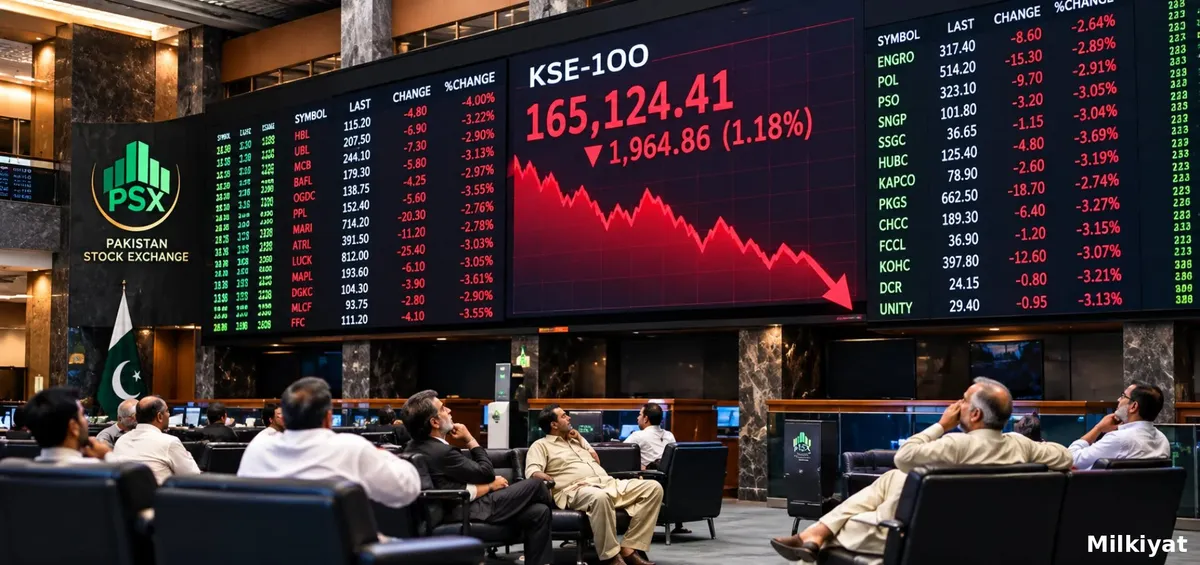
The Pakistan Stock Exchange ended October 12 under heavy selling pressure, with the benchmark KSE 100 Index falling 1,964.86 points to close at 165,124.41.
The decline represented a loss of 1.18 percent during the session as investors reacted to a combination of political uncertainty and wider market concerns.
For Pakistan real estate, the stock market drop is relevant mainly as an indicator of investor sentiment. It does not by itself prove that property prices or real estate demand are declining.
What Happened at the Pakistan Stock Exchange
The official PSX Data Portal shows that the KSE 100 closed at 165,124.41 on October 12 after falling 1,964.86 points.
The index had closed the previous session at 167,089.27 and traded between 165,168.49 and 166,988.32 during the day.
Selling pressure was reported across several major sectors, including banking, cement and energy.
The decline came during a period of increased domestic political uncertainty, which can make investors more cautious about taking new positions in financial markets.
Why Market Volatility Matters for Real Estate
Stock market movements and property prices do not move in exactly the same way.
However, both markets can be affected by broader investor confidence, economic expectations, interest rates and access to financing.
When financial markets become volatile, some investors may delay large investment decisions until conditions become clearer.
The Pakistan Stock Exchange financial literacy guidance notes that investors need to consider market downturns, risk capacity and volatility when making investment decisions.
For property developers, prolonged uncertainty can also influence access to capital if banks, investors or corporate buyers become more cautious.
Cement Sector Weakness Is Worth Watching
Selling pressure in cement shares is relevant to the construction sector because listed cement companies are closely connected with building activity and infrastructure demand.
However, falling cement share prices do not mean cement prices or construction activity have automatically declined.
Equity prices can move because of investor sentiment, earnings expectations, energy costs, political developments and wider market conditions.
The PSX stock screener allows investors to monitor individual companies and sector performance separately from the broader market index.
What Property Investors Should Watch
Property investors should avoid treating a single stock market session as a direct signal to buy or sell real estate.
The more important factors remain interest rates, inflation, construction costs, financing availability, economic growth and local property supply and demand.
If financial volatility continues for a longer period, it may weaken investment confidence and make developers more cautious about launching or financing new projects.
For now, the October 12 decline is better viewed as a sign of short term financial market uncertainty rather than evidence of a property market downturn.
For continued coverage of economic developments and their impact on Pakistan real estate, readers can follow Milkiyat.