Guide
Peshawar Revitalisation Plan: PDA Projects, Budget and What They Mean for Property

Real Estate Analyst
13 min read
This guide covers the Peshawar Revitalisation Plan, also reported as the Peshawar uplift plan and the Peshawar revival plan. For the Authority delivering much of it, see our guide to the Peshawar Development Authority.
What the Peshawar Revitalisation Plan Is
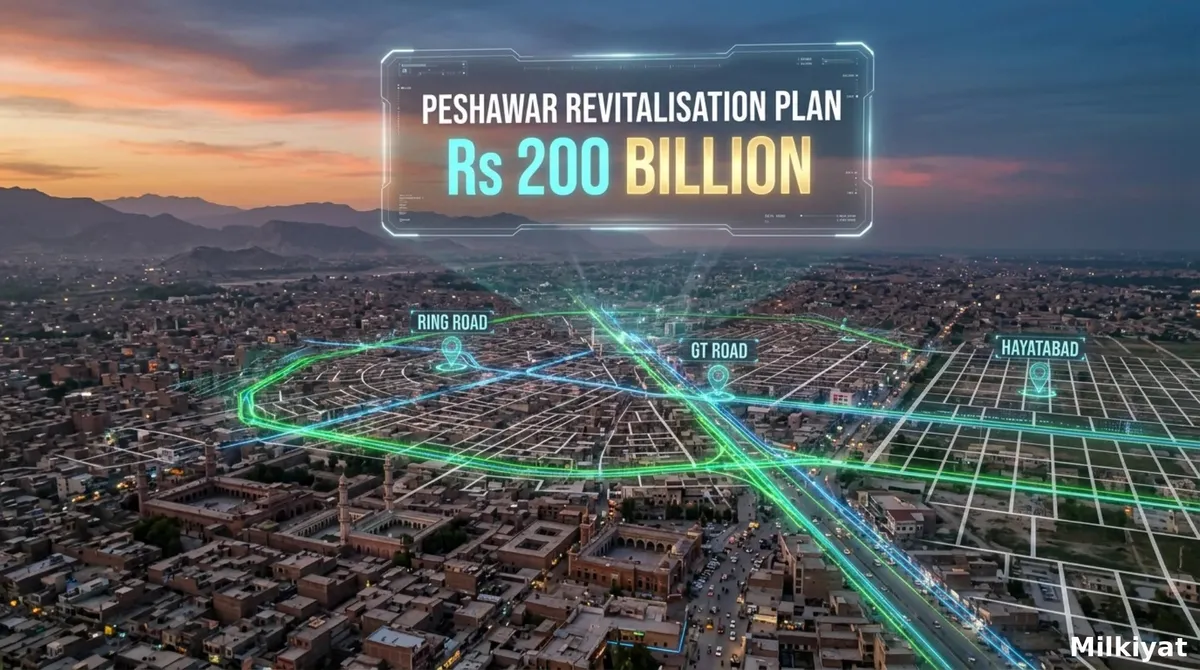
The Peshawar Revitalisation Plan is a provincial programme of urban infrastructure projects across the city, headlined at roughly Rs 200 billion, delivered through several agencies with the Peshawar Development Authority among the main implementers. Press coverage also calls it the Peshawar uplift plan and the Peshawar revival plan, and all three names describe the same programme.
Quick answers:
- What it is: a bundle of road, flyover, park, water and sanitation projects, not a single scheme
- Headline value: about Rs 200 billion, of which projects worth Rs 171 billion are reported as approved
- Who runs it: PDA, the Local Government Department, Public Health Engineering, Irrigation, Communication and Works, and the Khyber Pakhtunkhwa Highways Authority
- Where it lands: Ring Road, Warsak Road, GT Road, Hayatabad, Chamkani, Palosi, Pishtakhara, Regi Model Town and the walled city
- What it does not include: any published consolidated list of projects with their individual costs
That last point shapes everything below. This guide works from what has actually been announced and costed in public, and says plainly where the record stops.
The Rs 200 Billion Headline, and What Is Actually Approved
The Rs200 billion Peshawar plan figure comes from the Chief Minister's own description of the programme, repeated across briefings since the plan was approved at a Chief Minister House meeting in February 2026.
A Milkiyat.com computation of the approval gap. Reporting puts approved projects at Rs 171 billion against the Rs 200 billion headline.
- Share approved: 171 divided by 200 equals 85.5 percent
- Still unapproved: Rs 200 billion minus Rs 171 billion equals Rs 29 billion, or 14.5 percent
The 14.5 percent that has not cleared approval is not funded, not tendered, and not scheduled, so any project a seller cites may sit in that remainder.
Why approval is not the same as money
Four stages separate an announcement from a finished road, and the plan's projects are spread across all of them:
- Announced, named at a briefing with no PC-1 behind it
- Approved, cleared by a competent forum, which is what the Rs 171 billion counts
- Funded, carried in the Annual Development Programme with a release against it
- Under construction, with a contractor mobilised on site
A project can hold at the second stage for years. Ask which of the four a project has reached, and for the document that proves it.
The Projects With Published Costs
No consolidated schedule of plan projects and costs has been published. The table below is a Milkiyat tally compiled from reporting on individual groundbreakings rather than from an Authority document, and each figure is reported as an estimate.
| Project | Reported cost | Scope |
|---|---|---|
| Ring Road and GT Road level-two flyover | Rs 6.2 billion | 640 m dual carriageway plus a 4.5 km road |
| 19 major roads, Phase I(A) and I(B) | Rs 7.2 billion | Arterial roads plus Hayatabad entry points |
| Warsak Road flyover, Ring Road Phase II | Rs 3.2 billion | 800 m, 180 day target |
| Palosi flyover | Rs 2.6 billion | Local congestion relief |
| Pishtakhara Chowk underpass | Rs 2.1 billion | Three month target |
| Hazar Khwani interchange overpass | Rs 1.257 billion | Six lanes, on the Ring Road |
| Public parks upgrade | Rs 1 billion | 34 parks, five packages |
A Milkiyat.com computation of what is traceable. The seven costed projects total Rs 6.2 plus Rs 7.2 plus Rs 3.2 plus Rs 2.6 plus Rs 2.1 plus Rs 1.257 plus Rs 1, which equals Rs 23.557 billion.
- Against the Rs 200 billion headline: 11.8 percent
- Against the Rs 171 billion approved: 13.8 percent
So roughly seven rupees in every eight of the headline sit in projects whose individual costs have not been published.
Roads, Flyovers and Underpasses: Where the Money Is Going
The plan's centre of gravity is road capacity, and the named works cluster on a handful of corridors.
- Arterial upgrades: feasibility and design work on 35 major urban arterial roads, with 19 already in a costed rehabilitation phase
- Ring Road junctions: the GT Road level-two flyover, the Warsak Road flyover under Ring Road Phase II, and the Hazar Khwani six-lane overpass
- The Nasir Bagh to Regi Model Town missing link, listed in the plan as a Ring Road component
- A Hayatabad link road from the Industrial Estate to the Northern Bypass and Frontier Road, described as a top priority
- A cloverleaf interchange at the Pir Zakori intersection
- Underground electricity cabling from Pir Zakori flyover to Suri Pul, and Aman Chowk to Karkhano Market
Milkiyat has reported the Rs 72 billion Peshawar road upgrade programme that sits alongside this work. Read the two together rather than treating every road announcement as new money, because corridors recur across programmes under different headings.
Why the Ring Road dominates the list. Three of the costed works are junction upgrades on or feeding the Ring Road, so the plan is largely about moving through-traffic off internal streets rather than building new neighbourhoods. That favours plots with direct access to a junction.
Parks, Water and Sanitation: The Municipal Half
The plan is not only roads, and the municipal components are the ones most likely to change how a neighbourhood actually lives.
- Parks: 34 existing public parks upgraded under a Rs 1 billion package, with groundbreaking at Shahi Bagh and work started across all sites
- New parks: two theme parks proposed on Khweshgi and Takhta Baig roads, plus a children's park
- Water supply: new schemes, and rehabilitation of existing schemes that are not functioning
- Sewerage: a treatment plant at Faqir Kale, and rehabilitation of Shahi Khata
- Sanitation: procurement of electric road cleaning machines
- Slaughterhouses: four new facilities, reported at approval stages
Several of these were described as being at approval stages rather than under construction, which is a different thing again from the 85.5 percent figure above.
For a buyer, the municipal items deserve more weight than they get. A working water scheme or a sewerage connection decides whether a plot is liveable; a flyover two kilometres away only changes a commute. Peshawar has also begun charging households directly, as our report on the city's first monthly sanitation fee sets out.
The Frame of Peshawar, and the Projects With No Published Detail
The Frame of Peshawar appears in the approved plan as a component at Chamkani. Beyond the name and the location, the public record carries no cost, no scope, no design and no implementing agency for it.
That is worth stating plainly rather than filling in, because a named project with no published detail is exactly what gets quoted to buyers as a reason to pay more for land nearby. The same caution applies to the theme parks and the slaughterhouses, named without costs.
How to treat an undetailed project. Ask for three things: the PC-1, the approving forum and the date of approval. A project that cannot produce those has not reached the stage where money is committed, whatever the announcement said. Our guide on how to check a plot's development status before buying sets out the same discipline applied to a plot.
This is not a reason to dismiss the Frame of Peshawar. It is a reason to keep a named but undetailed project out of the price until the detail arrives. If something substantial is built at Chamkani, land nearby reprices then, and a buyer who waited will not have paid twice for the same expectation.
Which Areas Benefit
The plan's named works concentrate in specific corridors rather than spreading evenly across the city.
| Area or corridor | Named works | What it changes |
|---|---|---|
| Ring Road, northern and eastern | GT Road flyover, Hazar Khwani overpass, Nasir Bagh to Regi link | Through-traffic capacity and journey times |
| Warsak Road | Ring Road Phase II flyover, underground cabling to Suri Pul | Junction congestion on a main approach |
| Hayatabad | Industrial Estate link road, entry point upgrades, boundary wall work | Access and the township's edges |
| Chamkani | The Frame of Peshawar, scope unpublished | Unknown until details are released |
| Palosi and Pishtakhara | Flyover and underpass | Local congestion and access |
| Walled city and inner Peshawar | Road rehabilitation, Shahi Bagh, Shahi Khata | Streetscape and drainage |
Where a corridor is named, read what the work actually does. An interchange that moves through-traffic past a junction can reduce footfall at roadside shops while improving a commuter's run, so the same project helps residential value and can hurt retail frontage on the same road.
Note also what is absent. The two PDA townships appear mainly at their edges, through Hayatabad's entry points and the Nasir Bagh to Regi link. A plan weighted towards arterial capacity does not necessarily reach the street a plot sits on.
PDA's Role and the Budget 2026-27 Question
PDA is one implementer among six, not the owner of the programme. It is credited alongside the Local Government Department for the parks package, and its officers attend the groundbreakings, while roads and highways work also runs through Communication and Works and the Khyber Pakhtunkhwa Highways Authority. Knowing which agency owns a project tells you whose delivery record to check.
On the PDA budget 2026-27, the honest position is that no figure is published. What is on the record is narrower:
- PDA's own 2025-26 budget was cleared at the Authority's 14th meeting in April 2026
- The province's Annual Development Programme 2026-27 was still in consultation in late February 2026, with parliamentarians asked to submit schemes by 15 March
- The Land Use and Building Control Authority approved its 2026-27 budget separately in September 2026
- No PDA figure for 2026-27 appears in the Authority's published material
Anyone quoting a PDA budget 2026-27 number should be asked for the notification or minute it comes from. The gap matters because a project's place in the ADP, not its place in a press release, determines whether it is funded this year.
What the Plan Means for Property
The SERP for this topic is news coverage with no property analysis, so this is the part worth getting right.
- Approved is not funded, and funded is not built. A project can clear approval, wait years for release of funds, and still not break ground. Price land on what exists.
- Completion targets in this plan are short and untested. A 180 day flyover and a three month underpass are stated intentions, not delivery records.
- Nearby ring roads have overrun badly. Our report on how the Rawalpindi Ring Road missed a sixth deadline as its cost reached Rs 47 billion is the realistic benchmark for a corridor premium.
- Benefit is not uniform along a corridor. Plots at an interchange and plots mid-corridor behave differently, as our analysis of which societies benefit most from a ring road sets out.
- Fiscal room constrains everything. Our piece on infrastructure under fiscal constraints explains why announced programmes slip.
For the wider pattern of how infrastructure announcements move prices, our guide to Islamabad's biggest infrastructure projects and what they mean for property applies the same tests in another city.
How to Check a Revitalisation Plan Claim Before You Pay
When a seller prices a plot on a plan project, work through this.
- Ask which specific project, by name and location, not "the revitalisation plan".
- Ask whether it is approved, and by which forum, with the date.
- Ask for the PC-1 or the ADP entry, since a press release is not either.
- Check whether the cost has ever been published, because unpublished means unscheduled.
- Establish the distance and the access route from the plot to the actual work.
- Ask what the project does to your plot's use, since through-traffic helps homes more than shops.
- Compare the stated completion target with that agency's delivery record.
- Confirm the plot's own development status separately, since a nearby flyover does not bring water or sewerage.
- Ask who the implementing agency is, because six are involved and their records differ.
- Check whether the corridor appears in another programme too, so one road is not counted twice.
- Ask what land acquisition is still needed, since an unacquired alignment can still move.
The question that settles most of it. "Can you show me the approval, with its date and the forum that gave it?" A seller who produces that is describing a project. One who cannot is describing a press release.
Frequently Asked Questions
What is the Peshawar Revitalisation Plan?
It is a provincial urban infrastructure programme for Peshawar, headlined at about Rs 200 billion and approved at a Chief Minister House meeting in February 2026. It bundles roads, flyovers, underpasses, parks, water supply, sewerage and sanitation works delivered through PDA and five other agencies rather than one scheme.
Which projects are included?
Costed projects include a Rs 6.2 billion Ring Road and GT Road flyover, Rs 7.2 billion of rehabilitation across 19 roads, flyovers at Warsak Road and Palosi, the Pishtakhara underpass, the Hazar Khwani overpass and a Rs 1 billion upgrade of 34 parks. Water, sewerage and slaughterhouse works are named without costs.
Which areas benefit?
Named works concentrate on the Ring Road, Warsak Road, GT Road, Hayatabad, Palosi, Pishtakhara, Chamkani and the inner city. Benefit is uneven along any corridor, since interchange plots and mid-corridor plots behave differently, and a project can help homes while hurting roadside retail frontage.
When will it finish?
No completion date has been published for the programme as a whole. The Chief Minister has said effective implementation could change the city's outlook within one to two years.
Sources
- Business Recorder, for the plan's approval in February 2026 and its component list, including the Frame of Peshawar at Chamkani
- The News and ProPakistani, for the Rs 200 billion headline and the Rs 171 billion approved
- Dawn, for the Hazar Khwani interchange overpass at Rs 1.257 billion
- Associated Press of Pakistan, for the Annual Development Programme 2026-27 consultation and the Authority's 14th meeting
- Daily Times, Daily Independent and trade reporting, for the individual flyover, underpass, road and parks costs tallied above
- Peshawar Development Authority Act, 2017, for the Authority's functions and funding powers
*This guide explains the Peshawar Revitalisation Plan and what it means for property owners and buyers. It is general information, not legal, tax or financial advice. Project costs quoted here are estimates drawn from public reporting rather than from a consolidated Authority schedule, and approvals, costs and timelines change. Confirm any specific project with the Peshawar Development Authority or the relevant implementing agency before deciding, and take professional advice