Guide
Property Dealer Commission in Pakistan (2026): Rates, Rules, Who Pays & Everything You Must Know

By wajahat Ali
Real Estate Analyst
12 min read
The short answer: Property dealers in Pakistan customarily charge 1% of the sale price from each side on a residential sale a 2% total cost on the transaction and roughly half of one month's rent on a rental deal. Commercial deals run higher, often up to 2% per side. None of these figures are fixed by law. They are market convention, and they are negotiable.
The longer answer, which is the one that protects your money: there is a law. It has existed since 1980. It gives the provincial government power to cap what a dealer may charge, requires dealers to be registered before they can legally trade at all, and treats overcharging as grounds for suspending their licence. Almost nobody in this market behaves as though any of that exists.
1. The Customary Rates in 2026
There is no national commission table. What follows is prevailing market practice, which varies by city, property type, and how much leverage you have.
| City | Residential (per side) | Notes |
|---|---|---|
| Islamabad | ~1% of final sale price | Can stretch to 1–2% by mutual agreement |
| Rawalpindi | ~1% of final sale price | Tracks Islamabad convention closely |
| Lahore | 0.5% – 2% | Varies significantly by property type |
| Karachi | ~2% under Rs. 1 crore; 1–2% above | Inverse scaling on higher values |
Commercial transactions commonly carry up to 2 percent of total property value, roughly double the residential norm.
Rentals in Islamabad conventionally cost half of the first month's rent, though some dealers take a full month. In Karachi, one full month's rent is more common, and in some areas dealers charge only the tenant.
Notice the direction of travel in Karachi: higher-value property attracts a lower percentage. That is the clearest available evidence that these rates negotiate — the market already discounts them when the rupee figure gets large enough to be worth arguing about. Deal size, exclusivity of mandate, and clean filer documentation are all legitimate leverage.
The Critical Point: "Per Side"
When a dealer brokers a deal between two parties, both parties are typically liable to pay commission unless they have agreed different terms beforehand.
So "1% commission" on a Rs. 2 crore house is not Rs. 2 lakh of friction. It is Rs. 2 lakh from the buyer and Rs. 2 lakh from the seller. Rs. 4 lakh, total, leaving the transaction.
This dual-agency structure, one dealer collecting from both sides of the same deal is a conflict of interest that would be regulated or restricted in most mature property markets. Your dealer is not your agent. Your dealer is the transaction's agent, and the transaction only pays if it closes.
⚠️ The incentive problem. A dealer earning from both sides has no financial interest in you walking away from a bad plot. Any dealer advice that steers you toward closing should be weighed against that.
2. The Law Almost Nobody Cites
Property brokerage in Punjab which governs Rawalpindi and the wider Punjab market, is regulated under the Punjab Real Estate Agents and Motor Vehicles Dealers (Regulation of Business) Ordinance, 1980. It is old, it is under-enforced, and it is real law.
Section 3 — Registration is mandatory. No person may conduct real estate business unless registered with the designated registering authority and holding a valid certificate issued by that authority. An unregistered dealer is not a lightly-regulated dealer. They are operating in breach of the prohibition clause.
Section 7 — "Fixation of commission." The Government may prescribe the maximum rate of commission or remuneration which a real estate agent may charge on any transaction they arrange or negotiate.
This is the single most under-reported fact in Pakistani real estate. The legal architecture for capping dealer commission has existed for over four decades. What is missing is the exercise of that power through an actual prescribed rate.
📌 Milkiyat's read: Section 7 is an enabling provision, not a self-executing cap. Until a maximum is actually prescribed and notified, "1%" remains convention rather than a ceiling. But its existence means that when a dealer tells you the rate is "standard" or "fixed," they are describing a market habit, not a legal obligation. There is no legally fixed rate for them to point at.
Section 8 — Record-keeping is a statutory duty. Every agent must maintain accounts and records of the transactions they arrange, negotiate or make. So when you ask for a written receipt, you are asking them to do something the law already requires.
Section 9 Overcharging is suspendable. The registering authority may cancel or suspend a dealer's certificate for malpractice and the Ordinance names charging higher commission than allowed explicitly, alongside maintaining incorrect transaction accounts and dealing despite knowing of title defects. Up to three months' suspension for a first breach, six months for subsequent ones, with 15 days to respond to notice. Section 10 provides for simple imprisonment of up to six months, a fine, or both.
⚠️ Verify before you rely. Enforcement is weak and inconsistent, and the twin cities market largely operates as though this Ordinance does not exist. Treat these provisions as negotiating leverage and as grounds for a complaint — not as a guarantee that anyone will act. Confirm the current text and any amendments with a licensed property lawyer before building a legal position on them.
3. Tax on Commission: What Your Dealer Owes FBR
Under Section 233 of the Income Tax Ordinance, 2001, brokerage and commission is subject to withholding tax. For Tax Year 2026 (1 July 2025 – 30 June 2026, as amended by the Finance Act 2025), property dealers sit in the general "others" category:
| Category | Filer | Non-Filer | Nature |
|---|---|---|---|
| Advertising agent | 10% | 20% | Minimum tax |
| Life insurance commission (< Rs. 0.5M pa) | 8% | 16% | Minimum tax |
| Others (incl. property dealers) | 12% | 24% | Minimum tax |
Two things matter. First, it is a minimum tax — harsher than the adjustable withholding applied to many other categories. Second, the non-filer rate is double. That is a large part of why so much commission in this market moves as undocumented cash, and why so many dealers resist issuing receipts.
📌 Why this matters to you. A dealer who insists on cash and refuses a receipt is usually not doing it for your benefit. They are managing their own tax exposure using your transaction. You should not accept a worse paper trail on your own asset to facilitate it.
Do not confuse commission with transfer tax. Commission is what you pay your dealer; Sections 236K (buyer) and 236C (seller) are what you pay the state at transfer. For TY2026, 236K on a normal purchase up to Rs. 50M runs 1.5% filer, 4.5% late-filer, 10.5% non-filer, rising with value bands.
⚠️ A live flag. A Budget 2026–27 relief package affecting property transaction taxes has been publicly discussed, including proposed changes to 236C/236K. The figures above reflect the verified Finance Act 2025 / TY2026 position. Proposals do not become law until passed through the Finance Bill and notified by FBR. Confirm the live rate on your transaction date and don't let a dealer quote you tax from memory.
4. The Charge That Costs More Than the Commission
Commission is the visible cost. It is rarely the largest one.
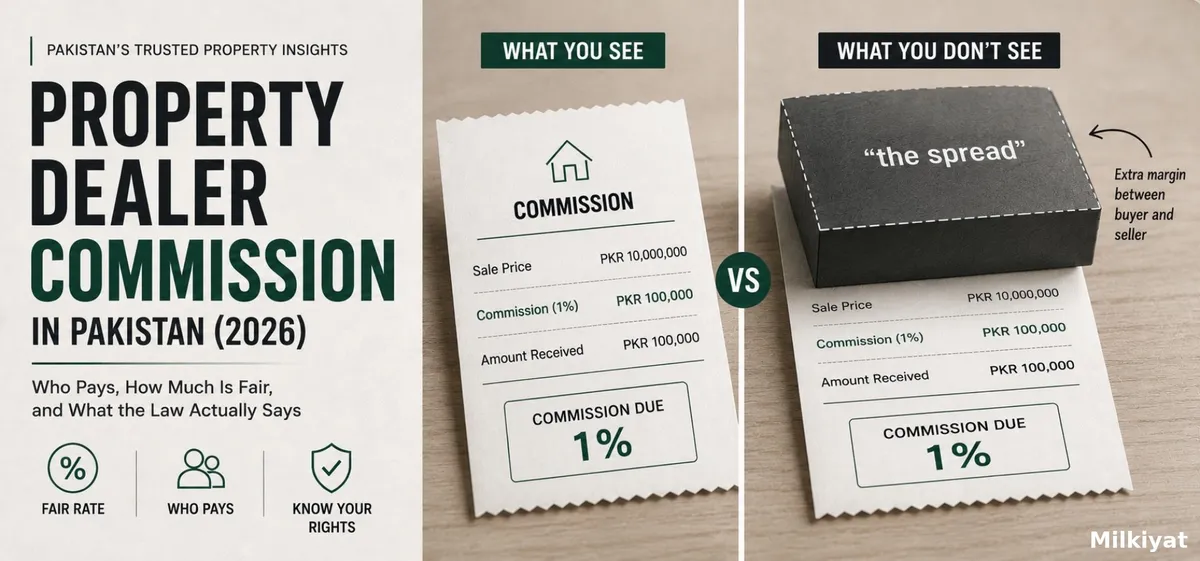
The structural complaint in this market, raised repeatedly by buyers and sellers, and rarely addressed, is what a dealer captures outside the stated commission by controlling the price itself.
The mechanism is simple. The dealer knows the seller will accept Rs. 1.8 crore. The dealer tells the buyer the price is Rs. 2 crore. The deal closes at Rs. 2 crore, the seller receives 1.8, and the dealer keeps the Rs. 20 lakh spread — on top of the 1% collected from each side.
That spread is frequently many times larger than the commission. Because it is embedded in the sale price rather than itemised, it appears on no receipt, is never withheld against under Section 233, and is invisible to both parties.
How to defend against it: establish price independently before engaging a dealer (transacted rates, not asking rates); meet the counterparty directly, a dealer resisting that may have a spread to protect; ask the seller what they are actually receiving; and never let a dealer hold your token money in a personal account.
5. Before You Pay Any Dealer: The Checklist
- ✅ Ask for the registration certificate. Under Section 3, they need one to trade legally. A dealer who cannot produce one is telling you something.
- ✅ Agree the rate in writing, per side, before viewing while they are still competing for your business.
- ✅ Demand a receipt for every rupee. Section 8 already requires them to maintain records.
- ✅ Verify the property yourself. The dealer is paid on closing; you are not. See our guides on RDA vs. CDA jurisdiction and how to verify a housing society's approval.
- ✅ In Rawalpindi, demand the Green Property Certificate. A dealer's word that a society is "RDA approved" is worth nothing against a plot-specific GPC.
- ✅ Never pay token money before independent title verification.
Frequently Asked Questions
What is the standard property dealer commission in Pakistan? There is no legally standard rate. Market convention is approximately 1% of the sale price from each party for residential sales in Islamabad and Rawalpindi, 0.5–2% in Lahore, and around 2% in Karachi for properties under Rs. 1 crore, dropping to 1–2% above that. Commercial deals commonly reach 2% per side. All are negotiable.
Who pays the property dealer commission — buyer or seller? Customarily both. Where a dealer brokers a deal between two parties, both are typically liable unless they have agreed otherwise in advance. This means a "1% commission" deal usually removes 2% of the sale value from the transaction in total.
Is there a legal maximum on property dealer commission in Pakistan? Section 7 of the Punjab Real Estate Agents and Motor Vehicles Dealers (Regulation of Business) Ordinance, 1980 empowers the Government to prescribe a maximum rate of commission. The power exists in statute. Until a maximum is actually prescribed and notified, prevailing rates remain market convention rather than a legal ceiling.
Do property dealers in Pakistan need a licence? Yes. Section 3 of the 1980 Ordinance prohibits conducting real estate business without being registered with the designated registering authority and holding a valid certificate. Enforcement is weak, but the requirement is law, and you are entitled to ask to see the certificate.
What happens if a property dealer overcharges commission? Under Section 9, charging higher commission than allowed is listed as a malpractice for which the registering authority may suspend or cancel the dealer's certificate — up to three months for a first breach and six months for subsequent breaches, with 15 days to respond to notice. Section 10 provides for imprisonment of up to six months, a fine, or both.
What is the commission on rental property in Pakistan? In Islamabad the convention is half of the first month's rent, though some dealers charge a full month depending on property type and agreement. In Karachi, one full month's rent is more common, and in some areas dealers charge only the tenant.
Is property dealer commission taxable in Pakistan? Yes. Under Section 233 of the Income Tax Ordinance 2001, brokerage and commission is subject to withholding tax. For Tax Year 2026, the rate applicable to property dealers is 12% for filers and 24% for non-filers, treated as minimum tax.
Can I negotiate property dealer commission in Pakistan? Yes. Rates are convention, not law. Leverage includes deal size, exclusivity of mandate, whether the dealer is also collecting from the counterparty, and the quality of your documentation. The Karachi market already discounts percentage rates on higher-value deals, which demonstrates the principle.
The Milkiyat Position
We are commission-free by design, so treat this as an interested party speaking plainly.
The 1% figure is not the problem. Skilled brokerage has real value, and a dealer who finds you the right plot, verifies it honestly, and gets the transfer done cleanly has earned a fee.
The problem is the information asymmetry the fee sits inside. A dual-agency structure where one person collects from both sides. A price spread that dwarfs the declared commission and appears on no document. A licensing regime that exists in statute and is ignored in practice. A registration certificate that almost no buyer has ever asked to see.
You cannot fix that market single-handedly. You can refuse to be the easiest party in it. Know the conventional rate. Know that it is a convention. Know that Section 7 exists. Ask for the certificate. Get the receipt. Verify the plot yourself.
This article is editorial research, not legal, tax, or financial advice. Commission conventions vary by city, dealer, and transaction, and tax rates change with each Finance Act. The Punjab Ordinance 1980 provisions cited here are under-enforced and subject to amendment. Always verify the current legal and tax position directly with the relevant authority and consult a licensed property lawyer and tax advisor before any financial commitment.
Sources: Punjab Real Estate Agents and Motor Vehicles Dealers (Regulation of Business) Ordinance, 1980 (Sections 3, 7, 8, 9, 10), via Punjab Laws Online (punjablaws.gov.pk); Withholding (Income) Tax Rates Card, Tax Year 2026, as updated by the Finance Act 2025 — Tariq Abdul Ghani & Co., Chartered Accountants; FBR withholding agent schedule under Section 233; prevailing commission conventions per Zameen.com and JagahOnline market reporting.