Guide
SBCA Building By-Law Revision and Green Construction Plans
Guide
A tenant guide to renting an office in D-12 Islamabad covering Markaz plazas, sizes, floors, rent benchmarks, approved use, agreements and a checklist.
Explore 1 bed apartment prices in Park View City Islamabad, including project comparisons, apartment sizes, price per sq ft, lake-facing views and buying options.
Explore apartments for sale in Park View City Islamabad, including 1, 2 and 3-bed units, project details, price comparisons, payment plans and buyer guidance.
A tenant guide to renting an office in F-10 Islamabad covering Markaz plazas, sizes, floors, rent benchmarks, approved use, agreements and a checklist.

By Maham Imtiaz
Real Estate AnalystVerified author
9 min read
Karachi's building rules are old. The Sindh Building Control Ordinance dates from 1979 and the Karachi Building and Town Planning Regulations from 2002. In November 2025, SBCA's own director general called the legal framework outdated and said by-laws would be revised to promote green and sustainable construction. Two months later, the Sindh High Court asked whether SBCA could lawfully approve buildings at all when key rules under the 1979 Ordinance had never been framed.
For buyers and builders, the revision matters because it will decide what can be built, how buildings are approved, and whether green features such as energy-efficient design and rainwater harvesting become requirements rather than options. Our guide on how to verify property in Karachi explains that SBCA's approvals are the core of the building layer of any purchase, and those approvals rest on the rules this guide describes.
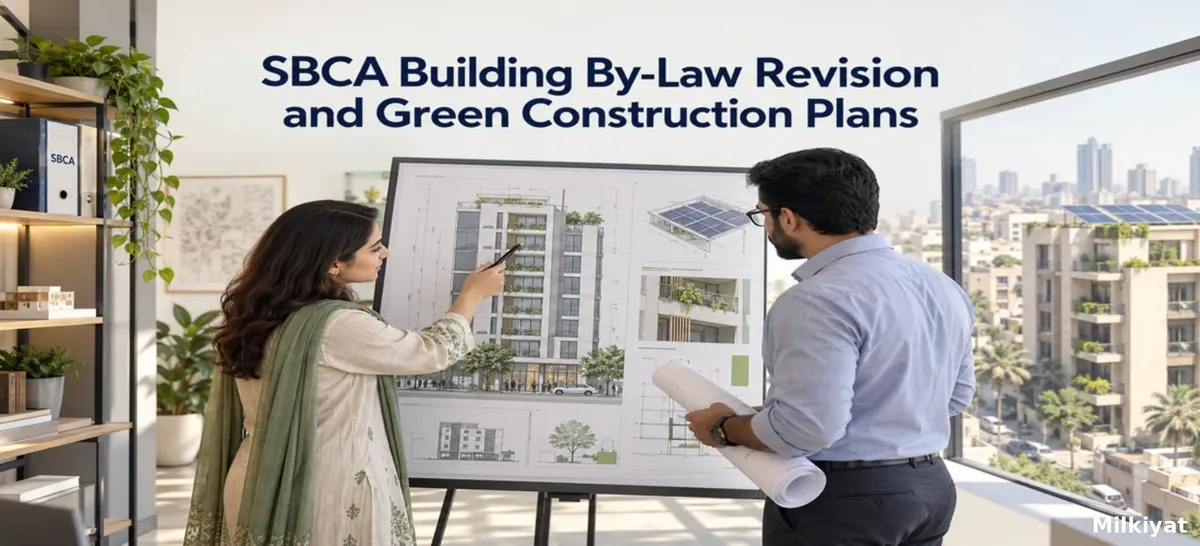
This guide explains which rules govern Karachi construction today, why they are being revised, what the High Court has questioned, what the national green and energy codes require, and what to watch for as the revision proceeds.
| Instrument | Year | What it does |
|---|---|---|
| Sindh Building Control Ordinance | 1979 | Creates SBCA's powers, approvals, penalties and completion rules |
| Karachi Building and Town Planning Regulations |
| 2002 |
| Detailed rules on height, covered area, open spaces, parking and fire safety |
| Rules under section 21 of the Ordinance | Never framed | The rule-making power the Ordinance provides |
| Draft Sindh Building Control Authority Act | 2025 | Proposed replacement for the Ordinance; not yet passed |
| Green Building Code of Pakistan | 2023, approved federally 2025 | Sustainability standards for buildings of four floors and more |
| Energy Conservation Building Code | 2023, launched in Sindh 2025 | Energy efficiency standards |
| Rainwater Harvesting Code | 2023 | Rainwater systems for commercial and industrial buildings |
In November 2025, after the Pakistan Green Building Conference in Karachi, SBCA's director general said the authority's legal framework, regulations and the SBCA Act were outdated, that by-laws needed revising to promote green construction, and that a draft framework had been prepared for the Sindh cabinet.
| Issue raised | Detail |
|---|---|
| Outdated law | Framework, regulations and Act need amendment |
| Green construction | By-laws to align with sustainable development |
| Cost | Green buildings need planning, expert input and higher investment |
| Capacity | 1,381 SBCA employees across Sindh |
| What works | Single window approvals in 15 days, with a reported 99% success rate for complete applications |
As of October 2026, no revised by-laws have been reported as notified.
In January 2026, a constitutional bench of the Sindh High Court took up a 2021 petition arguing that rules under section 21 of the Ordinance had never been framed in more than 40 years. The bench's preliminary view was that approvals granted without those rules might lack lawful sanction, that SBCA appeared to disregard the approved master plan, and that the 2002 regulations appeared to go beyond the scope of the Ordinance.
| Point | Petitioner | Government |
|---|---|---|
| Section 21 rules | Never framed; approvals lack sanction | Draft rules and legislative proposals under consideration |
| Master plan | SBCA ignores it | SBCA's role in master planning has been strengthened by later law |
| KBTPR 2002 | Exceeds the Ordinance | Valid framework |
The court summoned the chief secretary, the local government secretary and SBCA's director general to explain. No final ruling has been reported. If the court's preliminary view were upheld, approvals granted without the rules could face challenge, which is why the revision is not just a technical exercise.
| Code | Who approved | Applies to | Key content |
|---|---|---|---|
| Green Building Code of Pakistan 2023 | Federal cabinet, July 2025; developed by the Pakistan Engineering Council | Buildings of four or more floors | Energy efficiency, sustainability and climate resilience; practices such as passive solar design, green roofs, efficient lighting, renewable energy and building information modelling |
| Energy Conservation Building Code 2023 | Launched in Karachi in 2025 by Sindh's energy minister with NEECA | New construction, as adopted | Standards expected to cut building energy demand by up to 30% |
| Rainwater Harvesting Code 2023 | Federal cabinet, 2025 | Commercial and industrial buildings | Systems to collect, filter and reuse rainwater |
The Green Building Code of Pakistan 2023 is described as binding under the Pakistan Engineering Council's by-laws for engineering work. For it to be enforced through building approvals in Karachi, SBCA would need to build it into its own regulations, which is the purpose of the planned by-law revision.
| Area | Possible change | Effect |
|---|---|---|
| Approvals | Green and energy checks added to plan scrutiny | More documents for larger buildings |
| Design | Insulation, shading, efficient lighting, solar readiness | Higher upfront cost, lower running cost |
| Water | Rainwater harvesting for larger buildings | New plumbing and storage requirements |
| Legal basis | Section 21 rules framed or a new Act passed | Approvals on firmer legal ground |
| Enforcement | Penalties for non-compliance | Builders bear compliance risk |
None of these is in force yet for ordinary Karachi building plans. Treat any builder's "green building" label as marketing unless SBCA's approval says otherwise.
| You are | What to do now |
|---|---|
| Buying a flat | Ask whether the building follows the energy or green codes, and what that means for bills; check the approval as usual |
| Building a house | Consider efficient design voluntarily; it lowers running costs regardless of the rules |
| Developing a high-rise | Expect green code requirements to arrive through SBCA's revision; plan for them now |
| Worried about legality | Approvals remain valid unless a court rules otherwise; keep your approval documents |
Construction costs are a key factor in whether owners adopt green features. Our analysis of double-storey house construction costs in 2026 gives a sense of the baseline before any green upgrades.
The Ordinance is 47 years old. From 1979 to 2026 is 47 years, and the KBTPR is 24 years old.
Its rule-making power has gone unused for nearly five decades. Rules under section 21 were never framed in the 47 years since 1979, as the High Court noted in 2026.
Energy code savings could cut a household's demand by nearly a third. At the up-to-30% reduction cited for ECBC 2023, a home using 500 kWh a month could use 350 kWh, saving 150 kWh a month.
SBCA has about 55 staff per Karachi town on average, if all were posted in the city. 1,381 employees ÷ 25 towns = about 55, though the total covers all of Sindh, so the real figure for Karachi is lower.
The green code applies only above three storeys. Buildings of four or more floors fall under the Green Building Code, leaving most houses outside it.
Approval rules can change quickly once the cabinet acts. Our guide to SBCA building plan approval sets out the current process, which will remain the baseline until new by-laws are notified.
| Check | Where |
|---|---|
| Approved plan under current rules | SBCA |
| Any green or energy code compliance claimed | Builder's documents and SBCA approval |
| Status of the by-law revision | SBCA and Sindh local government department |
| Status of the High Court case on section 21 rules | A lawyer |
| Rainwater or energy requirements for larger buildings | SBCA and the relevant code |
A. SBCA's director general said in November 2025 that a draft framework to revise by-laws for green and sustainable construction was being sent to the Sindh cabinet. No revised by-laws have been reported as notified as of October 2026.
A. Because rules under section 21 of the 1979 Ordinance were never framed. In January 2026, a constitutional bench said approvals without them might lack lawful sanction, but no final ruling has been reported.
A. The federal cabinet approved it in 2025 for buildings of four or more floors. It will be enforced through Karachi building approvals only once SBCA incorporates it into its regulations.
A. The Energy Conservation Building Code 2023, launched in Karachi in 2025, sets energy efficiency standards expected to cut building energy demand by up to 30%.
A. The national Rainwater Harvesting Code targets commercial and industrial buildings. Houses are not currently required to install it under SBCA's rules.
A. Yes, unless a court rules otherwise. Keep your approval and completion documents safe.
A. Usually upfront, as SBCA's director general noted, but they can lower running costs through reduced energy and water use.
This guide is for general information. Building rules, codes and court proceedings are evolving, and builders and buyers should confirm the current requirements with SBCA and qualified professionals before relying on any change.