Real Estate Analyst
Updated 9 min read
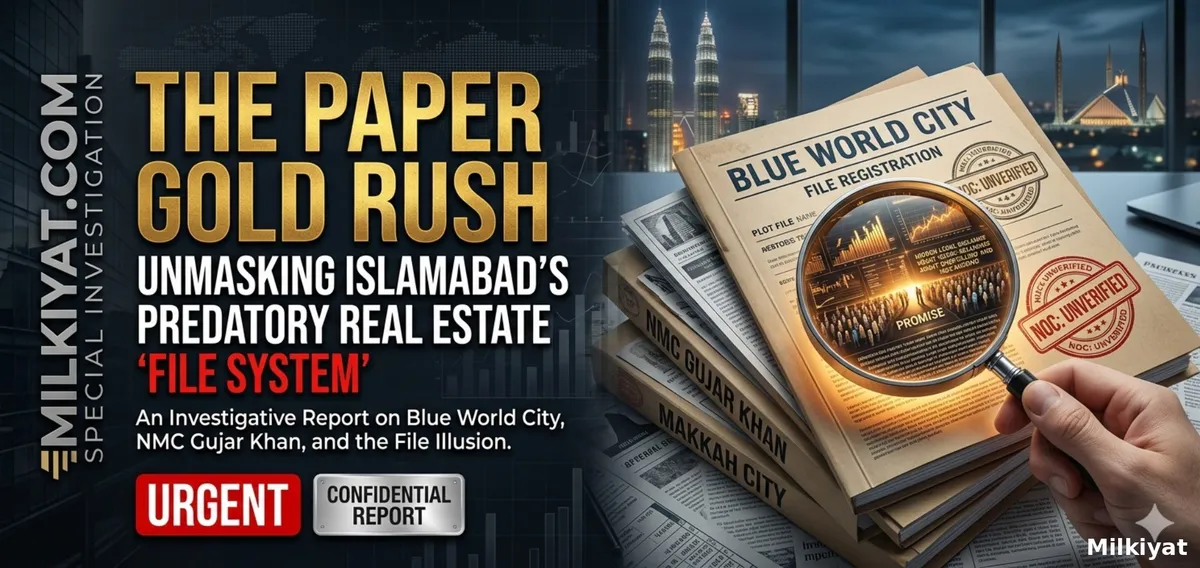
For decades, the dream of owning a piece of Pakistan’s capital has been a primary driving force for the middle class and overseas diaspora. Yet, walking into the modern real estate landscape of Islamabad and its outskirts reveals a multi-billion rupee illusion: The File System. Instead of exchanging currency for concrete, brick, and land, millions of investors are buying beautifully printed pieces of cardstock. This investigative report pulls back the curtain on how major housing societies exploit legal loopholes, weaponize aggressive marketing, and trade "virtual plots" to the public, leaving thousands of families financially devastated.
In a transparent real estate market, a buyer pays for a legally demarcated plot of land with a specific address, registered via an official state document like a Registry or a digitally verifiable Fard. In the speculative file system, a "File" is simply a promise. It represents an un-demarcated, un-allocated future right to a plot of land that often does not exist yet.
[Society Launches Project] ──> [Prints Thousands of Files] ──> [Sells to Open Market via Dealers]
                                                                           │
[Investor Holds a Promise, No Physical Plot] <── [Massive Over-Selling] ◄──┘
Societies use this mechanism to crowd-source interest-free capital from the public to buy actual land later. However, when the printing press spins out of control, the system devolves into a predatory scheme.
To understand the scale of the crisis, one only needs to look at the massive corporate machinery operating on the fringes of the capital.
Promoted heavily as a mega-tourism and luxury living destination, Blue World City has masterfully targeted overseas Pakistanis. However, the project has historically wrestled with serious jurisdictional and regulatory issues.
If Blue World City represents aggressive marketing, New Metro City (NMC) Gujar Khan stands as a textbook example of hyper-speculation and the severe fallout of overselling.
Dozens of smaller entities, like Makkah City and similar off-grid developments, utilize a more insidious strategy. By embedding religious iconography or holy names into their branding, they disarm the naturally cautious nature of middle-class investors.
How do these entities successfully sell thousands of empty promises without facing immediate public backlash? The survival of the file ecosystem relies on a three-pronged strategy:
| Exploitation Strategy | How It Works | The Consequence for the Public |
|---|---|---|
| Dealer Commission Loops | Societies offer authorized dealers massive margins (sometimes up to 10-20%) to push files. | Dealers act as hype-men, aggressively assuring buyers that "prices will double in months" just to secure their commissions. |
| Artificial Squeezes & Hype | Societies release news of an "upcoming ballot" or "file shortage" to create artificial demand. | Investors are panicked into buying more files at a premium ("Own-money"), only for the society to print a fresh batch later, crashing the price. |
| The "Balloting" Delay Tactics | Societies drag out the physical mapping of plots for years using multiple "computerized ballots." | Buyers keep paying installments out of fear that if they stop, they will lose their spot in the next ballot. |
If you own a real estate file in an unapproved housing society, you do not own real estate. You own a lottery ticket. When a developer sells 50,000 files for a tract of land that can physically only accommodate 10,000 plots, 40,000 people are guaranteed to lose. The developers use your hard-earned money to buy raw land, build grand entrance gates to show "development," and fund lavish marketing campaigns starring local and international celebrities. Meanwhile, the legal risk is shifted entirely onto you. If the project fails, faces a regulatory shutdown, or collapses under its own weight, the developers declare bankruptcy or drag the cases out in courts for decades. Your savings evaporate into a black hole of corporate litigation.
Before signing away your life savings to a real estate agent's persuasive pitch, protect yourself with three absolute rules:
A plot file is simply a registration certificate or application form that represents a promise of a future plot. It does not possess an address, street number, or block location. Conversely, a physical plot (or allocated plot) means you hold the legal rights to a physically demarcated piece of land with a specific, registered plot and street number on the society's master map.
Blue World City falls under the geographical jurisdiction of the Rawalpindi Development Authority (RDA), not the Capital Development Authority (CDA). It does not hold a blanket, full-project NOC. While the District Council granted certain localized structural approvals for chunks of land, major portions of its sprawling blocks remain legally unapproved or are pending extensions. Always verify if your specific block is covered on the official RDA portal before buying.
In late 2024, NAB initiated a formal inquiry against NMC Gujar Khan following mass public complaints regarding oversold files and failure to deliver plots. Because of swift regulatory pressure, the management cooperated with accountability authorities. In October 2025, NAB officially recovered and returned 767 million PKR in cash to 383 affected victims, while another 57 affectees were handed actual, processed plot allotments.
Legally, developers are required to serve multiple formal warning notices before taking cancellation actions. If a society operating without an NOC unilaterally cancels your file without offering a monetary refund or a verified physical alternative, you can file an official complaint with the National Accountability Bureau (NAB) or the Competition Commission of Pakistan (CCP) for predatory and deceptive market practices.
No. Under the rules of the CDA, RDA, and the Punjab Development of Cities Act, a housing society is strictly forbidden from marketing, advertising, booking, or selling files or plots before obtaining a formal No Objection Certificate (NOC). Selling files without an NOC is completely illegal, yet developers routinely bypass this rule by calling bookings "registration forms" or "membership certificates."
Real Estate Analyst
Updated 9 min read
For decades, the dream of owning a piece of Pakistan’s capital has been a primary driving force for the middle class and overseas diaspora. Yet, walking into the modern real estate landscape of Islamabad and its outskirts reveals a multi-billion rupee illusion: The File System. Instead of exchanging currency for concrete, brick, and land, millions of investors are buying beautifully printed pieces of cardstock. This investigative report pulls back the curtain on how major housing societies exploit legal loopholes, weaponize aggressive marketing, and trade "virtual plots" to the public, leaving thousands of families financially devastated.
In a transparent real estate market, a buyer pays for a legally demarcated plot of land with a specific address, registered via an official state document like a Registry or a digitally verifiable Fard. In the speculative file system, a "File" is simply a promise. It represents an un-demarcated, un-allocated future right to a plot of land that often does not exist yet.
[Society Launches Project] ──> [Prints Thousands of Files] ──> [Sells to Open Market via Dealers]
                                                                           │
[Investor Holds a Promise, No Physical Plot] <── [Massive Over-Selling] ◄──┘
Societies use this mechanism to crowd-source interest-free capital from the public to buy actual land later. However, when the printing press spins out of control, the system devolves into a predatory scheme.
To understand the scale of the crisis, one only needs to look at the massive corporate machinery operating on the fringes of the capital.
Promoted heavily as a mega-tourism and luxury living destination, Blue World City has masterfully targeted overseas Pakistanis. However, the project has historically wrestled with serious jurisdictional and regulatory issues.
If Blue World City represents aggressive marketing, New Metro City (NMC) Gujar Khan stands as a textbook example of hyper-speculation and the severe fallout of overselling.
Dozens of smaller entities, like Makkah City and similar off-grid developments, utilize a more insidious strategy. By embedding religious iconography or holy names into their branding, they disarm the naturally cautious nature of middle-class investors.
How do these entities successfully sell thousands of empty promises without facing immediate public backlash? The survival of the file ecosystem relies on a three-pronged strategy:
| Exploitation Strategy | How It Works | The Consequence for the Public |
|---|---|---|
| Dealer Commission Loops | Societies offer authorized dealers massive margins (sometimes up to 10-20%) to push files. | Dealers act as hype-men, aggressively assuring buyers that "prices will double in months" just to secure their commissions. |
| Artificial Squeezes & Hype | Societies release news of an "upcoming ballot" or "file shortage" to create artificial demand. | Investors are panicked into buying more files at a premium ("Own-money"), only for the society to print a fresh batch later, crashing the price. |
| The "Balloting" Delay Tactics | Societies drag out the physical mapping of plots for years using multiple "computerized ballots." | Buyers keep paying installments out of fear that if they stop, they will lose their spot in the next ballot. |
If you own a real estate file in an unapproved housing society, you do not own real estate. You own a lottery ticket. When a developer sells 50,000 files for a tract of land that can physically only accommodate 10,000 plots, 40,000 people are guaranteed to lose. The developers use your hard-earned money to buy raw land, build grand entrance gates to show "development," and fund lavish marketing campaigns starring local and international celebrities. Meanwhile, the legal risk is shifted entirely onto you. If the project fails, faces a regulatory shutdown, or collapses under its own weight, the developers declare bankruptcy or drag the cases out in courts for decades. Your savings evaporate into a black hole of corporate litigation.
Before signing away your life savings to a real estate agent's persuasive pitch, protect yourself with three absolute rules:
A plot file is simply a registration certificate or application form that represents a promise of a future plot. It does not possess an address, street number, or block location. Conversely, a physical plot (or allocated plot) means you hold the legal rights to a physically demarcated piece of land with a specific, registered plot and street number on the society's master map.
Blue World City falls under the geographical jurisdiction of the Rawalpindi Development Authority (RDA), not the Capital Development Authority (CDA). It does not hold a blanket, full-project NOC. While the District Council granted certain localized structural approvals for chunks of land, major portions of its sprawling blocks remain legally unapproved or are pending extensions. Always verify if your specific block is covered on the official RDA portal before buying.
In late 2024, NAB initiated a formal inquiry against NMC Gujar Khan following mass public complaints regarding oversold files and failure to deliver plots. Because of swift regulatory pressure, the management cooperated with accountability authorities. In October 2025, NAB officially recovered and returned 767 million PKR in cash to 383 affected victims, while another 57 affectees were handed actual, processed plot allotments.
Legally, developers are required to serve multiple formal warning notices before taking cancellation actions. If a society operating without an NOC unilaterally cancels your file without offering a monetary refund or a verified physical alternative, you can file an official complaint with the National Accountability Bureau (NAB) or the Competition Commission of Pakistan (CCP) for predatory and deceptive market practices.
No. Under the rules of the CDA, RDA, and the Punjab Development of Cities Act, a housing society is strictly forbidden from marketing, advertising, booking, or selling files or plots before obtaining a formal No Objection Certificate (NOC). Selling files without an NOC is completely illegal, yet developers routinely bypass this rule by calling bookings "registration forms" or "membership certificates."
Explore C-14 Islamabad in 2026, including its location, development and possession status, property options, connectivity and key factors for buyers and investors.
Property taxes in Pakistan changed for 2026-27. Here is what buyers and sellers need to know about 236K, 236C, filer status, and Section 7E.
Explore G-15 Islamabad in 2026, including property prices, apartments, road access, development status, rental demand and investment potential.
Explore I-12 Islamabad in 2026, including property prices, development status, NUST access, rental demand, investment potential and key checks for buyers.
Explore C-14 Islamabad in 2026, including its location, development and possession status, property options, connectivity and key factors for buyers and investors.
Property taxes in Pakistan changed for 2026-27. Here is what buyers and sellers need to know about 236K, 236C, filer status, and Section 7E.
Explore G-15 Islamabad in 2026, including property prices, apartments, road access, development status, rental demand and investment potential.
Explore I-12 Islamabad in 2026, including property prices, development status, NUST access, rental demand, investment potential and key checks for buyers.