Blog
The Long Wait: Inside the Possession Crisis of Islamabad's C-14, C-15, C-16, E-12 and I-12
Real Estate Analyst
11 min read
A city that was drawn on paper before it rose from the earth has learned to make its people wait. In five sectors of the federal capital, that wait has stretched across careers, retirements, and in the saddest cases, entire lifetimes.
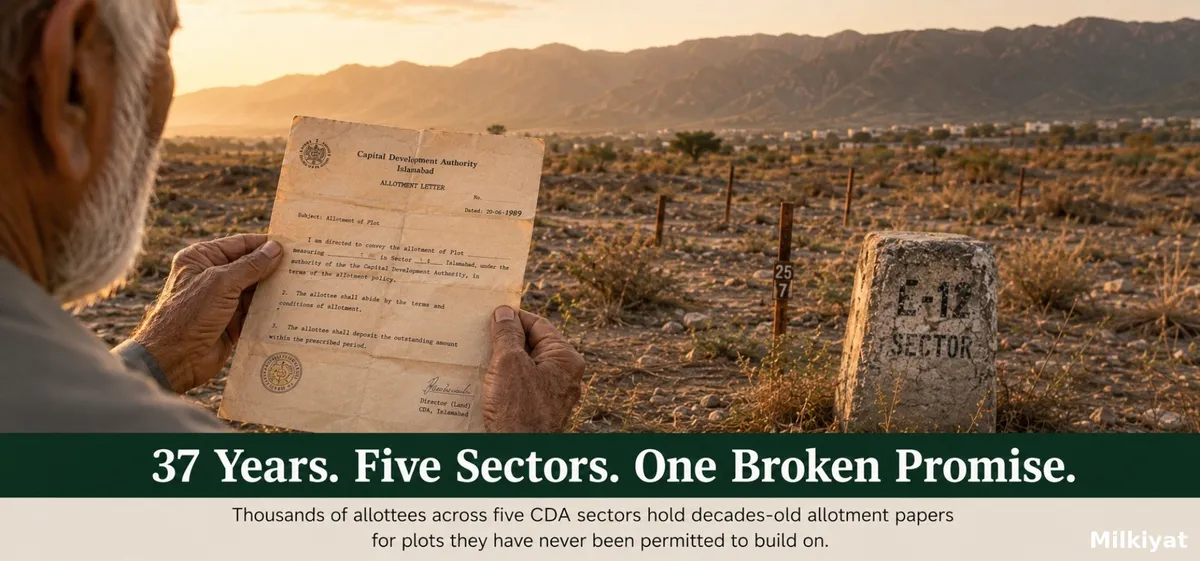
Every city keeps its promises somewhere. Islamabad keeps many of its broken ones in the northwest in sectors that exist vividly on allotment letters and payment receipts, and only faintly on the ground. There, along the foothills and the new spine of Margalla Avenue, thousands of families hold papers for plots they have never been allowed to build on. Some have held them for ten years. Some for twenty. In Sector E-12, some held them until the day they died.
This report walks through five of those sectors, E-12, I-12, C-14, C-15 and C-16 with one discipline throughout: every figure is drawn from a named, linked source, and every contested claim is flagged as such. Because in a market where dealers sell certainty they do not possess, the most valuable thing we can hand a buyer is the verified truth.
The crisis in one line: D-12, completed around 2006–2008, remains the last sector the CDA fully developed, a nearly two-decade gap during which private housing societies expanded aggressively while the state's own sectors stood still.
Sector E-12 was announced in April 1989 for the general public, government employees, and overseas Pakistanis, comprising 4,430 plots. The development authority committed to delivering the sector within a few years. It has now been thirty-seven.
CDA sector or private housing society? Compare approvals, NOCs, tenure, possession timelines, risks, and investment potential before buying property in Islamabad or Rawalpindi.
G-11 is a CDA sector, so ownership does not move through a patwari's intkal. This guide covers the full CDA transfer procedure, file verification, NDC, the 1% transfer fee, advance tax, biometrics and deed registration, plus the documents you need, the real 2026 cost stack, and how long a clean file actually takes.
G-11 is CDA-allotted land, so ownership is proved through CDA records and the Islamabad sub-registrar, not a Punjab patwari. This guide walks through the documents to demand, the checks to run in order, the fraud patterns that repeat in G-11, and what to do if a defect shows up mid-deal.
A complete look at flats for rent in G-11 Islamabad, pricing by bed count, the best sub-sectors, furnished vs unfurnished options, and what the rental agreement process actually involves.
Real Estate Analyst
11 min read
A city that was drawn on paper before it rose from the earth has learned to make its people wait. In five sectors of the federal capital, that wait has stretched across careers, retirements, and in the saddest cases, entire lifetimes.
Every city keeps its promises somewhere. Islamabad keeps many of its broken ones in the northwest in sectors that exist vividly on allotment letters and payment receipts, and only faintly on the ground. There, along the foothills and the new spine of Margalla Avenue, thousands of families hold papers for plots they have never been allowed to build on. Some have held them for ten years. Some for twenty. In Sector E-12, some held them until the day they died.
This report walks through five of those sectors, E-12, I-12, C-14, C-15 and C-16 with one discipline throughout: every figure is drawn from a named, linked source, and every contested claim is flagged as such. Because in a market where dealers sell certainty they do not possess, the most valuable thing we can hand a buyer is the verified truth.
The crisis in one line: D-12, completed around 2006–2008, remains the last sector the CDA fully developed, a nearly two-decade gap during which private housing societies expanded aggressively while the state's own sectors stood still.
Sector E-12 was announced in April 1989 for the general public, government employees, and overseas Pakistanis, comprising 4,430 plots. The development authority committed to delivering the sector within a few years. It has now been thirty-seven.
CDA sector or private housing society? Compare approvals, NOCs, tenure, possession timelines, risks, and investment potential before buying property in Islamabad or Rawalpindi.
G-11 is a CDA sector, so ownership does not move through a patwari's intkal. This guide covers the full CDA transfer procedure, file verification, NDC, the 1% transfer fee, advance tax, biometrics and deed registration, plus the documents you need, the real 2026 cost stack, and how long a clean file actually takes.
G-11 is CDA-allotted land, so ownership is proved through CDA records and the Islamabad sub-registrar, not a Punjab patwari. This guide walks through the documents to demand, the checks to run in order, the fraud patterns that repeat in G-11, and what to do if a defect shows up mid-deal.
A complete look at flats for rent in G-11 Islamabad, pricing by bed count, the best sub-sectors, furnished vs unfurnished options, and what the rental agreement process actually involves.
The arithmetic of that delay is merciless. A civil servant who was allotted a plot at forty is seventy-seven today. Dawn's reporting confirms the darker ledger: a number of the original allottees have already died, and their descendants are now the ones waiting for possession letters. A sector meant to house a generation has instead become an inheritance dispute passed down through one.
The proximate causes are familiar to anyone who follows CDA affairs: encroachments, unresolved built-up property awards, litigation, and long stretches of simple administrative inertia. The E-12 Action Committee's president, Ateeq Sheikh, put the grievance plainly when the CDA moved to bill allottees for development that never arrived questioning how development charges could be imposed while the site itself remained undeveloped, and pressing for the removal of high-tension power lines that still cross the sector.
Movement, at last, is real but partial. In 2025, city managers decided to issue possession letters for at least two sub-sectors of E-12, having made progress in two sub-sectors while the others lay unattended. By July 2026, following a review chaired by CDA Chairman Sohail Ashraf, officials reported that around 2,200 plots in E-12 were ready for possession — though Dawn's account of the same meeting notes that almost half of the sector's development work remains pending, with no sign of activity in one sub-sector.
Half a sector delivered after thirty-seven years is not a triumph. It is an apology with a ribbon on it.
If E-12 is the crisis's elder statesman, I-12 is its most crowded courtroom. In October 2025, a delegation of allottees, retired professors among them — told the CDA's Director General (Works) that they had been waiting for possession for over three decades despite repeated assurances.
The assurances have a documented history of expiring quietly. In May 2024, the then CDA chairman ordered development in I-12 completed within four months; progress afterward remained minimal, leaving the sector without basic amenities like electricity and water. Allottees, largely middle-class families, told The News they were weighing street protests.
By spring 2026, the CDA had begun accepting possession applications — but without any formal announcement or timeline, leaving applicants unsure of the next steps. One overseas allottee described waiting more than ten years to build a house for his family after investing his savings in the plot.
The most recent official word is the strongest yet: at the July 2026 review meeting, officials stated that more than 5,000 plots in I-12 are ready for possession, with over 90 per cent of development work reported complete. For allottees, the distinction that matters now is the one the CDA has still not supplied: a dated, published possession schedule, not another meeting's minutes.
C-14 is the sector the CDA points to when it wants to demonstrate it can still build. Launched for overseas Pakistanis, its one-kanal plots were priced at Rs60 million for 500 square yards, payable in four instalments over ten months, a payment velocity the authority demanded of buyers even as its own delivery clock ran on geological time elsewhere.
To its credit, the sector has moved. In December 2024, 85 per cent of road infrastructure and 35 per cent of sewerage and drainage work stood complete, and the chairman issued an unusually pro-buyer directive: possession must be handed over before the final instalment falls due. By February 2026, the CDA's own announcements stated that basic infrastructure in C-14 was in its final stages and plots were ready to be handed over. The July 2026 review confirmed most plots in C-14 as developed and ready for possession.
C-14 is therefore the test case for the CDA's credibility: a sector where the money was collected fast, the location along Margalla Avenue is prized, and the promises are freshest. If possession letters do not flow here on schedule, buyers should recalibrate every other assurance the authority has given.
The saddest sectors in this story are not the oldest ones. They are the ones where the same mistakes are being made in real time.
C-15 and C-16 launched alongside C-13 and C-14 — were acquired by the CDA in 2008 on a land-sharing basis, yet apart from partial work in these two sectors, development across the group never materialised. Balloting and allotment to the public followed in 2011, placing the sectors in Zone 3 along the new Margalla Avenue corridor.
The choke point is compensation. The built-up property (BuP) award for C-15 ,the mechanism by which occupants of existing structures are compensated so land can be cleared ,was announced in 2016, yet compensation to affected landowners remains pending a decade later. Unpaid awards mean unvacated land; unvacated land means pockets of built-up property obstructing the right-of-way for the sector's road network.
⚑ Flagged estimate: One market analysis places completed road earthwork in C-15 at roughly 40 per cent (Ghar Mubarak). This is a single non-official source; the CDA has published no comparable percentage for C-15 or C-16. Treat it as indicative, not confirmed.
Officially, the sectors remain in the waiting room. The CDA's December 2024 position acknowledged it was still facing problems securing possession of land from affectees in C-15 and C-16, with the chairman directing that legal hurdles and BuP issues be resolved on priority. Nineteen months later, the July 2026 meeting deferred the stalled sectors — including C-15 and C-16 — to the next meeting. Meanwhile, in May 2025, the authority announced development charges on plots across ten sectors, C-15 and C-16 among them — billing for a product still years from delivery.
| Sector | Launched / Acquired | Status (as of July 2026) | Core obstacle |
|---|---|---|---|
| E-12 | April 1989; 4,430 plots | ~2,200 plots ready; nearly half of work pending; one sub-sector untouched | Encroachments, BuP disputes, 37 years of inertia |
| I-12 | Allottees waiting 10–30+ years | 5,000+ plots declared ready; 90%+ work complete; no published possession schedule | Missed internal deadlines; utilities incomplete |
| C-14 | Land acquired 2008; balloted 2011; launched for overseas Pakistanis | Most plots developed and ready; possession directed before final instalment | Delivery-on-schedule is the open question |
| C-15 | Acquired 2008; balloted 2011 | Partial work only; deferred to next CDA meeting | BuP award (2016) compensation still unpaid |
| C-16 | Acquired 2008; balloted 2011 | Partial work only; deferred to next CDA meeting | Land possession from affectees unresolved |
Set these five stories side by side and a single machinery of delay reveals itself. Land is acquired before compensation is settled. Plots are sold — often to overseas Pakistanis and salaried families, the buyers least able to litigate — before land is cleared. Deadlines are announced in meetings and die in the same rooms. And when frustration peaks, the instrument of response is not a possession letter but a demand for development charges.
The beneficiaries of this vacuum have been private housing societies, which spent the CDA's lost decades selling their own promises — and the file-trading market, which thrives precisely because possession is scarce. A file in an undeveloped sector is hope rendered tradeable; every year of delay adds a layer of speculation between the paper and the plot. This is the market failure Milkiyat exists to document: when the state cannot deliver land, dealers sell the delay itself.
If you hold a plot in E-12, I-12 or C-14: monitor the CDA's official channels for possession letter announcements — the authority's chairman has directed the relevant wing to contact owners of developed plots for issuance of possession letters. File your possession application, keep your payment record and allotment documents in order, and verify your plot's demarcation on the ground before paying any further charges. Accept nothing verbal.
If you are considering buying in C-15 or C-16: understand what you are buying — CDA title with an indefinite possession horizon. Prices there sit well below C-14 for a reason. Verify every file directly through CDA's One Window operation, demand the transfer history, and price the plot as a multi-year hold with no construction date. Any dealer promising imminent possession in these two sectors is selling you a claim the CDA itself has not made.
If you are an overseas Pakistani: you are this crisis's most targeted constituency — C-14 was launched in your name and E-12 counted you among its original applicants. Transact only through documented, verifiable channels, and treat WhatsApp possession rumours as what they are: marketing.
Cities are, in the end, promissory notes made of concrete. Islamabad wrote thousands of them in 1989, in 2008, in 2011 — and has spent the decades since asking its creditors for patience. The recent momentum in E-12, I-12 and C-14 is genuine and should be acknowledged; possession letters, after so long, are not nothing. But a promise kept at gunpoint of public outrage, thirty-seven years late, to the heirs of the people it was made to, is a debt discharged — not honour restored.
The measure of the CDA now is simple, and it is dated: published possession schedules for I-12 and E-12's remaining sub-sectors, settled BuP compensation in C-15 and C-16, and delivery in C-14 before the final instalment — exactly as directed. Milkiyat will keep the ledger. The allottees have waited long enough for someone to.
Why has possession in Sector E-12 been delayed for 37 years? E-12 was launched in April 1989 with 4,430 plots and development promised within a few years. Encroachments, built-up property disputes, litigation, and administrative neglect stalled it for decades. As of 2026, roughly 2,200 plots are declared ready while work in remaining sub-sectors is incomplete.
When will I-12 allottees get possession? The CDA began accepting possession applications in 2026 and says over 5,000 plots are ready — but no formal possession schedule has been published. Rely only on official CDA notifications.
What is blocking C-15 and C-16? Unresolved built-up property compensation. The C-15 BuP award was announced in 2016 but payments remain pending, leaving occupied land blocking road rights-of-way.
Is it safe to buy a file in C-15 or C-16? Title risk is low (genuine CDA sectors); possession risk is high. Price it as a long-horizon hold, verify through CDA One Window, and ignore dealer possession promises.
Can construction begin after a possession letter? Yes — once the plot is demarcated, allottees can seek building plan approval under CDA by-laws. Confirm development charges status first.
Milkiyat.com is a commission-free real estate research platform for the Islamabad–Rawalpindi market. We accept no dealer commissions and no paid placements. Corrections: [email protected]
The arithmetic of that delay is merciless. A civil servant who was allotted a plot at forty is seventy-seven today. Dawn's reporting confirms the darker ledger: a number of the original allottees have already died, and their descendants are now the ones waiting for possession letters. A sector meant to house a generation has instead become an inheritance dispute passed down through one.
The proximate causes are familiar to anyone who follows CDA affairs: encroachments, unresolved built-up property awards, litigation, and long stretches of simple administrative inertia. The E-12 Action Committee's president, Ateeq Sheikh, put the grievance plainly when the CDA moved to bill allottees for development that never arrived questioning how development charges could be imposed while the site itself remained undeveloped, and pressing for the removal of high-tension power lines that still cross the sector.
Movement, at last, is real but partial. In 2025, city managers decided to issue possession letters for at least two sub-sectors of E-12, having made progress in two sub-sectors while the others lay unattended. By July 2026, following a review chaired by CDA Chairman Sohail Ashraf, officials reported that around 2,200 plots in E-12 were ready for possession — though Dawn's account of the same meeting notes that almost half of the sector's development work remains pending, with no sign of activity in one sub-sector.
Half a sector delivered after thirty-seven years is not a triumph. It is an apology with a ribbon on it.
If E-12 is the crisis's elder statesman, I-12 is its most crowded courtroom. In October 2025, a delegation of allottees, retired professors among them — told the CDA's Director General (Works) that they had been waiting for possession for over three decades despite repeated assurances.
The assurances have a documented history of expiring quietly. In May 2024, the then CDA chairman ordered development in I-12 completed within four months; progress afterward remained minimal, leaving the sector without basic amenities like electricity and water. Allottees, largely middle-class families, told The News they were weighing street protests.
By spring 2026, the CDA had begun accepting possession applications — but without any formal announcement or timeline, leaving applicants unsure of the next steps. One overseas allottee described waiting more than ten years to build a house for his family after investing his savings in the plot.
The most recent official word is the strongest yet: at the July 2026 review meeting, officials stated that more than 5,000 plots in I-12 are ready for possession, with over 90 per cent of development work reported complete. For allottees, the distinction that matters now is the one the CDA has still not supplied: a dated, published possession schedule, not another meeting's minutes.
C-14 is the sector the CDA points to when it wants to demonstrate it can still build. Launched for overseas Pakistanis, its one-kanal plots were priced at Rs60 million for 500 square yards, payable in four instalments over ten months, a payment velocity the authority demanded of buyers even as its own delivery clock ran on geological time elsewhere.
To its credit, the sector has moved. In December 2024, 85 per cent of road infrastructure and 35 per cent of sewerage and drainage work stood complete, and the chairman issued an unusually pro-buyer directive: possession must be handed over before the final instalment falls due. By February 2026, the CDA's own announcements stated that basic infrastructure in C-14 was in its final stages and plots were ready to be handed over. The July 2026 review confirmed most plots in C-14 as developed and ready for possession.
C-14 is therefore the test case for the CDA's credibility: a sector where the money was collected fast, the location along Margalla Avenue is prized, and the promises are freshest. If possession letters do not flow here on schedule, buyers should recalibrate every other assurance the authority has given.
The saddest sectors in this story are not the oldest ones. They are the ones where the same mistakes are being made in real time.
C-15 and C-16 launched alongside C-13 and C-14 — were acquired by the CDA in 2008 on a land-sharing basis, yet apart from partial work in these two sectors, development across the group never materialised. Balloting and allotment to the public followed in 2011, placing the sectors in Zone 3 along the new Margalla Avenue corridor.
The choke point is compensation. The built-up property (BuP) award for C-15 ,the mechanism by which occupants of existing structures are compensated so land can be cleared ,was announced in 2016, yet compensation to affected landowners remains pending a decade later. Unpaid awards mean unvacated land; unvacated land means pockets of built-up property obstructing the right-of-way for the sector's road network.
⚑ Flagged estimate: One market analysis places completed road earthwork in C-15 at roughly 40 per cent (Ghar Mubarak). This is a single non-official source; the CDA has published no comparable percentage for C-15 or C-16. Treat it as indicative, not confirmed.
Officially, the sectors remain in the waiting room. The CDA's December 2024 position acknowledged it was still facing problems securing possession of land from affectees in C-15 and C-16, with the chairman directing that legal hurdles and BuP issues be resolved on priority. Nineteen months later, the July 2026 meeting deferred the stalled sectors — including C-15 and C-16 — to the next meeting. Meanwhile, in May 2025, the authority announced development charges on plots across ten sectors, C-15 and C-16 among them — billing for a product still years from delivery.
| Sector | Launched / Acquired | Status (as of July 2026) | Core obstacle |
|---|---|---|---|
| E-12 | April 1989; 4,430 plots | ~2,200 plots ready; nearly half of work pending; one sub-sector untouched | Encroachments, BuP disputes, 37 years of inertia |
| I-12 | Allottees waiting 10–30+ years | 5,000+ plots declared ready; 90%+ work complete; no published possession schedule | Missed internal deadlines; utilities incomplete |
| C-14 | Land acquired 2008; balloted 2011; launched for overseas Pakistanis | Most plots developed and ready; possession directed before final instalment | Delivery-on-schedule is the open question |
| C-15 | Acquired 2008; balloted 2011 | Partial work only; deferred to next CDA meeting | BuP award (2016) compensation still unpaid |
| C-16 | Acquired 2008; balloted 2011 | Partial work only; deferred to next CDA meeting | Land possession from affectees unresolved |
Set these five stories side by side and a single machinery of delay reveals itself. Land is acquired before compensation is settled. Plots are sold — often to overseas Pakistanis and salaried families, the buyers least able to litigate — before land is cleared. Deadlines are announced in meetings and die in the same rooms. And when frustration peaks, the instrument of response is not a possession letter but a demand for development charges.
The beneficiaries of this vacuum have been private housing societies, which spent the CDA's lost decades selling their own promises — and the file-trading market, which thrives precisely because possession is scarce. A file in an undeveloped sector is hope rendered tradeable; every year of delay adds a layer of speculation between the paper and the plot. This is the market failure Milkiyat exists to document: when the state cannot deliver land, dealers sell the delay itself.
If you hold a plot in E-12, I-12 or C-14: monitor the CDA's official channels for possession letter announcements — the authority's chairman has directed the relevant wing to contact owners of developed plots for issuance of possession letters. File your possession application, keep your payment record and allotment documents in order, and verify your plot's demarcation on the ground before paying any further charges. Accept nothing verbal.
If you are considering buying in C-15 or C-16: understand what you are buying — CDA title with an indefinite possession horizon. Prices there sit well below C-14 for a reason. Verify every file directly through CDA's One Window operation, demand the transfer history, and price the plot as a multi-year hold with no construction date. Any dealer promising imminent possession in these two sectors is selling you a claim the CDA itself has not made.
If you are an overseas Pakistani: you are this crisis's most targeted constituency — C-14 was launched in your name and E-12 counted you among its original applicants. Transact only through documented, verifiable channels, and treat WhatsApp possession rumours as what they are: marketing.
Cities are, in the end, promissory notes made of concrete. Islamabad wrote thousands of them in 1989, in 2008, in 2011 — and has spent the decades since asking its creditors for patience. The recent momentum in E-12, I-12 and C-14 is genuine and should be acknowledged; possession letters, after so long, are not nothing. But a promise kept at gunpoint of public outrage, thirty-seven years late, to the heirs of the people it was made to, is a debt discharged — not honour restored.
The measure of the CDA now is simple, and it is dated: published possession schedules for I-12 and E-12's remaining sub-sectors, settled BuP compensation in C-15 and C-16, and delivery in C-14 before the final instalment — exactly as directed. Milkiyat will keep the ledger. The allottees have waited long enough for someone to.
Why has possession in Sector E-12 been delayed for 37 years? E-12 was launched in April 1989 with 4,430 plots and development promised within a few years. Encroachments, built-up property disputes, litigation, and administrative neglect stalled it for decades. As of 2026, roughly 2,200 plots are declared ready while work in remaining sub-sectors is incomplete.
When will I-12 allottees get possession? The CDA began accepting possession applications in 2026 and says over 5,000 plots are ready — but no formal possession schedule has been published. Rely only on official CDA notifications.
What is blocking C-15 and C-16? Unresolved built-up property compensation. The C-15 BuP award was announced in 2016 but payments remain pending, leaving occupied land blocking road rights-of-way.
Is it safe to buy a file in C-15 or C-16? Title risk is low (genuine CDA sectors); possession risk is high. Price it as a long-horizon hold, verify through CDA One Window, and ignore dealer possession promises.
Can construction begin after a possession letter? Yes — once the plot is demarcated, allottees can seek building plan approval under CDA by-laws. Confirm development charges status first.
Milkiyat.com is a commission-free real estate research platform for the Islamabad–Rawalpindi market. We accept no dealer commissions and no paid placements. Corrections: [email protected]