Guide
Where LDA's Authority Ends: TMA, Kasur and Sheikhupura Land Sold as Lahore

By Maham Imtiaz
Real Estate AnalystVerified author
Updated 13 min read
Short Answer
LDA’s approval powers now cover all four Lahore Division districts: Lahore, Kasur, Sheikhupura and Nankana Sahib. However, from 2021 to early 2024, its jurisdiction was largely limited to Lahore, while housing scheme approvals in the other districts shifted to local authorities. Building control there still remains with municipal bodies. Because plots in Kasur or Sheikhupura are often marketed as “Lahore,” buyers should verify the district and tehsil on the fard and confirm which authority approved the scheme, and when.
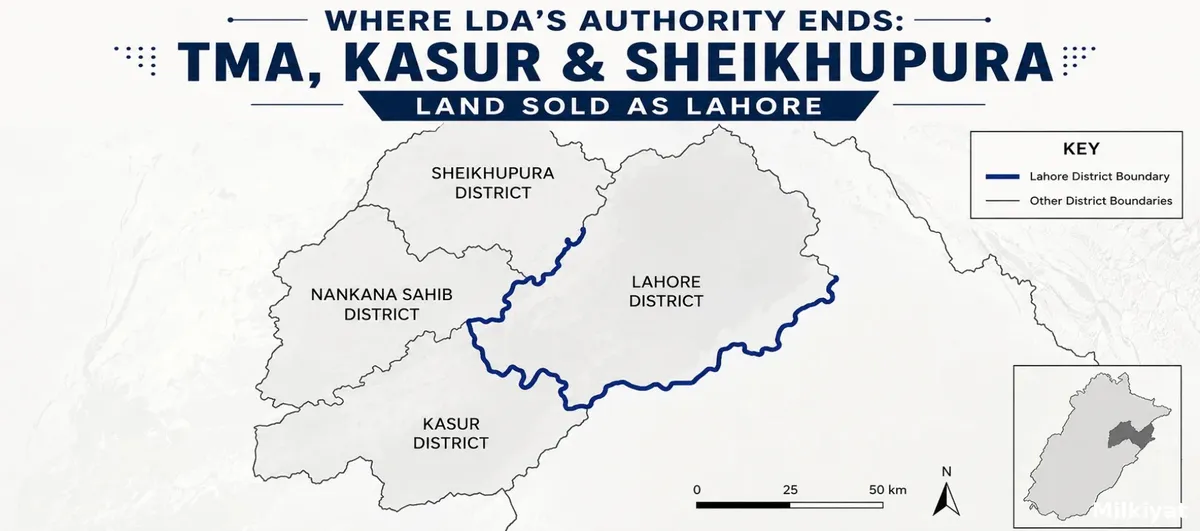
Almost every buyer in Lahore's outer belts has heard some version of this sentence from a dealer: "Sir, yeh Lahore hi hai." Sometimes it is true. Often the land sits across a district line that does not appear on any signboard, does not change the drive time, and does not change the view, but changes the law that governs the plot, the office that approves the map, the valuation table that sets your taxes, and the paperwork you will need the day you try to sell.
LDA's reach over Kasur, Sheikhupura and Nankana Sahib has changed three times since 2013. For the full jurisdiction timeline and what LDA governs inside Lahore, see our complete guide to LDA Lahore.
This guide explains where the LDA's authority actually ends, why the boundary has moved three times in the last twelve years, and how to check which side of it your plot is on.
The jurisdiction seesaw, in order
Understanding the risk requires understanding the timeline, because the year a scheme was approved matters as much as the authority that approved it.
1975 and 1988: the original boundary. The LDA Act, 1975 created the authority for metropolitan planning of Lahore. Its planning boundary was notified by the government in 1975 and again in 1988, as the Lahore metropolitan area. Everything outside that line was the business of local bodies.
2013: expansion to the whole division. In 2013 the Punjab government moved to create a single regulatory institution for the whole of Lahore Division, Sheikhupura, Kasur, Lahore and Nankana Sahib, by amending the LDA Act, 1975, so that a body which had previously been a district authority acquired regulatory control over all housing development in the division. Before that amendment, tehsil municipal administrations had the power to approve small housing projects. The stated reason was the mushrooming of illegal housing schemes, unauthorised commercial buildings and inappropriate land use in Kasur, Nankana Sahib and Sheikhupura, which the government wanted regulated under one uniform set of laws and policies rather than by the TMAs of the time.
April 2021: curtailment. An amendment ordinance replaced the words "metropolitan area of Lahore division" with "metropolitan area of Lahore" in the operative sections of the LDA Act, taking the authority's jurisdiction back to its pre-2013 position. The local government department followed with a letter titled "Curtailment of Jurisdiction of LDA…", directing the authority to hand over its entire land use and private housing scheme record for Sheikhupura, Nankana Sahib and Kasur to the respective tehsil municipal administrations, municipal committees and tehsil councils with immediate effect.
2022: the ordinance lapses. Because the ordinance was never enacted into law by the Punjab Assembly, the government was left with no option but to let the LDA continue working across the whole division under the 2013 amendment, including work on the Lahore Division Master Plan-2050.
February 2024: restoration. The Punjab government ordered the record of private housing schemes and land use conversion in Kasur, Sheikhupura and Nankana Sahib to be handed back to the LDA after district administrations failed to do so despite repeated directions, restoring the authority's power to approve housing schemes and land use conversion cases, which during the previous government had been given to deputy commissioners as heads of local governments.
So: expanded in 2013, curtailed on paper in 2021, functionally restored by 2022, and formally restored in 2024. Files were issued in each of those windows, by different offices, on different legal footings. That is why "it has an approval letter" is not, on its own, an answer.
What changed, and what never did
Two functions are often confused, and the difference matters for anyone building rather than just holding a file.
Private housing scheme approval and land use conversion. This is the function that moved back and forth. It is currently with the LDA across all four districts.
Building control: approving your house map, issuing completion. In Kasur, Sheikhupura and Nankana Sahib, building control stayed with tehsil-level municipal administrations even during the 2013–2021 expansion. When the LDA took over housing schemes in the three added districts, the TMAs there retained building control.
The practical consequence: a scheme in, say, Ferozewala or Kot Radha Kishan can be an LDA-approved layout whose individual house maps are approved by a municipal committee, under that body's bylaws, with completion certificates issued by it. If you assume LDA building bylaws apply and design a basement, a third storey or a commercial conversion accordingly, you may be building to the wrong rulebook. Our guide to LDA commercialisation and land use conversion covers the Lahore-side process; outside the metropolitan area, expect a different fee schedule and a different sanctioning office.
The same split explains why so many houses in the outer belt have no completion certificate at all, a problem we examine in detail in LDA Completion Certificate: Why Your Lahore House Probably Does Not Have One.
Why land in Kasur and Sheikhupura is sold as "Lahore"
Three reasons, none of them sinister on their own, which together produce a genuinely misleading picture.
One: the city really has grown past its district line. The LDA itself has repeatedly proposed absorbing the urbanised fringe. A proposal moved to the chief minister sought inclusion of Muridke, Kala Shah Kaku, Ferozewala, Kot Abdul Malik and Sharaqpur from Sheikhupura district, and Phool Nagar and Kot Radha Kishan from Kasur district, into the Lahore metropolitan area, with a described boundary running from Raiwind along the railway line to Kot Radha Kishan, on to the Phool Nagar bypass and the Multan Road crossing, then to Head Balloki on the Ravi. If planners are arguing about where Lahore ends, a dealer's claim that a plot is "practically Lahore" is not pure fiction. It is simply not a legal statement.
Two: the master plan pushes growth outward. The draft Lahore Division plan proposed accommodating about nine million of a projected 12.6 million additional people inside the administrative boundaries of Lahore district, with very limited horizontal expansion next to existing urban areas, and the remaining 3.6 million outside the district boundary on the northern side. Northward means Sheikhupura district. Developers read the same documents you do.
Three: pricing. A Lahore address supports a Lahore price. The gap between a Lahore-district plot and an equivalent plot two kilometres across the line in Kasur or Sheikhupura is real, and it is the margin the marketing is chasing. If you are benchmarking what you should be paying per marla by zone, start with our Lahore property market guide rather than a dealer's comparison set.
The belts where this happens
You do not need a map to know where to be careful. The pattern is consistent:
- South and south-west along Ferozepur Road and Multan Road, beyond Kahna, Manga Mandi and Raiwind, moving toward Kot Radha Kishan, Phool Nagar and Pattoki, Kasur district.
- South-east along the Bedian and Barki belt, where the Lahore district boundary runs closer to the developed edge than most buyers assume.
- North along the GT Road, through Kot Abdul Malik, Ferozewala, Kala Shah Kaku and Muridke, Sheikhupura district.
- West toward Sharaqpur and the Sheikhupura Road / motorway interchange belt.
Inside these belts, both things are true at once: some schemes are properly approved, and Lahore Division alone has had more than 600 illegal housing schemes on record, including roughly 230 developed or being established on green areas of Lahore, Kasur, Nankana Sahib and Sheikhupura in violation of the master plan and the applicable rules.
What actually follows a district line
This is the part dealers rarely walk you through.
Registry and mutation office. Your sale deed registers with the sub-registrar of the tehsil where the land lies, and mutation runs through that tehsil's revenue staff, not Lahore's.
Valuation tables and taxes. FBR valuation tables and provincial DC rates are notified district by district. A Kasur-district plot is taxed off Kasur's table, whatever the marketing says. That can cut both ways, but it should be priced in deliberately, not discovered at the registry counter.
Building approval and completion. As above, the municipal administration of that tehsil, under its bylaws.
Utilities and services. WASA's service area is Lahore's. Outside it, water and sewerage are the scheme's own or the local council's, with all the long-run maintenance risk that implies. Ask who owns the disposal station in year fifteen.
Resale and finance. Banks assess title, approval authority and marketability. A file approved by an office that has since lost the relevant power, or approved during the 2021–2024 gap, invites questions you will have to answer at sale, not at purchase.
Regularisation risk. Schemes that conflict with the master plan sit in a different category from schemes that are merely incomplete. The LDA maintains published lists of schemes existing in violation of the master plan of Lahore Division that it states cannot be regularised in any way, with separate lists for Kasur and Sheikhupura districts, warning the public against investing in them.
How to check, in about fifteen minutes
1. Get the fard and read the location line, not the brochure. The fard-e-malkiat names the mauza (revenue estate), tehsil and district. That is the only authoritative answer to "is this Lahore?" A Lahore mailing address, a Lahore mobile code and a Lahore office all prove nothing.
2. Match the mauza to the scheme's approved layout. Ask for the approval letter and the sanctioned layout plan, and check that your khasra numbers fall inside it. Plots sold on the edge of a scheme are frequently outside the approved boundary while the scheme itself is genuine.
3. Note the issuing authority and the date. LDA, a tehsil municipal administration, a deputy commissioner, or PHATA, and which year. Cross-check that against the timeline above. If the letter came from a DC or TMA between 2021 and 2024, ask what has happened to that file since the record moved back to the LDA.
4. Check the LDA's own lists. The authority publishes approved, under-process and illegal scheme lists, including district-wise lists for Kasur and Sheikhupura, at lda.gop.pk/illegal-schemes. The rules the lists are enforced under, the Land Use Rules 2020 and the LDA Act 1975.
5. Check the provincial portal. The Punjab government's Approved Housing Societies portal lets you filter by division, district and approving body, including LDA, local government, PHATA and RUDA. If a scheme's sponsors claim PHATA approval, read our PHATA-approved societies guide first — PHATA's remit does not overlap Lahore Division in the way marketing sometimes implies.
6. Visit the tehsil office. For anything outside Lahore district, the municipal administration is where building approval and completion will eventually be processed. A ten-minute visit tells you whether they have ever heard of the scheme.
Red flags in the sales pitch
- "It's basically Lahore, the district just happens to say Kasur on paper." That sentence contains its own answer. What the paper says is the only thing that binds.
- An approval letter with a reference number but no sanctioned layout plan you are allowed to see. A number without a map proves nothing about whether your specific khasra falls inside the approved boundary.
- A price justified by Lahore-district comparables, and a stamp duty estimate calculated off the Kasur or Sheikhupura rate. If the seller switches districts depending on which number flatters him, he has already told you where the land is.
- "It's coming into the master plan." Proposed inclusion is not inclusion. The Lahore Division Plan-2050 has been under revision against the 2023 census, with the LDA meanwhile using the 2016 plan for services related to the approval of housing schemes.
- Any pressure to pay before you have seen the fard. A genuine seller has no reason to withhold the one document that settles the district question in thirty seconds.
Frequently Asked Questions
Q1. Is LDA approval valid for land in Kasur or Sheikhupura district?
A1. Yes, for private housing schemes and land use conversion, under the LDA's current division-wide jurisdiction. Verify the letter's date against the 2021–2024 curtailment window, and remember that building control in those districts sits with local municipal administrations.
Q2. Can a plot legally be advertised as "Lahore" if it is in Kasur district?
A2. Marketing language is not regulated the way documents are. The binding record is the fard, which names the district and tehsil. Treat any conflict between the brochure and the fard as resolved in the fard's favour.
Q3. What happened to schemes approved by TMAs or deputy commissioners during 2021–2024?
A3. Their records were directed back to the LDA in February 2024. Individual files vary, so ask the LDA's Metropolitan Planning Wing directorate for that district about the specific scheme rather than relying on the original letter.
Q4. Does a Kasur or Sheikhupura location automatically mean a bad investment?
A4. No. It means a different regulatory path, a different tax table, different service providers and usually a longer holding period. Priced correctly and verified properly, these belts can work. Priced as Lahore, they rarely do.
Q5. Where do I compare this against genuinely Lahore-district options?
A5. Start with our scored comparison of the best areas to live in Lahore and the DHA Lahore area guide, then work outward by budget.
The bottom line
The LDA's authority does not end where the built-up area ends, and it has not ended in the same place for the last twelve years. That instability is not a reason to avoid Lahore's periphery, it is a reason to buy on documents rather than on adjectives. Establish the district and tehsil from the fard, establish which office approved the layout and in which year, and check both against the LDA's published lists before any money moves. Everything else in the pitch is negotiable. Those two facts are not.
Further reading on Milkiyat
- Lahore Property Market Guide 2026
- LDA Commercialisation and Land Use Conversion
- LDA Completion Certificate: Why Your Lahore House Probably Does Not Have One
- What Rs 1 Crore Actually Buys in Lahore in 2026
- All Milkiyat guides
Official and news sources