Guide
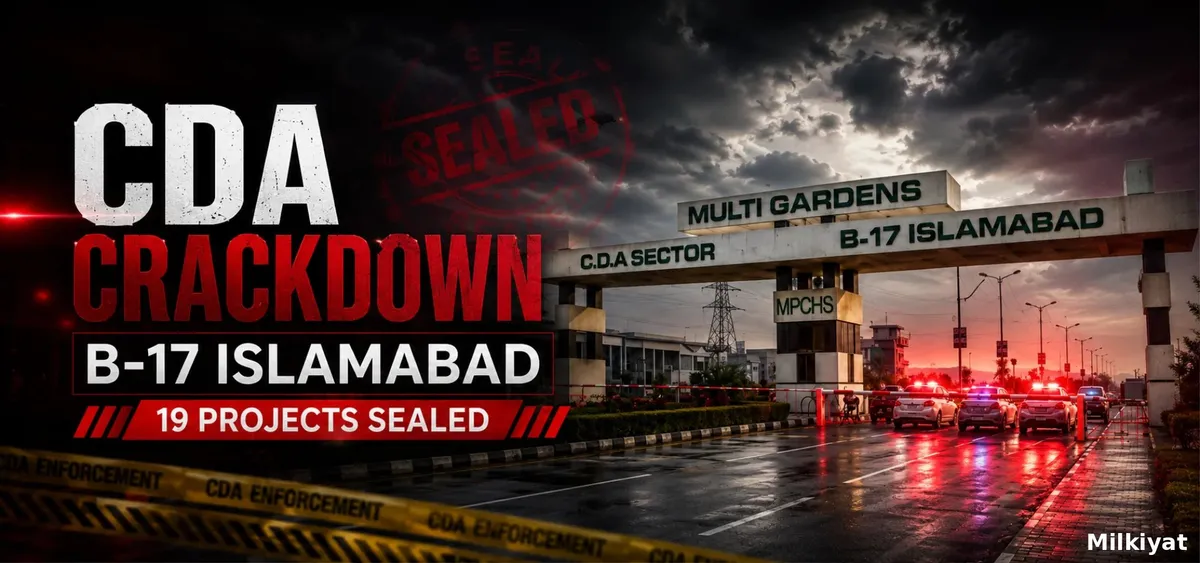
B-17 Islamabad Under CDA Scrutiny:Why 19 Plazas Were Sealed (2026)?

By wajahat Ali
Real Estate Analyst
Updated 10 min read
ShareWhatsApp
Guide
By wajahat Ali
Real Estate Analyst
Updated 10 min read
MDA’s New Malir Housing Scheme was launched in 1997 on 4,000 acres, but reports say only 231 of 27,107 allottees have possession. This guide covers its real status, sectors, official values and verification checks.
Shah Latif Town Scheme 25-A is MDA’s most developed plot scheme, with about 20,582 small plots along the National Highway. This guide covers its status, sectors, encroachment record, official values and how to verify a plot
Who approves building plans in Peshawar? See what PDA, LUBCA, TMAs, PHA and CMG each do, and how to find the right office to pass your house map.
Compare LDA housing schemes in Lahore, including Johar Town, Allama Iqbal Town, Sabzazar and LDA City, with buyer checks for ownership and possession.
Short Answer: CDA’s action against MPCHS in Sector B-17 mainly concerns alleged layout violations, amenity-plot conversions, right-of-way encroachments, missing revised approvals, and commercial buildings without individual CDA approval. Nineteen commercial and high-rise projects have also been sealed. However, the regulatory risk is not equal across B-17. Approved and developed residential plots generally carry lower exposure than disputed extensions or unapproved vertical projects. Buyers should therefore verify the CDA status of their specific plot, building, and approved land use before investing.
The real estate landscape of Islamabad is experiencing a massive regulatory correction. Sector B-17, primarily developed by the Multi Professional Cooperative Housing Society (MPCHS) under the name Multi Gardens, has long been celebrated as one of the safest, high-return investment hubs for domestic buyers and overseas Pakistanis alike. However, a sudden and aggressive enforcement drive by the Capital Development Authority (CDA) has triggered market-wide panic. With high-profile multi-story plazas sealed and a severe, sweeping show-cause notice served to the developer management, investors are desperate for the truth: Is your property in B-17 secure, or are you looking at potential legal lockdowns and demolitions? This comprehensive investigative report uncovers the explicit legal violations, the full details of the 19 sealed commercial structures, the latest regulatory notices, and the survival guide for property owners.
The regulatory pressure on MPCHS reached a critical flashpoint when the CDA issued an official, high-level 7-day show-cause notice directly targeting Multi Gardens (Sector A-17 / B-17). This is no longer a routine localized warning; it is a full-scale legal action utilizing the absolute power of the state.
The CDA has built its prosecution around several core structural violations:
The CDA is executing this operation under a multi-layered legal matrix, leaving little room for procedural evasion:
The physical execution of this enforcement strategy began when the CDA’s Building Control Section-II, supported by the Enforcement Directorate, local ICT administration, and Islamabad Police, moved on the sector's commercial sectors. Nineteen prominent multi-story commercial plazas and luxury apartment projects were locked and sealed on account of violating the ICT Building and Zoning Regulations.
[CDA Building Control Vetting]
       │
       ├──> Approved Individual Plans ──> Legal & Safe to Construct
       │
       └──> Bypassed / Only Society LOP ──> SEALED BY AUTHORITIES (19 Plazas)
The primary targets of this enforcement sweep include:
The official show-cause notice outlines severe consequences if compliance and structural restorations are not delivered swiftly:
Despite the alarming headlines, investors must avoid panic selling. There is a distinct, verifiable line dividing safe real estate from high-risk assets within B-17:
| Sector / Property Classification | Legal Standing | Risk Assessment | Action Plan for Owners |
|---|---|---|---|
| Blocks A, B, C & D (On-Ground Houses & Residential Plots) | Fully Approved / Original NOC Valid | Low Risk | Safe. These blocks conform to the initial layout plan. Existing on-ground homes face no structural threat. |
| Blocks E & F (Residential Plots) | Partially Approved / Infrastructure Complete | Medium Risk | Hold. Minor delays in utility integration may occur, but land titles are largely secure. |
| Block G, Extension Zones & Unapproved Vertical High-Rises | No Revised NOC / Pending LOP Approval | High Risk | Freeze Capital. Halt all upcoming installment payments on unapproved commercial projects until the developer produces a certified CDA regularization certificate. |
The Golden Rule of Capital Protection: High-court stay orders are currently protecting several affected plot owners in Blocks A and B. However, the Supreme Court of Pakistan has repeatedly ruled that illegal constructions on public amenity plots (parks/playgrounds) cannot create legal ownership rights. If your commercial apartment or shop sits on a re-zoned green area, your investment is in immediate danger.
Before deploying capital into B-17 or neighboring sectors like F-17, protect your finances with this regulatory checklist:
How Could the CDA Crackdown Affect B-17 Property Prices?
The immediate impact is likely to be strongest in commercial projects and high-rises directly affected by sealing or approval disputes. Such properties may face weaker resale demand, slower transactions, and greater buyer hesitation until their regulatory status becomes clear. Residential plots and houses located in established, approved blocks may experience less direct pressure, although broader uncertainty can temporarily affect market sentiment across B-17. Investors should therefore avoid judging the entire sector based on a single enforcement action and instead compare the approval status, location, development level, and legal documentation of each property individually. For buyers, regulatory uncertainty may also create negotiation opportunities, but a lower asking price should not be treated as a bargain unless the underlying legal position has been independently verified.
What If You Already Own a Unit in a Sealed Project?
Owners of apartments, shops, or offices in an affected building should first obtain the project's individual CDA building-plan approval and confirm why the structure was sealed. The developer should also provide documentary evidence of any regularisation process, revised approval, court order, or compliance application being pursued. Owners should avoid relying only on verbal assurances from sales staff. Payment receipts, allotment documents, approved plans, correspondence with the developer, and CDA-related documents should be kept together in case they are needed for legal or regulatory proceedings. Where a project's approval remains unresolved, investors should be particularly cautious about making additional payments, transferring ownership, or committing further capital without updated documentation.
FAQs
Is the entire B-17 sector illegal?
No. The issues discussed in the CDA action do not automatically make every property in B-17 illegal. Risk depends on the specific block, plot, building, land-use approval, and applicable CDA permissions.
Are residential plots in B-17 affected by the sealing operation?
The sealing action described in this report primarily concerns commercial and multi-storey developments with building-approval issues. Buyers of residential plots should still verify their individual location and approved status with CDA.
Is an MPCHS allotment letter enough to prove a commercial project is legal?
No. A society allotment or booking document does not replace the individual building-plan approval required for a commercial or high-rise development.
Should investors stop buying property in B-17?
Not necessarily. Buyers should avoid making sector-wide assumptions and instead conduct property-specific due diligence. Approved residential properties carry a different risk profile from disputed commercial or vertical projects.
What documents should a B-17 buyer verify?
Buyers should check the approved layout plan, society NOC, individual building approval where applicable, plot land-use classification, outstanding dues, utility approvals, and any revised CDA permissions affecting the property.
What is the biggest risk for buyers right now?
The biggest risk is purchasing a property based only on a society-level approval or developer assurance without confirming whether the specific plot or building is approved by CDA for its current use.