Guide
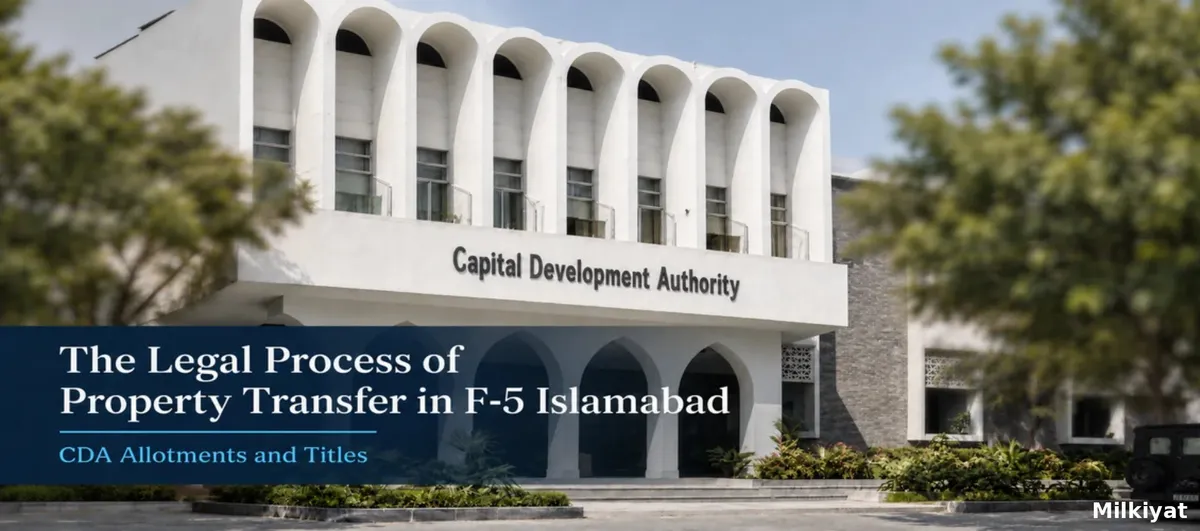
The Legal Process of Property Transfer in F-5 Islamabad: CDA Allotments and Titles
Guide
Guide

By Maham Imtiaz
Real Estate Analyst
12 min read
If you want to know how to transfer plot ownership in F-5 Islamabad, the process runs through the Capital Development Authority, not a provincial land registry. Both parties file a Transfer Application Form at CDA's One Window Operation (OWO) Directorate in G-7/4, surrender the original allotment or transfer letter, clear all dues, attach the required NOCs, pay the transfer fee (Rs 250 per square yard for residential plots) along with federal withholding tax, and appear in person for biometric admitting. CDA then issues a fresh transfer letter in the buyer's name. A normal case runs on CDA's roughly 20-day SOP; an urgent case costs an extra Rs 10,000 and can produce the transfer letter the same afternoon.
The single biggest source of confusion for buyers coming from Lahore or Rawalpindi is that F-5 property transfer does not happen in front of a patwari. F-5 sits on land the CDA acquired under the CDA Ordinance 1960, planned and allotted as sectors. Once the acquisition was complete, the old revenue record for that land stopped being the operative title document.
That is why searching for an F-5 Islamabad khasra number for a house in F-5/1 or F-5/2 usually leads nowhere useful. Khasra and khatooni numbers describe the pre-acquisition village land, Sheikhpur, Kalinjar and the other settlements that stood here before the master plan. What identifies your property today is the plot number, street number and sub-sector, which is why every serious verification starts with the sector map rather than the revenue record. Buyers who are still orienting themselves in the sector should read the F-5 sub-sector and boundary breakdown before they start matching plot numbers on paper to plots on the ground.
There is a second consequence. In F-5, ownership sits in CDA's estate file. The F-5 property registry you are actually relying on is CDA's Estate Management record, and the document that proves your position in it is the allotment letter or the most recent transfer letter.
By Maham Imtiaz
Real Estate Analyst
12 min read
If you want to know how to transfer plot ownership in F-5 Islamabad, the process runs through the Capital Development Authority, not a provincial land registry. Both parties file a Transfer Application Form at CDA's One Window Operation (OWO) Directorate in G-7/4, surrender the original allotment or transfer letter, clear all dues, attach the required NOCs, pay the transfer fee (Rs 250 per square yard for residential plots) along with federal withholding tax, and appear in person for biometric admitting. CDA then issues a fresh transfer letter in the buyer's name. A normal case runs on CDA's roughly 20-day SOP; an urgent case costs an extra Rs 10,000 and can produce the transfer letter the same afternoon.
The single biggest source of confusion for buyers coming from Lahore or Rawalpindi is that F-5 property transfer does not happen in front of a patwari. F-5 sits on land the CDA acquired under the CDA Ordinance 1960, planned and allotted as sectors. Once the acquisition was complete, the old revenue record for that land stopped being the operative title document.
That is why searching for an F-5 Islamabad khasra number for a house in F-5/1 or F-5/2 usually leads nowhere useful. Khasra and khatooni numbers describe the pre-acquisition village land, Sheikhpur, Kalinjar and the other settlements that stood here before the master plan. What identifies your property today is the plot number, street number and sub-sector, which is why every serious verification starts with the sector map rather than the revenue record. Buyers who are still orienting themselves in the sector should read the F-5 sub-sector and boundary breakdown before they start matching plot numbers on paper to plots on the ground.
There is a second consequence. In F-5, ownership sits in CDA's estate file. The F-5 property registry you are actually relying on is CDA's Estate Management record, and the document that proves your position in it is the allotment letter or the most recent transfer letter.
The F-5 Islamabad allotment letter is the foundation document. It records the allottee's name, plot number, size, sector, date of allotment and the terms under which CDA granted it. A transfer letter looks similar and does the same job for every owner after the first one.
Forged and photocopied letters have circulated in Islamabad for years, and CDA has itself moved to security-featured letters after repeated fake-file scandals. So the F-5 Islamabad allotment letter verification process should never rely on the paper the seller hands you. There are three reliable checks:
If the seller cannot produce the original letter and offers a court-attested photocopy instead, ask why. A genuine lost original is replaced by a Certified True Copy, which CDA issues only against a police FIR, an affidavit, an indemnity bond, an attested CNIC copy and a Rs 1,000 processing fee, with the allottee's statement recorded before the Deputy Director. A seller who has skipped that route has a problem you do not want to inherit.
Once the letter checks out, look for anything sitting on top of it. F-5 Islamabad property encumbrance in a CDA sector means something specific: a lien marked on the estate file, usually because the property was mortgaged to a bank or HBFC. CDA maintains a lien-marking procedure, and where a mortgage exists, the transfer file will need the original CDA agreement, the permission-to-mortgage letter and an NOC from the lending institution before Estate Management will move.
Also check for property tax arrears, water bill arrears and any building-control violation. All three surface later as refused NOCs, and all three are cheaper to discover now than after the token money is paid.
The transfer case is filed on the prescribed Transfer Application Form, filled by both parties and attested by a first-class officer. Along with it, CDA's published procedure asks for:
Where a female allottee appears, CDA asks that she be accompanied by a blood relation with documentary proof of identity. Where the allottee is a government servant, a departmental NOC is required.
An F-5 NOC in this context is not a housing-society approval certificate, that concept belongs to private schemes on the city's edge, not to a CDA sector. Here it means two internal clearances.
The Revenue Directorate NOC confirms property tax and CDA dues are clear. The Building Control Section NOC confirms the structure is not in non-conforming use and does not violate building and zoning regulations. In a sector like F-5, where old residences have quietly become offices, guesthouses and clinics, the BCS clearance is where transfers stall most often. If you are buying a house that a previous owner converted, understand the exposure first by reading how commercial and residential zoning rules are enforced inside CDA sectors.
There is no single number here, which is why a workable F-5 Islamabad stamp duty calculation guide is really a sequence rather than a rate. Calculate in this order.
Start with the assessed value. Duty and federal withholding are computed on the notified value, the district collector's valuation table or FBR's Islamabad valuation table, which is organised sector by sector, or the declared consideration if that is higher. F-sector valuations are among the highest in the capital, so the absolute rupee figures are large even at modest percentages.
Add CDA's own charges. Transfer fee is Rs 250 per square yard for residential plots. A family transfer is charged at a flat Rs 5,000 residential or Rs 10,000 commercial. Change of title through a registered sale deed carries a pay order of Rs 7,500 residential or Rs 10,000 commercial. Sub-division, if relevant, runs at Rs 75 per square yard.
Add ICT stamp duty and registration. Islamabad's stamp duty sits under the Stamp Act 1899 as applied to the capital and amended by successive federal Finance Acts, with a separate registration fee at the Sub-Registrar's office. E-stamping is now compulsory across ICT, manual judicial and non-judicial stamp papers stopped being accepted in early 2026, so the duty is generated and paid through the ICT e-stamping system. Confirm the operative percentage with the Sub-Registrar before you budget, because this figure has been revised more than once in recent Finance Acts.
Add federal withholding. Advance tax under section 236C applies to the seller and section 236K to the buyer, both collected at registration, with materially higher rates for anyone outside FBR's Active Taxpayer List. Section 7E deemed-income treatment reaches properties above the notified threshold, which most F-5 holdings comfortably cross. Getting onto the ATL before the transaction date is the cheapest tax planning available to either side.
CDA's revised standard operating procedures target completion in under 20 days for a clean case. What actually decides the timeline is document readiness, not CDA throughput.
For same-day processing, both parties pay an additional Rs 10,000 urgent fee and present the completed Transfer Application Form with all documents to the Assistant Director (Admitting) before 10 a.m. If the file is in order, admitting is completed before noon, the case moves to Estate Management-I or II by special messenger, and the transfer letter is delivered at the OWO counter between 2 p.m. and 3 p.m. Undelivered letters are dispatched the following day.
Both parties must appear in person on the due date with original CNICs. They are photographed and give signatures and thumb impressions in front of the Admitting Officer after confirming the transaction is satisfactory to both. This appearance is not waivable by a dealer's assurance.
Many F-5 owners want a registered instrument rather than a transfer letter alone, particularly for bank financing. In that route, the sale deed is executed and registered with the ICT Sub-Registrar, and the registered deed is then taken back to CDA for change of title in the estate record.
This is where the F-5 Islamabad registry copy matters. Registration with the Sub-Registrar and change of title at CDA are two separate acts. A deed registered but never entered in CDA's file leaves the estate record still showing the old name, which will block your next building plan, completion certificate or onward sale. A buyer performing an F-5 Islamabad property title deed check online should therefore verify both sides: the deed at the Sub-Registrar and the current name on CDA's estate record.
The legal process to transfer inherited F-5 Islamabad plot to heirs is a change of title in favour of legal heirs, not a sale, and follows its own checklist. Any one heir may apply at the Front Office, OWO, addressed to the Director Estate Management, with:
People often ask how to transfer F-5 Islamabad property intiqal style, expecting a mutation entry. In a CDA sector there is no patwari mutation; the equivalent step is this heirship change of title, and the newspaper publication requirement exists precisely to give absent heirs a chance to object.
F-5 is small, expensive and heavily attorney-driven, which is exactly the profile fraudsters prefer. Six habits remove most of the risk:
1. Can I transfer an F-5 plot without the original allotment letter?
A. Not directly. CDA requires the original to be surrendered. If it is lost, apply for a Certified True Copy with an FIR, affidavit, indemnity bond and Rs 1,000 fee, then proceed.
2. Is a vacant plot in F-5 exempt from any NOC?
A. Vacant plots are exempt from the Revenue Directorate NOC. Built properties are not, and non-conforming use still requires Building Control Section clearance.
3. Who pays the CDA transfer fee, buyer or seller?
A. CDA does not assign it. It is negotiated between the parties, and in most Islamabad transactions the buyer pays it while the seller bears the section 236C withholding.
4. Does registering a sale deed alone make me the owner in F-5?
A. No. The registered deed must be presented to CDA for change of title in the estate record, or the CDA file will still show the previous owner.
5. Can an overseas Pakistani complete an F-5 transfer without travelling?
A. Yes, through a special power of attorney attested by the Pakistan embassy, high commission or consulate, submitted with attested passport and CNIC copies.
A complete guide to Warda Hamna Residencia in G-11/3, Islamabad, covering how the four towers differ, apartment sizes and layouts, current sale and rental prices, and whether it's a good investment for buyers and tenants.
E-11 Islamabad offers Margalla Hills views and dense apartment stock, but its four sub-societies don't share one clean NOC history.
H-13 Islamabad has an active rental market near NUST, but large parts of the sector are officially restricted. Here's what to check first.
Explore the best areas along Islamabad Expressway in 2026 for buying, investment and rental income, with insights on prices, connectivity and future growth.
The F-5 Islamabad allotment letter is the foundation document. It records the allottee's name, plot number, size, sector, date of allotment and the terms under which CDA granted it. A transfer letter looks similar and does the same job for every owner after the first one.
Forged and photocopied letters have circulated in Islamabad for years, and CDA has itself moved to security-featured letters after repeated fake-file scandals. So the F-5 Islamabad allotment letter verification process should never rely on the paper the seller hands you. There are three reliable checks:
If the seller cannot produce the original letter and offers a court-attested photocopy instead, ask why. A genuine lost original is replaced by a Certified True Copy, which CDA issues only against a police FIR, an affidavit, an indemnity bond, an attested CNIC copy and a Rs 1,000 processing fee, with the allottee's statement recorded before the Deputy Director. A seller who has skipped that route has a problem you do not want to inherit.
Once the letter checks out, look for anything sitting on top of it. F-5 Islamabad property encumbrance in a CDA sector means something specific: a lien marked on the estate file, usually because the property was mortgaged to a bank or HBFC. CDA maintains a lien-marking procedure, and where a mortgage exists, the transfer file will need the original CDA agreement, the permission-to-mortgage letter and an NOC from the lending institution before Estate Management will move.
Also check for property tax arrears, water bill arrears and any building-control violation. All three surface later as refused NOCs, and all three are cheaper to discover now than after the token money is paid.
The transfer case is filed on the prescribed Transfer Application Form, filled by both parties and attested by a first-class officer. Along with it, CDA's published procedure asks for:
Where a female allottee appears, CDA asks that she be accompanied by a blood relation with documentary proof of identity. Where the allottee is a government servant, a departmental NOC is required.
An F-5 NOC in this context is not a housing-society approval certificate, that concept belongs to private schemes on the city's edge, not to a CDA sector. Here it means two internal clearances.
The Revenue Directorate NOC confirms property tax and CDA dues are clear. The Building Control Section NOC confirms the structure is not in non-conforming use and does not violate building and zoning regulations. In a sector like F-5, where old residences have quietly become offices, guesthouses and clinics, the BCS clearance is where transfers stall most often. If you are buying a house that a previous owner converted, understand the exposure first by reading how commercial and residential zoning rules are enforced inside CDA sectors.
There is no single number here, which is why a workable F-5 Islamabad stamp duty calculation guide is really a sequence rather than a rate. Calculate in this order.
Start with the assessed value. Duty and federal withholding are computed on the notified value, the district collector's valuation table or FBR's Islamabad valuation table, which is organised sector by sector, or the declared consideration if that is higher. F-sector valuations are among the highest in the capital, so the absolute rupee figures are large even at modest percentages.
Add CDA's own charges. Transfer fee is Rs 250 per square yard for residential plots. A family transfer is charged at a flat Rs 5,000 residential or Rs 10,000 commercial. Change of title through a registered sale deed carries a pay order of Rs 7,500 residential or Rs 10,000 commercial. Sub-division, if relevant, runs at Rs 75 per square yard.
Add ICT stamp duty and registration. Islamabad's stamp duty sits under the Stamp Act 1899 as applied to the capital and amended by successive federal Finance Acts, with a separate registration fee at the Sub-Registrar's office. E-stamping is now compulsory across ICT, manual judicial and non-judicial stamp papers stopped being accepted in early 2026, so the duty is generated and paid through the ICT e-stamping system. Confirm the operative percentage with the Sub-Registrar before you budget, because this figure has been revised more than once in recent Finance Acts.
Add federal withholding. Advance tax under section 236C applies to the seller and section 236K to the buyer, both collected at registration, with materially higher rates for anyone outside FBR's Active Taxpayer List. Section 7E deemed-income treatment reaches properties above the notified threshold, which most F-5 holdings comfortably cross. Getting onto the ATL before the transaction date is the cheapest tax planning available to either side.
CDA's revised standard operating procedures target completion in under 20 days for a clean case. What actually decides the timeline is document readiness, not CDA throughput.
For same-day processing, both parties pay an additional Rs 10,000 urgent fee and present the completed Transfer Application Form with all documents to the Assistant Director (Admitting) before 10 a.m. If the file is in order, admitting is completed before noon, the case moves to Estate Management-I or II by special messenger, and the transfer letter is delivered at the OWO counter between 2 p.m. and 3 p.m. Undelivered letters are dispatched the following day.
Both parties must appear in person on the due date with original CNICs. They are photographed and give signatures and thumb impressions in front of the Admitting Officer after confirming the transaction is satisfactory to both. This appearance is not waivable by a dealer's assurance.
Many F-5 owners want a registered instrument rather than a transfer letter alone, particularly for bank financing. In that route, the sale deed is executed and registered with the ICT Sub-Registrar, and the registered deed is then taken back to CDA for change of title in the estate record.
This is where the F-5 Islamabad registry copy matters. Registration with the Sub-Registrar and change of title at CDA are two separate acts. A deed registered but never entered in CDA's file leaves the estate record still showing the old name, which will block your next building plan, completion certificate or onward sale. A buyer performing an F-5 Islamabad property title deed check online should therefore verify both sides: the deed at the Sub-Registrar and the current name on CDA's estate record.
The legal process to transfer inherited F-5 Islamabad plot to heirs is a change of title in favour of legal heirs, not a sale, and follows its own checklist. Any one heir may apply at the Front Office, OWO, addressed to the Director Estate Management, with:
People often ask how to transfer F-5 Islamabad property intiqal style, expecting a mutation entry. In a CDA sector there is no patwari mutation; the equivalent step is this heirship change of title, and the newspaper publication requirement exists precisely to give absent heirs a chance to object.
F-5 is small, expensive and heavily attorney-driven, which is exactly the profile fraudsters prefer. Six habits remove most of the risk:
1. Can I transfer an F-5 plot without the original allotment letter?
A. Not directly. CDA requires the original to be surrendered. If it is lost, apply for a Certified True Copy with an FIR, affidavit, indemnity bond and Rs 1,000 fee, then proceed.
2. Is a vacant plot in F-5 exempt from any NOC?
A. Vacant plots are exempt from the Revenue Directorate NOC. Built properties are not, and non-conforming use still requires Building Control Section clearance.
3. Who pays the CDA transfer fee, buyer or seller?
A. CDA does not assign it. It is negotiated between the parties, and in most Islamabad transactions the buyer pays it while the seller bears the section 236C withholding.
4. Does registering a sale deed alone make me the owner in F-5?
A. No. The registered deed must be presented to CDA for change of title in the estate record, or the CDA file will still show the previous owner.
5. Can an overseas Pakistani complete an F-5 transfer without travelling?
A. Yes, through a special power of attorney attested by the Pakistan embassy, high commission or consulate, submitted with attested passport and CNIC copies.
A complete guide to Warda Hamna Residencia in G-11/3, Islamabad, covering how the four towers differ, apartment sizes and layouts, current sale and rental prices, and whether it's a good investment for buyers and tenants.
E-11 Islamabad offers Margalla Hills views and dense apartment stock, but its four sub-societies don't share one clean NOC history.
H-13 Islamabad has an active rental market near NUST, but large parts of the sector are officially restricted. Here's what to check first.
Explore the best areas along Islamabad Expressway in 2026 for buying, investment and rental income, with insights on prices, connectivity and future growth.