Guide
Development Charges Scam: How Private Housing Societies Impose Hidden Fees on Buyers

By wajahat Ali
Real Estate Analyst
Updated 9 min read
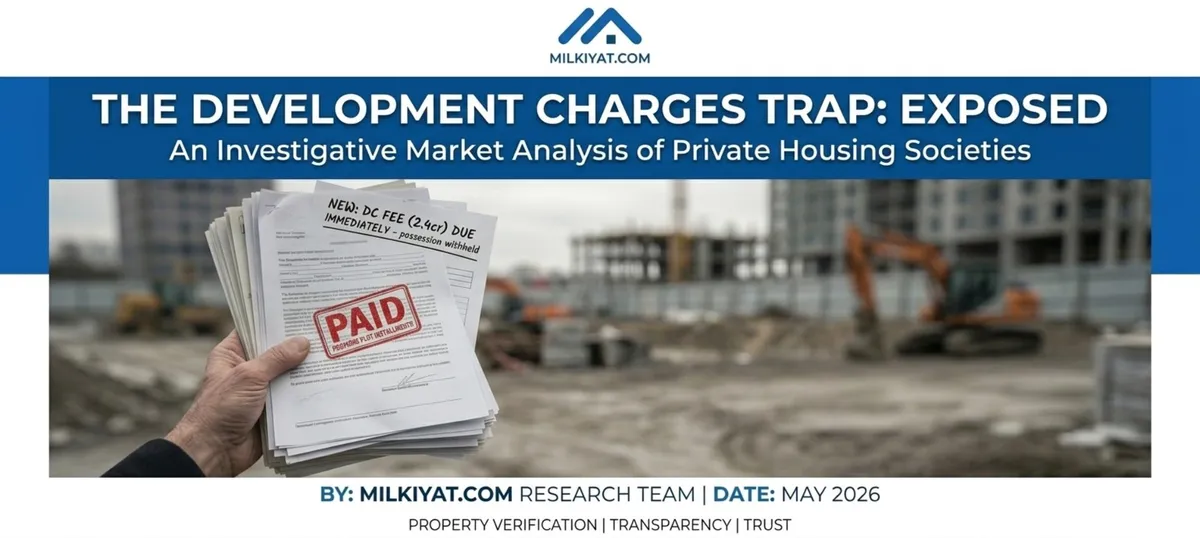
Imagine saving for years, securing a residential or commercial plot in a top housing scheme, and finally clearing your last installment. You breathe a sigh of relief, thinking your dream property is completely secure. Then comes the possession letter. The housing society administration informs you that before you can take physical possession or begin construction, you must pay "Development Charges" (DC)—a massive, unannounced sum that often equals or exceeds the initial base cost of the land. Across the Pakistani real estate market, hidden, inflated, or re-imposed development charges have evolved from standard infrastructure development fees into one of the most lucrative and legally grey practices run by private housing schemes. By capitalizing on public trust and weaponizing the "sunk cost" dilemma, developers systematically extract billions from local and overseas investors.
What Are Development Charges in Real Estate?
In legitimate real estate development, development charges are standard fees used to cover the actual costs of laying down essential physical infrastructure. These include:
- Grading and carpeting roads and main boulevards.
- Laying sewerage lines and drainage systems.
- Installing water filtration plants and supply lines.
- Setting up underground electrical grids and gas pipelines. However, predatory developers intentionally separate the "Cost of Land" from the "Cost of Development" to make their payment plans look far cheaper during early marketing phases.
Comparative Table: Development Charges in Top Housing Societies
To understand how widespread this practice is across different market tiers, consider the official and market-reported figures for major housing schemes. The discrepancy between what buyers expect to pay and the final cost highlights the true scale of the issue.
| Housing Society & Location | Average Base Plot Cost | Imposed Development Charges (DC) | Total Percentage Increase | Policy Shift / Mechanism |
|---|---|---|---|---|
| Park View City (Islamabad) | 40,000,000 PKR (Commercial) | 24,000,000 PKR | 60% Increase | Marketed as "All-Inclusive" at launch; development charges re-imposed at possession. |
| Blue World City (Rawalpindi/Isb) | 1,490,000 PKR (5 Marla Res.) | 1,500,000 to 1,750,000 PKR | 100% – 117% Increase | Low down-payment files; massive per-marla infrastructure fee levied later to secure balloting. |
| Rudn Enclave (Rawalpindi) | 1,575,000 PKR (5 Marla Gen.) | 1,150,000 PKR | 73% Increase | Strict escalation deadlines; fees jump if not cleared 100% prior to final balloting rounds. |
| New Metro City (Gujar Khan) | 1,990,000 PKR (5 Marla Res.) | 1,990,000 PKR | 100% Increase | Segmented pricing; base plot cost strictly covers raw dirt, doubling the total layout near possession. |
Case Studies: Park View City, Blue World City, Rudn Enclave, & New Metro City
Park View City Islamabad Commercial Development Charges
Park View City stands as a prime, high-end example of this financial maneuver. In its initial marketing drives, properties were explicitly sold with the assurance that development charges were baked directly into the premium price tag. Because it boasts a prime location and an official Capital Development Authority (CDA) NOC, buyers willingly paid steep prices, assuming they were completely immune to future hidden fees. Once the initial residential and commercial blocks reached maturity, the administration shifted the goalposts. For premium commercial sectors, buyers who had already cleared their 4-crore obligations were suddenly served heavy notices demanding an additional 2.4 crores just to secure physical possession and construction permits. By labeling these sudden massive figures as mandatory infrastructure adjustments due to macroeconomic inflation, the developer effectively forces the investor to pay a ransom on their own fully cleared property. If a commercial buyer cannot produce these extra crores, they cannot build, leaving their massive initial investment completely frozen.
Blue World City Per Marla Development Fee Layout
Blue World City captured the market by targeting lower-and-middle-class buyers, offering plots with remarkably low down payments and cheap monthly installment options. To a budget-conscious investor or a salaried worker, the payment plans looked like the ultimate ticket to land ownership. However, the entire model relies on separating the raw cost of the land from the actual cost of turning dirt into a liveable community. After buyers meticulously cleared their initial plot files, the society implemented a separate development charge framework climbing up to 350,000 PKR per Marla. For a modest plot, this means adding hundreds of thousands of unbudgeted rupees to the bill. To extract this cash quickly, the management introduced a "discount and reallocation" strategy. If a member pays the sudden development charges immediately in a lump sum, they are promised a plot number in a fully developed, prime location. If they cannot pay, their file risks being relegated to an un-balloted, raw patch of land far out in the project's future phases.
Rudn Enclave Balloting and Development Cost Deadlines
Rudn Enclave represents the standard "file-trading" model that shifts into an aggressive capital collection phase as soon as concrete infrastructure work hits the ground along the Rawalpindi Ring Road route. The society heavily utilizes upcoming milestone deadlines—such as final block balloting or possession ceremonies—to force rapid capital collection. The administration explicitly notifies file holders that if they do not clear 100% of their land dues and baseline development fees by a strict target date, their development rates automatically adjust upward—frequently rising to steep standard blocks of 230,000 PKR per Marla. This creates a high-pressure environment where middle-class investors are forced to scramble for liquidity. They must either pay the revised infrastructure fees immediately or face exclusion from the upcoming ballot, effectively making their files un-tradable on the open market.
New Metro City Gujar Khan Hidden Cost Strategy
Developed under BSM Developers, New Metro City utilizes a highly segmented corporate strategy to separate land prices from development costs right from the start. While their payment plans feature explicit rows for the "Cost of Land," the actual development charges are explicitly pushed to the final phases of the timeline or tucked away in localized adjustments. For instance, in blocks like Early Bird, a 5 Marla plot priced at a pre-launch rate of 1,990,000 PKR saw flat development charges of 1,990,000 PKR layered directly on top of the base cost later on. On top of these standard infrastructure adjustments, the developer layers an extra 10% premium for "Category Plots" (Corner, Main Boulevard, or Park Facing). Consequently, a buyer who calculates their budget strictly around the marketed down-payment and monthly installments finds themselves facing steep, mandatory lump-sum invoices at the exact moment they try to claim their physical boundaries.
Why Do Housing Authorities Allow Hidden Infrastructure Fees?
The Lack of Upfront Regulatory Auditing
Most local development authorities (such as the CDA, RDA, or LDA) require housing societies to submit an initial master plan to get a No Objection Certificate (NOC). However, regulators rarely enforce a strict, transparent ceiling on what a developer can charge a consumer for infrastructure. Without independent third-party audits of actual development expenses, developers can easily inflate engineering and labor invoices.
Fund Diversion and File Over-Selling
In many extreme cases, developers practice "fund diversion." They collect money for a specific block or project and use those funds to purchase completely new raw land elsewhere instead of installing the promised infrastructure on the current phase. When the time comes to actually build the roads and pipes, the treasury is empty, forcing them to levy massive "development charges" on original buyers to bail themselves out.
How Property Buyers Can Avoid the Development Charges Trap
If you are looking to invest in a private housing scheme, avoiding this trap requires strict due diligence before signing any booking form.
- Audit the Contractual Language: Never sign a document that leaves development charges "to be determined." Look for terms like "All-Inclusive Price" or "Development Charges Included." If they are separate, demand a fixed, non-escalating cap written clearly into the terms and conditions.
- Verify On-Ground Development Milestones: If a society claims development charges are required because work is actively happening, perform an on-site visit. Legitimate societies tie development charges to clear, transparent milestones (e.g., 20% upon road leveling, 20% upon sewerage completion). If a developer demands 100% of the development fee upfront while the site is still raw dirt, treat it as a massive red flag.
- Demand an Itemized Expense Breakdown: You have the right to know exactly what you are paying for. Demand a clear, written breakdown showing the cost per square yard for specific amenities (electrification, roads, water filtration). Scammers usually balk at providing itemized bills because they cannot back up the math.
Frequently Asked Questions (FAQ) for Property Investors
Q1: Can a housing society legally increase development charges after selling a plot? Yes, if the initial application form contains a clause stating that development fees are subject to adjustment based on material cost inflation or "actual expenses," developers retain the legal loophole to raise prices. Always check for an all-inclusive clause before buying.
Q2: What happens if I do not pay the development charges on time? Failure to pay development charges usually results in the society canceling your plot allocation, blocking your file from balloting rounds, or withholding physical possession, preventing you from starting home construction.
Q3: Are development charges included in the down payment? In most affordable or low-cost housing schemes, the down payment and initial installment plan cover the cost of land only. Development charges are almost always billed separately as the project nears completion.
To better understand how state enforcement agencies are reacting to shifting policies and illegal additions within these local housing schemes, you can watch this Real Estate Market Analysis on Regulatory Updates. This analysis sheds light on structural issues and ongoing local developments.