Guide
Faisal Town Phase 2 Land and Mouza Checks
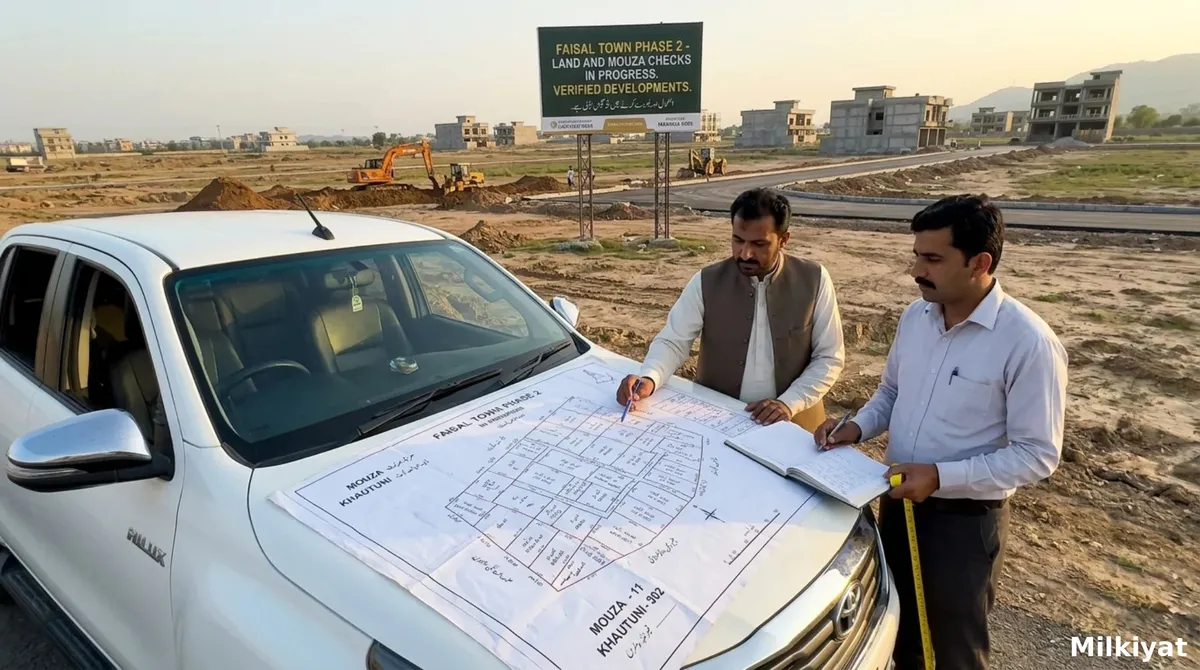

This guide covers land records and ownership checks. For approval status, see the Faisal Town Phase 2 NOC guide.
Overview
Before you ask whether a plot in Faisal Town Phase 2 is approved, ask a simpler question: whose land is it, and is it the land the approval covers? The scheme is advertised at more than 80,000 kanals across three villages in Tehsil Rawalpindi, and the land records behind that number are not public in any form we've been able to find.
This guide explains the land records every buyer should know, the checks that matter, and what to ask the developer to show you in writing. It's a companion to our Faisal Town Phase 2 guide, which covers the scheme as a whole.
If you're weighing a specific file, the open plots on the Faisal Town Phase 2 listings page are a useful place to find the sector and plot details that you'll need to check against the records below.
Where the land is
The developer places Faisal Town Phase 2 at Mera Kalan, Kolian Par and Dhalla in Tehsil Rawalpindi, beside the Thalian Interchange on the M-2 Motorway. Despite "Islamabad" in its marketing name, the land lies in Rawalpindi district, and the authority that has acted on the scheme is the Rawalpindi Development Authority (RDA).
That matters because land records are kept by village, or mouza, and by tehsil. A buyer checking records for "Faisal Town Phase 2" won't find a single entry. The records are kept under the names of the villages and under khasra numbers, which are the numbers of the individual parcels of land.
We haven't found a published list of the mouzas and khasra numbers that make up Phase 2, from the developer or from RDA. That is the first thing to ask for.
Milkiyat.com finding: approved land against advertised land
The only approved-area figure the developer has put forward is 7,300 kanals, in an RDA letter it announced in October 2022. Milkiyat has not been able to verify that letter. The scheme is marketed at a much larger size:
| Land figure | Kanals | Share covered by 7,300 kanals |
|---|---|---|
| Said to be under active development | 32,000 | 22.8% |
| Advertised on the developer's website | 80,000 | 9.1% |
All of these are developer figures. On the larger one, 7,300 ÷ 80,000 = 9.1%, which would leave about 72,700 kanals with no approval at all. The developer also says it plans to expand towards 200,000 kanals.
So the land question isn't only "who owns it". It's also "which part of it is approved, and is my plot inside that part".
The records you need to understand
Land in Punjab is recorded in a handful of documents. Each one answers a different question.
| Record | What it shows | Why it matters here |
|---|---|---|
| Fard | An extract of the ownership entry for a parcel | Confirms who the record names as owner today |
| Jamabandi | The periodic record of rights for a mouza | Shows the ownership history and the share each owner holds |
| Khasra number | The number of the individual parcel | Lets you tie a plot to a specific piece of land |
| Mutation (intiqal) | The entry that records a transfer | Shows whether land has actually moved to the developer or a related entity |
| Registry | The registered sale deed | Shows the transfer was registered |
| Approval letter | The authority's letter naming the land approved | Shows which khasras are inside the approval |
Fard and mutation are services of the Punjab Land Records Authority (PLRA). A PLRA notice for the 2023-24 financial year listed a fard through the online service at PKR 600, and verification of a fard, mutation or registry at PKR 700 when successful and PKR 400 when not. Those are older figures, so check the current fee before you apply.
A step-by-step land check
- Get the khasra list. Ask the developer for the mouza names and khasra numbers covered by Phase 2, and by the block your plot is in.
- Get a fresh fard for the parcels. Don't accept a photocopy supplied by the seller. Apply through PLRA's official channels and check the result yourself.
- Check who owns each parcel. Does the fard name the developer or a company linked to it? If it names individual villagers, ask for the registered sale deeds and the mutations that follow.
- Compare the area. The kanals on the fard should add up to the land the scheme claims to hold. A gap between the two is a question to put to the developer.
- Check for encumbrances. A fard can show mortgages, court orders or disputes. Ask the developer to confirm in writing that none exists.
- Look at the land use. Farmland has to be converted before it can be sold as residential plots. Ask what conversion approval covers your parcels.
- Match the plot to the layout. The allotment letter should name the sector, block and plot number, and the layout plan should show it.
None of this replaces a lawyer. For any purchase of real size, have a lawyer who knows Rawalpindi land records review the documents before you pay.
Matching the land to the approval
This is where most buyers stop, and where the risk is greatest. An approval letter covers a stated area. It does not cover the whole scheme unless it says so.
If the 7,300-kanal letter is genuine, your plot has to fall inside the khasras it names. Ask for the letter number, its date and the list of mouzas and khasras it covers, then compare those with the parcels under your sector. Our Faisal Town Phase 2 NOC guide explains the letter, RDA's show-cause notices and the 2026 position.
The developer's own pages say the Phase 2 NOC is not yet approved. RDA's notice of 31 October 2023 cited rule 46(1) of the Punjab Development Authorities Private Housing Scheme Rules 2021 and ordered a halt to development work, advertising and plot sales. A clean fard, in other words, tells you who owns the land. It doesn't tell you the land has been approved for a housing scheme.
If you're buying an open file
Most resale activity in this scheme is in open files, where one buyer sells a booking to another. The land checks above still apply, but the paperwork is one step further removed. A file is a contract with the developer, not a deed to a parcel, so what you hold is the right to be allotted a plot.
That makes three questions worth asking before you pay a private holder. Does the developer confirm in writing that the file is valid and has no dues? Has a plot number been assigned, and if so, which khasras sit under it? And does the file name the sector you were told it was in?
A plot with a number is easier to check than a file without one, because a number can be matched to a layout plan and then to land. A file with no number is a promise about land that hasn't been tied to any parcel yet.
Overseas buyers
If you're buying from abroad, you can't walk the land, so the records have to do more of the work. Have a trusted relative or lawyer apply for the fard and visit the plot position. If you give anyone authority to act for you in Pakistan, take legal advice on the document first, and keep copies of everything you're sent.
Red flags
- The seller can't or won't name the mouza and khasra numbers.
- The fard names someone other than the developer, and no mutation follows.
- The area on the records doesn't match the area the scheme claims.
- The plot's sector can't be found on any layout plan.
- The seller offers a photocopy of a fard instead of letting you apply for one.
- "The approval is coming" is offered in place of a letter.
- Pressure to pay before the records have been checked.
What we haven't been able to verify
Milkiyat hasn't seen a khasra list for Phase 2, and hasn't opened PLRA's records for Mera Kalan, Kolian Par or Dhalla. The developer's land figures are marketing figures, and the 7,300-kanal letter is unconfirmed. This guide tells you which records to ask for and what to compare. It can't tell you what those records will say.
What to ask the developer for, in writing
- The mouza names and khasra numbers covered by your sector and block.
- The approval letter number, date and the kanals it names.
- Proof that the land has been transferred to the developer or its company.
- Confirmation of any conversion of land use.
- A copy of the layout plan with your plot marked.
- A written statement that the plot carries no mortgage, dispute or court order.
FAQs
Where is Faisal Town Phase 2 located?
The developer places it at Mera Kalan, Kolian Par and Dhalla in Tehsil Rawalpindi, beside the Thalian Interchange on the M-2 Motorway. The land is in Rawalpindi district, not Islamabad.
What is a fard, and why does it matter?
A fard is an extract from the land record showing who is recorded as owner of a parcel. It's the quickest way to check whose land you're dealing with, but it says nothing about approval.
How much land is approved in Faisal Town Phase 2?
The only figure the developer has put forward is 7,300 kanals, which Milkiyat hasn't verified. The scheme is advertised at more than 80,000 kanals, so the approved share would be about 9%.
What is a khasra number?
It's the number of an individual parcel of land in a mouza. Ask for the khasra numbers behind your sector so that you can check them against the records and the approval letter.
Can I verify the land myself?
You can apply for a fard through the Punjab Land Records Authority and check it. For anything beyond that, such as the chain of transfers or land use, use a lawyer who knows Rawalpindi land records.
Does a clean fard mean the plot is approved?
No. It shows who owns the land, not whether RDA or another authority has approved it as a housing scheme.