Guide
Fake Property Listings in Pakistan: How to Spot Them
Guide
A tenant guide to renting an office in D-12 Islamabad covering Markaz plazas, sizes, floors, rent benchmarks, approved use, agreements and a checklist.
Explore 1 bed apartment prices in Park View City Islamabad, including project comparisons, apartment sizes, price per sq ft, lake-facing views and buying options.
Explore apartments for sale in Park View City Islamabad, including 1, 2 and 3-bed units, project details, price comparisons, payment plans and buyer guidance.
A tenant guide to renting an office in F-10 Islamabad covering Markaz plazas, sizes, floors, rent benchmarks, approved use, agreements and a checklist.

By Mariam Khan
Real Estate Analyst
11 min read
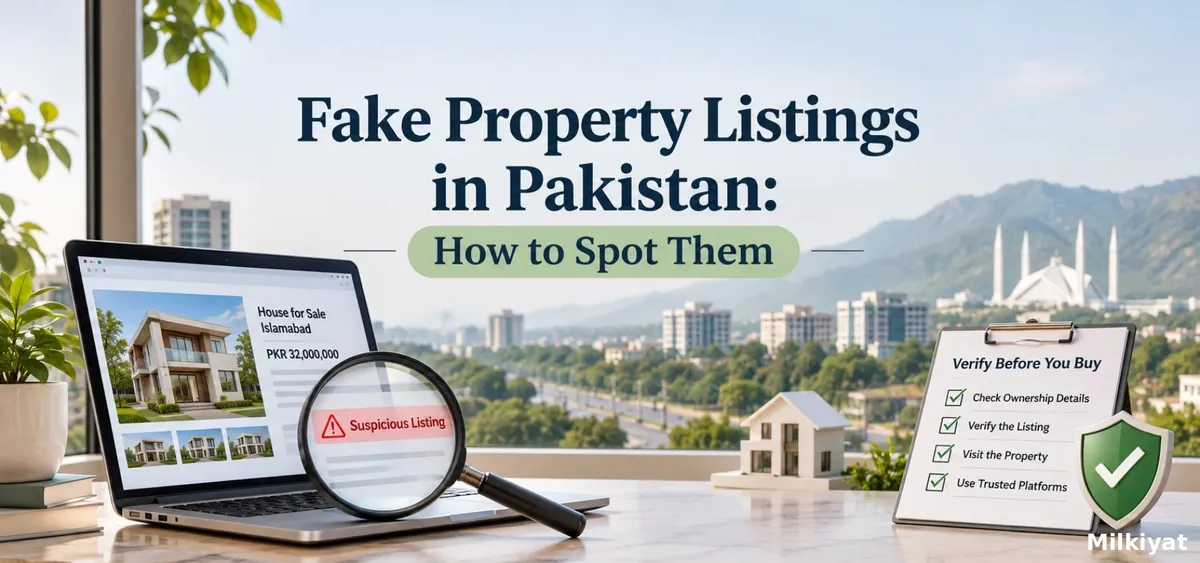
Fake property listings in Pakistan are often the first step in a property scam. A house in a prime sector at a suspiciously low price, a "direct owner" who's abroad and needs an advance today, a plot file that sounds too good to miss: these ads are designed to get you to send money before you check anything. Learning how to spot fake property listings is the cheapest protection a buyer or tenant can have.
This guide focuses on the listing itself: the red flags in fake property ads and photos, a step-by-step way to check whether a listing is genuine, how to verify the seller and documents, and how to report fake listings. For background on how dealers work, see our guide to real estate agents in Pakistan.
A fake property listing is an advertisement for a property that doesn't exist, isn't for sale or rent, isn't owned by the person advertising it, or is described falsely. Fake real estate listings and fake property advertisements usually aim to:
| Type | How it works |
|---|---|
| Bait listing | An attractive property at a low price that's "just been sold" when you call, followed by pressure to see something else |
| Phantom property | A listing for a property that doesn't exist, often with copied photos |
| Fake owner | Someone poses as the owner, often "abroad," and asks for an advance |
| Duplicate property listings | The same property posted by several people at different prices, some with no authority to sell |
| Fake files | Plot files in societies that haven't issued or allotted them |
| Fake property agents | Profiles with no office, no registration and no verifiable history |
| Rental advance scams | A "landlord" asks for advance rent and security to "hold" a flat they don't control |
These are the most reliable signs of how to identify fake property ads:
One red flag isn't proof of fraud. Several together are a strong reason to walk away.
This simple property listing verification routine catches most fake ads within a day.
Here's an illustrative example of using comparable listings to spot a price that's too good to be true. It's a worked example, not a valuation.
The listing: a 2-bed apartment advertised for Rs 60 lakh.
Five similar apartments in the same society: Rs 82 lakh, Rs 84 lakh, Rs 85 lakh, Rs 86 lakh, Rs 88 lakh.
The arithmetic
A practical rule: treat any listing more than about 20% below comparable listings as a red flag until proven otherwise. Here, 29% > 20%, so the listing needs full verification before any contact about payment. Genuine distress sales happen, but they come with verifiable documents and owners who welcome checks.
How to check property ownership before buying depends on where the property is recorded.
In Punjab, land-record property is managed through the Punjab Land Records Authority's Arazi Record Centres:
PLRA's official FAQs explain how fards are issued and how registry and oral mutations are processed.
For CDA sectors in Islamabad, ownership is recorded through CDA allotment and transfer letters. Confirm the record with CDA before paying. CDA's published procedures cover transfers, gift transfers and transfers to legal heirs.
For private societies, confirm with the society's transfer office that the seller owns the plot or file and that dues are clear. Separately, check that the society itself has a valid NOC from the relevant authority, such as CDA, RDA or LDA. Our guide on how to verify property ownership explains the checks for each type of authority.
Online tools can narrow risk before you visit. For example, Punjab has launched an online system to check a housing society's legal status. Always confirm the specific plot or file with the society or authority as well.
These checks are how to verify property documents in Pakistan properly: online first, then with the office that holds the record.
Many fake listings end with a request for token money. Protect yourself:
Our guide to token money rules explains receipts and refunds in detail.
Fake listings are one part of a wider pattern of property buying scams in Pakistan, including fake files, double-selling and illegal societies. Our guide to avoiding real estate scams covers property fraud in Pakistan more broadly.
Online fraud also has specific legal consequences. The Prevention of Electronic Crimes Act, 2016 covers offences such as electronic forgery and electronic fraud, and online property scams can be reported as cybercrime.
If you've already paid, our guide on how to complain against a property dealer explains each route in detail.
| ✔ | Check |
|---|---|
| ☐ | Price compared with at least five similar listings |
| ☐ | Photos reverse-searched |
| ☐ | Exact address and plot number confirmed |
| ☐ | Owner met or video-called with CNIC visible |
| ☐ | Dealer's registration and office verified |
| ☐ | Ownership confirmed with the society, CDA or land records office |
| ☐ | Society NOC status checked |
| ☐ | No payment before verification |
| ☐ | Payment only to the registered owner, by bank instrument |
| ☐ | Signed receipt and written agreement |
Working with a dealer who has a visible track record is one of the simplest ways to avoid fake listings. Milkiyat's agent pages show each dealer's areas, active listings, experience and reviews:
Even with a trusted agent, run the verification steps above before paying.
1. How can I spot fake property listings in Pakistan? Watch for prices far below similar listings, owners who are "abroad," requests for advance payment before viewing, vague addresses, copied photos, duplicate ads and advertisers who discourage verification.
2. How do I check if a property listing is fake? Compare prices, reverse-search the photos, confirm the exact address, video-call the advertiser from the property, verify the CNIC and dealer, and confirm ownership with the society, CDA or land records office before paying.
3. How do I identify fake property photos? Run a reverse image search, look for mismatched details or removed watermarks, and ask for a live video call from inside the property.
4. How do I verify property documents in Pakistan? For land-record property, check the fard, registry and intiqal through the land records office. For CDA sectors, confirm with CDA. For societies, confirm with the society's transfer office and check the society's NOC.
5. What is property token money fraud? It's when a fake seller or dealer collects a token or advance and disappears. Avoid it by paying only after verification, only to the registered owner, by bank instrument and against a signed receipt.
6. How do I report fake property listings? Report the listing to the platform, report online scams to the NCCIA, file a police complaint if you've lost money, and inform the society or authority.
Fake property listings rely on speed and trust: a low price, a believable story and pressure to pay before you check. Slow down, compare prices, verify the photos, the seller and the documents with the office that holds the record, and never pay before verification. Those few steps defeat most fake ads.
Start your search with verified agents on Milkiyat.com, and compare their listings and reviews before you contact anyone about payment.
This guide is for general information only. Verification procedures, online tools and reporting channels differ by province, authority and society, and change over time. Confirm current procedures with the relevant authority and consult a qualified lawyer if you suspect fraud. The price example is illustrative and isn't a valuation. Milkiyat.com does not provide legal, tax or financial advice.