Guide
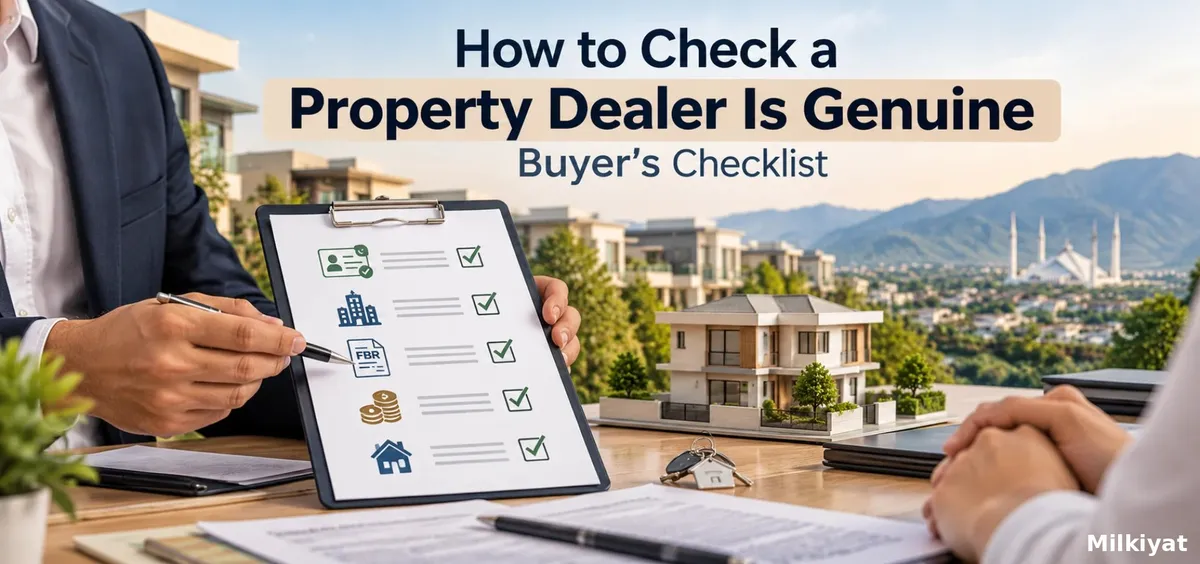
How to Check a Property Dealer Is Genuine: Buyer's Checklist

By Mariam Khan
Real Estate Analyst
13 min read
Finding a trustworthy property dealer in Pakistan is one of the biggest decisions in any property purchase, often bigger than the property itself. A good dealer saves you weeks of searching and steers you away from bad files. A bad one can take a hidden markup, hold your token money in a personal account, or lead you into a plot that doesn't legally exist. The difference usually isn't visible on the first visit, and that's why buyers need a checklist.
This guide gives buyers, sellers and overseas Pakistanis a step-by-step way to check a dealer before any money changes hands. For background on how dealers work, how they're paid and the rules they operate under, see our complete guide to property dealers.
The Checklist at a Glance
| # | Check | Pass looks like |
|---|---|---|
| 1 | Identity | CNIC name matches the business card, listing and receipts |
| 2 | Office | A real address you've visited, not just a WhatsApp number |
| 3 | Track record | Years in one area, real listings, reviews from real clients |
| 4 | FBR registration | Can show an FBR DNFBP registration record |
| 5 | Tax status | Appears on FBR's Active Taxpayer List |
| 6 | Company or local registration | SECP record for companies; local registration where required |
| 7 | Commission terms | Rate per side, agreed in writing before viewings |
| 8 | Money handling | Token to the owner by pay order, with a numbered receipt |
| 9 | Documents | Shows originals, lets you meet the owner, welcomes independent checks |
| 10 | Questions they ask you | Asks for your CNIC and source of funds, as the law requires |
A dealer who passes all ten isn't guaranteed to be perfect, but a dealer who fails several is a risk you don't need to take.
Why Verifying a Real Estate Agent Matters
Most property fraud in Pakistan runs through a middleman. The common patterns are:
- Hidden markups ("top"): the dealer quotes the buyer more than the seller will accept and keeps the difference.
- Token money fraud: advance money is paid to the dealer instead of the owner and is never passed on.
- Fake or unbacked files: plot files sold in societies that haven't approved or allotted them.
- Double selling: the same property is promised to more than one buyer.
There's also a legal reason. Since 2022, development authorities and housing societies have been barred from doing transfer business with agents who aren't registered with FBR. An unregistered dealer can leave your transfer stuck at the society office.
Part 1: Check the Person
1. Match the identity
Ask for the dealer's CNIC, or the CNIC of the agency owner, and check that the name matches:
- The business card and office signboard
- The online listing or profile
- The name on any receipt or commission agreement
A dealer who won't show a CNIC, or who uses different names in different places, fails this check.
2. Visit the office
A genuine dealer has a fixed place of business, usually in the markaz, commercial area or society you're buying in. Visit it once before you commit. Look for:
- A signboard with the agency name
- Staff who know the dealer
- Files, maps and rate lists for the local area
Working only from WhatsApp or a car isn't automatically fraud, especially for new agents, but it means you should apply every other check more strictly.
3. Check the track record
Ask the dealer:
- How long have you worked in this sector or society?
- Which deals have you closed here in the last year?
- Can I speak to two recent clients?
Then check their profile online. On Milkiyat's directory of property dealers, agent profiles show active listings, years of experience, the areas they cover and client reviews. A dealer with years of activity and real listings in one area is easier to trust than one who claims to cover "all Islamabad and Lahore."
Part 2: Check the Registrations
4. FBR DNFBP registration
Real estate agents in Pakistan are regulated by FBR as Designated Non-Financial Businesses and Professions (DNFBPs) under the anti-money laundering rules. A dealer working in their own name, or the agency they work for, should be registered with FBR.
Ask the dealer to show their FBR DNFBP registration record or certificate. If you're unsure, FBR's DNFBP helpline (051-9106603) can help you confirm the position.
5. Active Taxpayer List status
A professional dealer earns taxable commission and should be a filer. You can check anyone's filer status yourself using their CNIC or NTN through FBR's Active Taxpayer List service. It takes under a minute: for an individual, send ATL (space) 13-digit CNIC to 9966. For an agency or company, use its 7-digit NTN.
Not appearing on the ATL doesn't prove fraud, but a dealer who handles crores of rupees and isn't a filer is a warning sign.
6. Company or local registration
- If the agency is a company ("Pvt Ltd" or "SMC-Pvt Ltd"), search its exact name in SECP's company name search. A company that claims to be registered but doesn't appear is a red flag.
- In Khyber Pakhtunkhwa, real estate agents must hold a registration certificate from the District Excise and Taxation Officer under the KP Real Estate Agents Ordinance, 1983. The certificate is valid for one year and must be renewed annually, so ask to see a current one.
- Elsewhere, local rules differ by province and territory. Ask the dealer which local registration applies to them and to show proof. Our commission guide covers the dealer rules buyers most often ask about.
Part 3: Check How They Handle Money
7. Commission in writing, before viewings
Agree the commission rate per side and in writing before you visit any property. A written agreement should state:
- The rate, as a percentage or a fixed amount
- Who pays: buyer, seller or both
- When it's due, usually at transfer, not at token
- That no other charge or markup is included
A dealer who refuses to put the commission in writing, or says "we'll settle it later," fails this check.
8. Token money to the owner, never the dealer
This is the single most important money rule:
- Pay token money (bayana) by pay order or bank transfer in the registered owner's name.
- Never pay into the dealer's personal account.
- Get a numbered, signed receipt that names the property, the amount, the payer and the payee.
- Avoid large cash payments. Under FBR's rules, dealers must report cash transactions of Rs 2 million or more, and a genuine dealer won't push you towards cash.
Part 4: Check How They Handle the Property
9. Originals, owner and independent checks
A genuine dealer will:
- Show original documents (allotment letter, transfer letter, registry, fard or NDC), not just photocopies or WhatsApp images
- Let you meet the owner in person before the token is paid
- Encourage you to verify independently with the society or authority's transfer office
A dealer who discourages you from visiting the society office, says "verification will take too long, someone else is paying tomorrow," or can't produce the owner is showing three of the most common fraud signals together.
For the checks you should run on the property itself, follow our guide on verifying property ownership. For wider fraud patterns, see our guide to avoiding real estate scams.
Part 5: Check the Questions They Ask You
10. A genuine dealer will check you too
This test surprises most buyers. Registered dealers are legally required to carry out customer due diligence before a deal: verifying your identity, finding out whether you're buying for yourself or someone else, and in higher-risk cases asking about your source of funds.
So a genuine dealer should ask you for:
- Your CNIC or NICOP
- Whether you're buying for yourself or on someone else's behalf
- How you'll pay
A dealer who asks you nothing, happily accepts any amount of cash and doesn't want your CNIC until the transfer office demands it isn't following the rules, and is less likely to be following the other rules either.
Questions to Ask Any Property Dealer
Use this as a script on your first meeting.
| Question | Genuine answer | Red-flag answer |
|---|---|---|
| Are you registered with FBR? | "Yes, here's our record." | "That's only for big agencies." |
| Can I check your filer status? | "Of course, here's my CNIC/NTN." | "Why do you need that?" |
| What's your commission? | A clear rate per side, in writing | "Don't worry, we'll adjust it." |
| Who receives the token? | "The owner, by pay order." | "Give it to me, I'll pass it on." |
| Can I meet the owner? | "Yes, let's fix a time." | "The owner is abroad, I have full authority." (with no POA shown) |
| Can I verify with the society first? | "Yes, here's the file number." | "There's no time, another buyer is ready." |
| Which areas do you work in? | One or two named areas | "Everywhere, any city." |
What a Skipped Check Can Cost
Here's an illustrative example of why these checks matter more than the commission itself. It's a worked example, not a typical outcome.
Assumptions
- A buyer agrees to purchase a plot for Rs 1.2 crore.
- The dealer asks for 10% token money to "lock" the deal.
- Commission is the customary 1% per side.
The arithmetic
- Token money at risk: Rs 1,20,00,000 × 10% = Rs 12,00,000
- Buyer's commission: Rs 1,20,00,000 × 1% = Rs 1,20,000
- Token at risk compared with commission: Rs 12,00,000 ÷ Rs 1,20,000 = 10 times
What the checks cost
- ATL status by SMS: one text message
- SECP company search: free, online
- Office visit and society transfer office visit: a few hours
If the token is paid to the dealer instead of the owner and the dealer disappears, the buyer stands to lose ten times what they'd ever pay that dealer in commission. A few hours of checking protects against losing the whole token.
Genuine vs Risky Dealer: Quick Comparison
| Area | Genuine dealer | Risky dealer |
|---|---|---|
| Identity | Same name everywhere | Different names or none |
| Office | Fixed, visitable | Phone only, always "on the way" |
| Registrations | FBR record, filer status, local registration where required | Avoids the question |
| Commission | Written, per side | Verbal, "we'll adjust" |
| Token | To owner, by pay order | To dealer, in cash or personal account |
| Documents | Originals, owner present | Photocopies, owner "abroad" |
| Pressure | Gives you time to verify | Urgency, "other buyers waiting" |
| Your CNIC | Asks for it upfront | Doesn't ask, doesn't care |
What to Do If a Dealer Fails the Checklist
- Walk away before paying anything. There's always another dealer, and there's rarely only one property.
- Never pay to "hold" a deal while you verify. Verify first, then pay.
- If money has already changed hands, collect every receipt, message and bank record, and contact the society or authority immediately to flag the transaction.
- Confirm a dealer's FBR position through the DNFBP helpline if they claim registration you can't verify.
Using Milkiyat to Shortlist Dealers
The fastest way to start is with dealers who already work in the area you're buying in. You can browse agents in Islamabad and Rawalpindi property agents by area, or go straight to society-level pages such as Park View City agents. Compare their listings, experience and reviews, then run this checklist on your shortlist before you commit.
A directory profile is a starting point, not a substitute for the checks above.
FAQs
1. How can I check if a property dealer is genuine in Pakistan?
Verify the dealer's identity and office, check their FBR registration and Active Taxpayer List status, get commission terms in writing, pay token money only to the owner by pay order, and verify the property independently with the society or authority.
2. Do property dealers need to be registered with FBR?
Yes. Real estate agents are regulated by FBR as DNFBPs under the anti-money laundering rules, and housing societies and development authorities are barred from doing transfer business with unregistered agents.
3. How do I check a dealer's filer status?
Send ATL (space) the dealer's 13-digit CNIC to 9966, or use FBR's online Active Taxpayer List check. For a company or agency, use its 7-digit NTN.
4. Should I ever pay token money to a dealer?
No. Pay token money to the registered owner by pay order or bank transfer, and get a numbered, signed receipt.
5. Is it a red flag if a dealer asks for my CNIC?
No, it's a good sign. Registered dealers must verify their clients' identity under FBR's customer due diligence rules. It's more worrying if a dealer asks for nothing.
6. Is a dealer listed on a property portal automatically trustworthy?
No. A portal or directory profile helps you shortlist dealers by area and experience, but you should still run every check on this list before paying anything.
Conclusion
A trustworthy property dealer is easy to recognise once you know what to check: a consistent identity, a real office, FBR registration and filer status, written commission, token paid to the owner, original documents and a dealer who checks you too. None of these checks cost much, and together they protect you from the most common ways buyers lose money in Pakistan.
Start with verified agents on Milkiyat.com who work in your target area, and run this checklist before you sign or pay anything.
Disclaimer
This guide is for general information only. Registration requirements, tax rules and verification procedures differ by province, authority and society, and they change over time. Confirm current requirements with FBR, the relevant development authority or society, and a qualified lawyer before buying. The worked example is illustrative. Milkiyat.com does not provide legal, tax or financial advice.