Guide
Real Estate Agent in Pakistan: Property Dealer Commission, License, Income and Rules

By wajahat Ali
Real Estate Analyst
39 min read
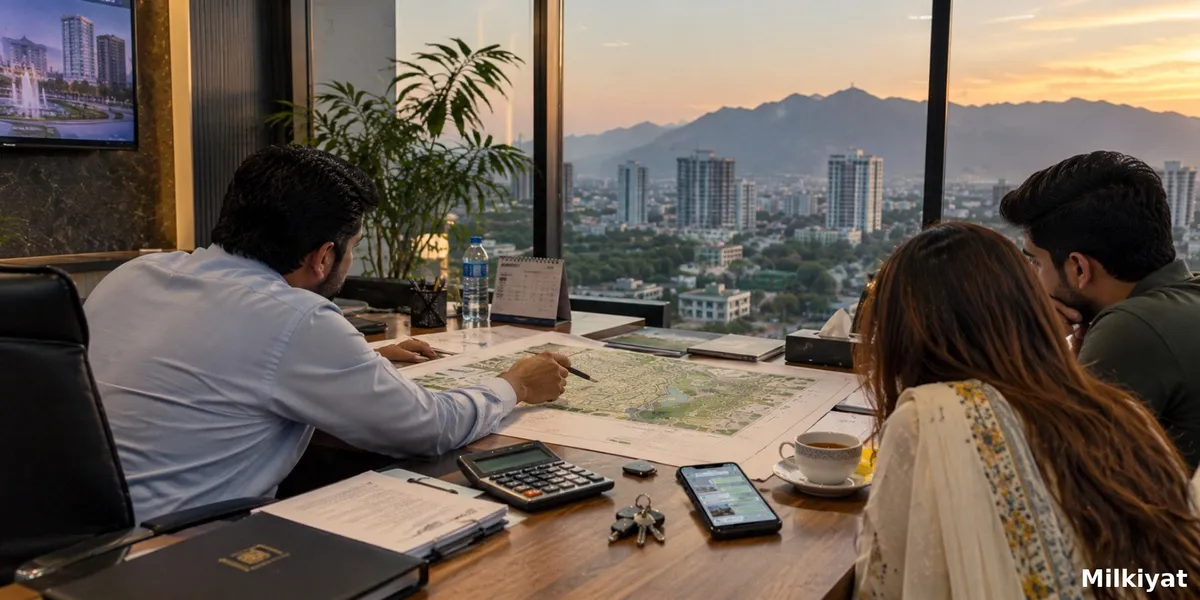
Behind a typical plot, house or rental deal in Pakistan stands a property dealer: a small office, a phone full of WhatsApp groups and a receipt book for token money. The job needs no degree, but a real estate agent in Pakistan is no longer unregulated. Since 2020 the Federal Board of Revenue (FBR) has supervised agents under anti-money-laundering law, and from 1 July 2026 the advance taxes they explain on every deal fell to 1.25% for buyers and 2.75% for sellers who are active filers.
This guide covers the profession from both sides. It explains how agents actually work and earn in Islamabad, Rawalpindi, Lahore and Karachi, and how buyers can tell a good agent from a risky one. Every rupee figure is calculated in the open.
Looking for an agent now? Browse Milkiyat's directory of KYC-approved real estate agents by location, property type and deal type, or go straight to verified real estate agents in Islamabad. Then use the checklist in this guide before you pay anyone.
Disclosure: Milkiyat.com is commission-free and buyer-first. Agents and agencies can list properties and buy placements on Milkiyat; none paid to be included in this guide.
Key facts
| Question | Short answer (October 2026) |
|---|---|
| What is a property dealer? | A commission agent who arranges property sales, purchases and rentals |
| Is a license required? | No single national license; FBR DNFBP registration is required to deal with societies and authorities, and some regions (such as Khyber Pakhtunkhwa) require estate agent registration |
| Usual sale commission | About 1% from the buyer and 1% from the seller |
| Usual rental commission | Half to one month's rent per side, depending on the city |
| Main regulator | FBR, under the Anti-Money Laundering Act 2010 (amended 2020) |
| Advance tax for active filers, 2026-27 | 1.25% for the buyer (Section 236K), 2.75% for the seller (Section 236C) |
| Typical income | Irregular; a solo dealer's good month can clear about Rs 200,000 net (Milkiyat model) |
| Biggest buyer risk | Files sold for land a developer does not own, and token money paid without a receipt |
What does a real estate agent or property dealer do in Pakistan?
A real estate agent finds the other side of a property deal and keeps it together until the transfer is complete. In Pakistan the same person may be called a property dealer, estate agent, realtor, broker or property consultant. The names reflect branding, not different legal status. Real estate agent meaning in Urdu: پراپرٹی ڈیلر (property dealer) or جائیداد کا ایجنٹ (jaidad ka agent), someone who arranges property deals for a commission.
The core jobs are the same in every city:
- Collect inventory (plots, houses, files, apartments, shops and rentals) from owners and other dealers.
- Match it to buyers and tenants, arrange viewings and negotiate the price.
- Take and receipt token money (bayana), and coordinate the sale agreement.
- Run the paperwork at the housing society, development authority or revenue office until transfer.
- Collect commission, usually at transfer.
Under Section 184 of the Contract Act 1872, any adult of sound mind can act as an agent. That low barrier explains why the trade ranges from multi-office consultancies to a single desk outside a society gate.
Types of real estate agents in Pakistan
| Type | What they do | Typical market |
|---|---|---|
| Society-based dealer | Works one society or sector, street by street | DHA, Bahria Town, CDA sectors |
| File trader | Buys and sells allocation files, often on their own account | New launches and open-form schemes |
| Project sales agent | Sells off-plan apartments and plots for a developer | High-rise projects in all major cities |
| Rental agent | Finds tenants and handles advance, security and agreements | Islamabad sectors, Lahore, Karachi |
| Commercial broker | Deals in shops, offices, plazas and warehouses | Business districts such as Blue Area, Islamabad |
| Agency or consultancy | Runs an office with staff agents, portal listings and marketing | All large cities |
| Overseas desk | Serves buyers abroad, often through power of attorney | DHA, Bahria Town and CDA transfers |
Real estate agent vs property dealer vs broker
In everyday use, "property dealer" suggests a small local office, while "real estate agent" and "consultant" are what larger firms use to signal professionalism. Legally, they are the same thing. The distinction that matters to a buyer is different: is the person acting as your agent for a fee, or selling to you as the owner?
A file trader selling his own stock is a seller, not your adviser.
A day in the life of a property dealer
A dealer's day runs late, lives on WhatsApp and is spent more in the car than at the desk. The office is where clients meet over tea and files are kept; the deals themselves move through phone groups, site visits and transfer counters.
| Time | What happens |
|---|---|
| 10am to 12pm | Clear WhatsApp: society groups post fresh inventory, buyer "demand" and rate moves. Repost listings to portals and client lists. |
| 12pm to 3pm | Site visits. Buyers check street width, park-facing and corner status; rental clients see three houses in an hour. |
| 3pm to 6pm | Verification and paperwork: transfer office checks, dues and NDC status, token receipts and agreement drafts. |
| 6pm to 10pm | Negotiation. Most buyer and seller meetings happen after office hours, often in the dealer's office. |
| Weekends | Family viewings, overseas clients in other time zones, and launch events for new projects. |
What the job really feels like:
- Income comes in lumps. Weeks can pass without a closing; then one transfer pays for a quarter.
- Trust is the business. Most deals come from referrals and repeat investors, and one bad deal spreads through WhatsApp groups within a day.
- Clients bypass you. A buyer who sees a plot through one dealer may try to reach the owner directly. Written commission terms are the only protection.
- The market sets the mood. Tax changes, valuation notices and society announcements can freeze or flood a market overnight.
How a property deal works, step by step
A clean resale in an established society usually closes in one to three weeks. A deal involving inheritance, a disputed file or a mortgage can take months. A good agent's value is knowing which step can go wrong and checking it before money moves.
- Inquiry and shortlist. The buyer's budget, area and timeline are matched to available inventory. Many buyers now arrive having already browsed listings online, such as houses for sale in Islamabad, and ask the agent to verify and negotiate.
- Site visit. Location, size, orientation, development and neighbourhood are checked in person. Sizes are quoted in marla and kanal; Milkiyat's area unit converter turns them into square feet.
- Negotiation. Price, payment schedule and who pays which fees are agreed.
- Token money (bayana). A deposit secures the deal. It should be receipted, paid by bank instrument where possible, and backed by written refund and forfeit terms.
- Document verification. Title, allotment or transfer letters, dues and the no-demand certificate (NDC) are confirmed at the source, not from photocopies.
- Sale agreement (iqrarnama). It sets the price, part payment, deadlines and what happens if either side defaults.
- Tax calculation. The buyer pays advance tax under Section 236K and the seller under Section 236C, plus stamp duty and transfer fees.
- Transfer. Both parties appear at the society, development authority or, for revenue land, the sub-registrar, with biometric verification.
- Final payment and possession. The balance is paid and possession documents are handed over.
- Commission. It is usually paid at transfer, sometimes partly at the token stage, as agreed in writing.
Steps 4 and 5 are where most losses happen: money changes hands before the property is verified. A complete token receipt is the simplest protection. Milkiyat's sample format below lists every field it should carry.
Property dealer commission rate in Pakistan
The market norm on a sale is about 1% of the price from the buyer and 1% from the seller. When each side has its own dealer, each keeps the 1% from their own client. No law fixes the rate. It is custom, and it is negotiable.
| Deal type | Customary commission | What to watch |
|---|---|---|
| Residential sale | About 1% from the buyer and 1% from the seller | Agree whether it is due at the token stage or at transfer |
| Commercial sale | Often quoted at 2% per side | Larger amounts and longer deals; always put it in writing |
| Rental in Islamabad | Half a month's rent per side; some charge a full month | Varies by property and agreement |
| Rental in Lahore | Usually one month's rent | Half to one month is common |
| Rental in Karachi | One month's rent from each side | Some areas charge the tenant only |
| Developer project sales | A fixed percentage paid by the developer | The buyer usually pays nothing directly, so ask |
These norms come from market guides published by milkiyat.com and from dealer practice. Treat them as customs, not legal rates.
Milkiyat.com finding: what one Rs 2 crore sale pays the dealer
A house sold for Rs 20,000,000 through a single dealer:
- Buyer's 1%: 20,000,000 × 0.01 = Rs 200,000
- Seller's 1%: 20,000,000 × 0.01 = Rs 200,000
- Total commission: Rs 400,000. With two dealers, one per side, each earns Rs 200,000.
Milkiyat.com finding: the same rent, double the fee
A house renting at Rs 150,000 a month:
- Islamabad, at half a month per side: 75,000 × 2 = Rs 150,000 in total commission
- Karachi, at one month per side: 150,000 × 2 = Rs 300,000 in total commission
The city's custom changes the fee as much as the property does. Before you sign, compare asking rents for similar units, for example apartments for rent in Islamabad, so the commission is calculated on a fair rent.
What a property dealer commission agreement should include
A one-page written agreement prevents most commission disputes. It should state:
- The names and CNIC numbers of the dealer and the client
- The property, identified by society, block and plot or house number
- The commission rate or fixed amount, and who pays it
- When it becomes due: at token, at transfer, or split between them
- Whether another dealer shares the commission, and in what proportion
- What happens to the commission if the deal fails or the client buys directly after a viewing
- The dealer's FBR DNFBP registration number
The commission you do not see: "top"
Some dealers charge no open commission at all. Instead, they buy from the seller at one price and sell to the buyer at a higher one, keeping the gap. In the trade this is called "top". It is legitimate when the dealer is openly the seller, and a breach of trust when he claims to be your agent. Ask directly: are you representing me, or selling to me?
Property dealer salary and income per month in Pakistan
A steady mid-market dealer can earn a solid middle-class income, but the first year is thin and market swings hit hard. There is no reliable survey of property dealer earnings in Pakistan, so the figures below are a worked model, not an average.
Milkiyat.com finding: a model month for a solo Islamabad dealer
Assumptions: two house rentals a month at Rs 100,000 rent; one Rs 1.5 crore sale every two months; office, fuel, staff and advertising costs of Rs 150,000 a month.
- Rentals, at half a month per side: 2 × (50,000 × 2) = Rs 200,000
- Sales, at 1% per side: (15,000,000 × 2%) ÷ 2 months = Rs 150,000 a month
- Gross income: 200,000 + 150,000 = Rs 350,000 a month
- After costs: 350,000 − 150,000 = about Rs 200,000, before income tax
- A month without the sale: 200,000 − 150,000 = Rs 50,000
That swing, Rs 200,000 one month and Rs 50,000 the next, is the reality of the job.
A better way to estimate your own income
Instead of asking what an average dealer earns, work through five numbers for your own market:
- How many qualified leads can you realistically generate each month?
- What share of those leads turns into completed deals?
- What commission is agreed and actually collected per deal?
- What does it cost to close those deals: office, transport, advertising, staff?
- How much is left after costs, taxes and any agency split?
Those five numbers give a far more useful estimate than any headline figure for "property dealer salary in Pakistan".
How real estate agents are paid
| Model | How it works | Best suited to |
|---|---|---|
| Independent dealer | Keeps the full commission and carries all costs | Experienced agents with a client base |
| Agency agent on commission | Splits commission with the agency, which provides office, leads and brand | Newcomers learning the trade |
| Salaried sales agent | Fixed pay plus incentives; most real estate agent jobs in Pakistan advertised by developers follow this model | People who need predictable income |
| Investor-dealer | Trades their own inventory and earns on price gains | Agents with capital who can carry market risk |
Commission splits and salaries vary widely between firms. Agree them in writing before your first deal.
The career path
- Junior agent in an agency, learning transfers and paperwork
- Independent dealer specialising in one society or sector
- Agency owner with staff agents and portal accounts
- Project marketing partner for developers, or investor-dealer
- Consultant offering valuation, portfolio advice and overseas client services
Four dealer profiles: what the job looks like in practice
About these profiles: each one is a composite built from common market practice and the commission norms in this guide. They are not real individuals, and no quotes are attributed to anyone. Figures are illustrative.
Composite profile 1: the newcomer at an Islamabad agency
In the first year, a junior agent mostly handles apartment rentals, because sales go to senior agents. A typical month: three apartment rentals at Rs 80,000 rent.
- Commission per deal, at half a month per side: 40,000 × 2 = Rs 80,000
- Three deals: 80,000 × 3 = Rs 240,000 to the agency
- Agent's share, at an illustrative 50:50 split: Rs 120,000
- Less own fuel and phone costs of Rs 25,000: about Rs 95,000 a month
The lesson: year one pays for the training, not the career. Rentals teach paperwork, tenant checks and negotiation with low stakes.
Composite profile 2: the established DHA Lahore dealer
Twelve years in one society, an office with two staff, and a network of repeat investors. On average, one Rs 3.5 crore house sale a month.
- Commission per sale, at 1% per side: 35,000,000 × 2% = Rs 700,000
- Less office rent, two salaries and advertising of Rs 300,000: about Rs 400,000 in an average month
- In a slow quarter with one sale in three months: 700,000 − (300,000 × 3) = a loss of Rs 200,000
The lesson: high earnings depend on volume. Fixed costs keep running when the market freezes, so established dealers keep reserves.
Composite profile 3: the Karachi rental specialist
Works apartment buildings in one neighbourhood, where one month's rent from each side is the norm. A typical month: four rentals at Rs 45,000 rent.
- Commission per deal: 45,000 × 2 = Rs 90,000
- Four deals: 90,000 × 4 = Rs 360,000
- Less a shared office, motorbike and online ads at Rs 120,000: about Rs 240,000 a month
The lesson: rentals give steadier income than sales, but disputes over advance, security deposits and police verification take up much of the agent's time.
Composite profile 4: the Rawalpindi file trader
Buys files at a new scheme's launch and sells them at a premium, acting as a principal rather than an agent. In a hot month: ten files sold at Rs 150,000 premium each.
- Gross gain: 150,000 × 10 = Rs 1,500,000
- Then the scheme's approval is questioned and demand stops. Holding ten unsold files bought at Rs 1,200,000 each ties up 1,200,000 × 10 = Rs 12,000,000 that cannot be sold at cost.
The lesson: file trading can earn the most and lose the most. Buyers dealing with a file trader are buying from a seller, not hiring an adviser, so they must verify the scheme's approval and land ownership themselves.
Property dealer license and registration in Pakistan
There is no single national license for real estate agents in Pakistan, but that does not mean agents are unregulated. Several layers of rules apply: contract law, the FBR's anti-money-laundering regime, provincial registration laws for estate agents, provincial taxes on services and professions and, in Islamabad, a 2020 regulatory act.
| Rule | What it requires of agents |
|---|---|
| Contract Act 1872, Section 184 | Any adult of sound mind may act as an agent, with duties of loyalty and disclosure to the client |
| Anti-Money Laundering Act 2010, amended in September 2020 | Registration with the FBR as a DNFBP, customer due diligence, sanctions-list screening and suspicious transaction reports |
| FBR condition on transferring bodies | Development authorities and housing societies may not process transfers through an agent who is not registered as a DNFBP |
| Islamabad Real Estate (Regulation and Development) Act 2020 | Agents must register with the Islamabad authority and quote their registration number on every deal; check with the authority whether registration has opened |
| Provincial sales tax on services | Registration with the provincial revenue authority (PRA, SRB, KPRA, or the FBR for Islamabad) and returns on commission income; rates vary by province |
| Khyber Pakhtunkhwa Real Estate Agents and Motor Vehicles Dealers (Regulation of Business) law | Registration certificate from the District Excise and Taxation Officer before doing business, renewed every year; the government may set a maximum commission, and breaches can bring suspension, fines or imprisonment of up to six months |
| AJK Real Estate Agent and Motor Vehicles Dealers (Regulation of Business) Act 1986 | Registration for agents working in Azad Jammu and Kashmir, with record-keeping duties |
| Islamabad excise registration | Islamabad's Excise and Taxation Department has run registration drives for estate agencies and property offices |
| Punjab professional tax | Property dealers are listed among professions assessed for professional tax under the Punjab Finance Act 1977 |
The FBR DNFBP regime, in plain words
In September 2020, amendments to the Anti-Money Laundering Act made the FBR the regulator for real estate agents. The law classes agents as "Designated Non-Financial Businesses and Professions" (DNFBPs). Dawn later reported that the FBR was imposing heavy fines on agents who refused to register.
The FBR then told development authorities and housing societies not to process transfers through unregistered agents. It also launched a mobile app for registration, sanctions-list screening and suspicious-transaction reporting, according to an FBR press release. In 2023, penalty regulations (SRO 290(I)/2023) set out fines for agents who skip due diligence or fail to report.
For a working dealer, that means four routine duties:
- Register on the FBR DNFBP portal and keep the registration certificate.
- Identify clients and beneficial owners: CNIC, and source of funds for large deals.
- Screen clients against proscribed and designated persons lists.
- Report suspicious transactions to the Financial Monitoring Unit and keep records.
What the law does not do
No law sets the commission rate, requires training or an exam, or gives buyers a compensation fund if a dealer disappears. That gap is why checking an agent matters more in Pakistan than in regulated markets such as Dubai or the UK.
Property taxes every agent must explain in 2026-27
From 1 July 2026, the Finance Act 2026 replaced value-based slabs with flat rates for active filers: 1.25% from the buyer under Section 236K and 2.75% from the seller under Section 236C. The News reported these as cuts from earlier tiered ranges of 1.5% to 2.5% for buyers and 4.5% to 5.5% for sellers.
| Tax or charge | Paid by | Active filer rate, tax year 2027 | Note |
|---|---|---|---|
| Advance tax, Section 236K | Buyer | 1.25% | Non-filers pay substantially higher rates |
| Advance tax, Section 236C | Seller | 2.75% | The separate "late filer" category was removed |
| Stamp duty | Buyer | Set by each province | Varies by province and property type |
| Registration, mutation and transfer fees | Buyer and/or seller | Fixed or by schedule | Varies by authority or society |
| Capital gains tax | Seller | Depends on holding period and purchase date | Refer clients to a tax adviser |
Taxes are charged on the FBR or DC valuation, which can differ from the agreed price. Milkiyat's property tax and transfer cost guide explains the wider set of charges.
Milkiyat.com finding: the 2026-27 cut on a Rs 2 crore deal
At a valuation of Rs 20,000,000, with both parties on the Active Taxpayers List. Under the old slabs, a property of this value paid the lowest rates: 1.5% for the buyer and 4.5% for the seller.
- Buyer, before: 20,000,000 × 1.5% = Rs 300,000. Now: 20,000,000 × 1.25% = Rs 250,000
- Seller, before: 20,000,000 × 4.5% = Rs 900,000. Now: 20,000,000 × 2.75% = Rs 550,000
- Combined: Rs 800,000 now, against Rs 1,200,000 before. That is a saving of Rs 400,000, or one third.
Milkiyat.com finding: what each side pays on top of a Rs 2 crore deal
Adding commission at 1% per side to the new advance tax, before stamp duty and transfer fees:
- Buyer: 200,000 commission + 250,000 advance tax = Rs 450,000, or 2.25% of the price
- Seller: 200,000 commission + 550,000 advance tax = Rs 750,000, or 3.75% of the price
A good agent shows both sides these rupee figures before token money changes hands, because filer status alone can change the cost of a deal.
How to become a property dealer in Pakistan
You can start without a degree, but not legally without an NTN and FBR DNFBP registration, and not successfully without one area you know better than anyone. Expect three to six months before deals arrive steadily.
- Pick a patch. Choose one society, sector or town and learn it street by street: rates, phases, possession, dues, development and approval status.
- Start inside an agency. Six to twelve months as a junior agent teaches transfers, negotiation and documentation. Agree your commission split in writing first. Milkiyat's agency directory shows established firms by location and specialisation.
- Get an NTN and stay a filer. Clients ask about filer status because it changes their own tax bill, and you will need it for your own returns.
- Register with the FBR as a DNFBP. Without it, societies and authorities may refuse to process transfers through you.
- Register with your province. Register for sales tax on services where your office operates: PRA in Punjab, SRB in Sindh, KPRA in Khyber Pakhtunkhwa, or the FBR for Islamabad. In Khyber Pakhtunkhwa, also get an estate agent registration certificate from the District Excise and Taxation Officer and renew it every year. In Punjab, property dealers are assessed for professional tax.
- Set up your paperwork. Letterhead, a numbered receipt book for token money, a standard commission agreement and a client file template.
- Join the local association for credibility, shared inventory and help with disputes.
- Build a digital presence. Portal listings, a Google Business Profile, a WhatsApp Business catalogue and short video walkthroughs.
- Learn each authority's transfer procedure. CDA, RDA, LDA, DHA, Bahria Town and private societies each have their own forms, fees and turnaround times.
Start-up costs to plan for:
- Office rent and advance in a market or society commercial area, unless you start from home
- Furniture, signboard, printer and stationery
- Portal subscriptions and social media advertising
- Transport and fuel for site visits
- Three to six months of living costs while the first deals close
For agents: get listed on Milkiyat
Milkiyat's agent directory lets buyers filter agents by location, residential or commercial work, and sale or rental deals. Each profile shows ratings, active listings, years of experience and working areas. Agents can sign in to the agent portal to add listings, and agencies appear in the separate agency directory.
Skills and tools every agent needs
The agents who last pair local knowledge with document discipline. Charm closes one deal; verification habits close the next twenty.
Core skills
- Market reading: block-by-block rates, which phases have possession, and which files are overpriced.
- Document literacy: allotment and transfer letters, NDC, fard and registry for revenue land, inheritance mutations and power of attorney.
- Negotiation: holding both sides to a price while keeping the deal alive.
- Tax literacy: explaining 236C, 236K, stamp duty and filer status in rupees, not percentages.
- Compliance: CNIC checks, source-of-funds questions and sanctions-list screening.
- Communication: in Urdu, English and local languages, including with overseas clients in other time zones.
The tool stack
| Tool | What agents use it for |
|---|---|
| WhatsApp groups and WhatsApp Business | Inventory sharing, client updates and catalogues, the market's real trading floor |
| Property portals and directories | Listings, leads and a public profile, for example a listing among property dealers on Milkiyat |
| Facebook groups, Instagram and TikTok | Society-specific audiences and video tours |
| Google Business Profile | "Property dealer near me" searches and reviews |
| Society and authority portals | Dues, transfer status and verification (DHA, Bahria Town, CDA, LDA, PLRA land records) |
| Spreadsheet or CRM | Leads, follow-ups and commission receivables |
| FBR IRIS and the DNFBP app | Tax filing, registration and reporting |
How buyers now search: Google and AI apps
More buyers now start with an AI assistant, asking questions like "best property dealer in DHA Lahore", "is this society approved?" or "how much commission should I pay?". These answers draw on pages that state facts plainly, with numbers, dates and sources. Agents who publish specific, checkable information, such as society rates, transfer steps and honest fee terms, are the ones these answers surface.
Property dealers in Islamabad, Lahore, Karachi and Rawalpindi
The title is the same, but the job is not. A DHA Karachi house broker and a file trader in a new Rawalpindi scheme work in different markets with different risks.
| Segment | How agents work it | Main risk for the client |
|---|---|---|
| Established societies (DHA, Bahria Town, CDA sectors) | Transfer-based deals at society or authority offices | Overpricing and undisclosed dues |
| Plots, files and new launches | Trading developed plots, and allocation files before plots are identified | Files sold beyond land owned; no possession |
| Apartments, ready and off-plan | Resale units and project sales on developer commission | Delays, missing approvals and layout changes |
| Revenue land (fard and registry) | Patwari records, mutation and registry at the sub-registrar | Title disputes, inheritance claims and forged fard |
| Rentals | Viewings, agreements and tenant police verification | Disputes over advance and security deposits |
| Commercial | Shops, offices and plazas for yield-focused buyers | Use violations and commercialisation fees |
Islamabad shows how big each segment is. In October 2026, Milkiyat carried more than 3,000 plots for sale in Islamabad, against about 100 apartments for sale in Islamabad. That is why so many of the city's dealers specialise in plots and files rather than apartments.
City by city
- Islamabad: CDA sectors sit beside private societies such as DHA Islamabad and Bahria Town, each with its own transfer route. Half a month's rent per side is a common rental fee. Compare property dealers in Islamabad by local listings and ratings, and see the Islamabad property guide.
- Rawalpindi: RDA-approved and unapproved schemes trade side by side, and the Ring Road corridor drives file activity, so approval checks come first. See the Rawalpindi property guide.
- Lahore: DHA and Bahria Town Lahore dominate secondary trading; LDA approval status is the first check on any other scheme. See Milkiyat's page for property dealers in Lahore and the Lahore property guide.
- Karachi: DHA, Bahria Town Karachi, Scheme 33 and high-rise apartments; SBCA approvals matter for buildings, and one month's rent per side is the rental norm. See Milkiyat's page for real estate agents in Karachi and the Karachi area guide.
- Peshawar and smaller cities: more revenue land and fewer structured societies, with heavier reliance on personal networks. For other cities, use the location filter to find a real estate agent in Pakistan who works your area.
Red flags: how buyers get misled
The trade's reputation problem is real, and most of it traces to a handful of repeat practices. In May 2026 the Consumers Association of Pakistan warned that many developers were selling projects without legal ownership of the land, as The News reported. Dealers are often the ones selling those files.
Find a property dealer by area or society in Islamabad
In Islamabad, the best agent is usually the one who works your exact sector or society. A dealer who closes deals in F-10 every month knows its street-by-street rates, which houses have been on the market too long, and how the CDA transfer process works there. A dealer from across the city does not. Start with a city-wide shortlist of real estate agents in Islamabad, then narrow it to agents who work the area you want.
CDA sectors and private societies work differently
Islamabad has two kinds of property market, and the agent's job is different in each.
| CDA sectors (F, E, G, I and D series) | Private housing societies | |
|---|---|---|
| Who handles the transfer | The Capital Development Authority (CDA) | The society's own transfer office |
| What the agent must know | CDA transfer steps, sub-sector rates, lease and building rules | Society by-laws, transfer fees, phase and block status |
| What the buyer must check | Ownership and dues with CDA | The society's approval status with the relevant development authority, plus ownership and dues with the society |
Find agents by sector
| Sector | What buyers there usually look for | Find agents |
|---|---|---|
| F-6 | Established central sector with large older houses | Property dealers in F-6 |
| F-7 | Central sector around Jinnah Super Market; high-end houses and rentals | Real estate agents in F-7 |
| F-8 | Central sector that includes the district courts area; houses and offices | Property dealers in F-8 |
| F-10 | Family residential sector with houses and apartment blocks | Property dealers in F-10 |
| F-11 | Newer F-series sector with houses and apartment projects | Real estate agents in F-11 |
| E-11 | Mix of cooperative society blocks and private apartment buildings | Property dealers in E-11 |
| G-11 | Mid-market residential sector popular with families | Real estate agents in G-11 |
| G-13 | Mid-market sector with houses and apartment buildings | Property dealers in G-13 |
| I-8 | Residential sector beside the I-9 industrial area | Real estate agents in I-8 |
| D-12 | Newer sector at the foot of the Margalla Hills; plots and new houses | Property dealers in D-12 |
| Blue Area | Islamabad's commercial centre: offices, shops and apartments | Commercial property agents in Blue Area |
In sectors such as E-11, some blocks belong to cooperative housing societies rather than CDA. Ask the agent which body handles the transfer for the exact plot or house, and confirm it yourself before paying token money.
Find agents by housing society
| Society | What to know before you buy | Find agents |
|---|---|---|
| Park View City Islamabad | Private society with plots, houses and commercial projects; see Milkiyat's Park View City guide | Park View City agents |
| DHA Phase 2 Islamabad | Transfers run through DHA's own office; know the sector and plot number before you call | Property dealers in DHA Phase 2 |
| Bahria Town Islamabad | Large private society with many phases; transfers through Bahria Town's office | Real estate agents in Bahria Town Islamabad |
| Bahria Enclave | Separate Bahria project with its own sectors and transfer process | Bahria Enclave agents |
| Gulberg Greens | Farmhouses and residential blocks; check the block and its development status | Property dealers in Gulberg Greens |
| Faisal Hills | Plot and file market; confirm approval, possession and dues before paying | Faisal Hills agents |
| Blue World City | Plot and file market; confirm approval, land ownership and possession before paying | Blue World City agents |
If an area page has no agents listed yet, browse all real estate agents in Islamabad and filter by the agents' working areas, or search the national agent directory.
Five questions to ask an area specialist
- How many deals have you closed in this sector or society in the past year?
- What did similar plots or houses on this street actually sell for, not just their asking prices?
- Which office handles the transfer here, and how long does it usually take?
- Do you own any inventory in this area yourself, or are you acting only as my agent?
- What problems have you seen with properties here: disputed files, unpaid dues, undeveloped blocks?
A genuine area specialist answers these from memory and with examples. Vague answers, or pressure to pay token money before you have checked anything, are a sign to keep looking.
Area agents: frequently asked questions
How do I find a property dealer in F-10 or F-11, Islamabad?
Start with Milkiyat's pages for property dealers in F-10 and real estate agents in F-11, which show agents with active listings in those sectors. Shortlist two or three, ask how many deals they have closed in the sector, and verify ownership and dues with CDA before paying.
Is it better to use an agent who works one society only?
Usually, yes. An agent who works one society, such as Park View City or DHA Phase 2, knows its transfer office, block-by-block rates and history of disputes. Generalists can still help, but they rely more on other dealers' information.
Do I need a different agent for CDA sectors and private societies?
Not necessarily, but the agent must know the right transfer process. CDA sectors transfer through CDA, while private societies transfer through their own offices. Ask which process applies before you agree on commission.
Risks the agent carries
- FBR penalties for missing DNFBP registration, due diligence or suspicious-transaction reports.
- Criminal liability for knowingly handling forged documents, under the Pakistan Penal Code's provisions on forgery, cheating and criminal breach of trust.
- Civil claims when they misstate title, dues or approval status.
The Milkiyat standard for a trustworthy dealer
One client per deal, or full written disclosure if both sides pay. Every token payment receipted with refund terms. Every document verified at its source before the client pays. A dealer who meets this standard is worth the commission.
How to find the best real estate agent in Pakistan
Start with a shortlist of agents who work your area, then check each one before any money moves. A genuine agent welcomes every check below; a risky one finds reasons to skip them.
Step 1: Shortlist agents on Milkiyat
Milkiyat's agent directory lists more than 2,600 KYC-approved agents across Pakistan (October 2026). You can filter by location, residential or commercial property, and sale, rent or both. Each profile shows:
- Ratings and reviews from clients
- Number of active listings
- Years of experience
- Working areas and city
- Agency, where the agent belongs to one
- A WhatsApp button to contact the agent directly
Searching in one city? Milkiyat also has city pages for agents in Islamabad, Lahore and Karachi. On the Islamabad page, each agent shows a "Verified" badge, a count of local listings and, where clients have left them, ratings.
Prefer to deal with a firm? The agency directory lists agencies by location and specialisation.
Verified agent vs licensed agent: what each check means
They are different checks:
| Check | What it tells you | What it does not tell you |
|---|---|---|
| Marketplace verification (such as Milkiyat KYC) | Who the agent is | Whether a specific property is safe |
| FBR DNFBP registration | The agent is registered under anti-money-laundering rules | Anything about the property |
| Provincial estate agent registration (e.g. Khyber Pakhtunkhwa) | The agent holds a statutory registration where it is required | Anything about the property |
| Property verification at the society, authority or PLRA | The title, dues and approval status of the property | Anything about the agent |
You need the agent checks and the property check. One never replaces the other.
Step 2: Check the agent before you pay
- Ask for the FBR DNFBP registration certificate and NTN.
- Visit the physical office; check association membership if the agent claims it.
- Ask directly: "Are you representing me, the seller, or yourself?"
- Agree the commission in writing: the rate, who pays and when.
- Get every token payment receipted, with refund and forfeit terms.
- Verify the property at its source: the society or authority transfer office, PLRA for revenue land, and approval status with CDA, RDA, LDA or SBCA.
- Check dues and NDC status yourself, not only through the dealer.
- Pay by bank instrument, not cash, wherever you can.
- Read reviews and call two past clients.
- Walk away from any pressure to pay before documents are checked.
For overseas Pakistanis
Never give a general power of attorney to a dealer. If you need one, give a specific, time-limited power of attorney to a family member or lawyer, and confirm every payment directly with the society or authority.
If something goes wrong
Keep every receipt, message and agreement. Complaint routes include the police, the Federal Investigation Agency for fraud, consumer courts, the society or authority's complaint cell, and the FBR for agents working without DNFBP registration.
The future of real estate agents in Pakistan
The dealer who thrives over the next five years will be paid for judgement and verification, not for access to a WhatsApp group. Four forces are pushing the trade that way.
- Lower transaction taxes. The 2026-27 flat rates for filers are meant to revive a market The News described as semi-frozen since the 2022 valuation reforms. More volume means more deals, but also more competition.
- Digitisation. Punjab's chief minister has directed that housing society approvals, administration and property transfers move fully online, as APP reported. That removes the dealer's role as a paperwork runner.
- Regulatory pressure. Consumer groups are calling for nationwide regulation along the lines of Dubai's property laws, and FBR enforcement of anti-money-laundering rules continues.
- AI search. Buyers increasingly get their first answers from AI apps, which reward agents and publishers who state verified facts.
Glossary of Pakistani property terms
| Term | Meaning |
|---|---|
| Property dealer | Common Pakistani term for a real estate agent |
| Bayana | Token money paid to secure a deal |
| Iqrarnama | Sale agreement setting price, payments and deadlines |
| File | A right to a future plot in a housing scheme, before a specific plot is allotted |
| Allotment letter | A document assigning a specific plot to a buyer |
| NDC | No-demand certificate confirming no dues are outstanding |
| Fard | Revenue record extract showing land ownership |
| Intiqal (mutation) | Change of ownership in revenue records |
| Registry | Sale deed registered with the sub-registrar |
| DNFBP | Designated Non-Financial Business or Profession, the FBR's category for real estate agents |
| Filer | A person on the FBR's Active Taxpayers List, who pays lower advance tax |
| Marla and kanal | Land units; Milkiyat's converter uses 1 marla = 225 sq ft and 1 kanal = 20 marla |
Frequently asked questions
What is the property dealer commission rate in Pakistan?
About 1% of the sale price from the buyer and 1% from the seller. Rentals usually cost half a month's rent per side in Islamabad and one month's rent per side in Karachi; Lahore is typically one month.
Who pays the property dealer, the buyer or the seller?
Usually both, about 1% each, unless agreed otherwise in writing. In developer project sales, the developer normally pays the agent.
Do you need a license to become a property dealer in Pakistan?
There is no single national license, but registration rules apply. You need an NTN and FBR registration as a DNFBP, plus provincial tax registration. Some regions also require registration as an estate agent: Khyber Pakhtunkhwa requires an annual certificate from the Excise and Taxation Department, AJK has its own act, and Islamabad's 2020 act requires registration with its regulatory authority.
What is DNFBP registration for real estate agents?
It is registration with the FBR under the Anti-Money Laundering Act. Registered agents must check client identity, screen sanctions lists and report suspicious deals. Housing societies and authorities may refuse transfers through unregistered agents.
What is a property dealer's salary or income per month in Pakistan?
Income is irregular. Milkiyat's worked model of a solo Islamabad dealer shows about Rs 200,000 net in a good month and about Rs 50,000 in a month without a sale.
What are the property taxes in Pakistan for 2026-27?
Active filers pay 1.25% as buyers under Section 236K and 2.75% as sellers under Section 236C, plus provincial stamp duty and transfer fees. Non-filers pay substantially higher rates.
How can I find the best real estate agent near me?
Shortlist agents who work your area in Milkiyat's directory of KYC-approved agents, then ask for their FBR DNFBP certificate and NTN, agree commission in writing, receipt every payment and verify the property directly with the society or authority.
What is the meaning of real estate agent in Urdu?
A real estate agent is called پراپرٹی ڈیلر (property dealer) or جائیداد کا ایجنٹ in Urdu: a person who arranges the sale, purchase or rental of property in return for a commission.
Is a verified agent the same as a licensed agent?
No. Marketplace verification confirms who the agent is. FBR DNFBP registration and, where required, provincial registration are legal obligations. Neither verifies a particular property, which must be checked with the society, authority or PLRA.
Is it safe to buy a property file through a dealer?
Only after the developer and the approving authority confirm that the scheme is approved and owns the land. Files sold beyond owned land are the market's biggest fraud risk.
Can a property dealer take token money?
Yes, but token money (bayana) should be receipted, paid by bank instrument where possible, and backed by written refund and forfeit terms.
Is real estate a good career in Pakistan?
It can be, for people who can live with irregular income, specialise in one area and build trust over years. It rewards local knowledge and verification discipline more than sales talk.
Find a real estate agent you can check
Milkiyat lists more than 2,600 KYC-approved agents and 20+ agencies across Pakistan. Filter by city, property type and deal type, compare ratings and experience, then contact agents directly on WhatsApp. Buying in the capital? Start with real estate agents in Islamabad. Use the checklist above before you pay anyone.
Disclaimer
This guide is for general information and does not constitute legal, tax, financial or investment advice. Registration, tax and anti-money-laundering requirements vary by province, business structure and activity, and change over time. Commission figures describe market customs, not legal rates. Property details, approvals, ownership and dues must be confirmed with the relevant authority, society and qualified professionals before any payment. Nothing in this guide guarantees property appreciation, rental income or investment returns.
Sources
- Dawn: FBR fines real estate agents under the DNFBP regime
- FBR: DNFBP actions and mobile app
- APP: Punjab to move housing society transfers online
- Khyber Pakhtunkhwa Excise and Taxation: registration of real estate agents
- AJK Real Estate Agent and Motor Vehicles Dealers Act 1986
- Islamabad Real Estate (Regulation and Development) Act 2020 (FAOLEX)
About the author
Wajahat Ali is the editor, lead researcher and primary author at Milkiyat.com, an independent real estate research platform covering the Islamabad–Rawalpindi market and expanding into Lahore and Karachi. Milkiyat's guides show every calculation and cite primary sources, under the platform's principle: Know before you own.