Blog
G-13 vs G-14 Islamabad: Allotment-to-Possession Timeline Compared

Blog
Blog
Real Estate Analyst
6 min read
For an allottee, getting the plot allotment letter is the easy part. The real waiting starts after that, through infrastructure development, built-up-property surveys, a provisional handover, and finally a possession letter that actually lets you break ground. G-13 and G-14, both developed by the Federal Government Employees Housing Authority (FGEHA) rather than CDA directly, show how differently that timeline can play out depending on when a sector launched and how well its development was managed along the way.
| Factor | G-13 (FGEHA Phase-III) | G-14 (FGEHA Phase-IV) |
|---|---|---|
| Launch year | 1996 | 2004 |
| Sub-sectors covered |
F-5 is enclosed by four of Islamabad's most significant roads, and each edge sets a different part of its value. This guide maps all four boundaries, corrects the widely repeated claims about F-5 bordering F-7 and G-6, and covers the Margalla Hills access that sits on the sector's own northern boundary road.
F-5 has no metro station of its own, but the Red Line terminus at Pak Secretariat sits on its southern edge. Here is every station, feeder route, fare and timing that matters for commuting into and out of the sector.
Compare Bahria Town Phase 7 and Phase 8 Rawalpindi rental yields, tenant demand, mature sectors, expanding areas and the risks shaping landlord returns.
Airport Green Garden vs Airport Enclave: Compare approval records, NOC status, title checks and key risks before buying property near Islamabad Airport.
Real Estate Analyst
6 min read
For an allottee, getting the plot allotment letter is the easy part. The real waiting starts after that, through infrastructure development, built-up-property surveys, a provisional handover, and finally a possession letter that actually lets you break ground. G-13 and G-14, both developed by the Federal Government Employees Housing Authority (FGEHA) rather than CDA directly, show how differently that timeline can play out depending on when a sector launched and how well its development was managed along the way.
| Factor | G-13 (FGEHA Phase-III) | G-14 (FGEHA Phase-IV) |
|---|---|---|
| Launch year | 1996 | 2004 |
| Sub-sectors covered |
F-5 is enclosed by four of Islamabad's most significant roads, and each edge sets a different part of its value. This guide maps all four boundaries, corrects the widely repeated claims about F-5 bordering F-7 and G-6, and covers the Margalla Hills access that sits on the sector's own northern boundary road.
F-5 has no metro station of its own, but the Red Line terminus at Pak Secretariat sits on its southern edge. Here is every station, feeder route, fare and timing that matters for commuting into and out of the sector.
Compare Bahria Town Phase 7 and Phase 8 Rawalpindi rental yields, tenant demand, mature sectors, expanding areas and the risks shaping landlord returns.
Airport Green Garden vs Airport Enclave: Compare approval records, NOC status, title checks and key risks before buying property near Islamabad Airport.
| G-13, plus G-14/4 historically grouped with it |
| G-14/1, G-14/2, G-14/3, G-14/4 |
| Total plots (FGEHA's own figures) | Roughly 6,000 to 6,700 | Roughly 5,486 |
| Major infrastructure milestone | About 90% of rehabilitation work complete, per FGEHA's own notice | 680 plots provisionally handed over in G-14/2 and G-14/3 |
| Final possession letters issued | Not separately published; sector largely built out | About 20, out of the 680 provisionally handed over |
| Construction actually started | Widespread, including new high-rise projects | Just 1 confirmed house, in G-14/3 |
| Newest activity | Kashmir Avenue Apartments, Lifestyle Residency project | G-14/4 rehabilitation and infrastructure works underway |
FGEHA launched G-13 in 1996 as Phase-III of its housing scheme. The land was acquired under the Land Acquisition Collector Act, 1894, and initial development work went to the Frontier Works Organization under CDA's original oversight. In March 2015, following findings by the federal ombudsman, responsibility for the sector's infrastructure and maintenance shifted formally from CDA to FGEHA itself. FGEHA then ran its own rehabilitation programme in 2016, and by its own account had finished roughly 90 percent of that work, with street lighting the main item still catching up.
Nearly three decades after launch, G-13 hasn't gone quiet. FGEHA's latest updates show real new development inside the sector, including the Kashmir Avenue Apartments high-rise project under construction in the Mauve Area spanning G-13/1 and G-13/4, plus a separate public-private "Lifestyle Residency" apartment project. FGEHA has also auctioned commercial plots across G-13 and G-14 together, most recently in June 2025. Put simply, G-13's original residential plots are largely through the pipeline, and the sector has moved on to adding denser new projects on top of that base.
G-14 launched eight years after G-13, in 2004, as FGEHA's Phase-IV. Development work on its G-14/1, 2, and 3 sub-sectors wasn't even awarded until 2012, already an eight-year gap between launch and construction starting. That slower start has compounded into a possession timeline well behind G-13's, and the four G-14 sub-sectors aren't moving together at all.
| Sub-sector | Launch context | Infrastructure status | Possession status |
|---|---|---|---|
| G-14/1 | Awarded 2012, part of Phase-IV | Built-up-property survey still underway | Tender cancelled and disputed in the Islamabad High Court |
| G-14/2 | Awarded 2012, part of Phase-IV | Roads largely built, electricity connected | 264 plots provisionally handed over |
| G-14/3 | Awarded 2012, part of Phase-IV | Roads largely built, IESCO has energized the area | 416 plots provisionally handed over; 1 house under construction |
| G-14/4 | Grouped historically with Phase-III (G-13) | Rehabilitation and infrastructure works awarded and underway | Not separately reported |
In G-14/2 and G-14/3 combined, FGEHA's own numbers show 680 plots provisionally handed over to allottees. That's where most of the pipeline currently stalls. Only around 20 allottees have gone on to receive a final possession letter. Only 3 have applied for the No-Objection Certificate needed to get a building plan approved. And as of FGEHA's latest update, only 1 allottee has actually started building a house in G-14/3. Built-up-property issues in G-14/2 and G-14/3 remain unresolved, which appears to be the key bottleneck holding back final possession letters.
G-14/1 sits further behind. Its built-up-property survey was still underway as of FGEHA's most recent public update, and its infrastructure tender was cancelled by FGEHA in mid-2025 after the lowest bid came in about 25 percent above the estimated cost. The contractor took the matter to the Islamabad High Court, which directed FGEHA's board to issue a formal decision. That dispute was still moving through FGEHA's internal review as of September 2025.
| Stage | G-14/2 and G-14/3 combined |
|---|---|
| Plots provisionally handed over | 680 |
| Allottees with final possession letters | About 20 |
| Allottees who applied for building-plan NOC | 3 |
| Allottees who have started construction | 1 |
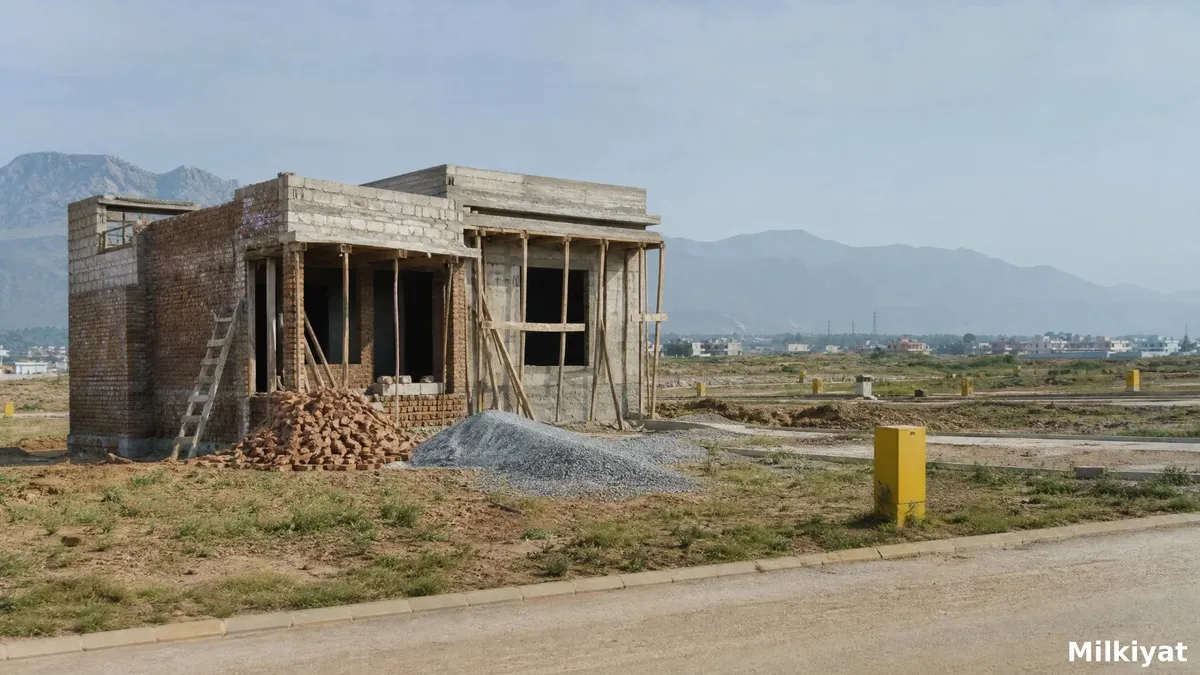
Provisional possession and final possession sound like a technicality, but the practical difference is enormous. A provisional handover generally lets an allottee see and access the plot. A final possession letter is what actually clears the way to apply for a building-plan NOC and start construction, the step that 680 G-14/2 and G-14/3 allottees have largely not been able to take. Buying into a sector at the provisional stage, without checking exactly which status a specific plot has reached, means buying into that uncertainty too.
In G-13, the core residential development is largely mature, so due diligence should focus on which specific block or new project a plot relates to, rather than on basic possession risk. In G-14, don't treat the sector as one unit. G-14/2 and G-14/3 are meaningfully further along than G-14/1, but even there, a plot that's only "provisionally handed over" is a different asset from one with a final possession letter, and that difference should be reflected in the price you're willing to pay. For any G-14/1 plot specifically, remember its infrastructure tender was still unresolved as of FGEHA's most recent update, so a buyer there is pricing in more schedule risk than elsewhere in the sector.
For a related look at how allotment and development bodies differ across Islamabad's sectors, see Milkiyat's F-11 vs E-11 Islamabad: CDA Freehold vs Cooperative Society Title.
| G-13, plus G-14/4 historically grouped with it |
| G-14/1, G-14/2, G-14/3, G-14/4 |
| Total plots (FGEHA's own figures) | Roughly 6,000 to 6,700 | Roughly 5,486 |
| Major infrastructure milestone | About 90% of rehabilitation work complete, per FGEHA's own notice | 680 plots provisionally handed over in G-14/2 and G-14/3 |
| Final possession letters issued | Not separately published; sector largely built out | About 20, out of the 680 provisionally handed over |
| Construction actually started | Widespread, including new high-rise projects | Just 1 confirmed house, in G-14/3 |
| Newest activity | Kashmir Avenue Apartments, Lifestyle Residency project | G-14/4 rehabilitation and infrastructure works underway |
FGEHA launched G-13 in 1996 as Phase-III of its housing scheme. The land was acquired under the Land Acquisition Collector Act, 1894, and initial development work went to the Frontier Works Organization under CDA's original oversight. In March 2015, following findings by the federal ombudsman, responsibility for the sector's infrastructure and maintenance shifted formally from CDA to FGEHA itself. FGEHA then ran its own rehabilitation programme in 2016, and by its own account had finished roughly 90 percent of that work, with street lighting the main item still catching up.
Nearly three decades after launch, G-13 hasn't gone quiet. FGEHA's latest updates show real new development inside the sector, including the Kashmir Avenue Apartments high-rise project under construction in the Mauve Area spanning G-13/1 and G-13/4, plus a separate public-private "Lifestyle Residency" apartment project. FGEHA has also auctioned commercial plots across G-13 and G-14 together, most recently in June 2025. Put simply, G-13's original residential plots are largely through the pipeline, and the sector has moved on to adding denser new projects on top of that base.
G-14 launched eight years after G-13, in 2004, as FGEHA's Phase-IV. Development work on its G-14/1, 2, and 3 sub-sectors wasn't even awarded until 2012, already an eight-year gap between launch and construction starting. That slower start has compounded into a possession timeline well behind G-13's, and the four G-14 sub-sectors aren't moving together at all.
| Sub-sector | Launch context | Infrastructure status | Possession status |
|---|---|---|---|
| G-14/1 | Awarded 2012, part of Phase-IV | Built-up-property survey still underway | Tender cancelled and disputed in the Islamabad High Court |
| G-14/2 | Awarded 2012, part of Phase-IV | Roads largely built, electricity connected | 264 plots provisionally handed over |
| G-14/3 | Awarded 2012, part of Phase-IV | Roads largely built, IESCO has energized the area | 416 plots provisionally handed over; 1 house under construction |
| G-14/4 | Grouped historically with Phase-III (G-13) | Rehabilitation and infrastructure works awarded and underway | Not separately reported |
In G-14/2 and G-14/3 combined, FGEHA's own numbers show 680 plots provisionally handed over to allottees. That's where most of the pipeline currently stalls. Only around 20 allottees have gone on to receive a final possession letter. Only 3 have applied for the No-Objection Certificate needed to get a building plan approved. And as of FGEHA's latest update, only 1 allottee has actually started building a house in G-14/3. Built-up-property issues in G-14/2 and G-14/3 remain unresolved, which appears to be the key bottleneck holding back final possession letters.
G-14/1 sits further behind. Its built-up-property survey was still underway as of FGEHA's most recent public update, and its infrastructure tender was cancelled by FGEHA in mid-2025 after the lowest bid came in about 25 percent above the estimated cost. The contractor took the matter to the Islamabad High Court, which directed FGEHA's board to issue a formal decision. That dispute was still moving through FGEHA's internal review as of September 2025.
| Stage | G-14/2 and G-14/3 combined |
|---|---|
| Plots provisionally handed over | 680 |
| Allottees with final possession letters | About 20 |
| Allottees who applied for building-plan NOC | 3 |
| Allottees who have started construction | 1 |
Provisional possession and final possession sound like a technicality, but the practical difference is enormous. A provisional handover generally lets an allottee see and access the plot. A final possession letter is what actually clears the way to apply for a building-plan NOC and start construction, the step that 680 G-14/2 and G-14/3 allottees have largely not been able to take. Buying into a sector at the provisional stage, without checking exactly which status a specific plot has reached, means buying into that uncertainty too.
In G-13, the core residential development is largely mature, so due diligence should focus on which specific block or new project a plot relates to, rather than on basic possession risk. In G-14, don't treat the sector as one unit. G-14/2 and G-14/3 are meaningfully further along than G-14/1, but even there, a plot that's only "provisionally handed over" is a different asset from one with a final possession letter, and that difference should be reflected in the price you're willing to pay. For any G-14/1 plot specifically, remember its infrastructure tender was still unresolved as of FGEHA's most recent update, so a buyer there is pricing in more schedule risk than elsewhere in the sector.
For a related look at how allotment and development bodies differ across Islamabad's sectors, see Milkiyat's F-11 vs E-11 Islamabad: CDA Freehold vs Cooperative Society Title.