Blog
Bahria Town Phase 7 vs Phase 8 Rawalpindi: Mature vs Expanding Phase Yields

Blog
Blog
By Bibi Masooma
Real Estate Analyst
15 min read
Landlords shopping between Bahria Town Phase 7 and Phase 8 in Rawalpindi are really choosing between two different kinds of rental bet. Phase 7 is finished: every street, mosque, and commercial strip that is likely to shape its rental appeal largely already exists. Phase 8 is still becoming itself, with mature, fully tenanted sectors sitting alongside newer Extension blocks that remain earlier in the development cycle. That difference should drive the decision far more than a simple price-per-marla comparison does.
This isn't a general "which phase is better" comparison. It's specifically about which phase makes more sense if rental income, rather than resale speculation, is the objective. For broader context on property returns and investment comparisons, see DHA Islamabad vs Bahria Town Rawalpindi: Which Offers Better Returns? and DHA Valley vs Bahria Town Phase 8: Instalment-File Risk Compared.
| 🏠 Rental Factor | Bahria Town Phase 7 | Bahria Town Phase 8 |
|---|---|---|
| 📍 Market Position | Mature and largely built out |
By Bibi Masooma
Real Estate Analyst
15 min read
Landlords shopping between Bahria Town Phase 7 and Phase 8 in Rawalpindi are really choosing between two different kinds of rental bet. Phase 7 is finished: every street, mosque, and commercial strip that is likely to shape its rental appeal largely already exists. Phase 8 is still becoming itself, with mature, fully tenanted sectors sitting alongside newer Extension blocks that remain earlier in the development cycle. That difference should drive the decision far more than a simple price-per-marla comparison does.
This isn't a general "which phase is better" comparison. It's specifically about which phase makes more sense if rental income, rather than resale speculation, is the objective. For broader context on property returns and investment comparisons, see DHA Islamabad vs Bahria Town Rawalpindi: Which Offers Better Returns? and DHA Valley vs Bahria Town Phase 8: Instalment-File Risk Compared.
| 🏠 Rental Factor | Bahria Town Phase 7 | Bahria Town Phase 8 |
|---|---|---|
| 📍 Market Position | Mature and largely built out |
| Mixed: mature sectors alongside expanding areas |
| 💰 Rental Income Potential | More predictable from an established tenant market | Varies significantly by sector and development stage |
| 👥 Tenant Demand | Established and easier to assess | Strong in developed sectors; less certain in newer areas |
| 🏗️ Development Risk | Lower, with most infrastructure already in place | Higher variation, particularly in outer sectors and Extension areas |
| ⏳ Time to Generate Rent | Generally better suited to immediate rental objectives | Developed sectors may perform quickly; newer areas may require patience |
| 📈 Investment Character | Primarily an income-focused play | Can combine rental income with longer-term development upside |
| 🎯 Best Suited To | Conservative landlords seeking dependable cash flow | Investors willing to select the exact sector and accept different levels of risk |
Key takeaway: The comparison is not simply Phase 7 versus Phase 8. For a rental investor, the more useful question is whether the specific property sits in a finished, tenant-ready location or an area where future development still needs to create the rental demand being priced into the investment.
Phase 7 sits along the Soan River side of GT Road, forming a continuous built up belt with DHA Phase 1, and is described across multiple sources as fully developed with both residential and commercial construction largely complete. Phase 8 is Bahria Town Rawalpindi's largest phase, structured into sectors A through P plus the standalone Safari Valley development, with a further Phase 8 Extension that trades mostly as unbuilt files rather than tenant ready housing. That structural difference one phase essentially "done," the other a mix of finished sectors and speculative extension is the single most important thing to understand before comparing rent numbers.
Phase 7's rental market benefits from maturity: established schooling and healthcare clusters within short driving distance, a settled commercial strip with recognised food and retail brands, and a tenant base that already knows the area. Indicative asking rents observed on property portals in 2025 put 1–2 bed apartments in Phase 7 in the roughly PKR 25,000–45,000 per month range, with 5 Marla houses around PKR 45,000–65,000 per month. These are asking-rent ranges pulled from listing portals, not a verified yield study, and should be treated as an indicative market band rather than a guaranteed return.
Because Phase 7 has little undeveloped land left, its rental supply is relatively fixed new rental stock mostly comes from resale and relet turnover rather than fresh construction, which tends to support rent stability but also limits how much additional yield upside is available from new supply.
Phase 8 covers a much wider range of product, and its rents reflect that spread. In the same 2025 market data, smaller units and apartments in Phase 8 were indicatively renting around PKR 26,000–45,000 per month, 5 Marla houses around PKR 45,000–65,000, 10 Marla houses around PKR 85,000–150,000, and 1 Kanal houses around PKR 150,000–320,000 a considerably wider band than Phase 7, reflecting the mix of established sectors (A through P, Safari Valley) and newer construction still catching up to demand. Phase 8's Business District, at the centre of the phase, functions as the primary commercial hub not only for Phase 8 but for Phase 7 as well, which supports tenant demand in the surrounding sectors.
| 🏘️ Rental Market Detail | Bahria Town Phase 7 | Bahria Town Phase 8 |
|---|---|---|
| 🏠 Typical Rental Stock | More concentrated mix of established apartments, houses and portions | Wider range, from apartments and smaller houses to 10 Marla and 1 Kanal properties |
| 💵 Indicative Rent Range | Apartments: approximately PKR 25,000–45,000; 5 Marla houses: approximately PKR 45,000–65,000 | Apartments: approximately PKR 26,000–45,000; 5 Marla houses: approximately PKR 45,000–65,000, with larger units reaching significantly higher rents |
| 👨👩👧 Tenant Profile | Families and professionals looking for an established, central Bahria location | More varied demand, including families, professionals and tenants seeking larger homes or sector-specific locations |
| 🔄 Rental Supply Pattern | Mostly existing stock circulating through tenant turnover and resale | Existing rental stock in developed sectors alongside new supply entering the market as construction expands |
| 📍 Location Sensitivity | Performance is relatively consistent across the mature phase, although street and property condition still matter | Performance can change sharply depending on proximity to the Business District, Safari Valley and the exact sector |
| 📦 Larger-Unit Market | More limited comparable data for larger houses in the reviewed snapshot | Stronger presence of 10 Marla and 1 Kanal rental stock, creating a much wider absolute rent range |
Rental-market takeaway: The key difference is not simply that Phase 7 is mature and Phase 8 is expanding. Phase 7 has a more concentrated and easier-to-benchmark rental stock, while Phase 8 offers a much wider range of unit sizes, rent levels and sector-specific outcomes.
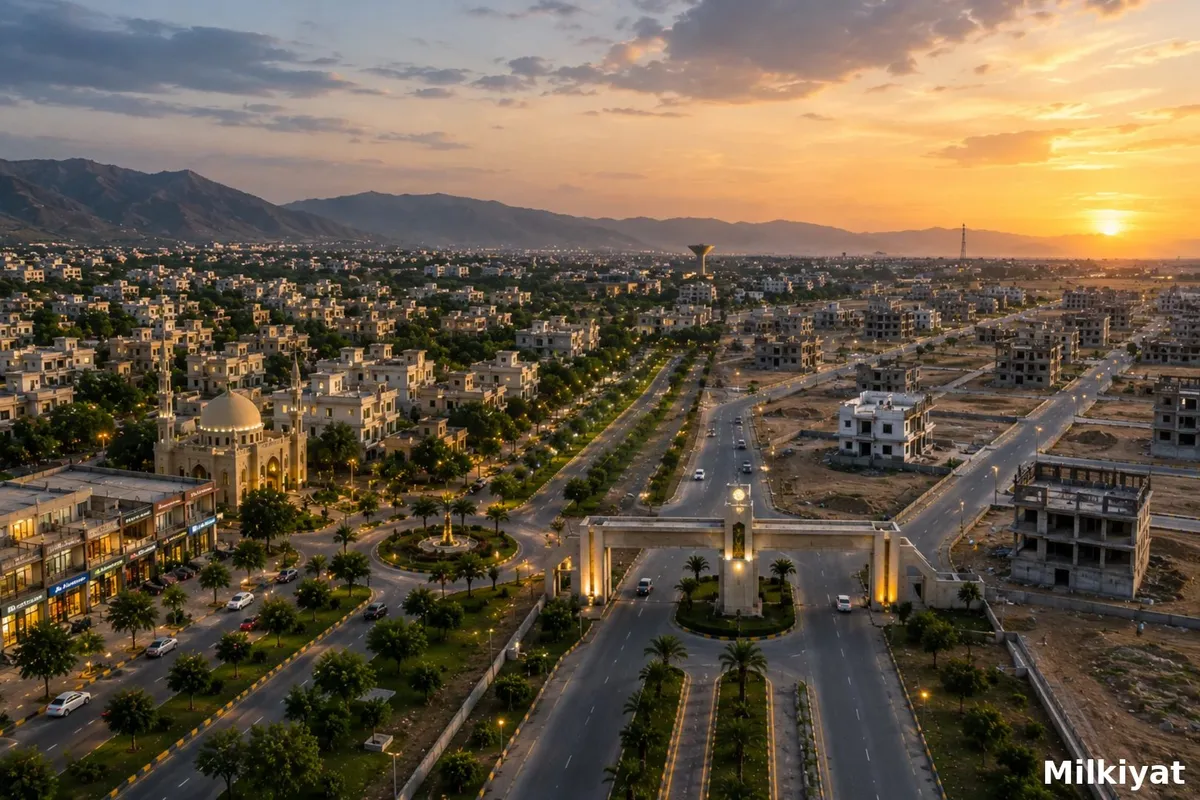
Bahria Town Phase 8's expanding residential and commercial development continues to shape its long-term rental potential.
Industry commentary increasingly presents Bahria Town Phase 8 as an emerging location for long-term rental income, supported by continued community development and the expansion of residential and commercial activity. However, this should be treated as a market observation rather than a verified yield figure. Actual rental performance still varies significantly by sector, property type, occupancy and the pace of development in the surrounding area.
Phase 7's occupancy is effectively at its ceiling it is fully built, and tenant turnover happens within existing stock rather than through new supply. Phase 8's occupancy varies sharply by sector: developed sectors close to the Business District and Safari Valley show strong, established demand, while outer sectors and the Extension zone remain thinner on population and amenities, which matters directly for how quickly a landlord there can actually secure a tenant. A buyer evaluating Phase 8 for rental purposes needs to look at the specific sector, not the phase name as a whole a plot bought in a developed A–P sector behaves very differently, as a rental asset, from one bought in the Extension.
Phase 7's commercial strength is concentrated but proven: locations like River View Commercial, Bahria Square Commercial, and Spring North Commercial host established food chains, banks, and retail brands, and this cluster also feeds pedestrian and vehicle traffic toward Phase 8's larger Business District next door. Phase 8's Business District is, by several accounts, the single largest commercial hub across both phases, though as of recent reporting some of its towers remain under construction alongside completed buildings — meaning its full commercial weight is still being built out, not yet fully realised.
Milkiyat's own analysis of Bahria Town's commercial performance places commercial rental yields across the Civic Center (Phase 4), the Phase 7 commercial hub, and the Phase 8 Business District broadly in the 7% to 9% range, with residential yields across Bahria Town Rawalpindi generally cited in the 5.5% to 6.8% band figures driven by the high population density and consistent tenant demand that Bahria Town as a whole is known for, rather than being unique to either phase individually. Separate market commentary on 2026 rent trends identifies Phase 7 and Phase 8 together as the strongest-performing rental areas within Rawalpindi, with Phase 7 favoured for the highest absolute rents and Phase 7/8 together favoured on yield percentage. No source reviewed for this article provides a phase-by-phase yield breakdown that isolates Phase 7 from Phase 8 with verified numbers any such specific split you see quoted elsewhere should be treated cautiously until you can trace it to a primary source.
What can be said with more confidence: Phase 7's yield is a known quantity, because its rental market is mature and its rent range is well documented across multiple portals. Phase 8's yield is a blended figure across a much wider quality range strong in its developed core, unproven in its Extension zone so an average yield number for "Phase 8" overall risks masking very different outcomes depending on exactly which sector a landlord buys into.
| Unit Type | Phase 7 (indicative monthly rent) | Phase 8 (indicative monthly rent) |
|---|---|---|
| 1–2 bed apartment | PKR 25,000 – 45,000 | PKR 26,000 – 45,000 |
| 5 Marla house | PKR 45,000 – 65,000 | PKR 45,000 – 65,000 |
| 10 Marla house | Not separately reported in sources reviewed | PKR 85,000 – 150,000 |
| 1 Kanal house | Not separately reported in sources reviewed | PKR 150,000 – 320,000 |
| Commercial yield (Bahria Town-wide, all phases) | 7% – 9% (Milkiyat estimate) | 7% – 9% (Milkiyat estimate) |
| Residential yield (Bahria Town-wide, all phases) | 5.5% – 6.8% (Milkiyat estimate) | 5.5% – 6.8% (Milkiyat estimate) |
Figures are indicative asking rent ranges drawn from property-portal listings observed in 2025, plus Milkiyat's own blended yield estimate across Bahria Town Rawalpindi's commercial and residential stock. No source reviewed provides a verified, phase-isolated yield split between Phase 7 and Phase 8 treat the yield rows as Bahria Town wide context, not a phase-specific figure. Actual achieved rents vary by sector, condition, and furnishing.
This is the real trade-off. Phase 7 offers a rental income stream that is largely already priced in you know roughly what a unit will rent for, because the tenant base and comparable supply already exist. Phase 8's developed sectors offer something similar, but its newer sectors and Extension carry the possibility of future rent growth as population density catches up, at the cost of near term rental income being thinner or non existent while that development happens. Buyers should not assume that "expanding" automatically means "higher future yield" it means higher uncertainty in both directions, and the outcome depends heavily on how quickly the surrounding sector actually fills up with residents, not just on proximity to the Business District on a master plan.
A landlord who wants a tenant-ready asset generating income from month one, with a well understood rent ceiling, is generally better served by Phase 7 or an already-developed Phase 8 sector (A through P, Safari Valley) close to the Business District. A landlord willing to accept a longer runway to first rental income, in exchange for potential capital appreciation as Phase 8's outer sectors and Extension develop, is taking a different kind of bet closer to a development play than a straightforward income play and should size that position accordingly.
| 🏠 Landlord Strategy | Better Fit | Why It Fits |
|---|---|---|
| 💰 Income from Month One | Phase 7 | Mature development, established occupancy and a more predictable rental market |
| 🏘️ Ready-to-Rent Property | Phase 7 or developed Phase 8 sectors | Existing infrastructure and stronger immediate tenant potential |
| 📈 Capital Growth Focus | Phase 8 outer sectors / Extension | More potential upside as development and population expand |
| ⏳ Willing to Wait for Rental Demand | Phase 8 developing areas | May require a longer runway before achieving stable occupancy |
| ⚖️ Balanced Income + Growth | Developed Phase 8 sectors | Combines existing rental demand with potential for further appreciation |
| 🎯 Best for Conservative Landlords | Phase 7 | Better suited to buyers prioritising predictable cash flow and lower development uncertainty |
| 🚀 Best for Higher-Risk Investors |
Key takeaway: Phase 7 is generally the stronger income play, while Phase 8 offers a broader spectrum ranging from established rental sectors to longer-term development and capital-growth opportunities.
Which is better for rental income, Phase 7 or Phase 8? It depends on the specific sector. Phase 7 offers a mature, predictable rental market. Phase 8's developed sectors (A–P, Safari Valley) perform comparably, but its newer sectors and Extension carry more uncertainty and, typically, less immediate rental demand.
Is Phase 7 more mature than Phase 8? Yes. Phase 7 is largely fully built out with an established commercial and residential base, while Phase 8 is Bahria Town Rawalpindi's largest and still-developing phase, mixing finished sectors with newer construction and an unbuilt Extension zone.
Does higher rent always mean higher rental yield? No. Yield depends on the purchase price relative to rent, not rent alone. A larger, more expensive unit in a developed Phase 8 sector may command a higher absolute rent than a Phase 7 apartment without necessarily delivering a higher percentage yield.
What should investors calculate before buying for rental income? The specific sector's development and occupancy status, current comparable rents from multiple listings, the plot's NOC or layout plan stage, and ongoing maintenance or utility costs not just the phase name or a single dealer's yield claim.
Note: Specific rent figures cited in this article are drawn from property portal listing data and market commentary rather than an official rental-yield survey, and are presented as indicative ranges rather than guaranteed returns.
| Mixed: mature sectors alongside expanding areas |
| 💰 Rental Income Potential | More predictable from an established tenant market | Varies significantly by sector and development stage |
| 👥 Tenant Demand | Established and easier to assess | Strong in developed sectors; less certain in newer areas |
| 🏗️ Development Risk | Lower, with most infrastructure already in place | Higher variation, particularly in outer sectors and Extension areas |
| ⏳ Time to Generate Rent | Generally better suited to immediate rental objectives | Developed sectors may perform quickly; newer areas may require patience |
| 📈 Investment Character | Primarily an income-focused play | Can combine rental income with longer-term development upside |
| 🎯 Best Suited To | Conservative landlords seeking dependable cash flow | Investors willing to select the exact sector and accept different levels of risk |
Key takeaway: The comparison is not simply Phase 7 versus Phase 8. For a rental investor, the more useful question is whether the specific property sits in a finished, tenant-ready location or an area where future development still needs to create the rental demand being priced into the investment.
Phase 7 sits along the Soan River side of GT Road, forming a continuous built up belt with DHA Phase 1, and is described across multiple sources as fully developed with both residential and commercial construction largely complete. Phase 8 is Bahria Town Rawalpindi's largest phase, structured into sectors A through P plus the standalone Safari Valley development, with a further Phase 8 Extension that trades mostly as unbuilt files rather than tenant ready housing. That structural difference one phase essentially "done," the other a mix of finished sectors and speculative extension is the single most important thing to understand before comparing rent numbers.
Phase 7's rental market benefits from maturity: established schooling and healthcare clusters within short driving distance, a settled commercial strip with recognised food and retail brands, and a tenant base that already knows the area. Indicative asking rents observed on property portals in 2025 put 1–2 bed apartments in Phase 7 in the roughly PKR 25,000–45,000 per month range, with 5 Marla houses around PKR 45,000–65,000 per month. These are asking-rent ranges pulled from listing portals, not a verified yield study, and should be treated as an indicative market band rather than a guaranteed return.
Because Phase 7 has little undeveloped land left, its rental supply is relatively fixed new rental stock mostly comes from resale and relet turnover rather than fresh construction, which tends to support rent stability but also limits how much additional yield upside is available from new supply.
Phase 8 covers a much wider range of product, and its rents reflect that spread. In the same 2025 market data, smaller units and apartments in Phase 8 were indicatively renting around PKR 26,000–45,000 per month, 5 Marla houses around PKR 45,000–65,000, 10 Marla houses around PKR 85,000–150,000, and 1 Kanal houses around PKR 150,000–320,000 a considerably wider band than Phase 7, reflecting the mix of established sectors (A through P, Safari Valley) and newer construction still catching up to demand. Phase 8's Business District, at the centre of the phase, functions as the primary commercial hub not only for Phase 8 but for Phase 7 as well, which supports tenant demand in the surrounding sectors.
| 🏘️ Rental Market Detail | Bahria Town Phase 7 | Bahria Town Phase 8 |
|---|---|---|
| 🏠 Typical Rental Stock | More concentrated mix of established apartments, houses and portions | Wider range, from apartments and smaller houses to 10 Marla and 1 Kanal properties |
| 💵 Indicative Rent Range | Apartments: approximately PKR 25,000–45,000; 5 Marla houses: approximately PKR 45,000–65,000 | Apartments: approximately PKR 26,000–45,000; 5 Marla houses: approximately PKR 45,000–65,000, with larger units reaching significantly higher rents |
| 👨👩👧 Tenant Profile | Families and professionals looking for an established, central Bahria location | More varied demand, including families, professionals and tenants seeking larger homes or sector-specific locations |
| 🔄 Rental Supply Pattern | Mostly existing stock circulating through tenant turnover and resale | Existing rental stock in developed sectors alongside new supply entering the market as construction expands |
| 📍 Location Sensitivity | Performance is relatively consistent across the mature phase, although street and property condition still matter | Performance can change sharply depending on proximity to the Business District, Safari Valley and the exact sector |
| 📦 Larger-Unit Market | More limited comparable data for larger houses in the reviewed snapshot | Stronger presence of 10 Marla and 1 Kanal rental stock, creating a much wider absolute rent range |
Rental-market takeaway: The key difference is not simply that Phase 7 is mature and Phase 8 is expanding. Phase 7 has a more concentrated and easier-to-benchmark rental stock, while Phase 8 offers a much wider range of unit sizes, rent levels and sector-specific outcomes.
Bahria Town Phase 8's expanding residential and commercial development continues to shape its long-term rental potential.
Industry commentary increasingly presents Bahria Town Phase 8 as an emerging location for long-term rental income, supported by continued community development and the expansion of residential and commercial activity. However, this should be treated as a market observation rather than a verified yield figure. Actual rental performance still varies significantly by sector, property type, occupancy and the pace of development in the surrounding area.
Phase 7's occupancy is effectively at its ceiling it is fully built, and tenant turnover happens within existing stock rather than through new supply. Phase 8's occupancy varies sharply by sector: developed sectors close to the Business District and Safari Valley show strong, established demand, while outer sectors and the Extension zone remain thinner on population and amenities, which matters directly for how quickly a landlord there can actually secure a tenant. A buyer evaluating Phase 8 for rental purposes needs to look at the specific sector, not the phase name as a whole a plot bought in a developed A–P sector behaves very differently, as a rental asset, from one bought in the Extension.
Phase 7's commercial strength is concentrated but proven: locations like River View Commercial, Bahria Square Commercial, and Spring North Commercial host established food chains, banks, and retail brands, and this cluster also feeds pedestrian and vehicle traffic toward Phase 8's larger Business District next door. Phase 8's Business District is, by several accounts, the single largest commercial hub across both phases, though as of recent reporting some of its towers remain under construction alongside completed buildings — meaning its full commercial weight is still being built out, not yet fully realised.
Milkiyat's own analysis of Bahria Town's commercial performance places commercial rental yields across the Civic Center (Phase 4), the Phase 7 commercial hub, and the Phase 8 Business District broadly in the 7% to 9% range, with residential yields across Bahria Town Rawalpindi generally cited in the 5.5% to 6.8% band figures driven by the high population density and consistent tenant demand that Bahria Town as a whole is known for, rather than being unique to either phase individually. Separate market commentary on 2026 rent trends identifies Phase 7 and Phase 8 together as the strongest-performing rental areas within Rawalpindi, with Phase 7 favoured for the highest absolute rents and Phase 7/8 together favoured on yield percentage. No source reviewed for this article provides a phase-by-phase yield breakdown that isolates Phase 7 from Phase 8 with verified numbers any such specific split you see quoted elsewhere should be treated cautiously until you can trace it to a primary source.
What can be said with more confidence: Phase 7's yield is a known quantity, because its rental market is mature and its rent range is well documented across multiple portals. Phase 8's yield is a blended figure across a much wider quality range strong in its developed core, unproven in its Extension zone so an average yield number for "Phase 8" overall risks masking very different outcomes depending on exactly which sector a landlord buys into.
| Unit Type | Phase 7 (indicative monthly rent) | Phase 8 (indicative monthly rent) |
|---|---|---|
| 1–2 bed apartment | PKR 25,000 – 45,000 | PKR 26,000 – 45,000 |
| 5 Marla house | PKR 45,000 – 65,000 | PKR 45,000 – 65,000 |
| 10 Marla house | Not separately reported in sources reviewed | PKR 85,000 – 150,000 |
| 1 Kanal house | Not separately reported in sources reviewed | PKR 150,000 – 320,000 |
| Commercial yield (Bahria Town-wide, all phases) | 7% – 9% (Milkiyat estimate) | 7% – 9% (Milkiyat estimate) |
| Residential yield (Bahria Town-wide, all phases) | 5.5% – 6.8% (Milkiyat estimate) | 5.5% – 6.8% (Milkiyat estimate) |
Figures are indicative asking rent ranges drawn from property-portal listings observed in 2025, plus Milkiyat's own blended yield estimate across Bahria Town Rawalpindi's commercial and residential stock. No source reviewed provides a verified, phase-isolated yield split between Phase 7 and Phase 8 treat the yield rows as Bahria Town wide context, not a phase-specific figure. Actual achieved rents vary by sector, condition, and furnishing.
This is the real trade-off. Phase 7 offers a rental income stream that is largely already priced in you know roughly what a unit will rent for, because the tenant base and comparable supply already exist. Phase 8's developed sectors offer something similar, but its newer sectors and Extension carry the possibility of future rent growth as population density catches up, at the cost of near term rental income being thinner or non existent while that development happens. Buyers should not assume that "expanding" automatically means "higher future yield" it means higher uncertainty in both directions, and the outcome depends heavily on how quickly the surrounding sector actually fills up with residents, not just on proximity to the Business District on a master plan.
A landlord who wants a tenant-ready asset generating income from month one, with a well understood rent ceiling, is generally better served by Phase 7 or an already-developed Phase 8 sector (A through P, Safari Valley) close to the Business District. A landlord willing to accept a longer runway to first rental income, in exchange for potential capital appreciation as Phase 8's outer sectors and Extension develop, is taking a different kind of bet closer to a development play than a straightforward income play and should size that position accordingly.
| 🏠 Landlord Strategy | Better Fit | Why It Fits |
|---|---|---|
| 💰 Income from Month One | Phase 7 | Mature development, established occupancy and a more predictable rental market |
| 🏘️ Ready-to-Rent Property | Phase 7 or developed Phase 8 sectors | Existing infrastructure and stronger immediate tenant potential |
| 📈 Capital Growth Focus | Phase 8 outer sectors / Extension | More potential upside as development and population expand |
| ⏳ Willing to Wait for Rental Demand | Phase 8 developing areas | May require a longer runway before achieving stable occupancy |
| ⚖️ Balanced Income + Growth | Developed Phase 8 sectors | Combines existing rental demand with potential for further appreciation |
| 🎯 Best for Conservative Landlords | Phase 7 | Better suited to buyers prioritising predictable cash flow and lower development uncertainty |
| 🚀 Best for Higher-Risk Investors |
Key takeaway: Phase 7 is generally the stronger income play, while Phase 8 offers a broader spectrum ranging from established rental sectors to longer-term development and capital-growth opportunities.
Which is better for rental income, Phase 7 or Phase 8? It depends on the specific sector. Phase 7 offers a mature, predictable rental market. Phase 8's developed sectors (A–P, Safari Valley) perform comparably, but its newer sectors and Extension carry more uncertainty and, typically, less immediate rental demand.
Is Phase 7 more mature than Phase 8? Yes. Phase 7 is largely fully built out with an established commercial and residential base, while Phase 8 is Bahria Town Rawalpindi's largest and still-developing phase, mixing finished sectors with newer construction and an unbuilt Extension zone.
Does higher rent always mean higher rental yield? No. Yield depends on the purchase price relative to rent, not rent alone. A larger, more expensive unit in a developed Phase 8 sector may command a higher absolute rent than a Phase 7 apartment without necessarily delivering a higher percentage yield.
What should investors calculate before buying for rental income? The specific sector's development and occupancy status, current comparable rents from multiple listings, the plot's NOC or layout plan stage, and ongoing maintenance or utility costs not just the phase name or a single dealer's yield claim.
Note: Specific rent figures cited in this article are drawn from property portal listing data and market commentary rather than an official rental-yield survey, and are presented as indicative ranges rather than guaranteed returns.
| 🔎 Main Landlord Check | Compare purchase price against established rents to avoid overpaying for a mature asset | Check the exact sector's occupancy, competing supply and realistic tenant demand before assuming a rent level |
| Greater exposure to future development upside, alongside higher uncertainty |
F-5 is enclosed by four of Islamabad's most significant roads, and each edge sets a different part of its value. This guide maps all four boundaries, corrects the widely repeated claims about F-5 bordering F-7 and G-6, and covers the Margalla Hills access that sits on the sector's own northern boundary road.
F-5 has no metro station of its own, but the Red Line terminus at Pak Secretariat sits on its southern edge. Here is every station, feeder route, fare and timing that matters for commuting into and out of the sector.
Airport Green Garden vs Airport Enclave: Compare approval records, NOC status, title checks and key risks before buying property near Islamabad Airport.
Compare PWD Housing Society and Soan Garden, exploring Islamabad Highway access, commuting, commercial activity, residential appeal and location advantages for buyers.
| 🔎 Main Landlord Check | Compare purchase price against established rents to avoid overpaying for a mature asset | Check the exact sector's occupancy, competing supply and realistic tenant demand before assuming a rent level |
| Greater exposure to future development upside, alongside higher uncertainty |
F-5 is enclosed by four of Islamabad's most significant roads, and each edge sets a different part of its value. This guide maps all four boundaries, corrects the widely repeated claims about F-5 bordering F-7 and G-6, and covers the Margalla Hills access that sits on the sector's own northern boundary road.
F-5 has no metro station of its own, but the Red Line terminus at Pak Secretariat sits on its southern edge. Here is every station, feeder route, fare and timing that matters for commuting into and out of the sector.
Airport Green Garden vs Airport Enclave: Compare approval records, NOC status, title checks and key risks before buying property near Islamabad Airport.
Compare PWD Housing Society and Soan Garden, exploring Islamabad Highway access, commuting, commercial activity, residential appeal and location advantages for buyers.