News
Growth vs. Governance: How CDA's New Approvals and RERA-Style Reforms Are Reshaping Islamabad Real Estate in 2026

By Bibi Masooma
Real Estate AnalystVerified author
7 min read
Islamabad's property market is being pulled in two distinct directions at once—and both are working in the buyer's favor, provided one understands how to read the underlying market mechanics.
On one side, the Capital Development Authority (CDA) is actively processing and approving new and extended layout plans across Zone-5, injecting fresh residential land into a capital that has long wrestled with supply constraints. On the other, federal regulatory bodies are tightening the rules of the game: a proposed Real Estate Regulatory Authority (RERA), mandatory Securities and Exchange Commission of Pakistan (SECP) registration for developers, the systematic dismantling of the informal paper "file system," and aggressive CDA crackdowns on unauthorized housing schemes.
For much of the last decade, Islamabad's real estate narrative was told as either a pure growth story or a strict regulatory crusade. In 2026, it is genuinely both—occurring simultaneously within the exact same zones and frequently involving the same industry players. Mastering the interplay between expansion and enforcement is now fundamental for anyone acquiring, divesting, or investing in the capital's real estate assets.
The Growth Side: CDA Opens the Taps in Zone-5
Zone-5 has quietly emerged as the busiest approval and development corridor in Islamabad. In July 2026, the CDA Directorate of Housing Societies initiated public consultations on a revised and extended layout plan (LOP) for the New Islamabad Enclave, a sprawling project covering approximately 999 kanals in Mouza Mughal—including Patti Chak Thub and Patti Mughal Khas—sponsored by Earth Developers (Pvt.) Ltd. Concurrently, the CDA advanced reviews for an extension of the long-established Zaraj Housing Scheme along Grand Trunk (G.T.) Road, incorporating nearly 19 additional kanals into its approved footprint.
These developments are part of a broader historical framework. Zones-5 and-2 were originally designated in 1992 to accommodate private cooperative housing societies and corporate developers, with Zone-4 incorporated in 2010. Since the introduction of regulatory update S.R.O. 886(I)/2023, every new or extended layout plan must navigate a mandatory public notice protocol—soliciting public objections, cross-verifying land ownership records, and publishing Khasra numbers—prior to final CDA endorsement. This transparent vetting mechanism is precisely what is currently unfolding across several flagship Zone-5 projects.
Market Implications of Current Approvals
| Market Dimension | Strategic Impact for Buyers & Investors |
|---|---|
| Inventory Expansion | New layout approvals pave the way for fresh plot launches within 12 to 24 months, mitigating upward price pressures in mature, fully built-out sectors. |
| Established Expansion | Extensions in mature societies like Zaraj demonstrate that established projects retain growth capacity, supporting long-term value preservation in surrounding micro-markets. |
| Transparent Pipelines | Mandatory public notices and published ownership audits grant buyers an unprecedented window into a project's legal standing prior to capital commitment. |
The Regulation Side: Tightening Standards Across the Board
While the CDA expands the legal land supply, federal regulators are systematically closing historical loopholes that enabled unauthorized and predatory schemes to thrive.
The Federal Real Estate Regulatory Authority (RERA) Momentum: In March 2026, Prime Minister Shehbaz Sharif instructed the Ministry of Housing and Works to expedite the operationalization of RERA. Designed to oversee ethical codes, protect consumer rights, and enforce accountability across commercial and residential developments, RERA mandates that developers secure regulatory clearance prior to project marketing, while compelling real estate agents to register before facilitating transactions.
Compulsory SECP Registration: During a high-level review in May 2026, the federal government proposed making SECP corporate registration mandatory for all housing and development entities. This initiative runs parallel to state strategies discouraging unchecked urban sprawl in favor of vertical, high-rise architectural integration in major urban centers.
Dismantling the Informal "File System": In June 2026, the National Accountability Bureau (NAB) instituted sweeping reforms aimed at eliminating speculative paper-file trading. By curbing cash-based opacity and transitioning toward verifiable, registered ownership transfers, regulators are transforming the security architecture of Pakistani real estate.
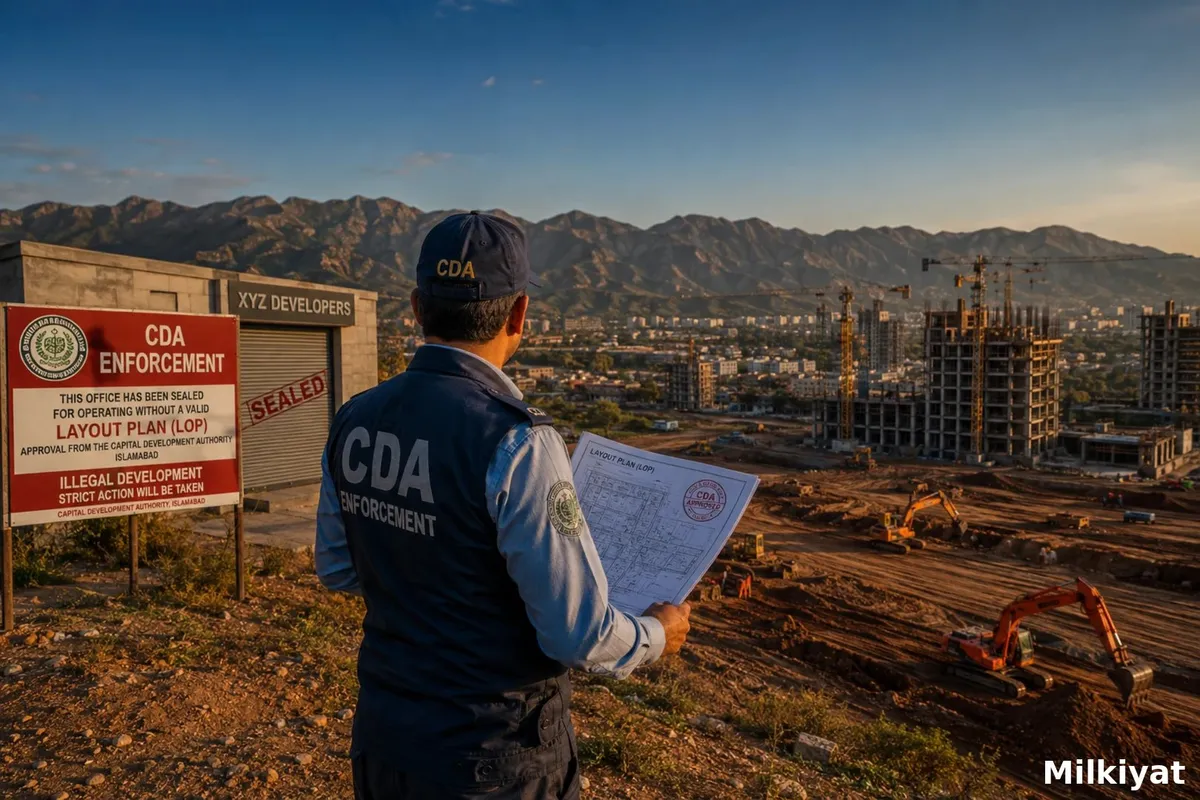
Aggressive Enforcement Against Illegal Schemes: In May 2026, the CDA formally classified 99 housing schemes across Zones III and IV as illegal, sealing non-compliant developer offices and instructing utility providers to sever connections. This represents one of the most uncompromising enforcement operations in the authority's history.
Synthesizing Growth and Regulation
The most critical insight often overlooked by mainstream commentary is that growth and regulation are not opposing forces; rather, they are mutually reinforcing pillars of a maturing market.
Unchecked land expansion without regulatory oversight is precisely how Islamabad accumulated dozens of defunct, illegal housing societies. Conversely, restrictive regulation divorced from new supply simply inflates property prices and drives prospective buyers toward informal, high-risk alternatives out of sheer necessity. The 2026 paradigm represents a controlled expansion model: the CDA permits market growth, but strictly through a verified public-notice pipeline, while federal regulators eliminate the informal channels that previously absorbed excess market demand.
"A Layout Plan approval or NOC issuance is no longer mere bureaucratic red tape; it is the definitive boundary dividing a protected, appreciating asset from a catastrophic legal liability."
Strategic Guidance for Market Participants
- Prioritize Due Diligence Over Marketing: Before committing capital to any emerging Zone-5 project, investors must consult the official CDA Housing Schemes Portal to verify active LOP and NOC statuses rather than relying on promotional brochures.
- Distinguish Consultation from Completion: Projects currently locked in public consultation offer attractive early-entry pricing but carry elevated regulatory risk compared to fully NOC-endorsed communities.
- Inspect Layout Extensions Independently: When evaluating extensions in established societies, ensure the specific extension has completed the independent public-notice and approval cycle. An extension does not automatically inherit the legal standing of the parent project.
- Insist on Formal Documentation: As the traditional paper file system phases out, buyers must reject informal token or on-file arrangements, insisting exclusively on registered, traceable ownership transfers.
- Monitor Institutional Reforms: Track the ongoing rollout of RERA and SECP mandatory registration frameworks, which will serve as reliable filters for identifying institutional-grade developers.
Frequently Asked Questions
Q1: Is it safe to invest in a CDA housing scheme currently undergoing public consultation?
It can present a lucrative early-stage opportunity, but it carries higher risk than an NOC-issued project. Public consultation indicates that the layout plan has not received final statutory approval. Investors must thoroughly examine the sponsor's track record on previously completed projects.
Q2: What differentiates a Layout Plan (LOP) from a No Objection Certificate (NOC)?
A Layout Plan represents the CDA's technical approval of a project's master design, permitting marketing activities but strictly prohibiting legal plot sales or construction. An NOC is granted only after all infrastructural and legal prerequisites are satisfied, legally authorizes construction and plot alienation.
Q3: What is RERA and what is its implementation timeline?
The Real Estate Regulatory Authority is a federal oversight body established to regulate developer conduct, enforce professional standards, and formalize transaction mechanisms across Pakistan's property sector.
Q4: How can buyers verify the exact legal standing of a housing society?
Investors should access the official CDA Housing Schemes portal to cross-verify specific societies and phases. Status categories range from "LOP Approved + NOC Issued" (maximum security) to "NOC Cancelled" (high risk).
Q5: Why is the CDA simultaneously approving new schemes and shutting down unauthorized ones?
This dual approach reflects a strategic transition toward controlled, accountable urban expansion. The CDA is channeling growth through transparent legal frameworks while systematically purging developments that bypassed statutory oversight.
References & Resources
Internal Resources (Milkiyat.com)
- List of Best CDA-Approved Housing Societies in Islamabad (2026)
- The End of Pakistan's Real Estate File System: A Complete Guide for Buyers & Developers
- Islamabad Master Plan Explained: Zones, Amendments & Investor Guide
- Housing Societies to Avoid in Islamabad 2026 | CDA Illegal List & Safe Alternatives
- CDA Approved Housing Projects in Islamabad 2026
External Official Sources
- Capital Development Authority (CDA) Official Website
- CDA Private Housing Schemes Verification Portal
- Securities and Exchange Commission of Pakistan (SECP)
- Business Recorder: Federal Real Estate Regulatory Authority (RERA) Updates
- ProPakistani: Islamabad Real Estate News & CDA Approvals
Call to Action
Thinking about investing in a new or extended CDA housing scheme? Consult Milkiyat.com's expert property advisory team for a complimentary legal-status audit before committing any token or booking amounts.