Guide
IMARAT's "Guaranteed Rental Income": Whose Money Is Actually Paying Your Rent?

By wajahat Ali
Real Estate Analyst
10 min read
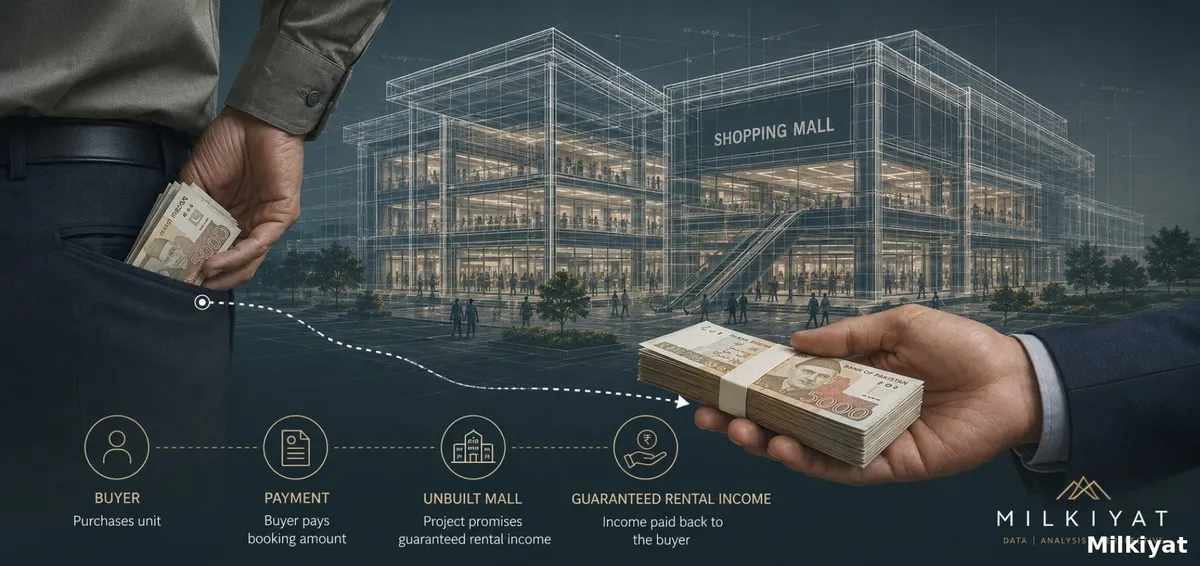
There is a pitch making the rounds in Islamabad and Rawalpindi's commercial property market, and it sounds almost too generous to question. You buy a share of a shop, sometimes as little as a few square feet, in an under-construction mall or mixed-use tower. From the day you pay, the developer pays you "rental income," often quoted at 8%, 10%, even 12% or more per year. Guaranteed. Before the building exists. Before a single tenant has signed a lease.
Marketing teams call this passive income. Sales agents call it the smartest investment in the twin cities. We call it what the arithmetic says it is: in most versions of this model, the developer is paying you back your own money and calling it rent.
This investigation examines the structural flaws of the guaranteed-rental and fractional-ownership model as marketed by large developers in the Islamabad–Rawalpindi market. Why is IMARAT in our title? Because IMARAT Group is the model's most visible marketer in the twin cities: its own promotional material, published through its affiliated portal Graana.com, advertises guaranteed resale options and fully leased, immediate rental-income products to overseas investors. That makes it the natural reference point for examining how this product category works. To be explicit about what we are and are not claiming: the five flaws below are structural flaws of the model itself, and they apply to every developer selling it. Where a claim concerns a specific IMARAT project, we flag it, show our source, or tell you plainly that we could not verify it. We sent written questions to IMARAT Group before publication their response, or the absence of one, appears at the end of this article.
How the model works on paper
The structure has three moving parts.
First, fractional sale. A single commercial unit, a shop, a food court counter, a serviced apartment, is divided into small square-foot fractions and sold to dozens or hundreds of separate buyers. This drops the entry ticket from crores to lakhs, which is precisely the point: it opens the product to salaried buyers and overseas Pakistanis who could never afford a whole unit.
Second, the guaranteed rental payout. Buyers are promised a fixed periodic payment, framed as rental income, that begins either immediately or shortly after booking, years before the project is complete and leasable.
Third, the buyback or resale promise. Many schemes add a guaranteed resale or buyback option, assuring buyers they can exit whenever they want.
Each of these parts, examined separately, has a serious structural problem. Together, they form something that deserves far more scrutiny than it gets.
How the model works in Park View City
Flaw one: you cannot earn rent from a building that does not exist
Rent is income generated by a tenant occupying a completed property. An under-construction plaza has no tenants. So the "rental" payments made during construction cannot, by definition, come from rental operations. They must come from somewhere else and there are only two candidates: the developer's own capital, or the money collected from buyers.
The mechanics of how this usually works internationally are well documented. The unit is priced at a substantial markup over its actual market value, and that markup is what funds the "guaranteed" payments meaning the buyer is effectively paying their own return in advance, slowly recouping an inflated purchase price rather than earning anything. A unit worth Rs. 10 million sold at Rs. 15 million leaves the developer Rs. 5 million of your money to hand back to you in comfortable monthly installments while calling it yield.
The test any buyer can run: take the total guaranteed payout over the guarantee period, add it to a realistic post-completion market rent, and compare the unit's price per square foot against comparable completed commercial property in the same corridor. If the fractional unit costs 30–50% more per square foot than finished, leased, registry-transferable property nearby, the "guarantee" is priced in. You funded it.
Flaw two: what you own is a promise, not a property
Pakistan's property rights system, fard, intiqal, registry, is built around identifiable, exclusively possessed units of land or built property. We have covered this system in detail in our Fard, Intiqal and Registry explainer.
Fractional square-foot buyers do not get this. When one shop has a hundred owners, no individual buyer can receive exclusive possession, a separate registry, or a mutation in the revenue record. What you typically hold is an allotment letter or a contractual agreement with the developer or a company it controls. That paper is a claim against a company, not a right in property. The practical consequences:
- You cannot mortgage it. No bank will lend against a fractional allotment letter.
- You cannot sell it on the open market. Your buyer pool is effectively whoever the developer's own sales floor brings you — which means your exit price is whatever the developer says it is.
- If the company fails, you stand in line as an unsecured creditor, not as an owner of real estate. The land underneath the project is usually titled to the developer or a special-purpose entity, not to you.
Internationally, developers running guaranteed-return schemes have been documented using special purpose vehicles and obscure contract clauses to shield themselves from liability, leaving buyers with little recourse if the developer fails. There is no reason to assume Pakistani contract drafting is friendlier to the buyer.
Flaw three: the payments depend on new sales continuing
Follow the cash. If pre-completion "rent" is funded from the sale price markup and from incoming booking payments, then the scheme's ability to pay existing buyers depends on selling to new buyers. That is not an accusation of intent, it is a description of the cash-flow structure. But it is also, mechanically, the defining feature of a Ponzi dynamic: earlier participants paid from later participants' capital.
A developer can run this structure honestly and complete the building. Many intend to. The problem is that the buyer has no visibility into which scenario they are in. When the market slows as Pakistan's did severely through 2022–24 sales stop, and with them the "guaranteed" payments. The guarantee is only as strong as the developer's sales pipeline, and no sales pipeline is guaranteed.
The disclosure that would settle this: an escrow or designated project account, audited, showing that payouts are funded from a reserved pool rather than from new bookings. Under-construction projects in regulated markets (RERA in India, DLD in Dubai) are legally required to escrow buyer funds. Pakistan has no equivalent enforced mechanism for this product. [VERIFY: confirm current SECP/CDA/RDA regulatory status of fractional real estate sales, to our knowledge there is no dedicated framework, but this must be checked as of publication date.]
Flaw four: the guarantee expires, the arithmetic doesn't
Suppose the building completes. The guarantee typically runs for a fixed period two years, three years, five. After that, your income is whatever the actual tenants of the actual mall actually pay, divided across all fractional owners, minus management charges.
Islamabad's commercial rental market does not pay 12%. Yields on completed, well-located commercial property in the twin cities generally sit far below the rates these schemes advertise. So when the guarantee lapses, the buyer faces a cliff: from the promised double-digit "return" down to genuine market yield ,on a unit they bought at a premium and cannot easily sell. The scheme's glossy years are the years when the money being paid out was substantially the buyer's own.
And collecting on a guarantee that a developer stops honouring is, in practice, extremely difficult, a documented pattern in these schemes globally, where contracts are structured to make the guarantee hard to enforce precisely when it matters.
Flaw five: nobody is counting the square feet
Here is the question that should end every fractional sales pitch: who reconciles the total square footage sold against the square footage that exists in the approved building plan?
The answer, in Pakistan's current regulatory environment, is nobody. CDA and RDA approve building plans; they do not audit how many fractional interests a marketing company sells against those plans. The SECP regulates companies, not square footage. There is no registrar of fractional interests. A developer could sell 120,000 square feet of a 100,000 square-foot floor and no institution would flag it before handover, if handover comes.
We are not alleging that any specific developer has oversold. We are stating that no buyer can currently verify that they haven't, and a product whose honesty is unverifiable by design does not deserve the benefit of the doubt.
The Shariah question the marketing avoids
These products are frequently marketed to religiously conscious buyers, and to overseas Pakistanis, as halal rental income — ijarah, not interest. This framing does not survive contact with the classical requirements of an ijarah contract, which require an existing, specified, deliverable asset in the lessor's possession. A fixed, predetermined return paid on capital, before any asset exists and regardless of any tenancy, is, in substance, a return on money. Most classical scholarship has a word for a guaranteed fixed return on money.
We are not muftis and we are not issuing a fatwa. We are saying: if a developer claims the product is Shariah-compliant, ask for the Shariah board's written approval, the names of the scholars, and critically — whether they reviewed the actual cash flows or only the marketing description.
What we asked, and what buyers should demand
An honest scheme can answer all of the following in writing. We recommend no buyer sign anything until they have every item:
- The contracting entity's name and SECP registration, and confirmation of whether that entity owns the land (with fard/registry as proof).
- The approved building plan (CDA/RDA), showing total leasable area against which the buyer can at least ask what percentage has been sold.
- A written statement of the funding source of pre-completion payouts, and whether buyer funds are held in escrow or a designated audited account.
- The specimen sale agreement, reviewed by the buyer's own lawyer specifically the buyback clause conditions, the guarantee enforcement mechanism, and the dispute forum.
- Independent evidence of post-guarantee market rents in the same corridor — not the developer's projections.
- The Shariah certification, if compliance is claimed, with scholar names and the scope of what was reviewed.
- Exit terms in writing: who sets the resale price, what fees apply, and how long buyback payment takes.
A developer who refuses to provide these documents has answered your question.
The honest summary
Guaranteed rental income on an unbuilt, fractionally sold unit is not a rental product. It is an unregulated, unsecured fixed-income instrument issued by a private company, collateralised by nothing the buyer can enforce, dressed in the language of property ownership. Some issuers will pay every rupee they promised. The buyer has no way to know, in advance, which ones and a market where honesty is unverifiable is a market that rewards whoever promises the most.
Real property in this market comes with a fard, a registry, and a tenant you can meet. If someone offers you 12% guaranteed on a building that doesn't exist, the first question is not how do I book it is whose money is paying me, and what happens when it runs out?
Milkiyat.com is commission-free and developer-independent. If you have documents — agreements, rate lists, payment records — from a guaranteed rental or fractional scheme in the twin cities, contact us. We verify before we publish.