Guide
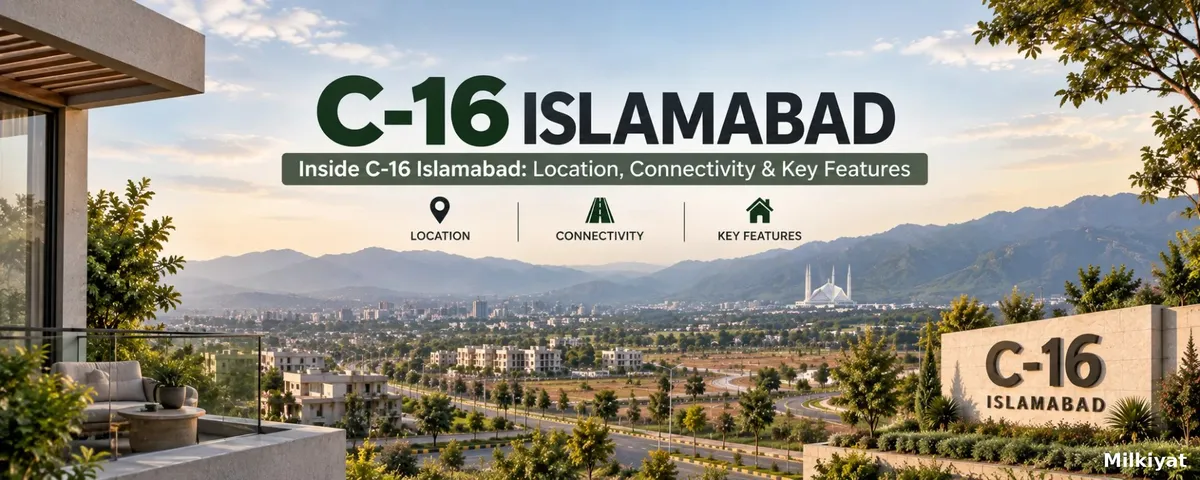
Inside C-16 Islamabad: Location, Connectivity & Key Features
Milkiyat.com is operated by MILKIYAT.COM ONLINE PORTAL (PRIVATE) LIMITED.
Corporate Unique Identification No. (CUI): 0337118
Incorporated under the Companies Act, 2017, Pakistan.
Guide
Guide

By Bibi Masooma
Real Estate Analyst
15 min read
Where is C-16 Islamabad located, and what does its master plan include? C-16 Islamabad is located near the foothills of the Margalla Hills along Margalla Avenue, close to neighbouring C-14. According to CDA planning information, the sector's master plan includes approximately 2,500 residential plots, a Markaz, and Class-III shopping centres.
However, these planned facilities should not be confused with operational amenities. C-16 remains a development-stage sector, with infrastructure works still progressing despite CDA's Rs 5 billion development tender for C-16/1 and C-16/2. Buyers should therefore distinguish between planned features shown in the master plan and facilities currently available on the ground. This guide focuses on the confirmed location, approved planning framework, current development status and what investors can realistically expect from C-16 Islamabad.
An area guide that describes amenities and connectivity as though they already exist, when a sector is still working through infrastructure tenders, isn't actually helping anyone make a good decision. C-16 has a well-documented master plan, making it possible to describe its intended features with real specificity. But planned and operational are different, and this guide keeps that distinction clear throughout.
| Feature | What Is Planned or Documented | Current Reality for Buyers |
|---|---|---|
| Residential plots | The master plan includes approximately 2,500 residential plots. |
By Bibi Masooma
Real Estate Analyst
15 min read
Where is C-16 Islamabad located, and what does its master plan include? C-16 Islamabad is located near the foothills of the Margalla Hills along Margalla Avenue, close to neighbouring C-14. According to CDA planning information, the sector's master plan includes approximately 2,500 residential plots, a Markaz, and Class-III shopping centres.
However, these planned facilities should not be confused with operational amenities. C-16 remains a development-stage sector, with infrastructure works still progressing despite CDA's Rs 5 billion development tender for C-16/1 and C-16/2. Buyers should therefore distinguish between planned features shown in the master plan and facilities currently available on the ground. This guide focuses on the confirmed location, approved planning framework, current development status and what investors can realistically expect from C-16 Islamabad.
An area guide that describes amenities and connectivity as though they already exist, when a sector is still working through infrastructure tenders, isn't actually helping anyone make a good decision. C-16 has a well-documented master plan, making it possible to describe its intended features with real specificity. But planned and operational are different, and this guide keeps that distinction clear throughout.
| Feature | What Is Planned or Documented | Current Reality for Buyers |
|---|---|---|
| Residential plots | The master plan includes approximately 2,500 residential plots. |
| Planned plots should not automatically be treated as fully developed, possession-ready properties. |
| Markaz | A central Markaz is included in the sector's planning framework. | Its inclusion in the master plan does not mean a functioning commercial centre is already operating. |
| Class-III shopping centres | Commercial shopping areas are provided for in the master plan. | These remain planned facilities unless development and operations are confirmed on the ground. |
| Road infrastructure | Roads and supporting infrastructure form part of the sector's development programme. | Development is ongoing; buyers should verify the latest physical progress before purchasing. |
| Utilities | Utility infrastructure is part of the planned development framework. | Availability should be verified for the specific plot rather than assumed from the master plan. |
| Margalla Avenue connectivity | C-16 is positioned along the Margalla Avenue corridor. | Strategic location is a positive factor, but actual accessibility can change as infrastructure progresses. |
| Margalla Hills setting | The sector is located near the foothills of the Margalla Hills. | The location advantage is real, but surrounding development and access remain subject to ongoing sector development. |
| Schools, markets and other amenities | Future planning may accommodate supporting facilities. | Buyers should distinguish between future/planned amenities and currently operational facilities. |
C-16's master plan provides evidence of what the sector is intended to become; it does not prove that every planned facility is currently available. For investors and end-users, the most important distinction is between documented planning, active development and completed/operational infrastructure.
C-16 sits in the foothills of the Margalla Hills, along the Margalla Avenue corridor. CDA's 2023 board record includes the revised layout plan for Sector C-16 and separately records the project for extending Margalla Avenue from N-5 to M-1, providing official evidence of the sector's planned location within this northern Islamabad corridor. CDA's official 2023 board record
This places C-16 within Islamabad's northern sector cluster and gives it a strategic position along the Margalla Avenue corridor. However, it is important to distinguish the sector's planned location and connectivity from infrastructure that is already fully operational.
The available official documentation supports C-16's position within the Margalla Avenue corridor, but it does not provide enough evidence to make confident claims about exact walking distances or precise boundaries between C-16, C-14, C-15 and C-13. Anyone making a location-dependent investment decision should therefore verify the exact boundaries and road alignments against CDA's official maps and approved planning documents, rather than relying on general property descriptions.
One of the more specific, genuinely useful facts confirmed about C-16 is its planned scale. CDA officials disclosed in 2023 that the sector's layout included around 2,500 residential plots, along with a markaz and class-III shopping centres. This is a considerably larger planned footprint than some of Islamabad's smaller infill sectors, and it suggests C-16 is intended to eventually function as a substantial, largely self-contained residential community, complete with its own commercial hub, rather than a small extension that depends entirely on neighbouring sectors for daily needs.
That said, a planned markaz and planned shopping centres are design elements in an approved layout, not operational businesses. As of the most recent confirmed reporting, C-16 remained classified among sectors still working through infrastructure development, meaning these commercial elements of the master plan had not yet been built out and opened to the public. Treat the 2,500-plot, markaz-and-shopping-centre description as an accurate account of what C-16 is designed to eventually become, not as a description of what exists there today.
The most concrete, checkable fact about C-16's current physical state is the scale of infrastructure work CDA has committed to fund. In November 2025, CDA issued tenders covering Sub-Sectors C-16/1 and C-16/2, with an estimated total cost of Rs 5 billion, one of the largest single infrastructure commitments among Islamabad's currently developing sectors. This tells us, with real confidence, that a substantial amount of road-building, utility installation, and general sub-sector development work has been formally commissioned and funded for the area.
It does not, on its own, tell us that this work has been completed, or that the sector's planned amenities, the markaz, the shopping centres, schools that might eventually be built to serve the community, are operational. A mid-2026 CDA review still grouped C-16 among sectors classified as "partially or fully stalled," which suggests the funded work was, at that point, still in progress rather than finished.
If a listing or third-party description presents C-16's markaz, shopping centres, or any other planned amenity as already open and operational, verify this directly with CDA or through an on-the-ground visit, since we could not confirm any of these facilities as currently active through an official source.
Because C-16 sits along Margalla Avenue, a significant arterial road serving Islamabad's northern sector corridor, it is reasonable to expect the sector to benefit from the wider connectivity provided by this route as its own internal infrastructure develops. The broader corridor connects C-16 with surrounding northern sectors, while the development of C-16's internal roads remains an important part of its transition toward a functioning residential area. For comparison, see how connectivity and access have developed in the more advanced C-14 Islamabad property market.
However, there is currently no need to overstate specific travel advantages. We do not have a CDA-confirmed statement giving fixed drive times from C-16 to landmarks such as Zero Point, Faizabad or other established parts of Islamabad. Any specific drive-time figures published for C-16 should therefore be treated as estimates rather than official benchmarks, particularly while the sector's internal road network and wider development continue to progress.
The practical takeaway: C-16 has a strategically positioned road corridor, but its eventual connectivity should be judged by completed internal roads and actual on-ground access, not by projected drive times alone.
Because C-16 and C-14 share the same general Margalla Avenue corridor, it's worth being specific about where the genuine similarities end and the confirmed differences begin. Both sectors share a broadly similar geographic setting at the foothills of the Margalla range. Both were part of CDA's broader push to develop long-delayed sectors under its current leadership. But C-14 had, by early 2026, progressed considerably further along its own development timeline, with its infrastructure work described by CDA as having entered its "final stages" and an active possession-handover process underway. C-16, despite its considerably larger Rs 5 billion funding commitment, remained in the "partially or fully stalled" category at a comparable point in 2026. This means that whatever connectivity, amenities, and established community life C-14 has begun to develop as a result of its more advanced stage shouldn't automatically be assumed to already exist in C-16, even given their shared corridor and similar origin story.
Given the sector's current classification, anyone connected to C-16 today, whether overseeing a plot, planning future construction, or simply monitoring the area's progress, should expect to rely on neighbouring, more established parts of Islamabad for schools, healthcare, groceries, and general shopping for the foreseeable future. This is a completely typical situation for a sector at this stage of CDA's development pipeline, and it mirrors the phase that more advanced sectors like C-14 themselves passed through before their own infrastructure and community life matured.
The genuinely useful long-term signal here is the scale of C-16's planned commercial infrastructure, a markaz and shopping centres built into the master plan for a sector of roughly 2,500 plots. Once the sector's basic infrastructure is complete and possession begins in earnest, this planned scale suggests C-16 has the underlying design to eventually support a fairly comprehensive local daily life, more so than a smaller sector without dedicated commercial space built into its original layout. Getting from today's largely undeveloped state to that eventual outcome, though, will likely take considerably longer than any single funding announcement suggests on its own.
| Daily-Life Factor | Current Situation | Long-Term Potential |
|---|---|---|
| Schools & Education | Residents and plot owners would currently need to rely mainly on established neighbouring areas for educational facilities. | Local educational facilities could emerge as the sector develops and population increases. |
| Healthcare | Nearby established areas remain the practical option for hospitals, clinics and other healthcare services. | Healthcare facilities may become more accessible as C-16 develops its planned commercial and community areas. |
| Groceries & Essentials | Day-to-day shopping is currently more dependent on surrounding developed areas. | Local shops and convenience businesses can develop as construction and occupancy increase. |
| General Shopping | C-16 does not yet function like a mature, fully populated residential sector. | Planned commercial areas could eventually support a broader range of retail services. |
| Markaz | Included in the sector's master plan but should not be treated as an operational commercial centre today. | Could become a major local commercial hub after development and population growth. |
| Shopping Centres | Planned within the sector's layout, but their future facilities should be distinguished from currently available amenities. | Could provide additional retail and everyday services once developed. |
| Community Life | Limited compared with established Islamabad sectors because development and occupancy are still progressing. | Community activity should increase alongside possession, construction and residential occupation. |
| Overall Living Experience | Development-stage environment rather than a mature residential neighbourhood. | Potential to develop into a more self-contained residential community once infrastructure and commercial areas mature. |
Key takeaway: C-16's master plan provides a credible foundation for future community life, but buyers should evaluate it based on what is operational today versus what is planned for the future.
C-16 is part of Islamabad's wider northern development corridor. To understand the possession challenges and development history affecting C-14, C-15, C-16, E-12 and I-12, read Milkiyat's analysis of Islamabad's possession crisis. For a broader view of Islamabad's property market, including established and developing sectors, explore the Islamabad City Hub.
| Sector | Development Stage | Why It Matters to C-16 Buyers |
|---|---|---|
| C-14 | More advanced development and possession progress | Provides a useful comparison for what C-16 could look like as infrastructure and occupancy mature. |
| C-15 | Developing sector with ongoing infrastructure considerations | Offers a direct comparison for investors evaluating Islamabad's northern growth corridor. |
| C-16 | Development-stage sector with major infrastructure investment | Represents the main focus of this guide, with potential upside alongside execution and timeline risk. |
| E-12 | Long-running development and possession challenges | Shows why planned infrastructure does not always translate quickly into possession. |
| I-12 | Development progressing through multiple stages | Provides another useful reference point when assessing the timeline risks of emerging CDA sectors. |
Key takeaway: Comparing C-16 with neighbouring sectors helps investors understand the difference between planned development, active infrastructure work and actual possession rather than judging the sector on future potential alone.
It's useful to close with a grounded picture of what C-16 is actually designed to become, based strictly on the confirmed elements of its master plan, since this is different from either dismissing the sector's potential entirely or overselling its current state. A community built around roughly 2,500 residential plots, with a dedicated markaz and class-III shopping centres built into the original layout, sits at a genuinely larger scale than many single-purpose residential schemes in Islamabad. If the sector's current infrastructure work completes as funded, and if CDA's leadership continues the kind of sustained attention that has, in sectors like C-14, eventually produced a possession-handover milestone, C-16 has the underlying design to support a fairly comprehensive, largely self-contained community, along a location that already benefits from proximity to the Margalla Hills and the Margalla Avenue corridor.
The distance between that eventual picture and C-16's current, still-partially-stalled reality is real, and this guide has tried to be specific about exactly where that distance currently stands. For anyone evaluating the sector today, the most useful mental model is probably this: you're not buying into an existing community, you're buying into a specific, well-documented plan for one, backed by real funding, but still some years away from being a place with the kind of daily life, established schools, functioning markets, mature landscaping, that makes an area guide genuinely descriptive of lived experience rather than of intentions.
It's worth stepping back to explain why this guide has repeatedly drawn a line between confirmed and planned features, rather than simply presenting C-16 as an attractive, amenity-rich location the way many property listings tend to. A location guide's entire value rests on accurately describing what a buyer or resident would actually experience, and for a sector still working through infrastructure tenders, that experience today is fundamentally different from what the finished master plan promises. Presenting the two as though they were the same thing doesn't just risk disappointing a buyer, it actively undermines their ability to make a genuinely informed decision about whether C-16's current stage matches their own timeline and needs.
This distinction becomes especially important for a sector like C-16, which has a documented history of the gap between announcement and reality stretching considerably longer than initial timelines suggested. A location description that borrows C-14's more established amenities and connectivity, simply because the two sectors share a corridor, would be actively misleading given how differently their timelines have actually played out. Holding this line consistently, describing only what's confirmed for C-16 specifically, rather than what's plausible by association with a better-established neighbour, is the standard this guide has tried to meet throughout.
1. Where exactly is C-16 located?
It sits in the foothills of the Margalla Hills, along Margalla Avenue, in the same general corridor as neighbouring Sector C-14.
2. How large is C-16's planned community?
Officials confirmed in 2023 that the sector's layout included around 2,500 residential plots, a markaz, and class-III shopping centres.
3. Is the markaz in C-16 already open?
No confirmed source indicates the planned markaz or shopping centres are currently operational. These are design elements of the approved master plan, not existing, functioning facilities, based on the sector's current development classification.
4. How does C-16's location compare to C-14's?
Both share the same general Margalla Avenue corridor at the foothills of the Margalla Hills, but C-14 has progressed considerably further in its development timeline, meaning its connectivity and amenities are more established than what currently exists in C-16.
5. What's the most reliable confirmed fact about C-16's current infrastructure state?
The Rs 5 billion tender CDA issued in November 2025 for Sub-Sectors C-16/1 and C-16/2, which confirms substantial infrastructure work has been commissioned, though not that it has been completed.
6. Can I rely on drive-time estimates I've seen for C-16?
Treat them cautiously. We don't have a CDA-confirmed source giving specific drive times from C-16 to major landmarks, so any figure you see should be treated as an estimate rather than an official confirmation.
7. When will C-16 have the kind of established daily life that C-14 or older sectors have?
No confirmed timeline exists for this. It would require the current infrastructure work to complete, possession to begin, and then a further period for planned commercial and community facilities to actually be built out and opened, a process that has taken considerably longer than initial announcements suggested in this sector's own documented history.
Explore the Johar Town commercial property market in 2026, including key commercial areas, location factors, buyer considerations, rental demand and investment potential.
Compare Johar Town Phase 1 and Phase 2 to understand property prices, location, accessibility, lifestyle, rental demand and investment potential for buyers in Lahore.
Johar Town Lahore property prices in 2026 vary by location, property type and commercial potential. Explore current house, plot and commercial property trends, key factors and buyer insights.
A complete buyer's guide to Lake Harbour 2 in Downtown Park View City Islamabad, its A-Com 07 lakefront position, FourSquare Developers' track record, the released 538 sq ft unit, booking procedure, a Lake Harbour 1 comparison, and an honest read on investment potential.
| Planned plots should not automatically be treated as fully developed, possession-ready properties. |
| Markaz | A central Markaz is included in the sector's planning framework. | Its inclusion in the master plan does not mean a functioning commercial centre is already operating. |
| Class-III shopping centres | Commercial shopping areas are provided for in the master plan. | These remain planned facilities unless development and operations are confirmed on the ground. |
| Road infrastructure | Roads and supporting infrastructure form part of the sector's development programme. | Development is ongoing; buyers should verify the latest physical progress before purchasing. |
| Utilities | Utility infrastructure is part of the planned development framework. | Availability should be verified for the specific plot rather than assumed from the master plan. |
| Margalla Avenue connectivity | C-16 is positioned along the Margalla Avenue corridor. | Strategic location is a positive factor, but actual accessibility can change as infrastructure progresses. |
| Margalla Hills setting | The sector is located near the foothills of the Margalla Hills. | The location advantage is real, but surrounding development and access remain subject to ongoing sector development. |
| Schools, markets and other amenities | Future planning may accommodate supporting facilities. | Buyers should distinguish between future/planned amenities and currently operational facilities. |
C-16's master plan provides evidence of what the sector is intended to become; it does not prove that every planned facility is currently available. For investors and end-users, the most important distinction is between documented planning, active development and completed/operational infrastructure.
C-16 sits in the foothills of the Margalla Hills, along the Margalla Avenue corridor. CDA's 2023 board record includes the revised layout plan for Sector C-16 and separately records the project for extending Margalla Avenue from N-5 to M-1, providing official evidence of the sector's planned location within this northern Islamabad corridor. CDA's official 2023 board record
This places C-16 within Islamabad's northern sector cluster and gives it a strategic position along the Margalla Avenue corridor. However, it is important to distinguish the sector's planned location and connectivity from infrastructure that is already fully operational.
The available official documentation supports C-16's position within the Margalla Avenue corridor, but it does not provide enough evidence to make confident claims about exact walking distances or precise boundaries between C-16, C-14, C-15 and C-13. Anyone making a location-dependent investment decision should therefore verify the exact boundaries and road alignments against CDA's official maps and approved planning documents, rather than relying on general property descriptions.
One of the more specific, genuinely useful facts confirmed about C-16 is its planned scale. CDA officials disclosed in 2023 that the sector's layout included around 2,500 residential plots, along with a markaz and class-III shopping centres. This is a considerably larger planned footprint than some of Islamabad's smaller infill sectors, and it suggests C-16 is intended to eventually function as a substantial, largely self-contained residential community, complete with its own commercial hub, rather than a small extension that depends entirely on neighbouring sectors for daily needs.
That said, a planned markaz and planned shopping centres are design elements in an approved layout, not operational businesses. As of the most recent confirmed reporting, C-16 remained classified among sectors still working through infrastructure development, meaning these commercial elements of the master plan had not yet been built out and opened to the public. Treat the 2,500-plot, markaz-and-shopping-centre description as an accurate account of what C-16 is designed to eventually become, not as a description of what exists there today.
The most concrete, checkable fact about C-16's current physical state is the scale of infrastructure work CDA has committed to fund. In November 2025, CDA issued tenders covering Sub-Sectors C-16/1 and C-16/2, with an estimated total cost of Rs 5 billion, one of the largest single infrastructure commitments among Islamabad's currently developing sectors. This tells us, with real confidence, that a substantial amount of road-building, utility installation, and general sub-sector development work has been formally commissioned and funded for the area.
It does not, on its own, tell us that this work has been completed, or that the sector's planned amenities, the markaz, the shopping centres, schools that might eventually be built to serve the community, are operational. A mid-2026 CDA review still grouped C-16 among sectors classified as "partially or fully stalled," which suggests the funded work was, at that point, still in progress rather than finished.
If a listing or third-party description presents C-16's markaz, shopping centres, or any other planned amenity as already open and operational, verify this directly with CDA or through an on-the-ground visit, since we could not confirm any of these facilities as currently active through an official source.
Because C-16 sits along Margalla Avenue, a significant arterial road serving Islamabad's northern sector corridor, it is reasonable to expect the sector to benefit from the wider connectivity provided by this route as its own internal infrastructure develops. The broader corridor connects C-16 with surrounding northern sectors, while the development of C-16's internal roads remains an important part of its transition toward a functioning residential area. For comparison, see how connectivity and access have developed in the more advanced C-14 Islamabad property market.
However, there is currently no need to overstate specific travel advantages. We do not have a CDA-confirmed statement giving fixed drive times from C-16 to landmarks such as Zero Point, Faizabad or other established parts of Islamabad. Any specific drive-time figures published for C-16 should therefore be treated as estimates rather than official benchmarks, particularly while the sector's internal road network and wider development continue to progress.
The practical takeaway: C-16 has a strategically positioned road corridor, but its eventual connectivity should be judged by completed internal roads and actual on-ground access, not by projected drive times alone.
Because C-16 and C-14 share the same general Margalla Avenue corridor, it's worth being specific about where the genuine similarities end and the confirmed differences begin. Both sectors share a broadly similar geographic setting at the foothills of the Margalla range. Both were part of CDA's broader push to develop long-delayed sectors under its current leadership. But C-14 had, by early 2026, progressed considerably further along its own development timeline, with its infrastructure work described by CDA as having entered its "final stages" and an active possession-handover process underway. C-16, despite its considerably larger Rs 5 billion funding commitment, remained in the "partially or fully stalled" category at a comparable point in 2026. This means that whatever connectivity, amenities, and established community life C-14 has begun to develop as a result of its more advanced stage shouldn't automatically be assumed to already exist in C-16, even given their shared corridor and similar origin story.
Given the sector's current classification, anyone connected to C-16 today, whether overseeing a plot, planning future construction, or simply monitoring the area's progress, should expect to rely on neighbouring, more established parts of Islamabad for schools, healthcare, groceries, and general shopping for the foreseeable future. This is a completely typical situation for a sector at this stage of CDA's development pipeline, and it mirrors the phase that more advanced sectors like C-14 themselves passed through before their own infrastructure and community life matured.
The genuinely useful long-term signal here is the scale of C-16's planned commercial infrastructure, a markaz and shopping centres built into the master plan for a sector of roughly 2,500 plots. Once the sector's basic infrastructure is complete and possession begins in earnest, this planned scale suggests C-16 has the underlying design to eventually support a fairly comprehensive local daily life, more so than a smaller sector without dedicated commercial space built into its original layout. Getting from today's largely undeveloped state to that eventual outcome, though, will likely take considerably longer than any single funding announcement suggests on its own.
| Daily-Life Factor | Current Situation | Long-Term Potential |
|---|---|---|
| Schools & Education | Residents and plot owners would currently need to rely mainly on established neighbouring areas for educational facilities. | Local educational facilities could emerge as the sector develops and population increases. |
| Healthcare | Nearby established areas remain the practical option for hospitals, clinics and other healthcare services. | Healthcare facilities may become more accessible as C-16 develops its planned commercial and community areas. |
| Groceries & Essentials | Day-to-day shopping is currently more dependent on surrounding developed areas. | Local shops and convenience businesses can develop as construction and occupancy increase. |
| General Shopping | C-16 does not yet function like a mature, fully populated residential sector. | Planned commercial areas could eventually support a broader range of retail services. |
| Markaz | Included in the sector's master plan but should not be treated as an operational commercial centre today. | Could become a major local commercial hub after development and population growth. |
| Shopping Centres | Planned within the sector's layout, but their future facilities should be distinguished from currently available amenities. | Could provide additional retail and everyday services once developed. |
| Community Life | Limited compared with established Islamabad sectors because development and occupancy are still progressing. | Community activity should increase alongside possession, construction and residential occupation. |
| Overall Living Experience | Development-stage environment rather than a mature residential neighbourhood. | Potential to develop into a more self-contained residential community once infrastructure and commercial areas mature. |
Key takeaway: C-16's master plan provides a credible foundation for future community life, but buyers should evaluate it based on what is operational today versus what is planned for the future.
C-16 is part of Islamabad's wider northern development corridor. To understand the possession challenges and development history affecting C-14, C-15, C-16, E-12 and I-12, read Milkiyat's analysis of Islamabad's possession crisis. For a broader view of Islamabad's property market, including established and developing sectors, explore the Islamabad City Hub.
| Sector | Development Stage | Why It Matters to C-16 Buyers |
|---|---|---|
| C-14 | More advanced development and possession progress | Provides a useful comparison for what C-16 could look like as infrastructure and occupancy mature. |
| C-15 | Developing sector with ongoing infrastructure considerations | Offers a direct comparison for investors evaluating Islamabad's northern growth corridor. |
| C-16 | Development-stage sector with major infrastructure investment | Represents the main focus of this guide, with potential upside alongside execution and timeline risk. |
| E-12 | Long-running development and possession challenges | Shows why planned infrastructure does not always translate quickly into possession. |
| I-12 | Development progressing through multiple stages | Provides another useful reference point when assessing the timeline risks of emerging CDA sectors. |
Key takeaway: Comparing C-16 with neighbouring sectors helps investors understand the difference between planned development, active infrastructure work and actual possession rather than judging the sector on future potential alone.
It's useful to close with a grounded picture of what C-16 is actually designed to become, based strictly on the confirmed elements of its master plan, since this is different from either dismissing the sector's potential entirely or overselling its current state. A community built around roughly 2,500 residential plots, with a dedicated markaz and class-III shopping centres built into the original layout, sits at a genuinely larger scale than many single-purpose residential schemes in Islamabad. If the sector's current infrastructure work completes as funded, and if CDA's leadership continues the kind of sustained attention that has, in sectors like C-14, eventually produced a possession-handover milestone, C-16 has the underlying design to support a fairly comprehensive, largely self-contained community, along a location that already benefits from proximity to the Margalla Hills and the Margalla Avenue corridor.
The distance between that eventual picture and C-16's current, still-partially-stalled reality is real, and this guide has tried to be specific about exactly where that distance currently stands. For anyone evaluating the sector today, the most useful mental model is probably this: you're not buying into an existing community, you're buying into a specific, well-documented plan for one, backed by real funding, but still some years away from being a place with the kind of daily life, established schools, functioning markets, mature landscaping, that makes an area guide genuinely descriptive of lived experience rather than of intentions.
It's worth stepping back to explain why this guide has repeatedly drawn a line between confirmed and planned features, rather than simply presenting C-16 as an attractive, amenity-rich location the way many property listings tend to. A location guide's entire value rests on accurately describing what a buyer or resident would actually experience, and for a sector still working through infrastructure tenders, that experience today is fundamentally different from what the finished master plan promises. Presenting the two as though they were the same thing doesn't just risk disappointing a buyer, it actively undermines their ability to make a genuinely informed decision about whether C-16's current stage matches their own timeline and needs.
This distinction becomes especially important for a sector like C-16, which has a documented history of the gap between announcement and reality stretching considerably longer than initial timelines suggested. A location description that borrows C-14's more established amenities and connectivity, simply because the two sectors share a corridor, would be actively misleading given how differently their timelines have actually played out. Holding this line consistently, describing only what's confirmed for C-16 specifically, rather than what's plausible by association with a better-established neighbour, is the standard this guide has tried to meet throughout.
1. Where exactly is C-16 located?
It sits in the foothills of the Margalla Hills, along Margalla Avenue, in the same general corridor as neighbouring Sector C-14.
2. How large is C-16's planned community?
Officials confirmed in 2023 that the sector's layout included around 2,500 residential plots, a markaz, and class-III shopping centres.
3. Is the markaz in C-16 already open?
No confirmed source indicates the planned markaz or shopping centres are currently operational. These are design elements of the approved master plan, not existing, functioning facilities, based on the sector's current development classification.
4. How does C-16's location compare to C-14's?
Both share the same general Margalla Avenue corridor at the foothills of the Margalla Hills, but C-14 has progressed considerably further in its development timeline, meaning its connectivity and amenities are more established than what currently exists in C-16.
5. What's the most reliable confirmed fact about C-16's current infrastructure state?
The Rs 5 billion tender CDA issued in November 2025 for Sub-Sectors C-16/1 and C-16/2, which confirms substantial infrastructure work has been commissioned, though not that it has been completed.
6. Can I rely on drive-time estimates I've seen for C-16?
Treat them cautiously. We don't have a CDA-confirmed source giving specific drive times from C-16 to major landmarks, so any figure you see should be treated as an estimate rather than an official confirmation.
7. When will C-16 have the kind of established daily life that C-14 or older sectors have?
No confirmed timeline exists for this. It would require the current infrastructure work to complete, possession to begin, and then a further period for planned commercial and community facilities to actually be built out and opened, a process that has taken considerably longer than initial announcements suggested in this sector's own documented history.
Explore the Johar Town commercial property market in 2026, including key commercial areas, location factors, buyer considerations, rental demand and investment potential.
Compare Johar Town Phase 1 and Phase 2 to understand property prices, location, accessibility, lifestyle, rental demand and investment potential for buyers in Lahore.
Johar Town Lahore property prices in 2026 vary by location, property type and commercial potential. Explore current house, plot and commercial property trends, key factors and buyer insights.
A complete buyer's guide to Lake Harbour 2 in Downtown Park View City Islamabad, its A-Com 07 lakefront position, FourSquare Developers' track record, the released 538 sq ft unit, booking procedure, a Lake Harbour 1 comparison, and an honest read on investment potential.