Guide
Investigative Report: Is Blue World City a Safe Investment or File Trap?

By wajahat Ali
Real Estate Analyst
Updated 7 min read
Blue World City sits on the Chakri Road corridor near the M-2 Motorway in Rawalpindi district, and has built one of the biggest marketing presences of any housing project around the twin cities. Behind the landmark replicas and low down payments lies a society where approval, development, and possession vary sharply from one block to the next. Before weighing whether it is worth your money, our full Blue World City guide sets out its layout, approval history, amenities, and development status.
This report looks at Blue World City's ownership, its legal status, how the plot file market works, and the main pros and cons of investing there. Because unballoted files can trade below what buyers originally paid, the secondary market is one of the clearest signals of how the project is really doing. Checking Blue World City resale listings shows current asking prices, and you should confirm each file's block, balloting, and approval status before paying.
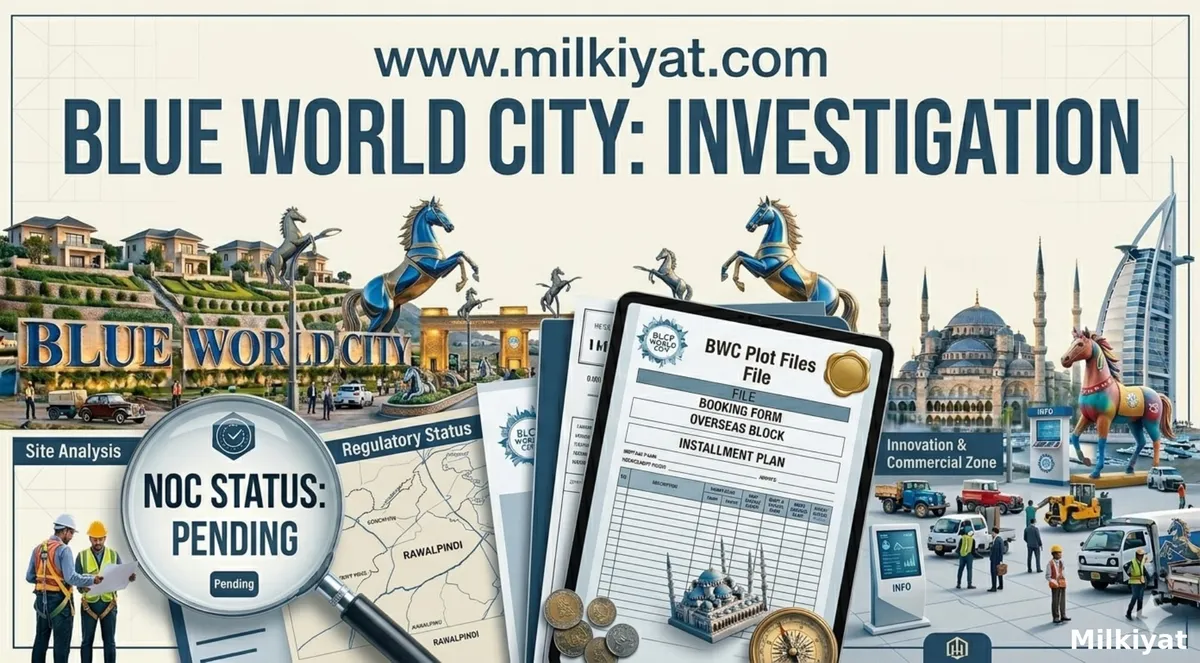
Blue World City (BWC) is frequently marketed as one of the most prominent mega-scale housing projects near the twin cities. BWC markets itself aggressively using replicas of world wonders such as the Grand Burj Al Arab, a massive Blue Mosque, and the world's largest horse mascots to attract buyers.
Behind the glitzy marketing campaigns and low-cost installment plans lies a highly complex, speculative, and risky real estate ecosystem. This investigative report uncovers the ground realities of Blue World City, detailing its ownership, legal status, the mechanics of the "file market," and the pros and cons of investing your hard-earned money there.
1. The Facts About the Ownership
Blue World City is owned and developed by the Blue Group of Companies (BGC), led by its chairman, Saad Nazir.
Who is Saad Nazir?
Saad Nazir is the son of Chaudhry Nazir, a former Deputy Director of the Lahore Development Authority (LDA). This background provided the family with deep, generational insight into land acquisition and real estate regulations in Pakistan. BGC started as a small printing and design company in 1998 before expanding into real estate marketing, construction, and massive land development.
The Corporate Alliance
To execute a project of this scale, Saad Nazir partnered with the Imperium Group of Companies (IGC), owned by Chaudhry Nadeem Ijaz and Chaudhry Naimat Ejaz. Together, they form a formidable consortium. BWC also heavily advertises a partnership with the state-owned Shanxi Construction Investment Group of China, utilizing this connection to brand the project as a "Pak-China Friendly City" tied conceptually to the China-Pakistan Economic Corridor (CPEC).
2. The Great "File" Mechanism: Millions of Files Sold?
One of the most persistent controversies surrounding Blue World City is the sheer volume of "plot files" sold to the public.
What is a "Plot File"?
A file is merely a piece of paper representing a promise of a future plot. It does not carry a specific plot number, street name, or physical boundaries. A file only transforms into a tangible asset after a process called balloting (allotting physical numbers via a lottery system) and subsequent possession.
Why "Lacs of Files" Are Out There
Real estate experts and whistleblowers point out that BWC has sold hundreds of thousands (lacs) of files globally, particularly targeting low-income families and overseas Pakistanis. The strategy relies on overselling:
Capital Injection via Air: Developers routinely sell far more files than the physical land they actually hold. They use the cash collected from these down payments to purchase new chunks of raw land gradually.
The Dealer & App Network: BWC utilizes a vast network of real estate dealers and modern mobile applications. Dealers are given high commissions to push cheap files (e.g., the "Awami Block" or "Sports Valley" files) with down payments as low as 10% to 15%.
The Resale Stagnation: By 2025 and 2026, the secondary file market faced severe saturation. Many investors discovered that their files had no buyers ("files not selling") or were trading at a "Minus Rate" (below the original amount paid). To absorb this excess paper, the management introduced internal adjustments, such as forcing clients to pay massive "balloting dues" (often requiring 75% to 90% of the land cost up front to get a plot number) or offering options to merge stagnant files into developed commercial zones like "Downtown."
3. Geographical and Legal Reality: "Is it Islamabad?"
For years, marketing materials labeled the project as "Blue World City Islamabad." However, an official probe by the Competition Commission of Pakistan (CCP) exposed this as deceptive marketing. The project is actually located deep within the jurisdiction of Rawalpindi, accessed primarily via the Chakri Road corridor near the M-2 Motorway. Following the CCP inquiry, BWC management officially committed to removing the word "Islamabad" from its primary corporate branding, though third-party dealers continue to use it for marketing clout.
The NOC Matrix
The legal status of BWC is historically fragmented: Initial RDA Footprint: The Rawalpindi Development Authority (RDA) originally issued a Technical Approval/NOC for a tiny fraction of the society—only about 427 kanals.
The District Council Shift: BWC later shifted its legal baseline to the District Council Rawalpindi under local government ordinances to get broader layout approvals.
The Sector-by-Sector Trap: Buyers must understand that "The Project" is not universally approved. While central blocks have structural and local regulatory nods, new extensions, further blocks, and outer valleys are continually launched before the corresponding land is legally acquired or approved.
4. Pros and Cons of Investing in Blue World City
If you are considering putting money into this project, you must balance the undeniable visual development against structural risks.
The Pros (Why People Invest)
Unbeatable Affordability: It remains one of the few mega-projects where a lower-middle-class individual can enter the real estate market via an easy 3-to-4-year installment plan.
Rapid On-Ground Infrastructure: Unlike ghost societies, BWC actually moves heavy machinery. The main boulevards, massive entry gates, Trafalgar Square replica, and central commercial areas are physically built and illuminated.
Tourism & Commercial Blueprint: If even half of the planned theme parks, water parks, and mega-stadiums are completed successfully, it will create an active economic hub on the outskirts of Rawalpindi, driving up commercial property values.
Strong Overseas Focus: The Overseas and General blocks receive priority development, offering a reasonable cushion for long-term holders looking to build a house in the distant future.
The Cons (The Hidden Risks)
The Risk of Over-Sized Paperwork: If you buy a raw file today, you are purchasing speculative paper. If you fail to clear heavy installments rapidly, your file risks being blocked, canceled, or excluded from balloting indefinitely.
Distant Possession Timelines: While a select few sectors are getting plot numbers, the vast majority of the outer blocks will take years—potentially a decade—to reach actual on-ground possession and utility deployment (electricity, gas, water).
Deep Outward Location: Located far from the core of Islamabad/Rawalpindi, it is not a practical residence for anyone who needs to commute to the city center daily for work. It depends heavily on future infrastructure like the Rawalpindi Ring Road to become truly accessible. Regulatory Vulnerability: Because the society expands constantly by launching new blocks, it is in a perpetual cat-and-mouse game with local regulatory bodies (RDA/District Council), which can cause sudden policy shifts or temporary bans on transfers
| Investor profile | Recommendations |
|---|---|
| Short-term Speculator | High Risk. The file market is saturated; flipping raw files for a quick profit is highly volatile and longer reliably profitable |
| Long-term end User (10+ years) | Feasible, but with Caution. Buy only map-demarcated, balloted plots or ready-to-possess files in fully developed blocks where you can physically see the ground. Avoid un-balloted, ultra-cheap non-developed files. |
For a more detailed guide on Pakistan’s property file system reforms and what they mean for buyers, investors, and developers, visit Milkiyat.com’s complete guide: “The End of Pakistan’s Real Estate File System: A Complete Guide for Buyers & Developers (2026)”.