Guide
KDA Scheme 33: Societies, Disputes and Verification
Guide

By Maham Imtiaz
Real Estate AnalystVerified author
12 min read
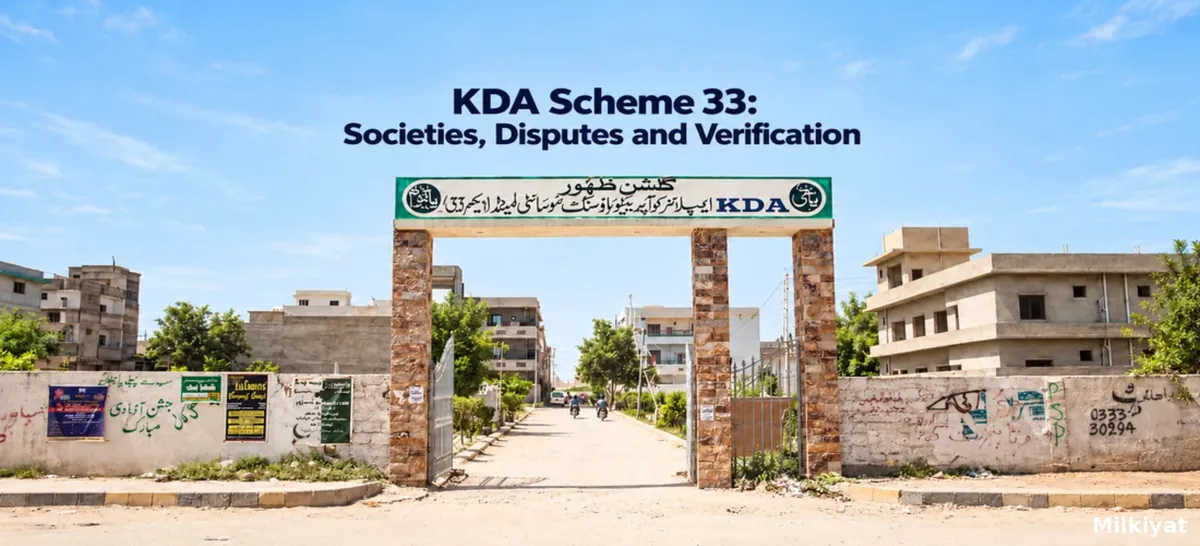
Scheme 33 is the largest and most complicated land scheme in Karachi. Stretched along the Super Highway behind Gulzar-e-Hijri, it was notified by the Karachi Development Authority in 1967, but most of its land was handed out by the Board of Revenue to more than a hundred cooperative housing societies from 1973 onward. Nearly six decades later, a buyer in Scheme 33 is dealing with up to four record keepers at once: the society, the Registrar of Cooperative Societies, the Board of Revenue and KDA.
That layered record is why Scheme 33 needs more checking than an ordinary KDA plot. Our guide on how to verify property in Karachi explains that title has to be traced to the body that granted the land, and in Scheme 33 the chain usually runs from a revenue grant to a society, and only then to the member selling you the plot.
This guide explains how Scheme 33 was set up, who controls what, the disputes that keep reaching the Sindh High Court, what official values show, and how to verify a Scheme 33 plot before paying.
| Year | Event |
|---|---|
| 1967 | KDA first notified Scheme 33 and was given its planning and development |
| 1971 | The Board of Revenue issued a notification setting the allotment policy, land cost and terms |
| 1973 onward | Land allotted to cooperative housing societies |
| 2002 | Allottees' federation said 123 societies held land and about 75,000 allottees had paid charges but many could not build |
| 2004 | Sindh decided to hand Scheme 33 to the city district government; 137 societies reported by then |
| 2020 | Sindh Co-operative Societies Act 2020 replaced the old cooperative regime |
| 2026 | Society disputes and encroachment cases still before the Sindh High Court |
The 2004 decision named "dual control of BoR and KDA" as a main obstacle to development. That split is still the key to understanding Scheme 33: KDA planned the scheme and its layouts, while the Board of Revenue granted the land.
| Item | Reported figure |
|---|---|
| Total area | 26,026 acres |
| Residential land allotted (2002 report) | 9,185 acres |
| Corridor land along the Super Highway | 1,400 acres |
| Green belt | 4,889 acres |
| Housing societies | 123 (2002) to 137 (2004) |
| Allottees who paid charges (2002) | About 75,000 |
| Outer development charges paid to BoR (2002) | Rs517.237 million |
| Outer development charges outstanding (2002) | Rs669.105 million |
| Cost of remaining outer development (2002 estimate) | Rs4.8 billion |
The figures come from 2002 and 2004 official meetings and allottee statements, the last detailed public count. No complete, current list of Scheme 33 societies is published by KDA or the cooperative department.
| Body | Role in Scheme 33 |
|---|---|
| Board of Revenue | Granted land to societies; holds the revenue record by deh and survey number |
| KDA | Notified the scheme; master plan and layout approvals; outer development |
| Registrar of Cooperative Societies | Registers societies, audits them and issues NOCs for sub-leases and transfers |
| The society | Allots plots to members, executes sub-leases, keeps the members' register |
| SBCA | Approves building plans, which now reach it through the Registrar |
| Sindh High Court and Cooperative Court | Decide land and internal society disputes |
The Sindh Co-operative Societies Act 2020 tightened the Registrar's role. Under section 32, a sub-lease, sale deed, gift or surrender of a society plot needs the Registrar's no objection certificate before registration; amenity plots can be allotted only with general body approval and the Deputy Registrar's permission; commercial plots must be sold by open auction; and building plans go to SBCA through the Registrar. Societies must also be audited every year.
Scheme 33's court record shows four recurring kinds of dispute.
1. Overlapping grants. In the 1980s, a 300-acre industrial layout granted to SITE overlapped 24 acres of Zaheen Cooperative Housing Society's land. The Board of Revenue gave the society replacement land in Sector 54-A in 1992, a 2005 consent decree confirmed its ownership, and in April 2022 the Sindh High Court still had to restrain SITE allottees from building on it.
2. Goth and old revenue claims. In Suit 1146 of 2022, a society said it held about 485 acres in Scheme 33 and that about 200 acres in Sector 10, Deh Bhitti Amri, had been encroached through a goth claim based on a 1989 sanction for 52 acres. The court restrained new allotments and sent its Nazir to inspect.
3. Encroachment on amenity plots. The Accountant General Sindh Employees Cooperative Housing Society told the High Court that part of its amenity plot AM-2 in Sector 27-A, about 9,239 square yards earmarked for a hospital, mosque and park, was occupied in October 2023. In September 2025 the court sent the society to the remedy under the encroachment law instead. The Sindh High Court order in CP D-866 of 2025 shows that owners must first approach the competent authority and then the Anti-Encroachment Tribunal.
4. Tenure and management problems. In 2009, the cooperative department issued notices to 34 societies in Sindh for allotting land held on 30-year agricultural tenancy leases as if it were 99-year residential land, a problem buyers often discover only when submitting a building plan. Other Karachi societies have been superseded and run by administrators for years after audit findings of mismanagement.
| Dispute type | Risk to a buyer | What to check |
|---|---|---|
| Overlapping grant | Two parties hold paper for the same land | Society's grant letter and demarcation plan, BoR record |
| Goth or old revenue claim | Part of the society's land is occupied | Site visit, Nazir or court reports, stay orders |
| Amenity encroachment | Plot sold to you may be carved from an amenity | KDA-approved layout plan |
| Short-tenure land | Building plan refused | Lease type: 99-year, not 30-year |
| Superseded society | NOCs and transfers stalled | Registrar's status of the society |
A plot can look perfect on a society file and still fail at one of these points. Possession matters as much as paper here. Our guide on how to verify whether a property has actual possession explains how to confirm that the land on the ground is the land in the file.
The FBR's Karachi valuation table lists Scheme 33 as one broad row, with separate rows for its better-known pockets.
| FBR row | Residential open plot, per sq ft | Commercial open plot, per sq ft |
|---|---|---|
| Air Force Officers Cooperative Housing Society, Scheme 33 | Rs5,000 | Rs14,000 |
| Commercial plots on Jinnah Avenue, Scheme 33 (Sector 40) | Rs5,000 | Rs14,000 |
| Scheme 33, excluding Metroville-III | Rs1,100 | Rs4,250 |
| Metroville II and III, KDA | Rs700 | Rs1,500 |
Most Scheme 33 society plots fall under the single Rs1,100 row, so the official value does not distinguish a well-developed society from one with no roads or water. Buyers should not read a dealer's price as proof that a society is developed.
The amenity check is especially important in older societies, where parks and school sites have been sold as residential plots. Our guide to KDA amenity plots and buyer risk explains how to make sure your plot was never meant to be one.
| Red flag | What it may mean |
|---|---|
| Seller cannot name the society's grant letter | Land may not belong to the society |
| "File" with no plot number | Plot may not exist on the layout plan |
| Society office closed or run by an administrator | Transfers and NOCs may be stalled |
| Plot next to a goth or under a stay order | Possession or title dispute |
| Price far below nearby societies | Short-tenure land, disputed land or no plot at all |
| Payment demanded outside the society's account | Fraud risk |
About a third of Scheme 33 was residential. 9,185 acres ÷ 26,026 acres = about 35.3% of the total area allotted for residential use in 2002.
Nearly a quarter was corridor or green belt. (1,400 + 4,889) ÷ 26,026 = 6,289 acres, about 24.2% of the scheme.
Societies had paid less than half their outer development dues by 2002. Rs517.237 million paid ÷ (Rs517.237 million + Rs669.105 million) = about 43.6%, leaving about 56.4% outstanding.
The average society held about 75 acres of residential land. 9,185 acres ÷ 123 societies = about 74.7 acres each in 2002.
A 120-square-yard plot ranges from about Rs1.2 million to Rs5.4 million on paper. 120 square yards = 1,080 square feet. At the general Scheme 33 rate: 1,080 × Rs1,100 = Rs1.19 million. In the Air Force Officers society: 1,080 × Rs5,000 = Rs5.4 million, about 4.5 times more.
The encroached amenity plot was about 1.9 acres. 9,239 square yards ÷ 4,840 = about 1.91 acres, nearly a tenth of the society's 20-acre allotment.
Scheme 33 is 59 years old. 2026 − 1967 = 59 years since KDA's first notification.
| Check | Where |
|---|---|
| Society registered, audited, not superseded | Registrar of Cooperative Societies |
| Society's land grant and possession letter | Board of Revenue and the society |
| 99-year lease, not 30-year tenancy | Society and Board of Revenue |
| Plot on the KDA-approved layout plan as residential | KDA master plan department |
| Seller in the members' register | Society office |
| No litigation or stay order | Sindh High Court and Cooperative Court |
| Plot demarcated and vacant | Site visit |
| Registrar's NOC before registration | Registrar of Cooperative Societies |
A. A large scheme along the Super Highway, notified by KDA in 1967 and covering about 26,026 acres, much of it allotted to cooperative housing societies by the Board of Revenue from 1973 onward. Gulzar-e-Hijri lies within it.
A. Official reports in 2002 and 2004 put the number at 123 to 137 societies. No current complete list is published, so confirm any society with the Registrar of Cooperative Societies.
A. Usually not directly. KDA planned the scheme, but most plots belong to cooperative societies that received land from the Board of Revenue. The society and the Registrar are the main record keepers.
A. Yes. Under the Sindh Co-operative Societies Act 2020, a sub-lease, sale deed, gift or surrender of a society plot needs the Registrar's NOC before registration.
A. Some societies allotted land held on 30-year agricultural tenancy leases as residential plots. Such land is not meant for housing until converted to a 99-year lease, and buyers often discover this when a building plan is refused.
A. Approach the competent authority under the Sindh Public Properties (Removal of Encroachment) Act 2010 first, then the Anti-Encroachment Tribunal if it fails to act. The Sindh High Court has sent such cases to these forums.
A. The FBR values most of Scheme 33 at Rs1,100 per square foot for residential open plots, with higher rows for the Air Force Officers society and Jinnah Avenue commercial plots.
This guide is for general information. Scheme 33's societies, records and disputes vary plot by plot, and buyers should confirm every grant, lease, NOC and record with the Registrar of Cooperative Societies, the Board of Revenue, KDA and a qualified lawyer before paying.
How much does house finishing cost per sq ft in Pakistan in 2026? This guide compares A, B and C category rates item by item, covers Islamabad, Rawalpindi and Lahore, explains grey structure vs finishing cost, and gives finishing budgets for 5 marla, 10 marla and 1 kanal houses.
What does construction labour cost per sq ft in Pakistan in 2026? This guide covers theka rates for Islamabad, Rawalpindi and Lahore, mason and trade daily wages, finishing labour rates, labour cost for 5 marla, 10 marla and 1 kanal houses, and labour-only vs with-material contracts.
A double-storey 10 marla grey structure costs roughly Rs 92 lakh to Rs 1.19 crore with material in late 2026. See cement, steel and brick quantities, plus labour-only costs for Islamabad, Rawalpindi and Lahore.
A double-storey 5 marla grey structure costs roughly Rs 53–68 lakh with material in late 2026. See how many cement bags, bricks and kg of steel you need, plus labour-only costs for Islamabad, Rawalpindi and Lahore.