Guide
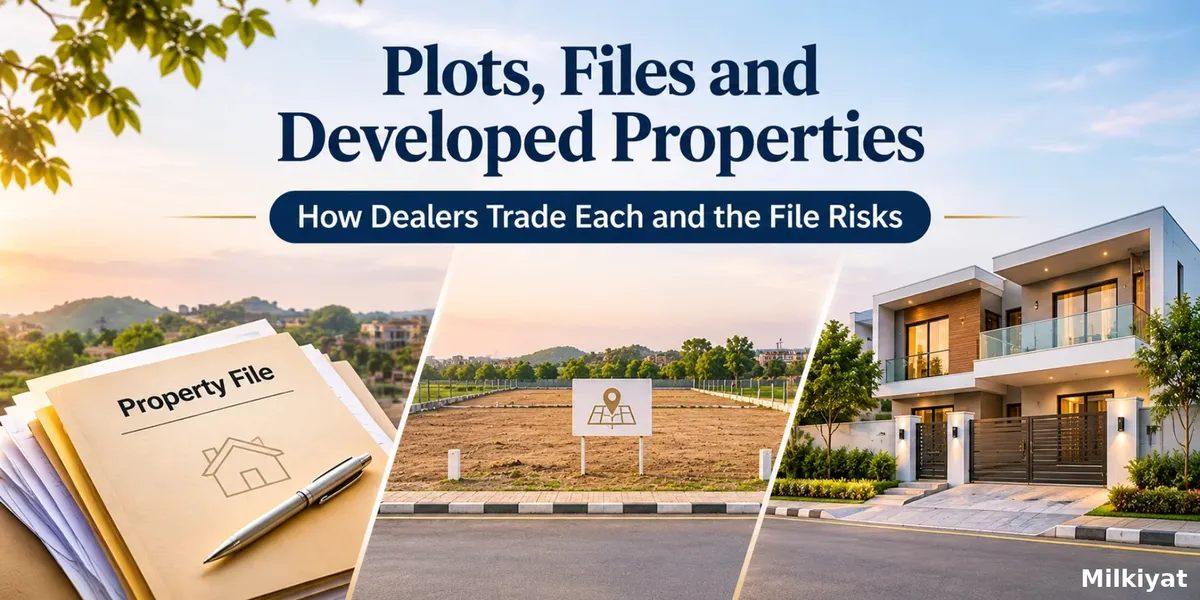
Plots, Files and Developed Properties: How Dealers Trade Each and the File Risks
Guide
Explore apartments for sale in Park View City Islamabad, including 1, 2 and 3-bed units, project details, price comparisons, payment plans and buyer guidance.
A tenant guide to renting an office in F-10 Islamabad covering Markaz plazas, sizes, floors, rent benchmarks, approved use, agreements and a checklist.
A tenant guide to renting a shop in F-10 Islamabad covering Markaz plazas, sizes, floors, rent benchmarks, approved use, agreements and a checklist.
Explore Harmony Park in Capital Smart City, including 3.5 marla residential plots, villa apartments, location, development and property considerations.

By Mariam Khan
Real Estate Analyst
11 min read
In Pakistan's property market, the same society can offer three very different products: a file that promises a plot in the future, an allotted plot with a number and location, and a developed property such as a finished house or apartment. Understanding plot file vs developed property is essential for buyers and dealers alike, because each is priced, traded, verified and transferred differently, and each carries different risks.
This guide explains how dealers trade each type, why files carry the highest risk, and how to verify a plot file before any money changes hands. For a complete overview of how dealers work, see our guide to real estate agents in Pakistan.
| Product | What you get | Key document | Main risk |
|---|---|---|---|
| Open file | A right to a plot of a stated size, location not yet fixed | Booking or membership form, payment receipts | No plot behind the file; anonymity; balloting |
| Allocated file | A file linked to a block or plot after balloting | Allocation or balloting letter | Possession delays; development charges |
| Allotted plot | A specific numbered plot | Allotment letter, site plan | Possession, dues and development status |
| Developed property | A finished house or apartment | Transfer letter or registry, plus building approvals | Title and construction issues |
A file is a membership or booking in a housing scheme that entitles the holder to a plot of a stated size, usually paid in instalments. At first, the file doesn't identify a specific plot. Plots are assigned later, often through balloting, once the society has acquired and planned the land.
Files are popular because they need less money upfront and can be traded quickly. Those same features make them attractive to speculators, and to fraudsters.
An allotted plot has a specific number, block and size, recorded in an allotment letter with a site plan. Once development is complete and dues are paid, the society issues a possession letter, and the owner can build. Allotted plots are priced by block, size, location (corner, park-facing, main boulevard) and development status.
A developed property is a finished house, apartment or commercial unit. Its value depends on location, construction quality, age and condition, as well as the underlying title. Ownership is recorded through a transfer letter (in CDA sectors and societies) or a registered sale deed and mutation (for land-record property). Buyers should also check building approvals and completion.
| Factor | Files | Allotted plots | Developed properties |
|---|---|---|---|
| Typical clients | Investors and speculators | Investors and future builders | Families, end users, landlords |
| How prices move | Fast; driven by society news, balloting and developer announcements | Block-wise, by development progress | Slower; tied to local demand and condition |
| Paperwork | Booking forms, receipts, allocation letters, society transfer | Allotment letter, site plan, NDC, transfer | Ownership documents, building approvals, NDC, transfer or registry |
| Verification focus | Does the file exist? Is it backed by land? Who holds it? | Plot status, dues, development charges | Title, approvals, construction, utilities |
| Deal speed | Very fast | Moderate | Slower, more viewings |
| Risk to the buyer | Highest | Medium | Lowest, if title is clean |
Dealers who specialise in a society often trade all three, but the verification work, and the conversations with clients about risk, are very different for each.
The biggest risk: a society sells more files than it has land for, or sells files before acquiring land at all. Buyers end up holding paper that may never become a plot.
A file in a society without the required NOC from the development authority carries serious legal risk, whatever its market price.
Forged booking forms, receipts or allocation letters, and the same file sold to more than one buyer.
Pakistan's National Risk Assessment 2023 rates real estate as a "Very High" money laundering risk and names open files and villas among the most vulnerable products. Because open files can change hands quickly and with little paperwork, they can be used to hide who really owns an asset.
An open file may be balloted into a less desirable block than the buyer expected, changing its value overnight.
Unpaid instalments can lead to penalties or cancellation, and development charges can add substantially to the cost before possession.
File prices can rise sharply on news and fall just as quickly. In a slow market, files can be hard to sell at all.
Even genuine, allocated files can take years to reach possession if development is slow.
FMU's red flag indicators for the real estate sector include several patterns that show up in file trading:
For dealers, these patterns call for extra client checks. For buyers, a seller or dealer showing them is a reason to slow down.
Before paying anything for a file:
Our buyer's checklist for property dealers explains how to check the dealer handling the file.
Our guide on how to verify property ownership covers these checks for each type of authority.
Here's an illustrative comparison showing why files feel exciting and why they're risky. It's a worked example with assumed figures, not investment advice.
A file on instalments
Scenario A: the file trades at a Rs 3,00,000 premium
Scenario B: the file trades Rs 2,00,000 below cost
An allotted plot, fully paid
What it shows: the same Rs 3,00,000 gain is a 20% return on a file but 5% on a fully paid plot, because the file buyer has paid less cash. The same leverage works in reverse: a modest price fall wipes out a large share of the cash invested, and the buyer still owes Rs 35,00,000 in instalments. That's before the risk that the file isn't backed by a plot at all.
Our guide to token money rules explains how to keep advance payments safe on file deals too.
Dealers who work one society every day know its file rates, balloting history, block-wise plot prices and transfer office procedures. Milkiyat's agent pages show each dealer's areas, listings and reviews:
1. What is the difference between a plot file and a developed property?
A file is a right to a plot in the future, often without a fixed location. A developed property is a finished house or apartment with clear ownership documents. Files carry far more risk.
2. What is an open file in property?
An open file is a booking or membership in a housing scheme that hasn't yet been assigned a specific plot. It can change hands several times before balloting.
3. Why are open files risky?
They may not be backed by land, may be in unapproved schemes, can be faked or duplicated, can be balloted into less desirable blocks, and are named in Pakistan's National Risk Assessment as highly vulnerable to money laundering.
4. How do I verify a plot file?
Check the society's approval status, verify the file number, holder, instalments and transfer history with the society office, see original documents, meet the holder, transfer through the society and pay the holder directly after verification.
5. Is an allotted plot safer than a file?
Generally, yes. An allotted plot has a specific number and location, though buyers should still check possession status, dues and development charges.
6. Should I buy a file through a dealer?
A dealer who specialises in the society can help, but only one who verifies the file with the society, explains the risks and keeps payments going directly to the holder.
Files, allotted plots and developed properties are three different products, even within the same society. Files offer low entry costs and fast trading, but carry the highest risks: no land behind the paper, unapproved schemes, fake or duplicate files, and anonymity that makes them attractive for money laundering. Allotted plots and developed properties are safer, but still need verification. Whatever you buy, verify it with the society or authority first, transfer it into your own name, and pay only the registered holder.
Find agents who specialise in your target society on Milkiyat.com, and compare their listings and reviews before you buy.
This guide is for general information only and isn't investment advice. Society rules, balloting procedures, development charges and approval status differ between schemes and change over time. Confirm the status of any file, plot or property with the society and the relevant development authority, and consult a qualified lawyer before buying. The worked example uses assumed figures. Milkiyat.com does not provide legal, tax or financial advice.
-National AML/CFT Authority / FBR, National Risk Assessment 2023:
-Financial Monitoring Unit (FMU) / FBR, Red Flag Indicators for Real Estate Sector: