Guide
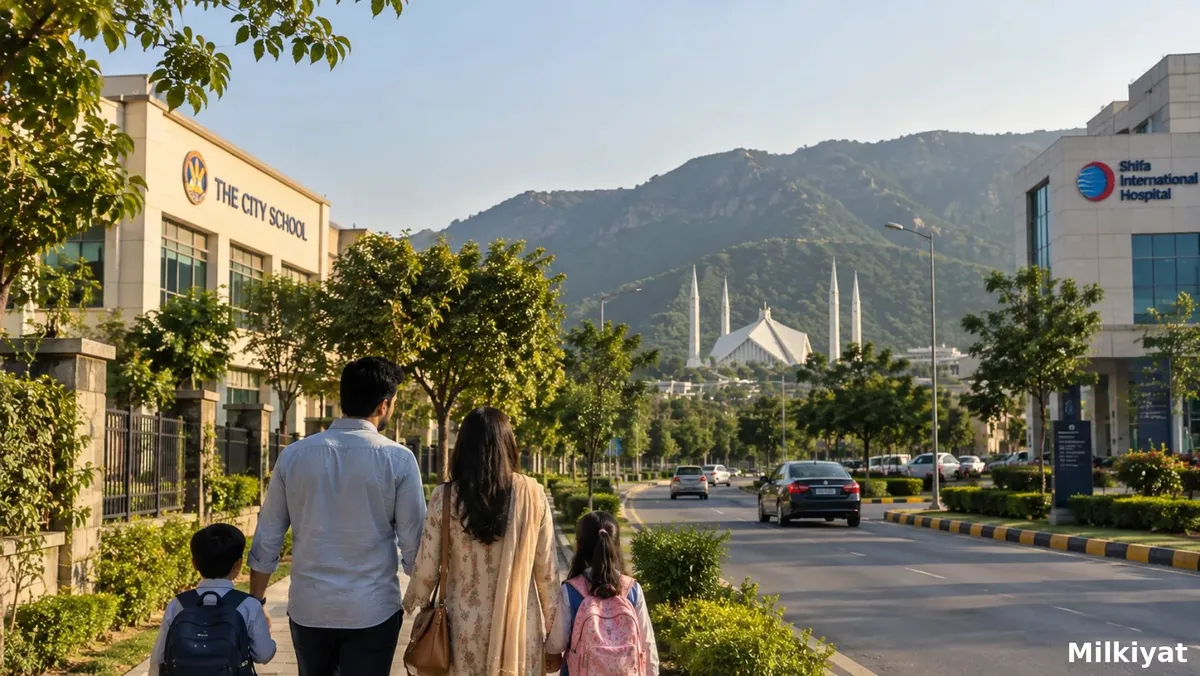
Best Areas for Families Near Islamabad Schools and Hospitals (2026 Guide)

By Bibi Masooma
Real Estate AnalystVerified author
13 min read
Short Answer
For families, F-8, F-10, F-11, G-11, and G-13 are some of the practical areas to consider in Islamabad. These sectors offer a good balance of schools, hospitals, markets, parks, and road connectivity. F-8 and F-10 are well-established options, while G-11 and G-13 may offer better value for families on a tighter budget.
Tip: Before buying or renting, check the actual distance to your preferred school and hospital, along with traffic, water supply, parking, and emergency healthcare access.
Introduction
Infrastructure is one of the biggest factors quietly reshaping Islamabad and Rawalpindi's property landscape. A new road can shorten a daily commute, a reliable water network can make a previously difficult-to-develop area more practical, and improved highway connectivity can create demand for commercial, industrial and logistics properties.
For property buyers and investors, the important question is not simply which infrastructure projects are being built, but which locations are likely to benefit from them and why. Understanding the relationship between infrastructure development and property prices in Islamabad and Rawalpindi can help buyers make more informed decisions in 2026. For a broader look at Islamabad's sectors, connectivity, property market and residential areas, explore our Islamabad Area Guide 2026.
Across the Islamabad-Rawalpindi region, different types of infrastructure are creating different opportunities. Water-supply improvements are particularly relevant to parts of Rawalpindi that have historically faced supply constraints, while new and extended road corridors are improving access to western Islamabad. At the regional level, CPEC-linked connectivity and industrial expansion could also influence demand for warehouses, commercial properties and supporting real estate around major interchanges and transport routes.
This guide examines these infrastructure developments through a property-market lens and looks at the areas that could benefit most in 2026, while separating actual infrastructure improvements from future plans and investment assumptions.
Best Areas for Families Near Islamabad Schools and Hospitals: A 2026 Housing Guide
Most property content in Islamabad is written around one question: will this plot or house appreciate? Families relocating with school-age children or elderly parents are usually asking a different question: can I get my kids to a decent school in fifteen minutes, and can I reach a proper hospital quickly if something goes wrong at 2 a.m.? Those two questions can change the shortlist of the best family-friendly areas in Islamabad considerably.
Islamabad has an advantage here that most Pakistani cities don't: the Capital Development Authority (CDA) planned the city around a grid-based sector system, with residential sectors designed as independent neighbourhood communities. This planning structure still influences which areas are convenient for families today, although development and service quality can vary between sectors. For a broader overview of residential sectors, connectivity and property options, see our Islamabad Area Guide 2026. The CDA's Planning and Design Wing also provides information about Islamabad's master plan and sector-based urban planning.
For families, location is about more than the size or price of a house. School proximity, hospital access, markets, parks, public transport, road connectivity, water supply and overall neighbourhood development can all affect everyday quality of life. Established sectors may offer easier access to existing facilities, while newer and peripheral areas can provide newer housing options but may involve longer journeys for schools, healthcare and daily shopping.
This guide looks at livability rather than investment upside: proximity to established schools, distance to a functioning hospital, and the everyday convenience of markets, transport and security. It also considers where the trade-offs show up as you move from Islamabad's older core sectors toward the city's expanding edges and satellite housing societies.
As Islamabad continues to upgrade existing sectors, infrastructure improvements such as roads, footpaths, parking, drainage, street lighting and commercial-area rehabilitation can also affect day-to-day convenience. CDA has announced sector improvement and rehabilitation initiatives covering these facilities across existing sectors. CDA's 2026 sector-upgrade update provides further details on these improvements.
The aim of this guide is therefore not to name one universally “best” area, but to help families compare locations based on the things that matter most in everyday life. A sector that works well for a family with children attending schools in central Islamabad may not be the best choice for someone who prioritises quick hospital access, quieter surroundings or a shorter commute to Rawalpindi.
How Islamabad's Sector Layout Affects Family Life
Islamabad's sector-based planning remains one of the city's biggest advantages for families. Each CDA sector is subdivided into four numbered sub-sectors, and the original planning approach was designed around the idea that residents should have access to essential facilities without travelling long distances. Primary schools were intended to serve individual sub-sectors, while secondary schools, colleges, markets, parks and other community facilities were planned at the sector level.
This planning model is particularly visible in Islamabad's established F- and G-sectors. Areas such as F-6, F-7, F-8, F-10, F-11 and G-6 through G-11 have developed over several decades and now contain a broad mix of schools, colleges, parks, markets, mosques and residential streets. Families living in these sectors can generally choose between multiple education options within a relatively short driving distance rather than depending on facilities located far outside their neighbourhood.
The concentration of established schools is also important for families who have children at different education levels. Parents may be able to find primary, secondary and higher-level educational institutions within the wider F- and G-sector cluster, reducing the need for long daily journeys across the city. The availability of established neighbourhood markets and everyday services adds another layer of convenience, particularly for households that prioritise routine accessibility over larger houses or newer developments.
However, Islamabad's planning advantages are not equally visible in every part of the city. Sectors developed later, particularly parts of the I-series as well as outer E- and D-sectors, can have thinner coverage of schools and healthcare facilities within their immediate boundaries. Residents in these areas may therefore depend more heavily on neighbouring sectors for specialised education, medical care and other services.
I-8 is a useful example. The sector has educational institutions and colleges, but residents may still need to travel to nearby sectors for major hospital services. For anything beyond routine medical care, facilities in areas such as H-8 and F-8 can become part of the practical daily catchment. This means that the distance shown on a map is not always the best measure of convenience; the availability of an operating facility and the actual travel route matter more.
The same principle applies when comparing established sectors with newer housing developments on Islamabad's outskirts. A newer area may offer larger houses, wider roads or modern community facilities, but families should look beyond the development's own boundaries and assess what is available within a realistic 10-, 15- or 20-minute drive.
For families, this makes sector-level planning an important part of the property decision. A house may look attractive in isolation, but its real convenience depends on the surrounding ecosystem of schools, hospitals, markets, parks and transport links. Buyers should therefore assess the neighbourhood as a whole rather than judging a property only by its size, construction quality or asking price.
In practical terms, established F- and G-sectors tend to appeal to families who place a premium on mature infrastructure and proximity to everyday services. Meanwhile, families considering I-series or peripheral areas may need to accept a greater reliance on neighbouring sectors. The trade-off can still make sense, particularly where a buyer values other factors such as space, budget or a quieter residential environment, but those compromises should be understood before purchasing.
Islamabad's Planned Sectors and Their Impact on Family Living
| Planning Feature | Family Benefit | Potential Limitation |
|---|---|---|
| Nearby Schools | Reduces school travel time and makes daily routines easier. | School options can vary between sectors. |
| Local Markets | Makes groceries, pharmacies and daily shopping more convenient. | Busy markets can create traffic and parking issues. |
| Parks & Play Areas | Provides accessible outdoor space for children and families. | Maintenance standards may differ by location. |
| Healthcare Access | Living near major hospitals can be valuable for families and elderly residents. | Some sectors are farther from large hospitals. |
| Main Road Access | Easier commuting to workplaces, schools and commercial areas. | Main roads may experience heavy peak-hour traffic. |
| Established Infrastructure | Older sectors generally have more mature roads, utilities and community facilities. | Older houses and infrastructure may require upgrades. |
| Newer Development Areas | Can offer modern housing and newer layouts. | Schools, hospitals and commercial facilities may take time to develop. |
| Green & Open Spaces | Supports a quieter environment and family recreation. | Access and maintenance can vary between neighbourhoods. |
Family Access by Sector Group
Family convenience can vary significantly across Islamabad's sector groups. Established sectors such as F-8 to F-11 generally provide stronger access to schools, hospitals, markets, parks and major roads. G-8 to G-11 also offer good everyday facilities, while G-13 to G-14 can provide a balance between newer housing and access to essential services. More peripheral areas may offer greater space or newer development but can involve longer travel times for schools, hospitals and daily shopping.
In simple terms: the closer a family is to established schools, healthcare, markets and main roads, the more convenient everyday life is likely to be.
| Sector Group | School Access | Nearest Major Hospitals | Typical Trade-off |
|---|---|---|---|
| F-6, F-7, F-8, F-10, F-11 | Dense multiple established private and international-standard schools | Maroof International (F-10), PIMS (G-8, short drive), Ali Medical Centre (F-8) | Higher rents/prices, older housing stock |
| G-6, G-7, G-9, G-10, G-11 | Strong mix of government colleges and private schools | PIMS (G-8), Poly Clinic (G-6) | Mixed density, heavier traffic near markaz areas |
| H-8, H-9 | Universities and colleges rather than school clusters | Shifa International (H-8), several private clinics | Institutional character, fewer standalone family homes |
| I-8, I-9, I-10 | Reasonable college access, thinner primary-school density | Rely on H-8/F-8 hospitals; no major hospital within sector | Water-supply and tubewell dependence (see related water guide) |
| E-7, E-11 | Good close to F-7/F-10/F-11 school clusters | Shares F-sector hospital access | Higher-end pricing, embassy-adjacent security profile |
| DHA Islamabad-Rawalpindi, Bahria Town phases | Growing school presence inside the society; several branded schools now operating on-site | Distance to major tertiary hospitals is longer; society-level clinics only for routine care | Longer commute to central Islamabad; GT Road/expressway dependent |
Hospital Access: Why It Varies More Than School Access
Islamabad's major tertiary-care hospitals are concentrated in a handful of locations: the Pakistan Institute of Medical Sciences (PIMS) in G-8, Shifa International Hospital in H-8, Maroof International Hospital in F-10, Poly Clinic in G-6, and Ali Medical Centre in F-8 Markaz. Families in the F- and G-sectors, and in E-7/E-11, are typically a 10–15 minute drive from at least one of these on a normal traffic day.
The picture changes for households in outer sectors and for gated societies along GT Road or the Islamabad Expressway DHA Phase 2 Islamabad, Bahria Town's Rawalpindi phases, and newer expressway-adjacent societies. These areas generally have on-site clinics or smaller private hospitals for routine care, but a medical emergency requiring PIMS- or Shifa-level facilities can mean a 30–40 minute drive, more in peak traffic. That distance is a genuine trade-off families should weigh against the larger houses and lower per-marla prices these societies typically offer Milkiyat.com does not have verified current pricing for this comparison and recommends checking listings directly for up to date figures.
What This Means for Different Kinds of Families
Families prioritising a short school run and hospital access: F-6 to F-11 and G-6 to G-11 remain the most consistent choices, at a price premium reflecting their maturity and location.
Families with a tighter budget who can accept a longer commute: I-series sectors offer reasonable college-level education access and lower housing costs, but buyers should separately check water-supply reliability in these sectors (see our related water-vulnerability guide) since several I-series areas depend heavily on tubewells affected by load-shedding.
Families wanting more space and are willing to trade proximity for it: DHA Islamabad-Rawalpindi and Bahria Town phases increasingly host branded schools within the society itself, which narrows the schooling gap, but tertiary hospital access and commute time to central Islamabad remain the main considerations.
What Buyers Should Verify Before Deciding
- Confirm the actual admission catchment or availability at your preferred school sector proximity does not guarantee a seat.
- Drive the route to the nearest major hospital at the time of day you would realistically need it (evening/night traffic differs sharply from midday).
- For peripheral societies, ask specifically which on-site clinic exists today versus what is "planned" a promised hospital is not the same as an operating one.
- Check current CDA sector development status directly with CDA before assuming full infrastructure is in place, especially in I-series and D-series sectors.
Bottom Line
For families whose top priority is minimising the school run and staying close to a major hospital, Islamabad's established F- and G-sectors remain the strongest match, at a higher price. Families prioritising space and budget over proximity may find peripheral societies workable, provided they verify on-the-ground school and clinic availability rather than relying on marketing material, and factor in the longer emergency-care commute.
FAQs
Which Islamabad sectors are closest to the most schools?
The F-6 to F-11 and G-6 to G-11 sector clusters have the densest concentration of established private and government schools in the city.
Is PIMS or Shifa International closer to most family sectors?
Both sit within a comparable radius of the F- and G-sector core; PIMS is in G-8 and Shifa International is in H-8, so the shorter drive depends on your exact sector.
Do DHA Islamabad and Bahria Town have schools inside the society?
Several branded schools now operate within these societies' developed phases, but coverage varies by phase confirm which schools are actually operating in your specific block before relying on it.
Are I-series sectors a good option for families on a budget?
They can work for education access, but several I-series sectors have documented dependence on tubewells affected by load-shedding, which is worth checking before committing.
Does living farther from central Islamabad always mean worse hospital access?
Not entirely some peripheral societies have decent routine-care clinics but access to tertiary/emergency-level hospitals is generally slower from these locations.