Guide
Dha-margalla-enclave-2026-plot-to-modern-home
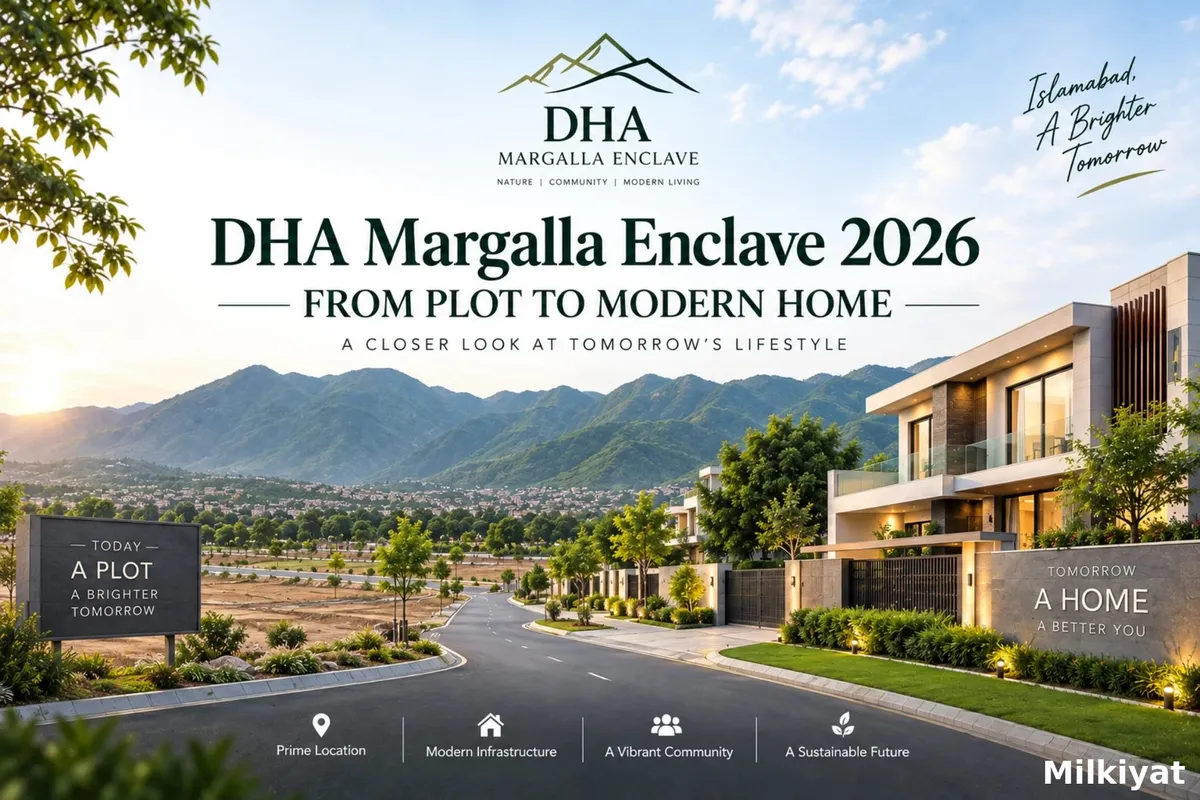

By Bibi Masooma
Real Estate AnalystVerified author
13 min read
Short answer:
DHA Margalla Enclave Islamabad is still primarily a plot-and-construction project rather than a fully developed neighbourhood. DHA has announced possession on selected ME-2 streets in 2026, while much of the scheme remains under development. Features such as Margalla Hills views, the Lake District, mosques, schools and healthcare facilities represent the planned community. Early buyers should therefore expect to live alongside ongoing construction rather than in an established Islamabad sector.
This guide focuses on living conditions, daily use amenities and the practical reality of living in DHA Margalla Enclave Islamabad not just plot prices or construction progress. It explains who the scheme currently suits, what facilities are available, what remains planned, how commuting may work, and whether an early move makes sense for your family.
Who this scheme is actually built for right now
Before imagining life in DHA Margalla Enclave, it helps to identify the project’s stage. This is not a mature sector such as G-11 or F-10, where roads, houses, schools, shops, utilities and rental markets have had years to settle into a predictable pattern. It is a joint CDA–DHA scheme on CDA land, with DHA executing development and handover work through a phased build-out.
That makes the scheme most suitable for two groups at present. The first is an early end-user who plans to build and live there over several years while infrastructure and private construction catch up. The second is an investor or long-term owner who is comfortable holding land rather than depending on rental income or immediate neighbourhood convenience. For a broader view of the area’s investment potential, see Milkiyat.com’s DHA Margalla Enclave investment guide.
A third group deserves a warning. Some buyers may have been shown a “move-in ready lifestyle” presentation without being told which specific street or block that description refers to. If that is your situation, the key question is not whether the master plan looks attractive. It is whether your exact plot sits on a street with working access, usable utilities, nearby occupied homes and a realistic daily route to school, work and healthcare.
A planned amenity can be valuable in the long term. It should not be counted as a current amenity until it is built, open and operating.
What exists today versus what is still planned
The status of the scheme is easier to understand when divided into physical infrastructure, household services and lifestyle facilities.
| Amenity or service | Broad status in 2026 | What a resident should assume |
|---|---|---|
| Boundary walls | Reported largely built around the perimeter | Security and site definition are progressing, but this does not prove internal livability |
| Jinnah Avenue frontage | Open and functioning as the main access route | The main entrance route exists; internal access still varies by street |
| Internal roads | Under construction in multiple blocks | Inspect the exact street before planning construction or daily use |
| Water, electricity and sewerage | Underground installation ongoing block by block | Confirm plot-level connection points and activation status |
| Schools and colleges | Planned within the master plan | Use established schools outside the scheme until an operating facility is confirmed |
| Clinics and hospitals | Planned across sectors | Plan for off-site healthcare for the foreseeable early period |
| Mosques | Planned at block level | Do not assume a completed mosque exists near your plot |
| Commercial markets | Planned along the boulevard and in the Lake District | Expect to travel outside the scheme for regular shopping initially |
| Parking near community facilities | Planned | Current parking convenience depends on the exact active site area |
The practical dividing line is between services a home cannot operate without and amenities that improve convenience. A family can travel to an outside school or clinic, although the commute may be inconvenient. A family cannot treat a house as fully livable if the road, electricity, water or sewerage connection at that street is unresolved.
The five blocks as future neighbourhoods
DHA Margalla Enclave is divided into ME-1, ME-2, ME-3, ME-4 and the Lake District. The residential blocks do not necessarily offer the same living experience because plot sizes, likely construction density and possession timing differ.
ME-1 and ME-4 carry 5 Marla and 10 Marla residential plots, alongside commercial plots. These smaller plot sizes are commonly compared by family buyers seeking a more accessible entry point. Once utilities reach a street, smaller plots may produce more simultaneous house construction because more households can build within a similar area. That can lead to a faster sense of neighbourhood activity, although construction traffic and unfinished plots may also remain visible for longer. For buyers comparing smaller residential plots, see Milkiyat.com’s guide to 5 Marla plots in Islamabad and Rawalpindi.
ME-2 and ME-3 carry 1 Kanal residential plots. These blocks are positioned toward larger homes, more space and a lower-density residential character. ME-2 is also the block associated with the first reported possession on selected streets in 2026. Possession, however, does not mean every street in the block has the same level of construction, occupancy or convenience.
The Lake District is a dedicated commercial precinct planned around an artificial lake. Its intended role is to bring restaurants, cafés and retail into the scheme. It is not a residential block, and its success will depend on the population, access and commercial demand generated by the surrounding neighbourhoods.
The choice between these areas is therefore partly a lifestyle choice and partly a timing choice. Buyers who value a denser, more active setting sooner may prefer to investigate ME-1 or ME-4 once street-level services are available. Buyers who prioritise larger plots, lower density and privacy may accept a longer wait in ME-2 or ME-3. Neither option guarantees a faster or better outcome; the exact development sequence remains decisive.
| Buyer priority | More relevant question |
|---|---|
| Move in as soon as possible | Which exact street has possession, utilities and usable access now? |
| Build a larger house | Is the 1 Kanal block’s street infrastructure complete enough for construction logistics? |
| Find a lived-in atmosphere | How many occupied homes exist nearby, not just how many plots are allotted? |
| Hold for long-term upside | Can you carry the investment without rent or immediate amenity income? |
| Depend on schools and clinics | Which functioning facilities outside the scheme will serve your family? |
Planned schools, healthcare and mosques
Project plans include schools, colleges, clinics, hospitals and block-level mosques. However, planned facilities should not be considered operational unless their construction, operator and opening status are confirmed.
For families, a planned school or hospital is very different from a functioning facility. Early residents may therefore need to rely on established institutions in Islamabad, which can mean longer commutes, higher transport costs and additional travel time until local facilities become operational.
For mosques, the same caution applies at a smaller daily scale. A block-level mosque can become an important social anchor once built, but a planned mosque does not help a household today. Ask whether the site has been allocated, whether construction has started, and which currently operating mosque is the practical alternative.
The Lake District as a future lifestyle anchor
The Lake District is a planned commercial precinct centred around an artificial lake, with proposed restaurants, cafés and retail for residents.
Its appeal comes from combining open space, scenery and commercial activity, but its success depends on completed roads, utilities, parking, safety and enough residents to create regular footfall.
For now, buyers should treat the Lake District as long-term potential rather than a current amenity and assess the property on existing infrastructure and accessibility.
Commute reality, not the brochure version
Jinnah Avenue gives the scheme a direct route toward the city. Project distance material places the F-7/F-8 Markaz area at roughly 18 kilometres, with an estimated drive of approximately 20 minutes via Park Road in light traffic. That is a useful orientation figure, but it is not a guaranteed commute time.
The estimate should be read alongside two facts. First, traffic conditions around Park Road and the Markaz areas change substantially by time of day. Second, the Park Road underpass intended to serve the scheme has faced delays, while the planned Srinagar Highway link through Banigala is not yet a completed route. Residents should therefore build their daily routine around the roads that exist now, not the network shown in the eventual vision.
A genuine commute test is more informative than a map. Drive from the actual plot or street to the school, office or university at the time you would normally travel. Repeat the test during the return journey. Record the distance, time, road bottlenecks, parking difficulty and the cost of making the trip several times each week.
The future access roads may reduce travel friction. They should be treated as an improvement to be delivered, not as a benefit already available to a household moving in today.
Building on your own plot
Early residents should expect house construction to continue alongside developer work, including roads, utilities, landscaping and neighbouring construction.
Before building, confirm with DHA’s site office that your specific plot has a usable road, clear demarcation and practical water and electricity connection points. Block-level development does not guarantee plot-level readiness.
Also budget for possible temporary needs such as generators, water tankers, extra storage, security and alternative access. These can increase the real cost of building or moving in during the early development stage.
A household should also ask whether waste collection, security response, street lighting and emergency vehicle access are already functioning. These practical services often receive less attention in a master-plan presentation but have a direct effect on the experience of living in a new area.
What is genuinely missing right now
The most important gaps are not cosmetic. There is no independently confirmed, currently operating school, hospital or retail market inside the scheme in the source material used for this guide. The Lake District is a planned commercial precinct rather than a functioning destination. Two of the three intended access routes are delayed or not yet built. Construction and utility work continue across parts of the project.
These gaps do not automatically make Margalla Enclave a poor long-term proposition. The scheme has institutional backing, a location near the Margalla landscape and a development model that may produce a substantial planned district over time. The issue is that the benefits are distributed across different time horizons.
| Time horizon | What a resident may reasonably focus on |
|---|---|
| Immediate | Exact street access, possession, utilities, security and construction disruption |
| Near term | House-building logistics, school and healthcare commutes, population growth and road completion |
| Medium term | Occupancy, commercial demand, block-level community services and additional access routes |
| Long term | Mature neighbourhood character, Lake District activity, resale depth and amenity completeness |
In 2026, “living in DHA Margalla Enclave” means living ahead of the infrastructure in many parts of the scheme. That can suit an early mover who values future potential and can absorb inconvenience. It is a poor fit for someone who needs a finished community immediately.
A realistic way to plan your move
A move should be planned as a sequence rather than a single event.
First, confirm that the specific plot is within a street where possession and physical access are documented. Second, verify the permanent utility connection path and keep a temporary water and power plan in the budget. Third, identify the schools, clinics, supermarkets, mosques and workplaces the household will use before the scheme’s own facilities open. Fourth, calculate the daily commute using only existing roads. Fifth, revisit the development every six to twelve months using DHA’s written updates and an in-person inspection.
This approach reduces the risk of treating a future amenity as a present benefit. It also helps distinguish between a household that can tolerate early-stage conditions and one that would be more comfortable renting or buying in an established sector while holding the Margalla Enclave plot as a longer-term asset.
How living here compares with an established sub-sector
An established CDA area such as G-11/1 offers ready access to homes, rentals, schools, shops, clinics, mosques, utilities and established roads. DHA Margalla Enclave, by comparison, offers newer planning, open surroundings, Margalla Hills views and long-term development potential.
The trade-off is uncertainty around population, commercial facilities and remaining infrastructure. Buyers needing immediate convenience may prefer an established sector, while those comfortable with phased development may find DHA Margalla Enclave more suitable for long-term living or investment.
The most important decision is to identify which buyer you are before committing money.
Questions worth asking before you commit to living here
Ask whether your specific street—not just your block—has a confirmed utility connection date. Ask whether the school and clinic sites shown on the master plan have been allotted to an operator or remain reserved land. Ask how many households are currently living on your street and the streets immediately around it. Ask which shops, mosques and healthcare providers are open today. Ask what your commute looks like using only existing roads. Finally, ask what temporary arrangements will be necessary during the first year of construction or occupation.
The answers should be specific. “The block is developing” is not a substitute for a street number. “Facilities are planned” is not a substitute for an operating address. “The road is coming soon” is not a substitute for a written date or a visible, usable connection.
Frequently asked questions
Can I actually move into DHA Margalla Enclave today?
Only on the limited number of streets within ME-2 where DHA has announced possession and where plot-level access and utilities have been confirmed. Elsewhere, construction and utility work remain active, so most owners should not assume that immediate occupation is practical.
Are schools and hospitals already operating inside the scheme?
Schools, colleges and clinic or hospital facilities form part of the planned amenity mix. They were not independently confirmed as operating in the source material used for this guide. Families should plan around established facilities outside the scheme.
What is the Lake District?
It is a planned commercial precinct around an artificial lake, intended for restaurants, cafés and retail. It is a future lifestyle feature, not a currently functioning commercial area.
How long is the commute to central Islamabad?
Project material places the F-7/F-8 Markaz area at about 18 kilometres, or roughly 20 minutes via Park Road in light traffic. Actual peak-hour travel can be longer, and the estimate does not depend on the delayed Park Road underpass being operational.
Which block should a family buyer consider first?
ME-1 and ME-4 contain 5 Marla and 10 Marla residential plots that many family buyers compare first. ME-2 and ME-3 contain 1 Kanal plots aimed at larger homes. The best choice depends on plot size, timing, budget and whether the specific street is ready for occupation.