News
Gul Plaza Fire Probe Blames Building Management as Karachi Commercial Property Safety Comes Under Scrutiny
News

News

Real Estate Analyst
5 min read
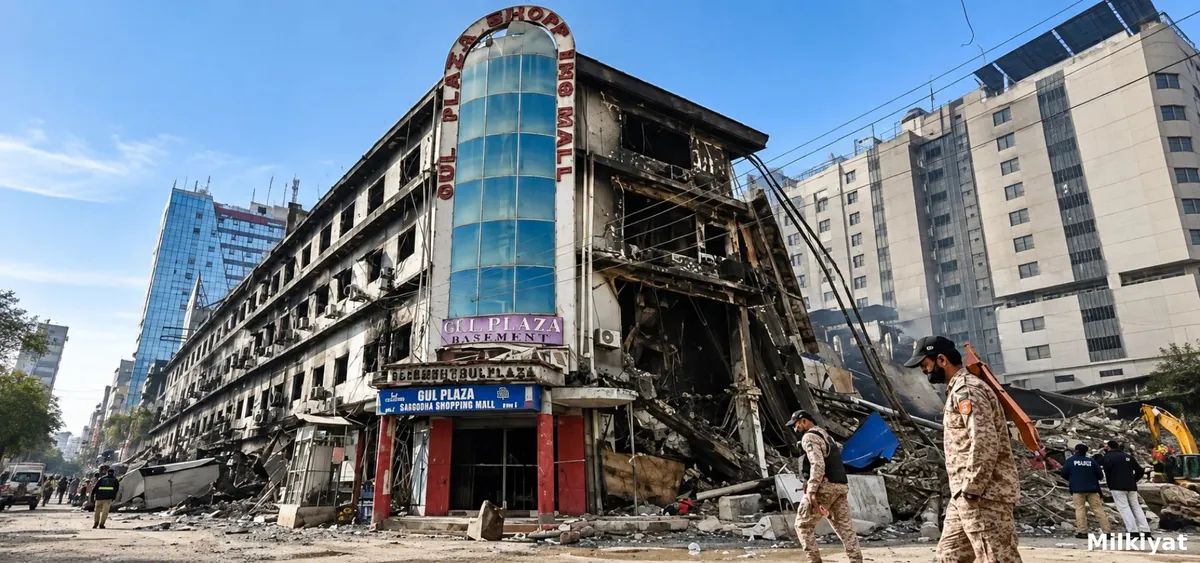
Karachi police submitted a fresh charge sheet before the South judicial magistrate on 5 September 2026 in the Gul Plaza fire case, holding the shopping mall's management primarily responsible for the blaze that killed more than 72 people and gutted over 1,100 shops on 17 January 2026. The charge sheet alleges the building lacked adequate firefighting equipment for its scale, had no alternative arrangement for emergency lighting, and had certain gates or grills locked, directly hampering evacuation efforts.
According to the charge sheet, police found no negligence on the part of the Karachi Metropolitan Corporation, the fire brigade, or Civil Defence, instead placing responsibility squarely on the Gul Plaza management association. Investigators included 87 witnesses in the case and specifically raised questions over the fire safety arrangements maintained at the shopping centre, alongside the safety measures available within individual shops. Police stated forensic examination found no explosive material and no traces of any flammable liquid, reinforcing that the fire's catastrophic spread and death toll stemmed from inadequate safety infrastructure rather than the nature of how the fire itself started.
This is not the investigation's first attempt at a charge sheet. An earlier version submitted in July had named six accused, including an 11 year old boy alongside his father and four members of the Gul Plaza Management Committee, but a judicial magistrate rejected that document, finding the investigating officer had not conducted a sufficiently thorough probe. This fresh charge sheet represents the investigation's corrected, resubmitted findings.
A parallel judicial commission, formed by the Sindh government under Justice Agha Faisal following Sindh High Court nomination, reached findings that align directly with and reinforce the police charge sheet. The commission concluded that Gul Plaza's de facto management was aware of the building's fire safety deficiencies but failed to take corrective measures, describing this as a failure spanning all three essential components of fire safety, prevention, detection, and firefighting, and stating that the absence of an integrated fire safety system meant the fire could not be regarded as an unforeseeable event, but rather as a foreseeable consequence of operating the building in a hazardous condition.
Prime Minister Shehbaz Sharif has urged early groundbreaking of Pakistan’s ML-1 railway project as the government and ADB push for faster progress on railway reforms, freight connectivity, and infrastructure development. The project could have major implications for industrial land, warehousing, and logistics property along the Karachi–Peshawar corridor.
Punjab has expanded its environmental enforcement drive, with construction sites now facing stricter inspections and sealing over regulatory violations. Six of 30 inspected sites were sealed during the reviewed period.
KDA has identified more than 350 shops, houses and structures on authority land worth over Rs8 billion in North Karachi. Occupants unable to prove legal title could face eviction and demolition.
Punjab has launched Mandi Mart projects in Lahore, Multan and Faisalabad, offering regulated commercial space linked to agricultural market modernisation. The Kahna Kacha Phase I commercial plot draw is scheduled for 10 September 2026.
Real Estate Analyst
5 min read
Karachi police submitted a fresh charge sheet before the South judicial magistrate on 5 September 2026 in the Gul Plaza fire case, holding the shopping mall's management primarily responsible for the blaze that killed more than 72 people and gutted over 1,100 shops on 17 January 2026. The charge sheet alleges the building lacked adequate firefighting equipment for its scale, had no alternative arrangement for emergency lighting, and had certain gates or grills locked, directly hampering evacuation efforts.
According to the charge sheet, police found no negligence on the part of the Karachi Metropolitan Corporation, the fire brigade, or Civil Defence, instead placing responsibility squarely on the Gul Plaza management association. Investigators included 87 witnesses in the case and specifically raised questions over the fire safety arrangements maintained at the shopping centre, alongside the safety measures available within individual shops. Police stated forensic examination found no explosive material and no traces of any flammable liquid, reinforcing that the fire's catastrophic spread and death toll stemmed from inadequate safety infrastructure rather than the nature of how the fire itself started.
This is not the investigation's first attempt at a charge sheet. An earlier version submitted in July had named six accused, including an 11 year old boy alongside his father and four members of the Gul Plaza Management Committee, but a judicial magistrate rejected that document, finding the investigating officer had not conducted a sufficiently thorough probe. This fresh charge sheet represents the investigation's corrected, resubmitted findings.
A parallel judicial commission, formed by the Sindh government under Justice Agha Faisal following Sindh High Court nomination, reached findings that align directly with and reinforce the police charge sheet. The commission concluded that Gul Plaza's de facto management was aware of the building's fire safety deficiencies but failed to take corrective measures, describing this as a failure spanning all three essential components of fire safety, prevention, detection, and firefighting, and stating that the absence of an integrated fire safety system meant the fire could not be regarded as an unforeseeable event, but rather as a foreseeable consequence of operating the building in a hazardous condition.
Prime Minister Shehbaz Sharif has urged early groundbreaking of Pakistan’s ML-1 railway project as the government and ADB push for faster progress on railway reforms, freight connectivity, and infrastructure development. The project could have major implications for industrial land, warehousing, and logistics property along the Karachi–Peshawar corridor.
Punjab has expanded its environmental enforcement drive, with construction sites now facing stricter inspections and sealing over regulatory violations. Six of 30 inspected sites were sealed during the reviewed period.
KDA has identified more than 350 shops, houses and structures on authority land worth over Rs8 billion in North Karachi. Occupants unable to prove legal title could face eviction and demolition.
Punjab has launched Mandi Mart projects in Lahore, Multan and Faisalabad, offering regulated commercial space linked to agricultural market modernisation. The Kahna Kacha Phase I commercial plot draw is scheduled for 10 September 2026.
Perhaps the most significant finding in the entire case is that these safety failures were not hidden or unknown. Civil Defence inspection reports for both 2024 and 2025, well before the fire, consistently recorded the absence of essential firefighting infrastructure, including hydrants, hose reels, and fire pumps, alongside an unreliable and non functional fire alarm system. Both audit reports also flagged the absence of trained personnel, a lack of fire drills, and non availability of rescue equipment. This means the building's fatal deficiencies were formally documented by inspectors on two separate occasions in the two years immediately preceding the fire, without correction.
The judicial commission's report specifically found that violations of the Civil Defence Order and Rules also amounted to violations of Chapter 13 of the Karachi Building and Town Planning Regulations, 2002, particularly Regulations 13.3 and 14.8, tying the building's failures directly to Karachi's own formal building safety regulatory framework rather than treating fire safety as a separate, informal standard.
Gul Plaza, located on MA Jinnah Road, was Karachi's largest shopping complex, housing nearly 1,200 family run shops across its basement, mezzanine, and three above ground floors, selling wedding garments, toys, crockery, and other merchandise. The fire that began on 17 January 2026 spread rapidly through an air conditioning duct after reportedly starting when an unattended child accidentally ignited artificial flowers with a matchstick in a ground floor shop, but investigators and the judicial commission have made clear that the building's near total absence of fire safety infrastructure is what transformed a containable shop fire into one of Karachi's deadliest disasters in more than a decade.
This case establishes a clear, formally documented precedent: a commercial building's management or association can be held primarily and legally responsible for a fire's deadly outcome where documented, repeated safety inspection findings were known and simply not acted upon. Owners, tenants, and management committees of Karachi's older, densely occupied commercial plazas should treat this case as direct confirmation that prior Civil Defence inspection findings create genuine legal exposure if left uncorrected, not merely an administrative formality. Given that Gul Plaza's failures were flagged in both 2024 and 2025 without correction, any commercial building currently holding an unresolved fire safety inspection finding should treat immediate remediation as a matter of both life safety and direct legal liability.
Tenants and investors with a stake in Karachi's older commercial plazas and shopping centres should independently request a building's most recent Civil Defence fire safety inspection record before signing a lease or making an investment, rather than assuming a building's continued, longstanding operation implies adequate safety compliance. Given this case's specific finding that locked gates and grills directly hampered evacuation, tenants should also directly verify that emergency exits in any commercial building are functional and unobstructed, a basic check this case shows cannot be safely assumed.
Perhaps the most significant finding in the entire case is that these safety failures were not hidden or unknown. Civil Defence inspection reports for both 2024 and 2025, well before the fire, consistently recorded the absence of essential firefighting infrastructure, including hydrants, hose reels, and fire pumps, alongside an unreliable and non functional fire alarm system. Both audit reports also flagged the absence of trained personnel, a lack of fire drills, and non availability of rescue equipment. This means the building's fatal deficiencies were formally documented by inspectors on two separate occasions in the two years immediately preceding the fire, without correction.
The judicial commission's report specifically found that violations of the Civil Defence Order and Rules also amounted to violations of Chapter 13 of the Karachi Building and Town Planning Regulations, 2002, particularly Regulations 13.3 and 14.8, tying the building's failures directly to Karachi's own formal building safety regulatory framework rather than treating fire safety as a separate, informal standard.
Gul Plaza, located on MA Jinnah Road, was Karachi's largest shopping complex, housing nearly 1,200 family run shops across its basement, mezzanine, and three above ground floors, selling wedding garments, toys, crockery, and other merchandise. The fire that began on 17 January 2026 spread rapidly through an air conditioning duct after reportedly starting when an unattended child accidentally ignited artificial flowers with a matchstick in a ground floor shop, but investigators and the judicial commission have made clear that the building's near total absence of fire safety infrastructure is what transformed a containable shop fire into one of Karachi's deadliest disasters in more than a decade.
This case establishes a clear, formally documented precedent: a commercial building's management or association can be held primarily and legally responsible for a fire's deadly outcome where documented, repeated safety inspection findings were known and simply not acted upon. Owners, tenants, and management committees of Karachi's older, densely occupied commercial plazas should treat this case as direct confirmation that prior Civil Defence inspection findings create genuine legal exposure if left uncorrected, not merely an administrative formality. Given that Gul Plaza's failures were flagged in both 2024 and 2025 without correction, any commercial building currently holding an unresolved fire safety inspection finding should treat immediate remediation as a matter of both life safety and direct legal liability.
Tenants and investors with a stake in Karachi's older commercial plazas and shopping centres should independently request a building's most recent Civil Defence fire safety inspection record before signing a lease or making an investment, rather than assuming a building's continued, longstanding operation implies adequate safety compliance. Given this case's specific finding that locked gates and grills directly hampered evacuation, tenants should also directly verify that emergency exits in any commercial building are functional and unobstructed, a basic check this case shows cannot be safely assumed.