Guide
How to Check Whether Utilities Are Actually Available at a Plot
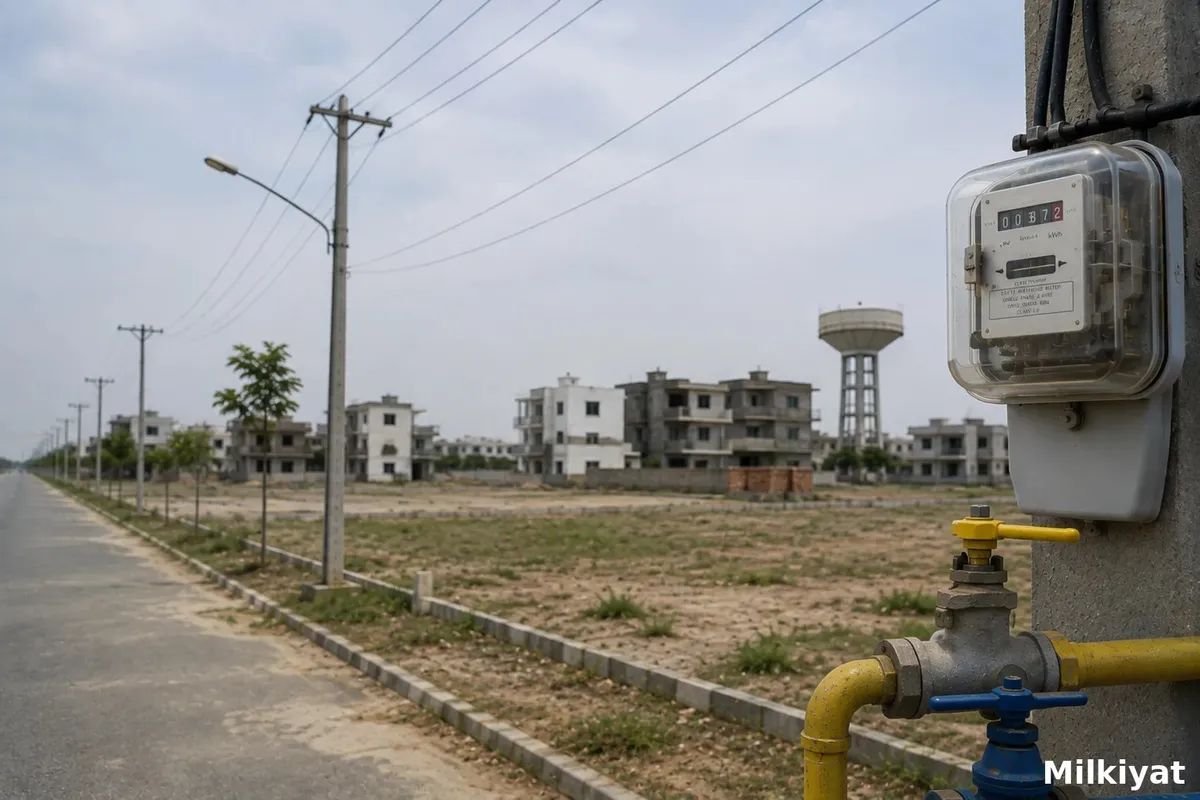

By Bibi Masooma
Real Estate AnalystVerified author
13 min read
Short Answer
Before paying a property token, verify electricity, gas, and water separately for the exact plot. Check electricity connection availability with IESCO, confirm with SNGPL whether the specific street is connected to its gas network, and ask the society or relevant water authority about the actual water supply. A general claim that “utilities are available” does not necessarily mean all three services are available at your plot.
Introduction
“Utilities available” is one of the more loosely used phrases in property marketing. It can mean that electricity poles exist on the street, that a gas pipeline runs somewhere in the scheme, or simply that utilities are “planned” for a future phase. For a buyer, these statements do not necessarily confirm that the specific plot has access to working utilities.
Because electricity, gas, and water are handled through different providers and arrangements, each utility should be checked separately before paying a token. Buyers should also confirm the relevant scheme’s approval and jurisdiction through the CDA's official housing scheme information or RDA's approved housing schemes where applicable.
This guide explains how to verify electricity, gas, and water availability for a specific plot before buying. It also covers the difference between an existing connection, nearby infrastructure, and a utility that is only planned for the future, helping buyers make a more informed decision before making a payment.
Electricity: Verifying Through IESCO
For Islamabad, Rawalpindi, Attock, Jhelum, and Chakwal, IESCO is the relevant electricity distribution company. Before relying on a seller's claim that electricity is available, buyers should confirm the connection status directly with IESCO.
An existing electricity connection is not proof of property ownership. IESCO's service requirements include ownership-related documents for a new connection, so property ownership should be verified separately through the legal documents.
For a new connection, buyers should also confirm whether the specific plot meets IESCO's requirements. Electricity poles or wires nearby do not automatically mean that the plot has an active or immediately available connection. Housing societies and newer developments may also have additional electrification requirements.
Before paying a token, verify both the property's ownership and its actual electricity connection status separately.
Gas: Verifying Through SNGPL and the RLNG Shift
Sui Northern Gas Pipelines Limited (SNGPL) covers Islamabad, Rawalpindi, and most of Punjab and KPK for domestic gas connections. A critical, relatively recent shift affects any utility check here: after a ban on new domestic gas connections that had been in place since 2009 (with a further tightening in 2022), the government lifted the ban in September 2025, but all new domestic connections are now issued only under the RLNG (Regasified Liquefied Natural Gas) scheme rather than the older system-gas arrangement, at tariffs reported to run meaningfully higher than legacy system-gas rates.
The single most important technical point for a buyer to confirm is whether the specific premises already sits on SNGPL's existing gas distribution network. If the pipeline does not already exist on the plot's street, a buyer would need to apply for a network extension instead of a standard new connection — a separate and considerably longer process. This distinction is easy for a seller to gloss over, since "gas available in the area" is not the same as "gas pipeline exists on this specific street."
Electricity vs. Gas Verification at a Glance
| Utility | Provider | What to Verify | Practical Check | Why It Matters |
|---|---|---|---|---|
| Electricity | IESCO | Whether the specific plot or street can receive an electricity connection. | Ask whether an IESCO connection already exists. If available, request the connection/reference number and verify it. | Electricity poles nearby do not necessarily mean the plot has an active or immediately available connection. |
| Gas | SNGPL | Whether the SNGPL network reaches the exact street or block. | Confirm network availability directly with SNGPL. Check whether neighbouring properties are actually connected. | Gas may be available in the wider area but not yet extended to the street where the plot is located. |
| Existing Electricity Connection | IESCO | Whether the seller's claimed connection belongs to the property being sold. | Match the connection details with the plot address and property documents. | A connection shown by the seller may belong to another property or nearby building. |
| Existing Gas Connection | SNGPL | Whether the gas connection is actually registered for the property. | Ask for relevant connection details and confirm them with SNGPL where possible. | Nearby gas supply should not be confused with a connection to the specific property. |
| New Electricity Connection | IESCO | Whether a new connection can be obtained for the plot. | If no connection exists, ask IESCO about availability, requirements and the connection process. | A buyer should know whether electricity can be connected before committing to the property. |
| Gas Network Extension | SNGPL | Whether the street requires an extension of the existing gas network. | Ask SNGPL whether the network already reaches the street or whether an extension is required. | An extension can mean additional time, requirements and possible costs. |
| Nearby Poles and Wires | IESCO | Whether visible electricity infrastructure actually serves the property. | During the site visit, identify the nearest connection and confirm its relationship to the plot. | Seeing poles or wires nearby is not proof that the plot has an active connection. |
| Nearby Gas Pipeline | SNGPL | Whether a visible gas pipeline is part of the active SNGPL network serving the street. | Do not rely only on what is visible. Confirm network availability with SNGPL. | A pipeline nearby does not automatically guarantee a connection for the plot. |
| Seller or Dealer Claim | Seller / Dealer | What “electricity and gas available” actually means. | Ask whether the claim refers to an existing connection, nearby infrastructure, or future availability. | Clear wording helps prevent misunderstandings before the token is paid. |
| Final Verification | IESCO / SNGPL | Whether the utility status applies to the exact plot, block and street. | Verify the information independently before making the payment. | This helps avoid buying a plot based on utilities that are only available elsewhere in the scheme. |
Water: Piped Supply vs. Tanker Dependency
Water supply can vary significantly from one housing scheme, sector, or block to another. Some developed areas have a piped water system, while others may depend on tanker deliveries or private borewells. For this reason, a seller's statement that “water is available” should not be treated as confirmation that the specific plot has a reliable water connection.
For properties in Islamabad, buyers can check relevant information through the CDA's official housing scheme information. For Rawalpindi-area schemes, the RDA's approved housing schemes information can help confirm the scheme's regulatory status. However, approval of a housing scheme does not by itself confirm that every plot has an active water connection.
Before paying a token, ask specifically whether the exact block and street receive piped water, depend on tankers, or use a private or shared borewell. Also ask about the current reliability and ongoing cost of the supply. These details can make a significant difference to the property's actual monthly expenses and day-to-day usability.
The key point is simple: verify the current water arrangement for the specific plot instead of relying on the scheme's overall reputation or a general “water available” claim.
Water Supply Verification Checklist
| Water Supply Type | What It Means | What the Buyer Should Check | Why It Matters |
|---|---|---|---|
| Piped Water Supply | Water is supplied through a formal pipeline network to the area or property. | Confirm whether the pipeline reaches the exact street, block and plot. Ask whether the connection is already active. | Piped supply can be more convenient, but availability and supply hours can vary by area. |
| Tanker Supply | Water is delivered to residents through private or government-authorised tankers instead of a regular pipeline. | Ask how frequently tankers are required, who arranges them, and the average monthly cost. | Regular tanker use can add a significant ongoing expense and may become difficult during periods of high demand. |
| Private Borewell | Water is obtained from an underground source through a privately installed borewell. | Ask whether the property has its own borewell and whether it is currently usable. | Borewell installation and maintenance can involve additional costs, and water availability and quality can vary. |
| Community Borewell | A shared borewell supplies water to several properties or a part of the block. | Confirm who operates it, which properties can use it, and whether there are regular maintenance charges. | Shared systems may depend on electricity, maintenance and the availability of the common facility. |
| Mixed Water Supply | A property may use more than one source, such as piped water plus a borewell or tanker. | Ask which source is the main supply and which one is used when the main source is unavailable. | A property advertised as having “water available” may still depend on an alternative source for regular use. |
| No Direct Connection | Water may be available in the wider scheme but not connected to the specific property or street. | Confirm whether the exact plot has a working connection or access to a reliable water source. | Nearby water infrastructure does not automatically mean the plot has a usable supply. |
| Water Availability Claim | The seller or dealer states that water is available without explaining the source. | Ask specifically: piped supply, tanker, borewell, or another source? | Clear information helps the buyer estimate future costs and avoid relying on a vague marketing claim. |
| Current Reliability | The supply may exist but may not be available continuously. | Ask residents or nearby property owners about supply frequency and recent interruptions. | A technically available water source may still be unreliable for everyday use. |
| Ongoing Cost | Different water sources have different monthly or maintenance costs. | Ask for recent tanker bills, maintenance charges, electricity costs for pumping, or other relevant expenses where applicable. | Understanding the ongoing cost gives a more realistic picture of the property's total running expense. |
A Practical Utility Verification Checklist
Before relying on a sales office's utility claims, buyers should:
- Ask IESCO (directly, or through a representative) whether the specific plot's location has passed or would pass a site inspection for a new electricity connection.
- Confirm with SNGPL whether the existing gas network already reaches the specific street, or whether a network extension would be required.
- Ask the society or relevant water authority whether water supply to the block is piped, tanker-dependent, or borewell-based, and at what typical cost and reliability.
- Request to see an existing utility bill or connection record for a neighbouring, already-occupied plot in the same block, where available, as practical evidence.
- Treat "utilities available in the scheme" as a claim requiring block-specific verification, not a fact about every individual plot.
Official Information vs. Society Claims vs. Buyer Verification
- Official information: IESCO's connection and site-inspection process, and SNGPL's network coverage confirmation for the specific street.
- Society/developer claims: General statements that "utilities are available" in the scheme or phase.
- Buyer verification: A direct check with IESCO/SNGPL for the specific plot, and confirmation of the water supply arrangement for that block.
| Source | What It Tells You | What the Buyer Should Do |
|---|---|---|
| Official Information | IESCO connection/site inspection and SNGPL network availability for the specific area. | Verify the information directly with the relevant authority. |
| Society/Developer Claims | General statements such as “electricity, gas and water are available.” | Treat these as claims until independently confirmed. |
| Buyer Verification | The actual utility status of the specific plot, block and street. | Check with IESCO/SNGPL and confirm the water supply arrangement before paying a token. |
Bottom Line
Checking utility availability at a plot means checking three separate things with three separate parties IESCO for electricity, SNGPL for gas network coverage, and the society or water authority for water supply rather than accepting a single general claim. Given the 2025–2026 shift to RLNG-only new gas connections and the longer process required where a network extension is needed, this check is especially worth doing carefully before committing to a plot, since utility access affects both the cost and timeline of eventually building on it.
FAQs
Q1: Does seeing electricity poles on the street mean my plot has electricity available?
Poles indicate infrastructure is nearby, but a formal connection still requires an IESCO application and a site inspection confirming the specific plot meets technical requirements.
Q2: Can I still get a new gas connection in Islamabad or Rawalpindi in 2026?
Yes, but only under the RLNG scheme following the September 2025 lifting of the domestic connection ban, and only if your street already sits on SNGPL's existing distribution network otherwise a separate, longer network-extension process applies.
Q3: How do I find out if my street already has a gas pipeline?
Confirm directly with SNGPL, since this is a network-coverage fact specific to the street, not something that can be reliably assumed from the scheme's general marketing.
Q4: Is water supply guaranteed in all CDA-approved sectors?
No. Water supply arrangements vary by sector and block, and some areas have relied on tanker-based supply even within established sectors, based on periodic government tenders for tanker water delivery.
Q5: What proof of ownership do utility providers require for a new connection?
IESCO requires ownership proof for the premises, but notes that having an electricity connection does not itself constitute proof of ownership the two should be verified separately.
Q6: What is the quickest way to get practical evidence of utility availability before buying?
Ask to see a recent utility bill or connection record from a neighbouring, already-occupied plot in the same block, in addition to direct confirmation from IESCO and SNGPL.
Internal Links Used
- Registry vs File vs Plot: Islamabad & Rawalpindi Explained — https://milkiyat.com/articles/registry-vs-file-vs-plot-whats-the-real-difference-in-islamabad-rawalpindi
- House vs Plot Investment in Islamabad 2026 — https://milkiyat.com/articles/house-vs-plot-investment-in-islamabad-2026-which-delivers-higher-roi
Official Sources Used
-
SNGPL: Buyers can check the official SNGPL online application for a domestic RLNG gas connection. SNGPL states that applications should only be submitted for premises located on its existing gas network, so buyers should confirm that the network actually reaches the specific property before relying on a seller's claim that gas is available.
-
Water Supply: Piped water, tanker supply, or borewell arrangements should be confirmed directly with the relevant housing society or local water authority for the specific block, as availability varies by scheme.