News
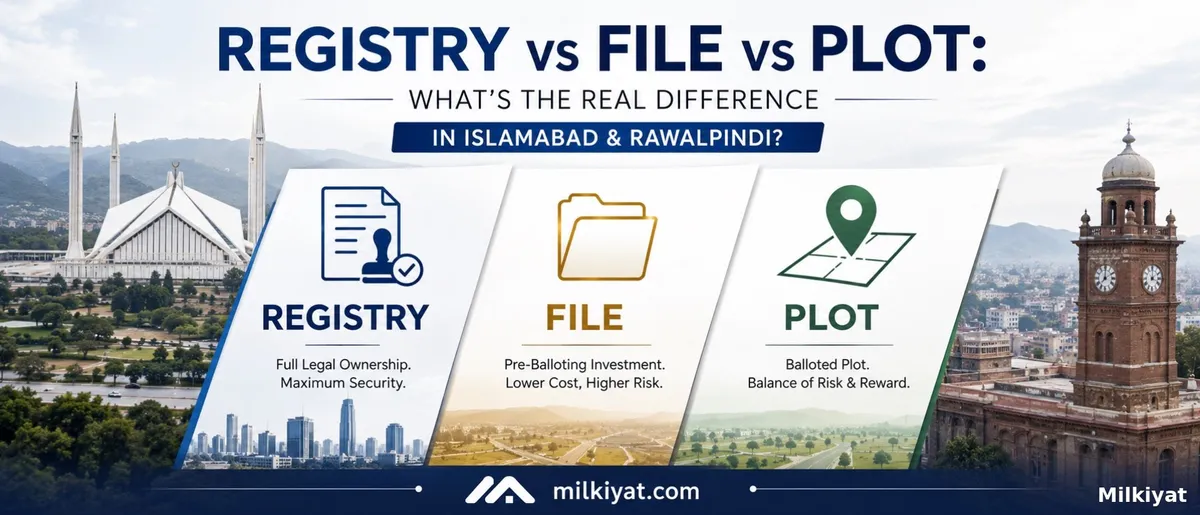
Registry vs File vs Plot: What's the Real Difference in Islamabad & Rawalpindi?

Real Estate Analyst
News
Real Estate Analyst
News
Real Estate Analyst
10 min read
"Registry," "file," and "plot" get used interchangeably by dealers in the twin cities and that loose language costs buyers money. Each term describes a completely different legal state: whether the land physically exists in your name, whether it's just a booking promise, or whether it's been formally registered with a government office. Confusing them is how people end up owning a stack of paper with no enforceable claim to actual land. This guide breaks down exactly what each term means in the Islamabad-Rawalpindi market, how the legal process differs between CDA and RDA jurisdiction, and which one you should actually be buying.
10 min read
"Registry," "file," and "plot" get used interchangeably by dealers in the twin cities and that loose language costs buyers money. Each term describes a completely different legal state: whether the land physically exists in your name, whether it's just a booking promise, or whether it's been formally registered with a government office. Confusing them is how people end up owning a stack of paper with no enforceable claim to actual land. This guide breaks down exactly what each term means in the Islamabad-Rawalpindi market, how the legal process differs between CDA and RDA jurisdiction, and which one you should actually be buying.
| Factor | File | Plot | Registry |
|---|---|---|---|
| What it is | A booking/allotment slot, pre-balloting | A physically demarcated, numbered piece of land | The legal document proving registered ownership |
| Physical existence | None a documented promise only | Yes mapped, numbered, boundary-marked | N/A it's the ownership record, not the land |
| Identifier | File/registration number only | Plot number (assigned after balloting) | Registry/mutation number at the land record office |
| Price behavior | Highly speculative, swings with market sentiment | Tracks development stage and specific attributes (corner, park-facing, boulevard) | Not priced separately it's part of the transaction cost |
| Construction allowed | No | Yes, after possession + NOC | N/A |
| Typical use | Short-term speculative trading | Medium to long-term hold, end-use, or resale | Final legal proof required for any of the above |
| Risk level | Highest no physical asset, developer-dependent | Moderate depends on society's NOC status | Lowest once completed, ownership is legally settled |
Read this correctly: a file and a plot in the same society are not interchangeable investments, and neither one is legally "yours" until the corresponding registry or CDA transfer letter is in your name.
A file is a booking slot proof that you've paid a developer for a future allotment, before any specific plot number has been assigned. It carries a file or registration number, not a plot number; the plot number only gets assigned once the society completes its balloting. Files are actively traded in bulk on the secondary market ("5 files of a society," in dealer language) well before physical land is even readied for possession.
Files appreciate fastest in percentage terms during a project's earliest years this is exactly why speculative buyers chase them but that appreciation is built entirely on developer trust and project momentum, not on any tangible asset. If the developer delays, defaults, or the project gets tied up in an NOC dispute, your file's value can evaporate with nothing to fall back on. This dynamic played out visibly in the recent Bahria Town ownership turmoil see our coverage of the Malik Riaz vs the Establishment: Bahria Town crisis for how quickly file-based holdings can be affected by developments outside your control.
A plot is the file's endpoint: a specific, numbered, physically mapped piece of land within a society or CDA/RDA sector, recognized by the relevant development authority. Once your file converts into a plot through balloting, you get an allotment letter and, eventually, a possession certificate at which point construction becomes possible once you've secured the required building permits.
Plots price differently from files because location-specific attributes now matter: corner plots, park-facing plots, and main-boulevard plots all carry premiums that a generic file simply can't reflect. Plots also carry no ongoing society "maintenance fee" burden the way apartments or built houses in gated communities often do, and they're generally the most liquid of the three categories once a project has active possession easier to sell quickly than raw files in a stalled project.
This is where twin-cities buyers get tripped up, because "registry" works differently depending on where the land sits.
For a deeper look at how jurisdiction shapes this entire process differently across the two cities, see our RDA vs CDA jurisdiction guide.
| Risk Factor | File | Plot (Un-Possessed) | Registry/Transfer Complete |
|---|---|---|---|
| Developer default risk | High | Moderate | None ownership already settled |
| NOC/legal status dependency | Very high | High | Resolved by definition |
| Court/litigation exposure | High in unapproved schemes | Moderate | Low, barring pre-existing disputes |
| Fraud risk (double-selling) | High files are easy to oversell | Moderate | Low registered title is traceable |
| Resale liquidity | Fast but volatile | Fast in active societies | Slowest full due diligence required, but most trustworthy |
The single biggest fraud risk in this market is a society or dealer overselling files well beyond the actual land available a documented pattern in a number of Islamabad's roughly 160 housing schemes, many of which remain unauthorized. Always verify a society's NOC status directly and confirm your specific file or plot is backed by real, allotted land, not just an inventory promise. Our guide on CDA-approved housing projects in Islamabad lists which schemes actually hold legitimate approval.
For the full breakdown of how these taxes stack up against a constructed, income-generating property, see our house vs plot investment ROI analysis.
A file is a bet on a developer's promise. A plot is a real, mapped asset once balloted and possessed. A registry whether a CDA transfer letter or a Sub-Registrar deed is the only stage where the law actually recognizes the land as yours. The safest capital allocation in the twin-cities market moves progressively from file to plot to registry as your risk tolerance shrinks and your holding horizon lengthens. If you're building your primary home or securing long-term family wealth, skip the file stage entirely and buy an already-possessed, registry-ready plot.
Is a file legally the same as owning land? No. A file is only a booking or registration number it has no physical existence and is not recognized as land ownership by any development authority until it converts into a balloted, numbered plot.
Can I get a bank loan against a file? Generally no. Banks require a registered, possession-ready plot or constructed property as collateral. A file alone rarely qualifies.
What's the difference between a plot allotment letter and a registry? An allotment letter confirms you've been assigned a specific plot after balloting. A registry (or CDA transfer letter) is the separate legal step that formally transfers title into your name you can hold an allotment letter without yet completing that transfer.
Do I need a registry for property inside a CDA-approved housing society, or just a transfer letter? Inside CDA-regulated private societies, ownership moves through a CDA Transfer Letter processed internally by the society and CDA not a separate Sub-Registrar deed. A true Sub-Registrar registry applies mainly to non-scheme revenue land, common in parts of Rawalpindi.
Are files riskier than plots? Yes. Files depend entirely on the developer completing balloting and delivering possession; plots are physically demarcated and recognized by the authority once balloted, making them meaningfully more secure even before full registry transfer.
How much does registering or transferring a plot typically cost? Combined stamp duty, transfer/registration fees, mutation charges, and applicable Capital Gains Tax commonly total 8–12% of the transaction value across a full buy-and-sell cycle.
The Paper Gold Rush: Unmasking Islamabad’s Predatory Real Estate "File System"
Pakistan's File System Is Ending: What It Means for Islamabad & Rawalpindi Buyers (2026)
All legal and tax information reflects the framework as of mid-2026 and is provided for general guidance only not legal advice. Always verify current procedures and fees directly with CDA, RDA, or a licensed property lawyer before transacting.
| Factor | File | Plot | Registry |
|---|---|---|---|
| What it is | A booking/allotment slot, pre-balloting | A physically demarcated, numbered piece of land | The legal document proving registered ownership |
| Physical existence | None a documented promise only | Yes mapped, numbered, boundary-marked | N/A it's the ownership record, not the land |
| Identifier | File/registration number only | Plot number (assigned after balloting) | Registry/mutation number at the land record office |
| Price behavior | Highly speculative, swings with market sentiment | Tracks development stage and specific attributes (corner, park-facing, boulevard) | Not priced separately it's part of the transaction cost |
| Construction allowed | No | Yes, after possession + NOC | N/A |
| Typical use | Short-term speculative trading | Medium to long-term hold, end-use, or resale | Final legal proof required for any of the above |
| Risk level | Highest no physical asset, developer-dependent | Moderate depends on society's NOC status | Lowest once completed, ownership is legally settled |
Read this correctly: a file and a plot in the same society are not interchangeable investments, and neither one is legally "yours" until the corresponding registry or CDA transfer letter is in your name.
A file is a booking slot proof that you've paid a developer for a future allotment, before any specific plot number has been assigned. It carries a file or registration number, not a plot number; the plot number only gets assigned once the society completes its balloting. Files are actively traded in bulk on the secondary market ("5 files of a society," in dealer language) well before physical land is even readied for possession.
Files appreciate fastest in percentage terms during a project's earliest years this is exactly why speculative buyers chase them but that appreciation is built entirely on developer trust and project momentum, not on any tangible asset. If the developer delays, defaults, or the project gets tied up in an NOC dispute, your file's value can evaporate with nothing to fall back on. This dynamic played out visibly in the recent Bahria Town ownership turmoil see our coverage of the Malik Riaz vs the Establishment: Bahria Town crisis for how quickly file-based holdings can be affected by developments outside your control.
A plot is the file's endpoint: a specific, numbered, physically mapped piece of land within a society or CDA/RDA sector, recognized by the relevant development authority. Once your file converts into a plot through balloting, you get an allotment letter and, eventually, a possession certificate at which point construction becomes possible once you've secured the required building permits.
Plots price differently from files because location-specific attributes now matter: corner plots, park-facing plots, and main-boulevard plots all carry premiums that a generic file simply can't reflect. Plots also carry no ongoing society "maintenance fee" burden the way apartments or built houses in gated communities often do, and they're generally the most liquid of the three categories once a project has active possession easier to sell quickly than raw files in a stalled project.
This is where twin-cities buyers get tripped up, because "registry" works differently depending on where the land sits.
For a deeper look at how jurisdiction shapes this entire process differently across the two cities, see our RDA vs CDA jurisdiction guide.
| Risk Factor | File | Plot (Un-Possessed) | Registry/Transfer Complete |
|---|---|---|---|
| Developer default risk | High | Moderate | None ownership already settled |
| NOC/legal status dependency | Very high | High | Resolved by definition |
| Court/litigation exposure | High in unapproved schemes | Moderate | Low, barring pre-existing disputes |
| Fraud risk (double-selling) | High files are easy to oversell | Moderate | Low registered title is traceable |
| Resale liquidity | Fast but volatile | Fast in active societies | Slowest full due diligence required, but most trustworthy |
The single biggest fraud risk in this market is a society or dealer overselling files well beyond the actual land available a documented pattern in a number of Islamabad's roughly 160 housing schemes, many of which remain unauthorized. Always verify a society's NOC status directly and confirm your specific file or plot is backed by real, allotted land, not just an inventory promise. Our guide on CDA-approved housing projects in Islamabad lists which schemes actually hold legitimate approval.
For the full breakdown of how these taxes stack up against a constructed, income-generating property, see our house vs plot investment ROI analysis.
A file is a bet on a developer's promise. A plot is a real, mapped asset once balloted and possessed. A registry whether a CDA transfer letter or a Sub-Registrar deed is the only stage where the law actually recognizes the land as yours. The safest capital allocation in the twin-cities market moves progressively from file to plot to registry as your risk tolerance shrinks and your holding horizon lengthens. If you're building your primary home or securing long-term family wealth, skip the file stage entirely and buy an already-possessed, registry-ready plot.
Is a file legally the same as owning land? No. A file is only a booking or registration number it has no physical existence and is not recognized as land ownership by any development authority until it converts into a balloted, numbered plot.
Can I get a bank loan against a file? Generally no. Banks require a registered, possession-ready plot or constructed property as collateral. A file alone rarely qualifies.
What's the difference between a plot allotment letter and a registry? An allotment letter confirms you've been assigned a specific plot after balloting. A registry (or CDA transfer letter) is the separate legal step that formally transfers title into your name you can hold an allotment letter without yet completing that transfer.
Do I need a registry for property inside a CDA-approved housing society, or just a transfer letter? Inside CDA-regulated private societies, ownership moves through a CDA Transfer Letter processed internally by the society and CDA not a separate Sub-Registrar deed. A true Sub-Registrar registry applies mainly to non-scheme revenue land, common in parts of Rawalpindi.
Are files riskier than plots? Yes. Files depend entirely on the developer completing balloting and delivering possession; plots are physically demarcated and recognized by the authority once balloted, making them meaningfully more secure even before full registry transfer.
How much does registering or transferring a plot typically cost? Combined stamp duty, transfer/registration fees, mutation charges, and applicable Capital Gains Tax commonly total 8–12% of the transaction value across a full buy-and-sell cycle.
The Paper Gold Rush: Unmasking Islamabad’s Predatory Real Estate "File System"
Pakistan's File System Is Ending: What It Means for Islamabad & Rawalpindi Buyers (2026)
All legal and tax information reflects the framework as of mid-2026 and is provided for general guidance only not legal advice. Always verify current procedures and fees directly with CDA, RDA, or a licensed property lawyer before transacting.
The Senate Standing Committee on Housing and Works has directed NAB to investigate alleged annexation of Shamilaat and forest land in FGEHA Sky Gardens, also known as Green Enclave-II in Bhara Kahu, raising fresh concerns over the scheme’s unresolved land status
Punjab has launched land record services at Pakistan’s Embassy in Abu Dhabi and Consulate in Dubai, allowing overseas Pakistanis in the UAE to obtain Fards and access official Punjab property records without travelling to Pakistan.
Prime Minister Shehbaz Sharif has directed provinces and territories to survey properties that can qualify for financing under the Apna Ghar Scheme, with Islamabad selected as the pilot city for a new mortgage-eligible plot identification system.
The Federal Cabinet has approved the National Housing Policy 2025 and its Action Plan, introducing a new national framework focused on vertical housing, zoning compliance, energy efficiency, affordable housing finance and katchi abadi resettlement.
The Senate Standing Committee on Housing and Works has directed NAB to investigate alleged annexation of Shamilaat and forest land in FGEHA Sky Gardens, also known as Green Enclave-II in Bhara Kahu, raising fresh concerns over the scheme’s unresolved land status
Punjab has launched land record services at Pakistan’s Embassy in Abu Dhabi and Consulate in Dubai, allowing overseas Pakistanis in the UAE to obtain Fards and access official Punjab property records without travelling to Pakistan.
Prime Minister Shehbaz Sharif has directed provinces and territories to survey properties that can qualify for financing under the Apna Ghar Scheme, with Islamabad selected as the pilot city for a new mortgage-eligible plot identification system.
The Federal Cabinet has approved the National Housing Policy 2025 and its Action Plan, introducing a new national framework focused on vertical housing, zoning compliance, energy efficiency, affordable housing finance and katchi abadi resettlement.