Guide
Is Margalla Enclave Approved? NOC, EIA and CDA DHA Joint Venture Explained
Real Estate Analyst
12 min read
Overview
People searching for Margalla Enclave NOC often want a simple yes-or-no answer: is the project approved, and is it safe to buy a plot? A responsible answer starts by separating several different questions. Who is developing the project? What do the official records say about its planning and environmental process? Which documents apply to a specific plot? And what should a buyer verify before making a payment?
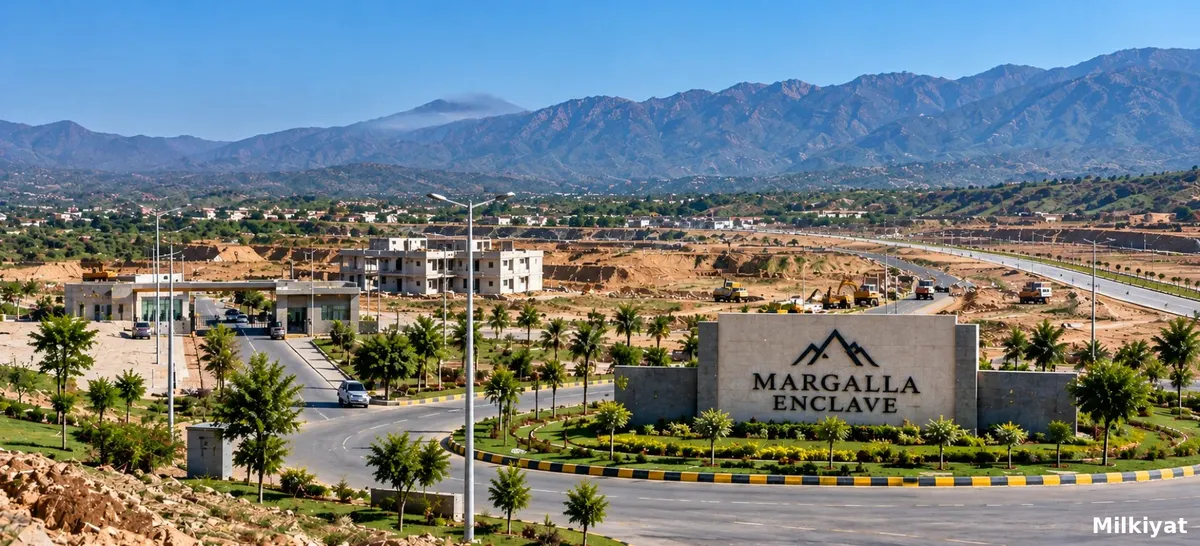
The official Margalla Enclave project portal describes the scheme as a joint venture of CDA and DHA Islamabad-Rawalpindi. Pakistan’s environmental authority also published notices for a public hearing on the Environmental Impact Assessment (EIA) report for the development of Margalla Enclave on Kuri Road, Zone IV, Islamabad. These are meaningful official records, but they are not interchangeable with every possible approval or property document.
For the broader project context, read the Margalla Enclave Islamabad guide. This article focuses more narrowly on the meaning of approval terminology, the EIA process and a practical verification process for buyers. It does not offer a legal opinion or claim that every individual plot has the same status.
1. What is the CDA DHA joint venture?
CDA is the public authority responsible for planning and development functions in Islamabad, while DHA Islamabad-Rawalpindi is the other named partner in the Margalla Enclave project. The official project website presents Margalla Enclave as a joint venture between the two organisations. The Government of Pakistan’s Press Information Department also described Margalla Enclave as a new CDA and DHA joint venture in its February 10, 2025 press release about a visit to the project and development work.
This joint-venture structure is important context. It distinguishes Margalla Enclave from a privately marketed housing scheme whose developer and approval history must be assessed on a different basis. However, the presence of a public-sector partner does not remove the need to check the specific records relevant to a transaction. Buyers should still confirm the identity of the plot, the applicable layout or allotment record, outstanding dues, transfer conditions and possession status.
A brochure, property listing or dealer’s verbal assurance is not the same as an official document. When the information provided by a seller differs from the project record, pause and request clarification from the authority responsible for that record.
2. What does “approved” actually mean?
The word “approved” is often used as if it describes one single certificate. In practice, a development project may involve several separate documents and administrative steps. These can include planning or layout records, environmental review, project-specific permissions, allotment documents, payment records and permissions connected with construction or possession.
A document should be judged by its issuing authority, date, title, scope and conditions. For example, a layout plan relates to the arrangement of roads, plots and land uses shown on that plan. An environmental document concerns environmental assessment and associated requirements. An allotment letter identifies a particular allocation or property interest under the terms stated in that letter. One document does not automatically prove every other point.
For this reason, avoid treating a general statement such as “CDA and DHA project” as a substitute for checking the document required for your particular decision. Equally, do not assume that a project has no valid status simply because a search for a familiar private-society NOC format does not immediately produce a certificate. The correct route is to ask the relevant authority which approvals and records apply to this specific joint venture and request the current documentary evidence.
Documents that should not be confused
| Record or term | What it can help establish | What it does not prove by itself |
|---|---|---|
| Joint-venture announcement | The named partners and public description of the project | The current status of every plot or payment account |
| Layout plan | The layout or land-use arrangement represented by that plan, subject to its status and conditions | Ownership, transfer eligibility or possession of an individual plot |
| EIA report | The environmental assessment, potential impacts and proposed mitigation measures | That the report has automatically received final environmental approval |
| Public-hearing notice | That a hearing was announced for public review of the EIA | That all concerns were resolved or every required approval was granted |
| Allotment or intimation letter | The allocation details and terms stated in the document | That the document is genuine, fully paid or currently transferable without verification |
| Dues statement and transfer confirmation | Current payment position and transfer requirements, when issued by the relevant office | A substitute for verifying the property’s identity and location |
3. What do the official EIA records say?
Pakistan’s environmental authority published a notice titled “Public Hearing of Environmental Impact Assessment Report of development of Margalla Enclave Project, Kuri Road, Zone IV, DHA, Islamabad.” The notice states that the public hearing was conducted on July 17, 2025, at Embassy Lodge Hotel and Marquee near Park Road in Zone IV, Islamabad. A separate notice published on July 2, 2025, announced the hearing for that date. The authority’s website also links to the EIA report for the project.
The EIA document identifies the project as the Environmental Impact Assessment of Margalla Enclave Project, Zone IV, Islamabad, and names the CDA and DHA Islamabad-Rawalpindi joint venture as the project proponent. Its executive summary describes the site as being near Kuri Road and Jinnah Avenue, in the area of Mouzas Kuri and Rehara, Zone IV, Islamabad.
These records confirm that the project’s environmental assessment was documented and that a public-hearing process was announced and held. But the distinction matters: a public hearing is part of environmental review, not a synonym for a final approval letter. The accessible notice and report should not be presented as proof of an approval decision unless the relevant authority’s decision or approval conditions are also checked.
What buyers should do: ask the project office or relevant environmental authority for the current environmental decision or approval status, including any conditions, validity period, monitoring requirements or subsequent directions that apply. If the answer is important to your purchase, request it in writing and retain the response with the property documents.
4. Does an EIA mean every plot is approved and ready?
No. An EIA and the status of an individual plot answer different questions. An environmental assessment considers potential effects of a project and may identify mitigation measures, monitoring and other requirements. It does not identify, by itself, whether a particular plot has been allotted to the seller, whether all dues are paid, whether the plot can be transferred today, or whether possession has been formally offered for that exact location.
The same distinction applies to development progress. A road may be visible on site, or a plot may appear on a map, without proving that all administrative conditions for transfer or possession have been completed. Conversely, a general project update may describe progress without detailing the status of every street or plot. Buyers should use the record that directly answers the question they need to resolve.
For current development and possession context, consult the Margalla Enclave development and possession status guide. Treat it as background information, then confirm the latest position for the specific plot with the responsible office before committing money.
5. A practical document checklist before buying
Use this checklist before paying a token, booking amount or resale premium. Keep copies of the records and record the date on which each status was confirmed.
- Confirm the project identity. Ask which official project or scheme the property belongs to and which authority maintains the record.
- Request the original allotment or intimation document. Check the allottee’s name, plot or file reference, size, sector or location details, issue date and any conditions. Do not rely on a cropped screenshot alone.
- Match the plot to the relevant plan. Ask the responsible office to confirm the plot reference and location against the applicable official layout or record. An approximate online map pin is not enough.
- Confirm the payment position. Obtain a current statement of dues and verify whether instalments, surcharges or other amounts remain outstanding.
- Check transfer eligibility. Ask whether the property can currently be transferred, which documents are needed, what charges apply and whether any restriction or hold exists.
- Verify possession separately. If the seller says the plot is possessionable, ask for the relevant possession notice or certificate and confirm the plot number with the project office.
- Check project-level environmental information. If environmental approval is material to your decision, request the latest official status and any conditions that apply. Do not infer final approval solely from a public-hearing notice.
- Keep written evidence. Save official emails, receipts, statements and confirmations. Record the office or official channel used and the date of the check.
If documents contain different spellings, sector references, plot sizes or scheme names, do not assume the difference is harmless. Ask for written clarification before making a payment. For complicated ownership, inheritance or transfer questions, seek advice from a qualified property lawyer.
6. Questions to ask CDA, DHA or the project office
Instead of asking only, “Is Margalla Enclave approved?”, ask questions that can be answered with specific records:
- What is the current status of the project’s layout and other applicable planning records?
- What is the latest environmental approval or decision status following the EIA public hearing?
- Are there any conditions, monitoring obligations or later directions that a buyer should know about?
- Which office can authenticate an allotment or intimation document for a particular plot?
- Is the exact plot fully paid, transferable and eligible for possession, and what document confirms each status?
- What official charges and documents are required for transfer at the present date?
Where possible, request a dated written response. If an official directs you to another department, ask for the correct office or channel rather than relying on an informal interpretation. Keep the question specific to the project or plot so that the answer can be checked against the correct record.
7. Common mistakes to avoid
Treating a public hearing as final approval
A hearing shows that an EIA was presented for public review. Check the environmental authority’s decision and conditions before describing the project as having final environmental approval.
Treating the joint venture as a guarantee about an individual plot
The CDA and DHA partnership is important project context, but a buyer must still authenticate the seller’s documents and verify the property’s current payment, transfer and possession position.
Relying on an agent’s screenshot
A screenshot can be incomplete, outdated or disconnected from the full record. Request complete documents and verify them directly through the office that issued or maintains them.
Assuming all approval terms mean the same thing
NOC, layout approval, environmental approval, allotment and possession are different terms. Ask which document is being referred to and what it actually confirms.
Skipping verification because a deadline is approaching
Urgency is not evidence. If a seller pressures you to pay before documents can be checked, pause the transaction until the important discrepancies are resolved.
Frequently Asked Questions
Is Margalla Enclave a CDA and DHA joint venture?
The official project portal and the Government of Pakistan’s February 2025 press release describe Margalla Enclave as a joint venture involving CDA and DHA Islamabad-Rawalpindi. Buyers should still authenticate the documents for the exact plot being offered.
Has an EIA public hearing been held for Margalla Enclave?
Pakistan’s environmental authority published a notice stating that the EIA public hearing for the project was conducted on July 17, 2025. The hearing notice is evidence of the hearing, not by itself proof of a final environmental approval decision.
Does an EIA report mean a plot is ready for possession?
No. Possession should be confirmed separately for the exact plot through the relevant project office and the appropriate official document.
Is an NOC the only document I need to check?
No. The applicable records depend on the project structure and the transaction. Confirm project-level status as well as the plot’s allotment, dues, transfer eligibility, location and possession status.
Where can I view current Margalla Enclave properties?
You can review Margalla Enclave property listings for market options. A listing is not proof of legal status, so verify the individual property independently. You can also browse Islamabad property listings and houses for sale in Islamabad for wider comparisons.
Conclusion
The available official sources establish that Margalla Enclave is described as a CDA and DHA joint-venture project and that its EIA report went through a public-hearing process announced for July 17, 2025. Those facts are useful, but they should not be stretched into a blanket statement that every approval, condition, plot transfer or possession status has been verified.
For a careful decision, ask the relevant authority for the current project-level planning and environmental status, then verify the exact plot’s allotment, payment position, transfer eligibility and possession record. Browse properties in Margalla Enclave for market context, but base a purchase on authenticated records, not marketing language alone.
Sources Consulted
- Official Margalla Enclave project portal
- Pakistan Environmental Protection Agency: EIA public hearing conducted on July 17, 2025
- Official Environmental Impact Assessment report for Margalla Enclave
- Press Information Department: Margalla Enclave CDA and DHA joint venture, February 10, 2025
- CDA housing schemes register
Disclaimer
The information provided in this article is for general informational purposes only. Readers should verify location details, sector references, planning documents, property records, approvals, and development status through the relevant official authorities, including CDA and DHA Margalla Enclave management, before making any property purchase or investment decision. This article does not constitute legal, financial, or investment advice. Milkiyat.com does not guarantee the accuracy or completeness of third party information. Always conduct independent verification before proceeding with a property transaction.