Blog
The File in the Drawer

By wajahat Ali
Real Estate Analyst
Updated 10 min read
ShareWhatsApp
Blog
By wajahat Ali
Real Estate Analyst
Updated 10 min read
Blog
By wajahat Ali
Real Estate Analyst
Updated 10 min read
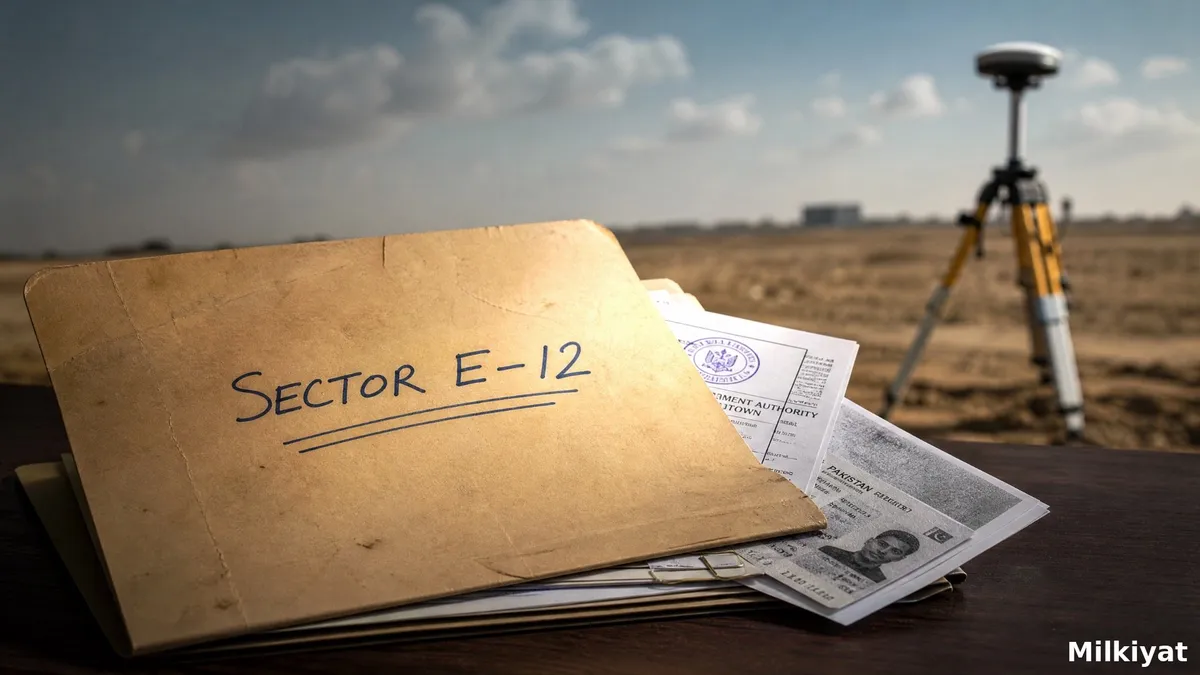
Every Pakistani family I know has one. A file in a drawer.
Manila, usually. Soft at the corners from being handled too often in the first years and then not at all for a decade. Inside: an allotment letter, a payment schedule with the installments ticked off in blue ballpoint, a receipt book, and a photocopy of a CNIC belonging to someone who may no longer be alive.
The file represents a plot. The plot represents a house. The house represents the thing the whole arrangement was actually for a room your children sleep in, a gate you walk through, an address you can say out loud.
Most of these files never became houses. They became the house.
Sector E-12 was launched in April 1989. The CDA sold over 4,000 plots to government officers and ordinary members of the public, promising development inside of a year. The first meaningful possession letters arrived in June 2026.
Sit with that number, because it isn’t a statistic. It’s a life. Somebody bought a plot in E-12 at thirty-two, believing they’d raise children in the house they’d build there. That person is sixty-nine now, if they’re alive at all. Many aren’t. The possession letters CDA is issuing this year are being collected, in a lot of cases, by the legal heirs of the people who paid for them. The children who were supposed to grow up in that house are now middle-aged, standing in a queue, holding their dead father’s file.
I want to be precise about what that is, because the industry has a whole vocabulary designed to make it sound like something else. “Delayed possession.” “Development timeline extended.” “Land acquisition complications.”
It’s a transfer of wealth. From a man who worked for thirty years and saved, to a system that took his money in 1989 and gave him a piece of paper. He financed the state’s land bank, interest-free, for the length of an entire adult life, and he was never once described as a creditor. He was described as an allottee. Which is a word that means someone who has been given something, and that is exactly backwards. He gave. They took.
And E-12 is the legal version. It’s the CDA. The federal regulator. The gold standard. That’s the good outcome.
Now consider what the private market built on top of that template.
If the state could sell undeveloped land and take thirty-seven years to deliver, then the model was proven: you don’t need land to sell land. You need paper.
So the file became the product. Not the plot — the file. A tradeable claim on a future plot in a future sector of a scheme that might, eventually, receive an approval. Files could be issued faster than land could be developed, which meant files could be issued in quantities that exceeded the land entirely. Blue World City is the textbook case: baseline planning permission through PHATA covers roughly 12,465 Kanals. The marketed footprint exceeds 100,000 Kanals. Blocks — Sports Valley, Waterfront District, Awami Greens — get sold to the public years before their coordinates receive final layout stamps. I documented the full picture in the Blue World City investigation, and the honest verdict isn’t “scam.” It’s worse than that, in a way. It’s neither fully approved nor a clean fraud — a permanent grey zone that’s far more profitable than either.
When you issue more files than you have land, the files eventually trade below zero. Dealers who are holding inventory they know is unbacked dump it at whatever they can get, and the market discovers a phrase that should not exist in a functioning property market: minus rate. A negative price on a claim to a piece of Pakistan.
That’s the machine. And it ran, essentially unmolested, for thirty years.
In February, the RDA declared 293 private housing schemes illegal across Rawalpindi, Taxila, Gujar Khan, Kallar Syedan and Kahuta. Published the full list in Daily Jang. Banned land transactions across all of them. Filed FIRs against developers under Section 34(1)-B of the Punjab Development of Cities Act — a cognisable offence carrying up to three years’ imprisonment. Then handed the deceptive-marketing cases to the FIA’s Cybercrime Wing.
In May, CDA declared 99 schemes in Zones 3 and 4 illegal, sealed the offices of Shaheen Town and Islamabad Green Paradise, and instructed IESCO, SNGPL and PTCL to cut utilities to unauthorised schemes. I covered the full enforcement sweep in the CDA and RDA crackdown breakdown.
And then the quiet one, the one nobody put on a billboard, the one that actually ends the era.
From July 1, 2026, the Green Property Certificate became the only legally valid proof of ownership in Rawalpindi. It replaces a Fard system that had been running for 485 years. To get one, a PLRA surveyor physically walks onto your plot with differential GPS, measures the boundary coordinates, confirms you are in active physical possession, and hardcodes it. Two neighbouring landowners must show up in person and biometrically confirm you’re the rightful owner. The details go on the PLRA site for a fifteen-day public objection window. I wrote the full ten-step process out in the Green Property Certificate guide .
No physical land = no GPC = no legal transfer.
You cannot GPS-survey a plot that doesn’t exist. You cannot biometrically verify neighbours for a Waterfront District that is currently a field. Every single “NOC under process” file, every “pre-launch” claim, every marketed block sitting on land nobody acquired — it all runs into a government surveyor with a GPS unit standing in a place where the plot was supposed to be, and there is nothing there, and the certificate cannot be issued.
Thirty years of paper, and the thing that finally beat it was a man with a measuring device and a requirement to physically show up.
I should say the part that’s uncomfortable for someone in my position to say.
I don’t think the industry is going to like what comes next, and I don’t think it should. A market that generated its margins from the gap between what was sold and what existed is about to find out how much of its business was in that gap. Some of it — a lot of it — is going to disappear. Dealers whose entire book was file-flipping are going to discover their book was a rumour.
Good. That was never a real business. It was a queue, and the people at the back of the queue were the ones holding files in drawers, waiting for houses that were never coming.
But here’s what I think everyone is getting wrong about 2026, on both sides.
The enforcement wave is not bad news for property. It’s bad news for paper. Every illegal scheme removed from the market is unpriced competition eliminated for the legitimate ones. Every FIR is a risk premium that legitimate developers no longer have to compete against. When you delete 293 fake schemes, the verified ones don’t fall — they get repriced upward, because for the first time the market can tell them apart.
This is the most bullish thing that has happened to Pakistani real estate in my lifetime. It just doesn’t look like it, because it arrives dressed as a crackdown.
Something slower and much better: property you can stand on. I’ve watched the house-versus-plot maths invert completely — the policy rate fell from 22–25% to roughly 11–12%, making mortgages viable, while vacant land now carries holding costs and earns nothing. The old playbook was: buy paper, wait, sell paper to the next believer. The new one is: buy something real, and let it produce.
And the regulatory geography finally matters more than the brand name. A society with “Islamabad” in the title is frequently a Rawalpindi project, because the capital’s name commands a premium and nobody checks — I laid out which authority actually governs which corridor precisely because that single confusion has funded more bad investments than outright fraud has. Bahria Town is the perfect trap: some phases are CDA, some are RDA, same brand, completely different legal reality. Th e verified CDA-approved societies list exists because I got tired of watching people buy a name instead of a jurisdiction.
The airport corridor is the same story at scale — mostly RDA despite the branding, which I mapped out society-by-society in the airport belt guide . And for people entering with real capital constraints, the 5 Marla installment guide covers the corridor’s legitimately approved entry points, because “affordable” and “unapproved” have been synonyms for far too long and they don’t have to be.
None of that research makes me a rupee in commission. That’s the entire design of Milkiyat. The moment I take a cut of a transaction, I have a reason to want you to make it. I’d rather have a reason to want you to be right.
I keep coming back to the drawer.
The thing about that file is that it was never really an investment. Nobody’s grandfather bought a plot in E-12 as a portfolio allocation. He bought it because he wanted somewhere for his family to be. The financial framing came later, from us, from the industry, from people who found it easier to talk about ROI than about the fact that we were selling people their own future and then not delivering it.
Thirty-seven years is not a delay. It’s a theft carried out slowly enough to remain legal.
So when I look at 2026 at the 293 FIRs and the 99 sealed schemes and the surveyor with the GPS unit standing in an empty field, unable to issue a certificate for land that was sold a hundred times over , I don’t see a crisis.
I see the first serious attempt in my lifetime to make the paper mean the thing it says it means.
There are files in drawers all over this country. Some of them are going to turn out to be worth nothing, and the people holding them deserve to know that now rather than in another thirty-seven years.
And some of them are going to turn out to be worth exactly what they claim.
For the first time, we’re building a system that can tell you which is which.
That’s not a small thing. That might be the whole thing.
I write about Pakistani real estate without taking commissions, because the two are incompatible. Verification research at Milkiyat.com . If you’re holding a file, check it against the official CDA or RDA portal this week not the developer’s brochure, not a dealer’s WhatsApp forward. The portal.
Every Pakistani family I know has one. A file in a drawer.
Manila, usually. Soft at the corners from being handled too often in the first years and then not at all for a decade. Inside: an allotment letter, a payment schedule with the installments ticked off in blue ballpoint, a receipt book, and a photocopy of a CNIC belonging to someone who may no longer be alive.
The file represents a plot. The plot represents a house. The house represents the thing the whole arrangement was actually for a room your children sleep in, a gate you walk through, an address you can say out loud.
Most of these files never became houses. They became the house.
Sector E-12 was launched in April 1989. The CDA sold over 4,000 plots to government officers and ordinary members of the public, promising development inside of a year. The first meaningful possession letters arrived in June 2026.
Sit with that number, because it isn’t a statistic. It’s a life. Somebody bought a plot in E-12 at thirty-two, believing they’d raise children in the house they’d build there. That person is sixty-nine now, if they’re alive at all. Many aren’t. The possession letters CDA is issuing this year are being collected, in a lot of cases, by the legal heirs of the people who paid for them. The children who were supposed to grow up in that house are now middle-aged, standing in a queue, holding their dead father’s file.
I want to be precise about what that is, because the industry has a whole vocabulary designed to make it sound like something else. “Delayed possession.” “Development timeline extended.” “Land acquisition complications.”
It’s a transfer of wealth. From a man who worked for thirty years and saved, to a system that took his money in 1989 and gave him a piece of paper. He financed the state’s land bank, interest-free, for the length of an entire adult life, and he was never once described as a creditor. He was described as an allottee. Which is a word that means someone who has been given something, and that is exactly backwards. He gave. They took.
And E-12 is the legal version. It’s the CDA. The federal regulator. The gold standard. That’s the good outcome.
Now consider what the private market built on top of that template.
If the state could sell undeveloped land and take thirty-seven years to deliver, then the model was proven: you don’t need land to sell land. You need paper.
So the file became the product. Not the plot — the file. A tradeable claim on a future plot in a future sector of a scheme that might, eventually, receive an approval. Files could be issued faster than land could be developed, which meant files could be issued in quantities that exceeded the land entirely. Blue World City is the textbook case: baseline planning permission through PHATA covers roughly 12,465 Kanals. The marketed footprint exceeds 100,000 Kanals. Blocks — Sports Valley, Waterfront District, Awami Greens — get sold to the public years before their coordinates receive final layout stamps. I documented the full picture in the Blue World City investigation, and the honest verdict isn’t “scam.” It’s worse than that, in a way. It’s neither fully approved nor a clean fraud — a permanent grey zone that’s far more profitable than either.
When you issue more files than you have land, the files eventually trade below zero. Dealers who are holding inventory they know is unbacked dump it at whatever they can get, and the market discovers a phrase that should not exist in a functioning property market: minus rate. A negative price on a claim to a piece of Pakistan.
That’s the machine. And it ran, essentially unmolested, for thirty years.
In February, the RDA declared 293 private housing schemes illegal across Rawalpindi, Taxila, Gujar Khan, Kallar Syedan and Kahuta. Published the full list in Daily Jang. Banned land transactions across all of them. Filed FIRs against developers under Section 34(1)-B of the Punjab Development of Cities Act — a cognisable offence carrying up to three years’ imprisonment. Then handed the deceptive-marketing cases to the FIA’s Cybercrime Wing.
In May, CDA declared 99 schemes in Zones 3 and 4 illegal, sealed the offices of Shaheen Town and Islamabad Green Paradise, and instructed IESCO, SNGPL and PTCL to cut utilities to unauthorised schemes. I covered the full enforcement sweep in the CDA and RDA crackdown breakdown.
And then the quiet one, the one nobody put on a billboard, the one that actually ends the era.
From July 1, 2026, the Green Property Certificate became the only legally valid proof of ownership in Rawalpindi. It replaces a Fard system that had been running for 485 years. To get one, a PLRA surveyor physically walks onto your plot with differential GPS, measures the boundary coordinates, confirms you are in active physical possession, and hardcodes it. Two neighbouring landowners must show up in person and biometrically confirm you’re the rightful owner. The details go on the PLRA site for a fifteen-day public objection window. I wrote the full ten-step process out in the Green Property Certificate guide .
No physical land = no GPC = no legal transfer.
You cannot GPS-survey a plot that doesn’t exist. You cannot biometrically verify neighbours for a Waterfront District that is currently a field. Every single “NOC under process” file, every “pre-launch” claim, every marketed block sitting on land nobody acquired — it all runs into a government surveyor with a GPS unit standing in a place where the plot was supposed to be, and there is nothing there, and the certificate cannot be issued.
Thirty years of paper, and the thing that finally beat it was a man with a measuring device and a requirement to physically show up.
I should say the part that’s uncomfortable for someone in my position to say.
I don’t think the industry is going to like what comes next, and I don’t think it should. A market that generated its margins from the gap between what was sold and what existed is about to find out how much of its business was in that gap. Some of it — a lot of it — is going to disappear. Dealers whose entire book was file-flipping are going to discover their book was a rumour.
Good. That was never a real business. It was a queue, and the people at the back of the queue were the ones holding files in drawers, waiting for houses that were never coming.
But here’s what I think everyone is getting wrong about 2026, on both sides.
The enforcement wave is not bad news for property. It’s bad news for paper. Every illegal scheme removed from the market is unpriced competition eliminated for the legitimate ones. Every FIR is a risk premium that legitimate developers no longer have to compete against. When you delete 293 fake schemes, the verified ones don’t fall — they get repriced upward, because for the first time the market can tell them apart.
This is the most bullish thing that has happened to Pakistani real estate in my lifetime. It just doesn’t look like it, because it arrives dressed as a crackdown.
Something slower and much better: property you can stand on. I’ve watched the house-versus-plot maths invert completely — the policy rate fell from 22–25% to roughly 11–12%, making mortgages viable, while vacant land now carries holding costs and earns nothing. The old playbook was: buy paper, wait, sell paper to the next believer. The new one is: buy something real, and let it produce.
And the regulatory geography finally matters more than the brand name. A society with “Islamabad” in the title is frequently a Rawalpindi project, because the capital’s name commands a premium and nobody checks — I laid out which authority actually governs which corridor precisely because that single confusion has funded more bad investments than outright fraud has. Bahria Town is the perfect trap: some phases are CDA, some are RDA, same brand, completely different legal reality. Th e verified CDA-approved societies list exists because I got tired of watching people buy a name instead of a jurisdiction.
The airport corridor is the same story at scale — mostly RDA despite the branding, which I mapped out society-by-society in the airport belt guide . And for people entering with real capital constraints, the 5 Marla installment guide covers the corridor’s legitimately approved entry points, because “affordable” and “unapproved” have been synonyms for far too long and they don’t have to be.
None of that research makes me a rupee in commission. That’s the entire design of Milkiyat. The moment I take a cut of a transaction, I have a reason to want you to make it. I’d rather have a reason to want you to be right.
I keep coming back to the drawer.
The thing about that file is that it was never really an investment. Nobody’s grandfather bought a plot in E-12 as a portfolio allocation. He bought it because he wanted somewhere for his family to be. The financial framing came later, from us, from the industry, from people who found it easier to talk about ROI than about the fact that we were selling people their own future and then not delivering it.
Thirty-seven years is not a delay. It’s a theft carried out slowly enough to remain legal.
So when I look at 2026 at the 293 FIRs and the 99 sealed schemes and the surveyor with the GPS unit standing in an empty field, unable to issue a certificate for land that was sold a hundred times over , I don’t see a crisis.
I see the first serious attempt in my lifetime to make the paper mean the thing it says it means.
There are files in drawers all over this country. Some of them are going to turn out to be worth nothing, and the people holding them deserve to know that now rather than in another thirty-seven years.
And some of them are going to turn out to be worth exactly what they claim.
For the first time, we’re building a system that can tell you which is which.
That’s not a small thing. That might be the whole thing.
I write about Pakistani real estate without taking commissions, because the two are incompatible. Verification research at Milkiyat.com . If you’re holding a file, check it against the official CDA or RDA portal this week not the developer’s brochure, not a dealer’s WhatsApp forward. The portal.
CDA sector or private housing society? Compare approvals, NOCs, tenure, possession timelines, risks, and investment potential before buying property in Islamabad or Rawalpindi.
G-11 is a CDA sector, so ownership does not move through a patwari's intkal. This guide covers the full CDA transfer procedure, file verification, NDC, the 1% transfer fee, advance tax, biometrics and deed registration, plus the documents you need, the real 2026 cost stack, and how long a clean file actually takes.
G-11 is CDA-allotted land, so ownership is proved through CDA records and the Islamabad sub-registrar, not a Punjab patwari. This guide walks through the documents to demand, the checks to run in order, the fraud patterns that repeat in G-11, and what to do if a defect shows up mid-deal.
A complete look at flats for rent in G-11 Islamabad, pricing by bed count, the best sub-sectors, furnished vs unfurnished options, and what the rental agreement process actually involves.
CDA sector or private housing society? Compare approvals, NOCs, tenure, possession timelines, risks, and investment potential before buying property in Islamabad or Rawalpindi.
G-11 is a CDA sector, so ownership does not move through a patwari's intkal. This guide covers the full CDA transfer procedure, file verification, NDC, the 1% transfer fee, advance tax, biometrics and deed registration, plus the documents you need, the real 2026 cost stack, and how long a clean file actually takes.
G-11 is CDA-allotted land, so ownership is proved through CDA records and the Islamabad sub-registrar, not a Punjab patwari. This guide walks through the documents to demand, the checks to run in order, the fraud patterns that repeat in G-11, and what to do if a defect shows up mid-deal.
A complete look at flats for rent in G-11 Islamabad, pricing by bed count, the best sub-sectors, furnished vs unfurnished options, and what the rental agreement process actually involves.