Guide
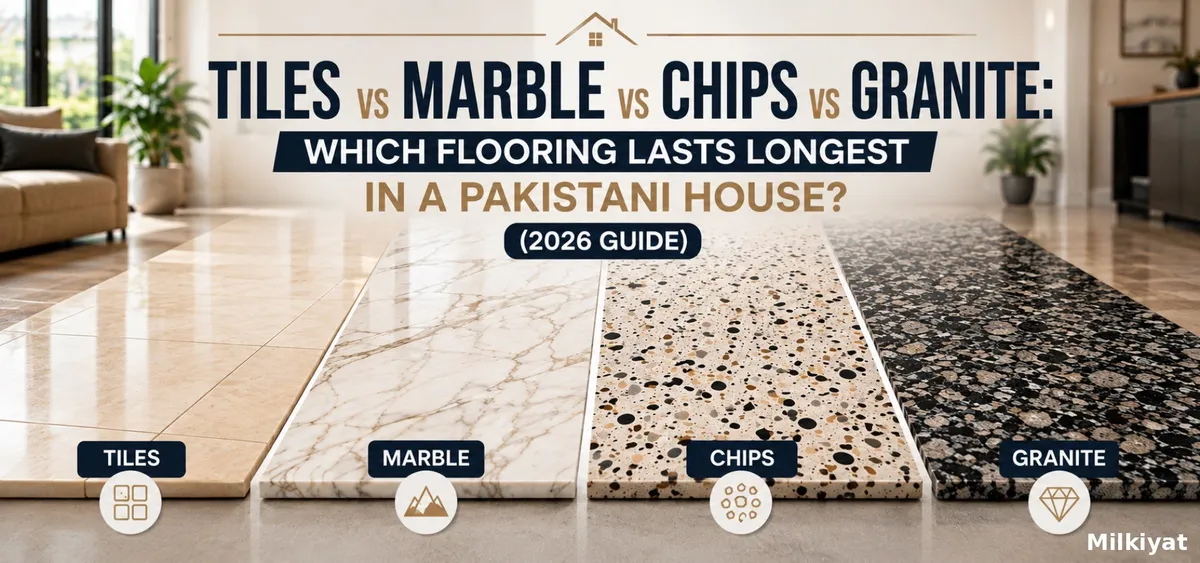
Tiles vs Marble vs Chips vs Granite: Which Flooring Lasts Longest in a Pakistani House? (2026 Guide)

By wajahat Ali
Real Estate Analyst
Updated 18 min read
Quick Answer
Granite is the hardest and least likely to break. Cast-in-situ chips (terrazzo) is the most permanent and the cheapest over a building's life. Ceramic tile is the cheapest upfront. Marble is the luxury choice and the softest of the four. No single material wins every category, so most well-built Pakistani homes mix two or three.
The 30-Second Comparison Table
| Factor | Tiles (ceramic/porcelain) | Marble | Chips (terrazzo/mosaic) | Granite |
|---|---|---|---|---|
| Surface hardness (Mohs) | ~7 equivalent (porcelain body) | 3–5 (softest) | Depends on chip + binder; cement matrix is soft | 6–7 (hardest) |
| Resists breaking/cracking | Good, but brittle at hollow spots | Moderate — chips at edges | Excellent — monolithic, no grout lines | Excellent |
| Realistic service life | 15–30 yrs (ceramic), 30–50 yrs (good porcelain) | 30–50+ yrs with re-polishing | 75–100 yrs | 40–75 yrs |
| Truly "permanent"? | No — replaced in renovation cycles | Semi — surface renewable by grinding | Yes — closest to permanent | Yes, in practical terms |
| Cheapest upfront | ✅ Ceramic wins | ✗ | ✅ Cast-in-situ is very cheap | ✗ Most expensive per sq ft |
| Cheapest over 40 years | ✗ | ✗ | ✅ | Close second |
| Luxury perception in Pakistan | Medium (large-format imported porcelain rates high) | ✅ Highest | Low–medium (rising with designer terrazzo) | High |
| Stains / acid damage | Very resistant (porcelain) | Vulnerable — etches with lemon, vinegar, acidic cleaners | Cement matrix stains if unsealed | Very resistant |
| Best for | Bathrooms, kitchens, rentals, whole-house budget builds | Drawing room, foyer, stairs, feature walls | Whole floors, stairs, courtyards, long-hold homes | Kitchen counters, stairs, thresholds, entrances |
| Repairability | Replace individual tile (colour match risk) | Re-polish in place | Grind and re-polish in place | Difficult to repair; hard to cut |
What Each Material Actually Is
Before comparing them, it helps to be precise because "tile," "chips" and "marble" are used loosely in Pakistani markets.
Tiles
Two very different products sit under one word. Ceramic tile has a more porous body. Porcelain tile is defined by standards — the Tile Council of North America and ANSI A137.1 classify a tile as porcelain only if it absorbs 0.5% water or less when tested to ASTM C373. That threshold is the whole reason porcelain works outdoors, in wet areas and under heavy footfall while ordinary ceramic does not. Ask your dealer for the absorption figure, not the marketing name — mislabelling is common worldwide, which is precisely why a certification agency exists.
Marble
A metamorphic rock, mostly calcite. Pakistan is genuinely rich in it, with major reserves in Balochistan (Chaghi, Ziarat, Loralai) and Khyber Pakhtunkhwa (Buner, Swat, Mohmand), which is why Ziarat White, Badal Grey, Tavera and Verona are household names here. Being calcite is also its weakness: acids attack it chemically, not just physically.
Chips (Terrazzo / Mosaic)
The Pakistani "chips floor" is terrazzo marble, granite, quartz or glass chips set in a cement (or epoxy) binder, then cured, ground and polished. It comes two ways: cast in situ, poured on site and polished into one continuous surface, or pre-cast chips tiles laid like any other tile. The cast-in-situ version has no grout lines and no adhesive layer, which is the source of nearly all of its performance advantage.
Granite
An igneous rock of quartz, feldspar and mica. It is the hardest of the four and the only one whose specification minimums genuinely read like a structural material. Note that Pakistan uses relatively little locally quarried granite for flooring, much of what is sold here is imported, which is a large part of why it prices above marble.
Which Flooring Lasts the Longest and Is Hardest to Break?
Short answer: granite resists damage best; cast-in-situ chips survives longest as a floor system.
Those are two different questions, and conflating them is the most common mistake homeowners make.
On raw material strength, granite wins clearly
The published minimums under ASTM C615 (granite dimension stone) versus ASTM C503 (marble dimension stone) are not close:
| Property (minimum required) | Granite — ASTM C615 | Marble — ASTM C503 |
|---|---|---|
| Compressive strength | 19,000 psi (131 MPa) | 7,500 psi (52 MPa) |
| Modulus of rupture | 1,500 psi | 1,000 psi |
| Flexural strength | 1,200 psi | 1,000 psi |
| Abrasion resistance (Ha) | 25 | 10 |
| Water absorption (max) | 0.40% | 0.20% |
Granite must take roughly two and a half times the compressive load and two and a half times the abrasion that marble must, before either can be sold as compliant dimension stone. On the Mohs scale the gap shows up the same way: granite sits around 6–7, marble around 3–5.
That abrasion figure deserves attention. ASTM C503 itself notes that marble's minimum of 10 pertains to light foot traffic, and recommends a minimum of 12 for stairways, floors and platforms carrying heavy foot traffic. Marble is specified for light traffic by default. A hallway in a joint-family house in Lahore is not light traffic.
On floor-system longevity, chips wins clearly
A floor fails at its weakest layer, not its hardest one. Tiles fail at the adhesive bed and the grout. Marble fails at the surface. Cast-in-situ chips has neither an adhesive bed nor grout lines — it is bonded continuously to the slab.
The National Terrazzo & Mosaic Association documents century-old terrazzo floors in US federal buildings still rated good-to-excellent, needing only occasional chip repair, resealing and routine cleaning. Industry service-life figures put properly installed terrazzo at 75 to 100 years or more — effectively the life of the structure.
Compare that with what happens to tile. The failure mode is well known in the trade: if adhesive coverage under a tile is incomplete, the void becomes the point where the tile cracks under impact or load — and then you are hunting for a matching replacement from a discontinued batch. This is not a knock on tile quality; it is a knock on tile as a system.
The practical ranking
- Cast-in-situ chips — longest-lived floor system
- Granite — toughest individual material
- Good porcelain — excellent surface, system-dependent
- Marble — beautiful, softest, needs the most protection
Which One Is Truly Permanent?
Chips (cast in situ) is the only one that behaves like a permanent building element rather than a finish.
Here is the test that matters: when a floor gets tired, can you restore it, or must you demolish it?
- Chips: grind and re-polish in place. The floor comes back. You can do this several times over a century because the material is homogeneous through its depth.
- Marble: also renewable. Re-honing and re-polishing removes etch marks and scratches. Practically, expect refinishing every several years in high-traffic zones — and each cycle removes a little thickness.
- Granite: so slow-wearing that it rarely needs refinishing, but it is a jointed floor. Individual pieces can be replaced; the joints remain.
- Tiles: effectively non-renewable. A worn or dated tile floor is chipped out and replaced. That demolition — dust, debris, screed removal, days of disruption — is the hidden cost nobody budgets for.
If your definition of "permanent" is "I never want to break this floor out again," the honest answers are chips first, granite second.
Which Flooring Is Cheapest in Pakistan?
Cheapest upfront: ceramic tile and cast-in-situ chips. Cheapest over the life of the house: chips, by a wide margin.
Indicative material rates (2026, PKR per sq ft)
| Material | Reported market range | Notes |
|---|---|---|
| Chips / terrazzo tiles | 50 – 150 (premium 200+) | Cast-in-situ is usually quoted as a supply-and-fix job, not a per-tile rate |
| Ceramic tile | 120 – 450 | Local brands cluster at the lower end |
| Marble | 70 – 1,180+ | Tavera and Badal Grey at the bottom; Ziarat Supreme White, Black & Gold and imported Italian at the top |
| Porcelain tile | 350 – 1,000+ | Large formats, polished finishes and Spanish/Italian imports push this up |
| Granite | 300 – 2,000 | Grade, thickness and finish drive the spread; much of it imported |
⚠️ Read these as market-reported ranges, not quotations. Pakistani stone and tile rates move with the rupee, freight, and season, and vary between Karachi, Lahore and Islamabad. Verify with two or three local suppliers before you budget. Sources for the ranges above are listed at the end of this article.
The number that actually matters: installed cost
Material price is roughly half the story. A complete flooring line item includes base preparation and levelling (screed), adhesive or cement-sand bed, fixing labour, grout, skirting, thresholds, cutting and wastage allowance, and — for marble and granite — final polishing. Bathrooms add waterproofing and fall-to-drain.
Two practical rules:
- Order about 5% extra for cutting, breakage and pattern matching, and keep one unopened box for future repairs. Diagonal layouts, borders and large formats need more.
- Compare BOQ-style installed rates, never sticker price. The cheapest quote is usually the one that quietly excluded levelling, skirting or decent grout.
To convert your covered area before pricing anything, use the Milkiyat Area Unit Converter (marla, kanal, square feet), and run whole-project numbers through the Milkiyat Construction Cost Calculator.
Which Flooring Is Considered Luxury?
Marble — but the definition of luxury has been shifting.
Perceived luxury ranking in the Pakistani market, highest to lowest:
- Imported and premium local marble — Italian Statuario, Botticino, Ziarat Supreme White, Black & Gold, onyx. Book-matched slabs in a double-height foyer remain the top status signal in DHA and Bahria homes.
- Granite — reads as expensive and serious rather than ornate. Dominant on kitchen counters and stair treads; less common as full flooring because the speckled pattern fights large open plans.
- Large-format imported porcelain — 24×48 and up, matte or semi-polished, marble-look or concrete-look. This is where high-end Pakistani interior designers have moved, because it delivers a luxury visual with granite-level practicality.
- Designer terrazzo — globally fashionable again, with exposed brass dividers and oversized chips. In Pakistan it still carries a "purani wali chips" association, which makes it an excellent value play for anyone willing to be slightly ahead of local taste.
Luxury ≠ durability. Marble sits at the top of the luxury table and at the bottom of the hardness table. That contradiction is the single most important thing to understand before signing a flooring contract.
Ten More Factors Most Comparisons Skip
1. Slip resistance
For level interior floors likely to get wet, ANSI A137.1 references a minimum DCOF of 0.42. Polished marble and polished granite fall below comfortable levels when wet. Use honed, flamed or brushed finishes in bathrooms, kitchens, wudu areas and around outdoor taps. This matters more in Pakistani homes than in Western ones because of how much floor washing happens.
2. Summer heat
Marble, granite and chips are all thermally massive and stay noticeably cooler underfoot than ceramic through a Multan or Jacobabad June. Chips has an additional edge — it is seamless, so it does not trap the fine dust that grout lines collect during dust storms and loo season.
3. Winters and the north
The same thermal mass works against you in Murree, Abbottabad, Quetta or Swat, where stone floors are punishingly cold. If you are building in a cold zone without underfloor heating, budget for rugs — or use wood-look porcelain in bedrooms.
4. Acid and stain vulnerability
This is marble's real Achilles heel. Because it is calcite-based, contact with lemon juice, vinegar, tea, harsh cleaners or acidic bathroom chemicals causes etching — a dull mark chemically eaten into the surface, not a stain sitting on top of it. No amount of scrubbing fixes it; only re-polishing does. Never use acid-based bathroom cleaner on a marble floor. Porcelain and granite shrug all of this off.
5. Grout — the weak link nobody photographs
Every jointed floor is only as good as its grout. Cement grout in a Pakistani kitchen or bathroom discolours within two years. Epoxy grout costs more and installs slower, and it is almost always worth it in wet areas. Cast-in-situ chips has no grout at all, which is why 40-year-old chips floors still look clean while 6-year-old tile floors look grubby.
6. Adhesive versus cement-sand fixing
For porcelain and large-format tiles, a proper tile adhesive gives better bond and far fewer hollow tiles than traditional cement-sand fixing. Hollow tiles are not a cosmetic issue — they are the pre-existing crack waiting for the day someone drops a steel degchi.
7. Skilled labour availability
Cast-in-situ chips requires a genuinely skilled crew, and that trade has thinned as tiles took over. In Islamabad and Lahore you can still find good chips masons; in smaller cities it can be hard. Conversely, tile fixers are everywhere — but large-format tile fixing is a specialist skill and mediocre fixers produce lippage. Inspect a contractor's previous job before hiring, whichever material you choose.
8. Installation time and site disruption
Tiles are fastest. Marble and granite are moderate but need careful handling — marble chips easily in transit despite its weight. Cast-in-situ chips is slowest: pouring, curing, grinding and polishing take days and generate slurry. Factor this into a renovation where the family is living in the house.
9. Structural load and thickness
Stone flooring is heavy, and thicker slabs are heavier still. Flooring in Pakistan typically uses 12–18 mm marble, with thicker sections for high-traffic hallways and countertops. On upper floors and cantilevered slabs, confirm the dead load allowance with your structural engineer rather than assuming.
10. Resale value
In the Pakistani resale market, marble in the drawing room and entrance measurably lifts perceived value, because buyers read it instantly as a quality signal. A well-maintained chips floor reads as "old construction" to many buyers even though it is technically the better floor — which is unfair, and also a fact you should price in. Good large-format porcelain throughout, with a marble foyer, is currently the combination that survives valuation best. Track what comparable finished homes are actually fetching on the Milkiyat Property Index before over-spending on finishes.
Room-by-Room Recommendation for a Pakistani House
| Space | Best choice | Why |
|---|---|---|
| Drawing room / foyer | Marble (or large-format porcelain) | Luxury signal, low traffic, guests see it first |
| Lounge / TV lounge | Porcelain or chips | Daily heavy use; needs to survive children and furniture |
| Bedrooms | Porcelain, chips, or wood-look tile | Comfort and warmth matter more than hardness |
| Kitchen floor | Matte porcelain | Grease, water, dropped utensils, acidic spills |
| Kitchen counter | Granite | Heat, knives, load — nothing else comes close |
| Bathrooms | Anti-slip porcelain, DCOF ≥ 0.42 | Wet-floor safety is non-negotiable |
| Stairs | Granite or chips | Highest wear point in any house; marble treads dull fastest |
| Courtyard / terrace / car porch | Chips, granite, or vitrified outdoor tile | Freeze-thaw and UV exposure; ceramic will not survive |
| Servant quarter / store / garage | Chips or basic ceramic | Function over finish |
The smart-money mix used by most experienced Pakistani builders: marble in the foyer and drawing room, porcelain through living areas and wet zones, granite on stairs and counters, chips in service areas and courtyards. You get the luxury where it is seen and the durability where it is needed.
Six Mistakes That Waste Money
- Buying "porcelain" without asking for the water absorption figure. Under 0.5% or it is not porcelain, whatever the box says.
- Putting polished marble in a bathroom. Slippery when wet, and the acidic cleaner will etch it within a month.
- Comparing tile prices instead of installed prices. The exclusions are where the money hides.
- Skipping epoxy grout in wet areas to save PKR 15,000. You will pay it back in re-grouting within three years.
- Ordering exactly the measured quantity. Dye lots change. Keep spares from the same batch.
- Choosing marble for a house you will rent out. Tenants do not re-polish floors.
Frequently Asked Questions
Which flooring lasts the longest? Cast-in-situ chips (terrazzo) — industry service-life figures put it at 75 to 100 years, and century-old terrazzo floors remain in active service. Granite is the longest-lasting individual material at roughly 40–75 years, followed by marble and then tile.
Which flooring is hardest and least likely to break? Granite. It rates 6–7 on the Mohs scale and must meet a minimum compressive strength of 19,000 psi under ASTM C615 — about two and a half times the 7,500 psi minimum required of marble under ASTM C503.
Which flooring is cheapest in Pakistan? Chips tiles and entry-level ceramic tiles are the cheapest per square foot, with chips commonly reported in the PKR 50–150 range and ceramic from around PKR 120. Over a 40-year horizon, cast-in-situ chips is the cheapest because it never needs replacing.
Which flooring is considered luxury in Pakistan? Marble — particularly imported Italian varieties and premium local stone such as Ziarat Supreme White and Black & Gold. Granite and large-format imported porcelain sit just below it.
Is marble or tile better for Pakistani summers? Marble and chips stay cooler underfoot than ceramic because of their thermal mass. Chips has the additional advantage of being seamless, so it does not trap dust in grout lines.
Is chips flooring outdated? It is out of fashion in Pakistan and back in fashion internationally. Technically it remains the most durable and lowest-lifecycle-cost floor available, which makes it strong value for anyone building a long-hold family home rather than a quick resale.
Can marble be repaired if it gets scratched or dull? Yes. Marble is re-honed and re-polished in place, which removes etch marks and light scratches. Expect to repeat this periodically in high-traffic areas. Each cycle removes a small amount of thickness.
What is the difference between chips flooring and terrazzo? None, essentially. "Chips" is the common Pakistani term for terrazzo — marble, granite, quartz or glass chips set in a cement binder, then ground and polished. It is available cast in situ or as pre-cast tiles.
Which flooring is best for bathrooms in Pakistan? Anti-slip porcelain with a dynamic coefficient of friction of at least 0.42, laid with epoxy grout over proper waterproofing and a correct fall to the drain. Avoid polished marble.
The Verdict
- Want the toughest surface? Granite.
- Want the floor your grandchildren will still be walking on? Cast-in-situ chips.
- Want the lowest upfront bill? Ceramic tile or chips tiles.
- Want the lowest total cost over the life of the house? Chips, decisively.
- Want the floor guests notice? Marble.
- Want the best all-round balance for a modern Pakistani home? Large-format matte porcelain everywhere, marble in the foyer, granite on the stairs and kitchen counter.
Flooring is one of the few finishing decisions that is genuinely difficult to reverse. Get the sequence right: fix the budget, convert your areas properly, get three BOQ-style installed quotes, inspect each contractor's last job in person, and only then choose the material.
Plan Your Build with Milkiyat
- Construction Cost Calculator — estimate the full build cost for your plot
- Area Unit Converter — marla, kanal and square feet
- 5 Marla House Finishing Cost in Islamabad & Rawalpindi (2026) — where flooring sits inside a full finishing budget
- 7 Marla Double Storey House Construction Cost in Pakistan (2026)
- 8 Marla House Construction Cost in Islamabad & Rawalpindi
- 20 Marla House Construction Cost in Pakistan 2026
- Milkiyat Property Index — check what finished homes are actually fetching
- Browse houses for sale across Pakistan
Sources
Technical standards and industry bodies
- ASTM International — C615/C615M, Standard Specification for Granite Dimension Stone
- ASTM International — C503/C503M, Standard Specification for Marble Dimension Stone
- Tile Council of North America — Porcelain Tile Certification (ANSI A137.1, ASTM C373)
- ANSI — The definition of porcelain tile under ANSI A137.1
- ASTM International — Standards and the ceramic tile industry
- National Terrazzo & Mosaic Association — Life Cycle for a Lifetime
- Natural Stone Institute — ASTM standards relevant to natural stone
Pakistan market pricing (market-reported, verify locally)
- Avenir Developments — Flooring Costs in Pakistan, 2026 price guide
- Tiles Price Pakistan — Chips tiles price in Pakistan
- Pointshift — Marble price in Pakistan, updated rates
- Civil Construction Guide — Finishing material rates in Pakistan
Prices quoted are indicative market ranges reported by third-party sources and were current at the time of writing. Milkiyat.com does not sell flooring materials. Always obtain written quotations from local suppliers and contractors before budgeting.