Guide
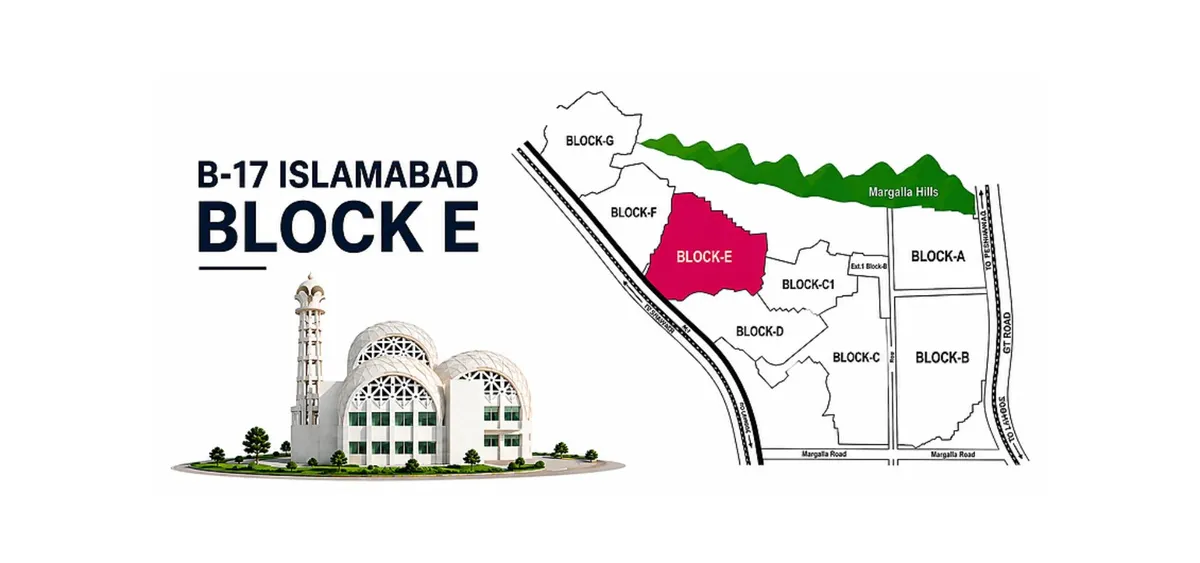
B-17 Islamabad Block E

By Maham Imtiaz
Real Estate AnalystVerified author
12 min read
Short Answer:
Block E is one of the Phase-2 blocks of Multi Gardens B-17 Islamabad, developed by MPCHS in Zone II of the Islamabad Capital Territory, between GT Road (N-5) and the M-1 Motorway. It is planned around a central circular commercial and residential core, and offers mostly 8 marla, 10 marla, 14 marla and 1 kanal residential plots, plus a commercial strip. Roads, underground utilities, parks and mosques are in place across most of the block, but a portion of Block E has historically been listed as non-possessionable, so the possession status of a specific plot number must be confirmed with the MPCHS office in writing before payment. As of August 2026, asking prices for residential plots in Block E broadly run from about Rs 9.5 million for an 8 marla to Rs 27 million at the top of the range, with an average of roughly Rs 1.4 million per marla. That places Block E in the middle of the B-17 price ladder: cheaper than Blocks A, B and C, dearer than G.
Where Block E sits in the B-17 master plan
To understand Block E you first have to understand how B-17 is put together. B-17 is not a single CDA-built sector in the way F-7 or G-11 are. It is a private cooperative scheme, Multi Gardens, developed by the Multi-Professional Cooperative Housing Society (MPCHS), and it spreads across more than one sector grid on the official Islamabad layout.
Phase 1 covered Blocks A, B and C, spanning roughly 7,673 kanals along GT Road, about a kilometre before the Taxila bypass. Phase 2 added Block C-1 extension, Block D, Block E and Block F. Block G, closest to the motorway, came later in 2018.
A detail most buyers never hear from a dealer: on the official CDA layout, the blocks do not all sit inside the B-17 grid. Block A is technically A-17, Block C is B-18, and Block E and Block F fall inside A-19. Only Block B sits squarely in B-17 proper. MPCHS markets the whole scheme under one B-17 banner because it develops all of it, but the underlying sector reference on your file may not read "B-17". That is normal for this scheme and does not by itself indicate a problem, but it is one more reason to read the file rather than the brochure.
If you want the full picture of how the blocks fit together before narrowing down to Block E, start with our top housing societies in Islamabad and Rawalpindi.
B-17 Islamabad location and how Block E connects
The b 17 sector islamabad sits in Zone II, bounded on the east by the N-5 National Highway (GT Road) and on the west by the M-1 Islamabad–Peshawar Motorway. Block E lies in the interior of the scheme rather than on the GT Road frontage, which is the standard trade-off: quieter and less commercial noise, slightly longer run to the main gate.
Typical drive times from Block E:
| Destination | Approximate distance / time |
|---|---|
| Main GT Road entrance (B-17 Gate 1) | 5–8 minutes |
| Sangjani Toll Plaza / M-1 access | 10–15 minutes |
| Islamabad International Airport | 25–30 minutes via motorway |
| G-11 / Islamabad city centre | 35–45 minutes, traffic dependent |
| Taxila and HITEC City | 10–15 minutes |
| Wah Cantt | 15–20 minutes |
Two things dominate the b 17 islamabad location story for the next few years, and both decide how easy Block E will be to get in and out of by 2027. The first is Margalla Avenue, the corridor running from D-12 to GT Road near B-17. The second is the extension that links Margalla Avenue directly to the M-1 Motorway, and this is the one that actually unlocks the corridor's value. The CDA's own working paper has said as much: the full benefit of Margalla Avenue cannot be realised until it reaches the M-1. The link is a 2.7-kilometre stretch from GT Road to the Sangjani Grid Station inside Islamabad's limits, joined to a further 2.5-kilometre section that ties into the motorway, with a new interchange at Sangjani on GT Road. Officials have indicated completion by December 2026, with the Sangjani Interchange pushed ahead of the rest to ease the GT Road bottleneck, as reported by Dawn.
For a Block E buyer, the practical reading is simple: your commute today runs through GT Road and is subject to its congestion. The infrastructure that changes that is under construction but not finished. Price your plot on today's access, and treat the interchange as upside rather than a promise you have already paid for. Our roundup of Islamabad's biggest infrastructure projects in 2026 tracks the timelines in detail.
Block E layout and plot sizes
Block E was designed around a central circular core that mixes residential and commercial use, with a carpeted main road running through it and underground utility ducting. The residential plot categories most commonly available are:
- 8 marla: the volume category in Block E, and the size with the deepest resale market
- 10 marla: the standard family size across the scheme
- 14 marla: a category MPCHS uses in its Phase-2 blocks that you will not find in most Islamabad societies
- 1 kanal: the top residential tier, concentrated on wider streets
There is also a commercial component in the circular core. MPCHS at one stage ran an incentive for the first owners to complete commercial buildings up to the second floor in Block E, which tells you the commercial fabric here was still filling in rather than mature.
Around the residential grid the block is laid out with parks, mosque plots, school plots and space earmarked for a vocational institute and healthcare facilities. Not all of these are built. A plot marked "school" on a master plan is a reservation, not a school.
Development and possession status: the part that matters most
This is where b-17 islamabad details stop being marketing and start being due diligence.
The mature end of B-17 is Phase 1. Blocks A, B and C are fully developed, carpeted roads, underground electricity, gas, water, functioning markets, mosques, parks, a post office and thousands of families in residence. Schools operate inside the scheme, including campuses in Blocks A and B, with HITEC schools and the University of Wah within reach.
Block E is not at that stage. It is a Phase-2 block where infrastructure is largely laid but occupancy is thin compared with Phase 1, and, critically, a portion of Block E has been reported as non-possessionable, with figures as high as 40% of the block cited in society status updates. The reasons vary by pocket: land acquisition gaps, alignment issues, and areas held back pending development completion.
What this means in practice:
- Two plots in the same block, a few hundred feet apart, can have completely different status. One may be possession-ready and buildable today; the other may be a file you cannot construct on for years.
- Dealers rarely volunteer this. The listing says "Block E, 8 marla, prime location". It does not say "possession pending".
- The price difference between a possession-ready plot and a non-possessionable one in the same block is real, and if you pay possession-ready money for a file, you have overpaid by a wide margin.
The only reliable check is to take the exact plot number and street to the MPCHS office and get written confirmation of possession status, dues and transfer eligibility. A verbal "haan ji possession hai" from an agent is worth nothing. Our guide on how to verify a property before you pay walks through the wider verification process for Islamabad.
Facilities in and around Block E
What Block E residents actually have access to, in and near the block:
- Utilities: underground electricity, Sui gas and water supply on the developed side; connections are provided on demand rather than automatically, and tube wells serve the scheme's water supply
- Roads: carpeted main road through the block with a central boulevard connection to the wider scheme
- Parks and green belts: landscaped open space within the block and along the boulevard
- Mosques: block-level mosque provision, with larger jamia mosques in the developed blocks
- Markets: supermarkets and commercial pockets exist across several blocks; the nearest fully functional commercial density is in Phase 1, not Block E itself
- Schools: inside the scheme: Islamabad School System, Qurtuba School, Air Foundation, The Smart School, City School and Turk International campuses; most sit in the older blocks, so expect a short drive from Block E
- Healthcare: clinics and pharmacies within the scheme; HITEC and Wah facilities within 10–15 km
- Banking: HBL and JS Bank branches operate inside B-17
- Recreation: a 74-kanal community club in Block B and a four-season lake project developed on roughly 94 kanals of the scheme's water catchment
The honest summary: Block E residents live in a developing block but borrow the amenity base of a mature scheme next door. That is a much better position than a greenfield society, and a worse one than buying in Block B.
Block E prices in 2026
The figures below are asking prices from listing portals as of August 2026, not recorded transaction prices. Sellers ask high; deals close lower.
| Metric (Block E, residential plots) | Value |
|---|---|
| Asking range across all sizes | Rs 9.5 million – Rs 27 million |
| Average asking price | ~Rs 11.75 million |
| Average rate per marla | ~Rs 1.4 million |
| 8 marla asking range | Rs 9.5 million – Rs 14 million (avg ~Rs 11 million) |
Set against average asking prices in other blocks, roughly Rs 7.5 million in G, Rs 11.5 million in F, Rs 16.5 million in C-1, and Rs 26–35 million in the Phase-1 blocks A, B and C, Block E sits in the middle. Note that those block averages mix plot sizes, so they indicate where the demand and the built-up density sit, not a clean per-marla comparison.
Three factors move a Block E price more than anything else: possession status, position relative to the main road and the circular core, and whether the plot is on a corner or park face. A non-possessionable file and a possession-ready plot are effectively two different products sold under the same heading.
Who Block E suits
It works for a buyer with a 3–5 year horizon who wants a genuinely CDA-and-RDA-approved scheme with real infrastructure at a price well below Phase-1 rates, and who is buying to build within a few years rather than to flip in six months.
It works less well for someone who needs to move in immediately with mature commercial and school density on their doorstep, or for a short-term speculator. Phase-1 blocks give you the first; the second is difficult in a market where FBR valuations were revised sharply upward in December 2025 and Section 7E applies to idle plots.
Risk and due diligence checklist
B-17 has been under active CDA enforcement scrutiny, with commercial plazas sealed over master-plan and building-control violations, read our reporting on why CDA cracked down on B-17 and the detail on the sealed plazas. That enforcement has mostly targeted commercial construction rather than residential plot titles, but it is a live regulatory environment and you should treat it as such.
Before you pay anything on a Block E plot:
- Get the plot number, street and block confirmed in writing by MPCHS, not by the dealer.
- Ask specifically whether the plot falls in a possessionable or non-possessionable pocket.
- Confirm outstanding development charges and any transfer dues.
- Verify the seller's identity against the allotment record and check for a No Demand Certificate.
- Confirm the scheme's NOC status with the CDA directly rather than relying on a brochure copy.
- Check FBR valuation for the area so you know your CGT, WHT and 7E exposure before you sign.
- Pay through banking channels only, and complete the transfer at the society office.
For the broader legal picture on which Islamabad schemes hold clean approvals, see our CDA approved, under-process and illegal societies list, and compare Block E against the wider market in our top housing societies in Islamabad and Rawalpindi roundup.
Frequently asked questions
Q1: Is B-17 Block E in Islamabad possession-ready?
A: Partly. Much of the block has developed infrastructure, but a portion has been reported as non-possessionable. Status is plot-specific and must be confirmed in writing with MPCHS.
Q2: What plot sizes are available in Block E?
A: Mainly 8 marla, 10 marla, 14 marla and 1 kanal residential plots, plus commercial plots in the central circular core.
Q3: Is B-17 CDA approved?
A: Yes. The CDA issued the NOC to MPCHS for the scheme, with the first approval granted on 30 January 2008, and the layout has also been processed with RDA for the portions falling in its jurisdiction. Verify current standing with the CDA before purchase.
Q4: How far is Block E from Islamabad International Airport?
A: Roughly 25–30 minutes via the motorway in normal traffic.
Q5: Is Block E cheaper than Block B or C?
A: Considerably. Average asking prices in the Phase-1 blocks run two to three times Block E levels, reflecting mature development and occupancy.
Q6: Should I buy in Block E or Block G?
A: Block G is cheaper and closer to the motorway but earlier in its development cycle. Block E costs more and has more infrastructure in place. The choice comes down to how long you can wait.
Prices quoted are asking prices from public listing portals as of August 2026 and are indicative only. Confirm plot status, dues and approvals directly with MPCHS and the CDA before any payment. Milkiyat.com does not act as a dealer for this scheme.