Guide
Deglobalisation Boosting Real‑Estate Demand — PwC 2026 Global Outlook

Real Estate Analyst
21 min read
Introduction
The global economic landscape is undergoing a profound transformation, marked by a discernible shift away from the hyper-globalisation that defined the late 20th and early 21st centuries. This phenomenon, often termed "deglobalisation," is not merely a reversal of trade flows but a fundamental re-evaluation of supply chain vulnerabilities, national security interests, and economic resilience. As nations and corporations increasingly prioritize stability and self-reliance over pure cost efficiency, the implications for the global real estate market are monumental. PwC's 2026 Global Outlook, particularly its "Emerging Trends in Real Estate" reports for Europe and the United States & Canada, highlights this paradigm shift, identifying deglobalisation as a primary concern for real estate investors and developers [1] [2]. This article, drawing extensively from PwC's insights and other authoritative sources, will delve into how this accelerating trend is reshaping real estate demand, creating new opportunities in sectors like data centers, logistics, and industrial real estate, and influencing investment strategies across key global regions, with a specific focus on the untapped potential within Pakistan.
The Rise of Deglobalisation
Deglobalisation, while a complex and multifaceted trend, can be understood as a process characterized by the retreat from extensive global economic integration towards more localized, regional, or national economic activities. This shift is driven by a confluence of factors, including geopolitical tensions, the vulnerabilities exposed by global crises like the COVID-19 pandemic, and a growing emphasis on national sovereignty and economic security. The PwC 2026 reports underscore this sentiment, revealing that a staggering 70% of real estate professionals now view deglobalisation as a key concern, a dramatic increase from 31% in 2024 [1]. This indicates a broad recognition within the industry that the era of seamlessly interconnected global supply chains is giving way to a more fragmented, yet potentially more resilient, system.
The initial impetus for deglobalisation can be traced to the trade wars of the late 2010s, which highlighted the risks associated with over-reliance on single-source suppliers and distant manufacturing hubs. The subsequent pandemic lockdowns brought these vulnerabilities into sharp relief, disrupting everything from medical supplies to consumer goods and prompting a widespread re-evaluation of just-in-time inventory models. Furthermore, escalating geopolitical rivalries, particularly between the US and China, and regional conflicts in the Middle East and Eastern Europe, have intensified calls for "friend-shoring" and "nearshoring" – strategies aimed at relocating production and sourcing to politically aligned or geographically proximate countries. This strategic realignment is fundamentally altering the calculus for corporate location decisions, placing a premium on supply chain resilience and proximity to end markets, rather than solely on labor costs.
Why Real Estate Is the Biggest Beneficiary
The real estate sector, by its very nature, is intrinsically linked to economic activity and infrastructure. As deglobalisation prompts a restructuring of global supply chains and a re-emphasis on domestic or regional production, it directly translates into new and intensified demand for specific types of real estate assets. The need for secure, efficient, and strategically located facilities becomes paramount. This is why real estate is emerging as one of the primary beneficiaries of this global economic shift.
The core reason lies in the physical requirements of these new economic models. Nearshoring and friend-shoring necessitate new manufacturing plants, assembly lines, and distribution centers in different geographical locations. Companies are not simply moving existing operations; they are often building new, more advanced facilities designed for greater automation, efficiency, and resilience. This drives demand for industrial land, purpose-built factories, and modern logistics warehouses. Moreover, the increasing digitalization that underpins these new supply chains, from advanced manufacturing to e-commerce fulfillment, fuels an insatiable demand for data centers – the digital infrastructure of the modern economy.
Investors, recognizing these shifts, are recalibrating their portfolios. The PwC reports indicate a move towards "resilient" and "duration-focused" assets, with less emphasis on short-term speculative gains [1]. This means a greater appetite for real estate that supports essential economic functions and offers stable, long-term income streams. The traditional office and retail sectors, while still important, are being overshadowed by the robust growth prospects of industrial, logistics, and data center real estate, which are seen as more insulated from economic cycles and more directly aligned with the structural changes brought about by deglobalisation.
Supply‑Chain Security: The New Investment Thesis
Supply chain security has rapidly ascended to the forefront of corporate and governmental priorities, transforming from a niche operational concern into a central investment thesis for real estate. The disruptions of recent years—from pandemic-induced factory shutdowns to geopolitical blockades and trade disputes—have laid bare the fragility of extended, globally optimized supply chains. The imperative now is to build redundancy, reduce lead times, and ensure continuity of operations, irrespective of external shocks. This strategic pivot is directly translating into significant real estate investment.
Companies are actively pursuing strategies such as nearshoring, reshoring, and friend-shoring. Nearshoring involves relocating production closer to the end consumer markets, often within the same continent or region. Reshoring brings manufacturing back to the home country. Friend-shoring focuses on moving supply chains to countries with stable political alliances and shared values. Each of these strategies requires new physical infrastructure: factories, assembly plants, research and development facilities, and, crucially, advanced logistics and distribution centers to manage the flow of goods within these new regional ecosystems. This is driving a surge in demand for industrial land and specialized industrial properties in strategic locations.
For real estate investors, this translates into a compelling opportunity. Assets that facilitate supply chain resilience—such. as modern, automated warehouses, cross-dock facilities, and industrial parks with excellent multimodal transport links—are becoming highly sought after. The investment thesis is no longer solely about rental yield but also about the strategic value these properties offer in de-risking global operations. Governments are also playing a role, offering incentives for companies to relocate manufacturing, further stimulating demand for industrial real estate in designated zones. This focus on supply chain security is not a temporary trend but a fundamental recalibration of global commerce, with lasting implications for real estate investment and development [3].
Data Centers: The Fastest‑Growing Asset Class
In the era of deglobalisation, where digital connectivity and data sovereignty are paramount, data centers have emerged as arguably the fastest-growing and most critical real estate asset class. The exponential growth of artificial intelligence (AI), cloud computing, e-commerce, and the Internet of Things (IoT) is creating an insatiable demand for digital infrastructure. As businesses and governments seek to localize data storage and processing for security, regulatory compliance, and reduced latency, the need for strategically located, high-capacity data centers is skyrocketing.
The PwC 2026 outlook consistently identifies data centers as a leading niche operational sector, attracting significant capital [1]. Projections indicate that global data center capacity is expected to nearly double by 2030, with an estimated 100 GW of new capacity coming online between 2026 and 2030 [4]. The global data center market is forecast to reach approximately $430 billion in 2026, driven by enterprise modernization and cloud migration initiatives [5]. This growth is not uniform; specific regions are experiencing hyper-growth due to unique drivers.
For instance, the Gulf Cooperation Council (GCC) region is witnessing a "gigawatt-scale" execution in data center development, fueled by sovereign AI initiatives and a push for digital transformation [6]. Similarly, established markets like the US, Germany, and the UK continue to expand, while emerging markets in Southeast Asia are rapidly building out their digital infrastructure to support burgeoning digital economies and attract foreign investment. The real estate implications are clear: a sustained demand for large tracts of land with access to reliable power, fiber optic connectivity, and cooling infrastructure. Investors are increasingly viewing data centers not just as tech infrastructure but as essential, long-term real estate assets that underpin the digital economy, offering robust returns and resilience against economic downturns [7].
Logistics & Industrial Real Estate
The recalibration of global supply chains, driven by deglobalisation, has profoundly reshaped the landscape of logistics and industrial real estate. The shift towards nearshoring, reshoring, and friend-shoring directly translates into a heightened demand for modern, efficient, and strategically located warehouses, distribution centers, and manufacturing facilities. Companies are no longer solely focused on minimizing transportation costs by locating production in distant, low-wage countries; instead, they prioritize resilience, speed-to-market, and proximity to key consumer bases or raw material sources.
This trend is evident in the projected tightening of supply within the industrial sector. Global industrial and logistics deliveries in 2026 are anticipated to be 42% below the peak levels seen in 2023, indicating a period of reduced new construction and increased absorption of existing space [8]. This supply-demand imbalance is expected to drive rental growth and asset appreciation in prime logistics hubs. The demand is particularly strong for facilities equipped with advanced automation, robotics, and sustainable features, reflecting a broader industry push towards efficiency and environmental responsibility.
Geographically, regions benefiting from these shifts include Mexico, which is becoming a crucial nearshoring destination for US-bound manufacturing, and various countries in Southeast Asia, which are attracting investment as companies adopt "China+1" strategies to diversify their manufacturing bases [9] [10]. These regions are seeing significant development in industrial parks, special economic zones, and logistics corridors. For real estate investors, this means a continued focus on acquiring and developing high-quality industrial assets in these strategic locations, recognizing their critical role in the reconfigured global economy. The long-term confidence in industrial real estate remains strong, despite short-term market uncertainties, as it directly supports the fundamental need for efficient movement and storage of goods in a less globalized world [11].
Geopolitics: How Conflict Accelerates Deglobalisation
Geopolitical tensions and conflicts are not merely catalysts for deglobalisation; they are powerful accelerants, fundamentally reshaping global trade, investment, and, consequently, real estate demand. The ongoing US-China strategic competition, the war in Ukraine, persistent instability in the Middle East, and disruptions to critical shipping lanes like the Red Sea have collectively forced a re-evaluation of global economic interconnectedness. These events underscore the risks of economic interdependence with geopolitical rivals and highlight the urgent need for greater national and regional self-sufficiency.
The US-China dynamic, characterized by trade tariffs, technology restrictions, and ideological differences, has spurred a concerted effort by Western nations to decouple critical supply chains from China. This has led to increased investment in manufacturing capabilities in allied nations (friend-shoring) and closer to home (nearshoring). The war in Ukraine has further exposed Europe's energy dependencies and prompted a push for energy independence and diversification, which has real estate implications for renewable energy infrastructure and related industrial facilities. Similarly, the Red Sea disruptions, caused by regional conflicts, have highlighted the vulnerability of maritime trade routes, pushing companies to explore alternative shipping corridors and to hold larger, more localized inventories, thereby increasing demand for warehousing and logistics space in diverse locations.
For real estate, this translates into a strategic imperative. Governments are actively promoting the development of Special Economic Zones (SEZs) and industrial parks to attract relocated manufacturing and logistics operations. Investors are increasingly factoring geopolitical risk into their location decisions, favoring stable political environments and regions with strong trade alliances. This geopolitical calculus is driving capital towards assets that enhance national security, economic resilience, and supply chain autonomy, making real estate a critical component of broader national strategies in a deglobalizing world [12].
Regional Analysis (US, EU, GCC, China, SEA)
The impact of deglobalisation on real estate is manifesting differently across various global regions, reflecting their unique economic structures, geopolitical alignments, and strategic priorities.
United States: The US market is experiencing a significant push for reshoring and nearshoring, particularly in advanced manufacturing and technology sectors. This is driving demand for industrial real estate, especially in states offering incentives and access to skilled labor. Data center growth remains robust, fueled by domestic cloud and AI expansion. However, the unpredictability of US economic policy, including tariff shifts, is also prompting some European investors to look for more stable opportunities closer to home [1].
European Union: Europe faces a complex interplay of deglobalisation and regional integration. While the continent is keen to reduce reliance on external supply chains, particularly from Asia, internal market dynamics and diverse national interests create varied real estate opportunities. The PwC 2026 Europe report highlights continued investor confidence in major liquid cities like London, Madrid, Paris, and Berlin, which offer stability and economic depth [1]. Data centers and new energy infrastructure are key growth areas, driven by digitalization and decarbonisation agendas. Nearshoring within Europe, particularly to Eastern and Central European nations, is also boosting industrial and logistics demand.
GCC (Gulf Cooperation Council): The GCC region is emerging as a significant player in the deglobalisation narrative, particularly in the digital infrastructure space. Driven by ambitious national visions and sovereign AI initiatives, countries like Saudi Arabia and the UAE are investing heavily in gigawatt-scale data centers and advanced logistics hubs [6]. This strategic push aims to diversify their economies away from oil, establish themselves as regional digital and trade gateways, and enhance their geopolitical influence. Real estate investment is flowing into these critical infrastructure projects, as well as into new urban developments supporting these economic transformations.
China: While often seen as the epicenter of the previous era of globalisation, China is now adapting to the realities of deglobalisation. The country is focusing on strengthening its domestic supply chains and fostering internal consumption. Real estate development continues, but with a greater emphasis on domestic industrial parks, logistics networks, and technology hubs that support indigenous innovation. Foreign investment in certain sectors may face increased scrutiny, while opportunities may arise in areas aligned with China's dual circulation strategy.
Southeast Asia (SEA): Southeast Asia is a major beneficiary of supply chain diversification strategies, often referred to as "China+1." Countries like Vietnam, Indonesia, Malaysia, and Thailand are attracting significant foreign direct investment in manufacturing and logistics as companies seek to reduce their reliance on China. This is leading to a boom in industrial park development, warehouse construction, and infrastructure upgrades across the region [9]. The burgeoning digital economies in SEA are also driving demand for data centers, making it a dynamic real estate market for investors seeking growth opportunities outside traditional manufacturing hubs.
Pakistan: The Untapped Beneficiary
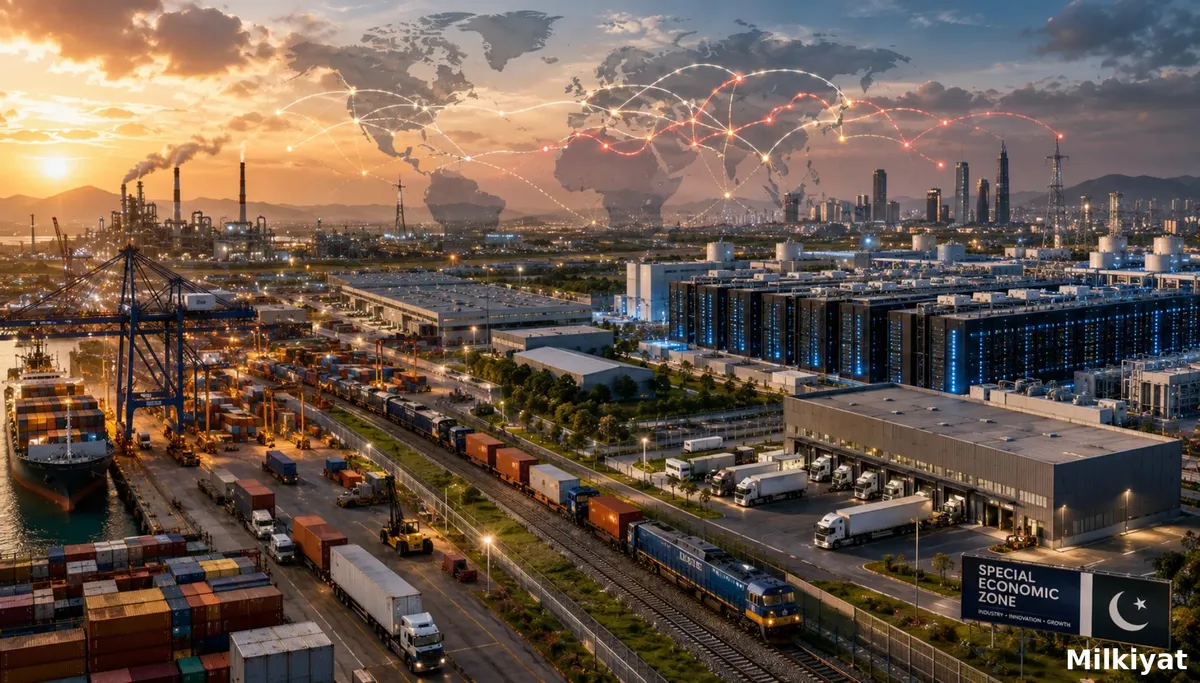
Pakistan, strategically located at the crossroads of South Asia, Central Asia, and the Middle East, stands to become a significant, albeit largely untapped, beneficiary of the deglobalisation trend. The country's potential lies in its burgeoning network of Special Economic Zones (SEZs), its role in regional connectivity projects like the China-Pakistan Economic Corridor (CPEC), and its growing digital economy, which necessitates robust data center infrastructure.
The expansion of SEZs is a critical component of Pakistan's strategy to attract foreign investment and boost industrialization. The number of SEZs in Pakistan has grown substantially, from just seven in 2019 to 44 by 2025, with a focus on providing incentives and infrastructure for manufacturing and export-oriented industries [13]. These zones are ideal locations for companies looking to nearshore or friend-shore their operations, offering tax breaks, streamlined regulations, and access to a large labor pool. The CPEC, while facing its own challenges, continues to develop logistics corridors and industrial parks that can facilitate regional trade and manufacturing, further enhancing Pakistan's appeal as a logistics and industrial hub.
Furthermore, Pakistan's rapidly expanding digital landscape is creating a significant demand for data centers. As local businesses embrace digitalization and international companies seek localized data storage solutions, the country's data center potential is growing. Investment in this sector, coupled with improvements in fiber optic connectivity and energy infrastructure, could position Pakistan as a regional data hub. For real estate investors, this translates into opportunities in developing and managing industrial parks, logistics warehouses, and state-of-the-art data centers within these SEZs and strategic corridors. The key to unlocking this potential lies in continued policy stability, infrastructure development, and a concerted effort to attract and facilitate foreign direct investment [14].
Investment Outlook (2026–2030)
The period between 2026 and 2030 is poised to be a transformative era for global real estate, shaped predominantly by the enduring forces of deglobalisation and technological advancement. Investors will increasingly prioritize resilience, strategic importance, and long-term value over short-term gains, leading to a reallocation of capital across sectors and geographies.
Institutional Investors: Large institutional investors, including pension funds and sovereign wealth funds, will continue to increase their allocations to alternative real estate assets such as data centers, logistics facilities, and specialized industrial properties. Their focus will be on assets that offer stable, inflation-hedged income streams and are critical to the functioning of the new, more localized global economy. Platforms that can aggregate and manage these specialized assets across multiple regions will be particularly attractive.
Developers: Developers will need to adapt to changing demand patterns, focusing on building flexible, sustainable, and technologically advanced facilities. This includes developing smart warehouses with automation capabilities, energy-efficient data centers, and industrial parks designed for specific manufacturing needs (e.g., advanced robotics, clean energy integration). The ability to navigate complex regulatory environments and secure reliable power and connectivity will be crucial.
REITs (Real Estate Investment Trusts): REITs specializing in industrial, logistics, and data center properties are expected to outperform. Their diversified portfolios of income-generating assets in these high-demand sectors will appeal to investors seeking exposure to the deglobalisation trend. However, REITs with heavy exposure to traditional office and retail, particularly in secondary locations, may face headwinds.
Governments: Governments will play a pivotal role in shaping the real estate investment landscape through policy incentives, infrastructure spending, and regulatory frameworks. Those that actively promote friend-shoring, nearshoring, and digital infrastructure development through favorable tax regimes, SEZs, and efficient permitting processes will attract the most capital. Investment in critical infrastructure, such as reliable energy grids and high-speed internet, will be essential to support these new real estate demands.
Risks: Navigating the New Landscape
While deglobalisation presents significant opportunities, it also introduces a new set of risks that real estate investors and developers must carefully navigate. The shift away from a globally optimized system creates inherent inefficiencies and potential for increased costs.
Inflation and Interest Rates: The reshoring and nearshoring of manufacturing can lead to higher production costs due to increased labor expenses and stricter environmental regulations in developed economies. These higher costs can contribute to inflationary pressures, which, in turn, may prompt central banks to maintain higher interest rates. Elevated interest rates increase borrowing costs for real estate development and acquisition, potentially dampening investment activity and impacting asset valuations. The cost of capital becomes a more significant factor in project feasibility.
Regulatory Tightening and Trade Barriers: Deglobalisation is often accompanied by increased protectionism, including new tariffs, import quotas, and non-tariff barriers. These measures can disrupt supply chains, increase the cost of materials for construction, and complicate cross-border real estate transactions. Furthermore, a patchwork of evolving national regulations, particularly concerning data sovereignty and environmental standards, can create compliance challenges and add to operational complexities for multinational real estate portfolios.
Energy Costs: The operation of modern industrial facilities and, especially, data centers is highly energy-intensive. As geopolitical tensions impact global energy markets and the transition to renewable energy sources progresses, energy costs can be volatile. Data centers, in particular, require massive and reliable power supplies, making them vulnerable to energy price spikes and grid instability. Investment in on-site renewable energy generation and energy-efficient designs will become increasingly critical to mitigate this risk.
Geopolitical Volatility: While deglobalisation is partly a response to geopolitical risks, the process itself can be destabilizing. Ongoing conflicts, trade disputes, and political instability in key regions can deter foreign investment, disrupt construction projects, and impact property values. Investors must conduct thorough geopolitical risk assessments for each market, considering factors beyond traditional economic indicators. The focus on "friend-shoring" also implies a greater sensitivity to political alliances and potential shifts in international relations.
Successfully navigating these risks will require a nuanced understanding of global economic and political dynamics, a flexible investment strategy, and a strong emphasis on due diligence and risk mitigation in real estate development and acquisition.
Related Reading on Milkiyat
- Pakistan Construction Cost Guide 2026
Pakistan's Construction Cost Crisis 2026: Cement, Steel, and the Collapse of the Builder's Budget - Pakistan Real Estate Investment Guide 2026
Pakistan's Rs 18.77 Trillion Budget: A Stability Bet Built on Record Tax Targets, a Surging Defence Bill, and the Ever-Present Shadow of the IMF - Apna Ghar Program 2026
Wazir-e-Azam Apna Ghar Program – “Ghar Ho Tu Apna”: Complete Guide for First-Time Homebuyers in Pakistan (2025–2026) - Islamabad Property Market Report 2026
CDA vs MCI Islamabad 2026: The Complete Comparison Guide - Overseas Pakistani Property Investment Guide
Top 5 Housing Societies for 5 Marla Plots on Installments in Islamabad & Rawalpindi (2026)
FAQ
Q1: What is deglobalisation and how does it impact real estate? A1: Deglobalisation refers to the trend of decreasing interdependence and integration among national economies, driven by factors like geopolitical tensions and supply chain vulnerabilities. It impacts real estate by shifting demand towards more localized, resilient assets such as data centers, logistics hubs, and industrial facilities that support nearshoring and friend-shoring strategies.
Q2: Which real estate sectors are benefiting most from deglobalisation? A2: Data centers, logistics and industrial real estate are the primary beneficiaries. Data centers are crucial for digital infrastructure, while logistics and industrial properties support the relocation of manufacturing and storage closer to end markets or allied nations.
Q3: How is PwC's 2026 Global Outlook addressing deglobalisation? A3: PwC's 2026 Global Outlook reports highlight deglobalisation as a top concern for real estate professionals. They emphasize the industry's adjustment to a prolonged period of transition, with a focus on resilient assets and long-term value in a volatile environment.
Q4: What role do geopolitical tensions play in this trend? A4: Geopolitical tensions, such as the US-China rivalry and regional conflicts, accelerate deglobalisation by forcing nations and corporations to prioritize supply chain security and national interests over pure economic efficiency. This leads to strategic realignments like friend-shoring and nearshoring, driving demand for new real estate infrastructure.
Q5: How can Pakistan benefit from deglobalisation in real estate? A5: Pakistan can benefit through the expansion of its Special Economic Zones (SEZs), the development of logistics corridors under CPEC, and its growing potential as a data center hub. These factors can attract foreign investment in industrial and digital infrastructure, supporting localized manufacturing and data storage needs.
Conclusion
The forces of deglobalisation are fundamentally reshaping the global economic order, and with it, the landscape of real estate investment. The PwC 2026 Global Outlook provides a clear lens through which to view this transformation, underscoring the critical importance of resilience, strategic location, and specialized asset classes. As supply chains reconfigure, digital infrastructure expands, and geopolitical considerations drive investment decisions, sectors such as data centers, logistics, and industrial real estate are poised for sustained growth. While challenges like inflation, regulatory shifts, and energy costs persist, the overarching trend points towards a more localized, secure, and technologically advanced real estate ecosystem. For astute investors and developers, understanding and adapting to these shifts will be paramount to unlocking significant opportunities in the years to come, particularly in emerging markets like Pakistan that are strategically positioned to capitalize on this new global paradigm.
References
[1] PwC. (2025, November 4). Emerging Trends in Real Estate®: Europe 2026. Retrieved from https://www.pwc.com/gx/en/industries/financial-services/real-estate/emerging-trends-real-estate/europe.html [2] PwC. Emerging Trends in Real Estate® 2026. Retrieved from https://www.pwc.com/us/en/industries/financial-services/asset-wealth-management/real-estate/emerging-trends-in-real-estate-pwc-uli.html [3] PERENews. (2025, February 6). Drive for resilience recalibrates global logistics. Retrieved from https://www.perenews.com/drive-for-resilience-recalibrates-global-logistics/ [4] JLL. (2026, January 5). 2026 Market Outlook for Global Data Centers. Retrieved from https://www.jll.com/en-us/insights/market-outlook/data-center-outlook [5] Precedence Research. Data Center Market Size, Share, and Trends 2026 to 2035. Retrieved from https://www.precedenceresearch.com/data-center-market [6] Arizton. GCC Data Center Market – Industry Outlook & Forecast 2026-2031. Retrieved from https://www.arizton.com/market-reports/gcc-data-center-market-analysis [7] Research and Markets. Data Center Real Estate Global Market Report 2026. Retrieved from https://www.researchandmarkets.com/reports/6226021/data-center-real-estate-global-market-report?srsltid=AfmBOoqpK6fnCYyMlwDJ5QaYsLaMf1jcurBTauVMuhFLqgVBvSCxwFgz [8] JLL. (2025, December 8). Global Real Estate Outlook. Retrieved from https://www.jll.com/en-us/insights/market-outlook/global-real-estate [9] Cushman & Wakefield. Nearshoring: Opportunities for Real Estate in EMEA. Retrieved from https://www.cushmanwakefield.com/en/united-kingdom/insights/nearshoring-opportunities-for-businesses [10] JLL. (2024, January 4). Adapting to shifting trade policies: 5 predictions for industrial real estate. Retrieved from https://www.jll.com/en-us/guides/adapting-to-shifting-trade-policies-5-predictions-for-industrial-real-estate [11] Clarion Partners. (2025, December 11). Industrial Real Estate: Short-term Uncertainty, Long-term Confidence. Retrieved from https://www.clarionpartners.com/insights/industrial-real-estate-outlook [12] World Bank. (2026, April 8). Challenges of Conflict and Industrial Policy for Development. Retrieved from https://openknowledge.worldbank.org/entities/publication/9cdd6157-e12b-4c7e-a269-6415ec4d74c0 [13] Profit by Pakistan Today. (2026, January 16). BOI briefs investment minister on SEZ-led industrialisation, China B2B follow-up. Retrieved from https://www.facebook.com/profitpk/posts/boi-briefs-investment-minister-on-sez-led-industrialisation-china-b2b-follow-upr/1193202832971539/ [14] PIDE. Special Economic Zones in Pakistan: Promises and Perils. Retrieved from https://www.pide.org.pk/Research/Research-Report-Special-Economic-Zones-in-Pakistan-Promises-and-Perils.pdf