Guide
How to Assess a New Road, Highway or Interchange's Real Impact on Property Prices
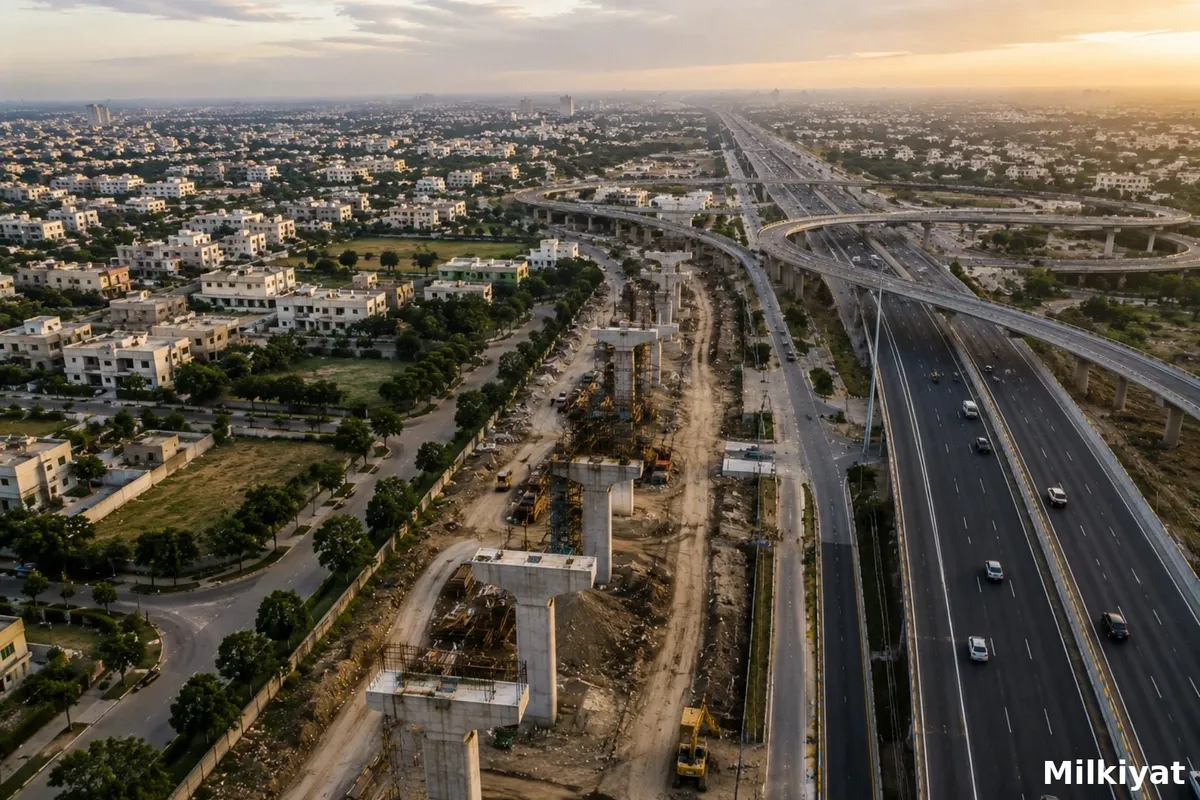

By Bibi Masooma
Real Estate AnalystVerified author
11 min read
Short Answer
Do new roads and interchanges increase property prices? They can, but proximity alone does not guarantee a price increase. A new road or interchange is most likely to create real value when the project is physically completed, the specific property has practical access to it, and surrounding development has had enough time to respond.
Rawalpindi’s Adiala and Chakri interchanges on the Ring Road provide useful real-world examples. They show both the potential upside of improved connectivity and the risk of property prices rising on expectations before the infrastructure is actually delivered.
Introduction
Will property prices rise after a new road or interchange opens? This is one of the most common claims in Pakistan’s real estate market—and one buyers should examine carefully.
New roads, highways, and interchanges can genuinely increase property values by reducing travel times, improving accessibility, attracting commercial activity, and making previously less-connected areas more attractive. But the impact is rarely uniform across an entire area.
The critical question is not simply “How close is the property to the new road?” It is “Can this specific property actually benefit from it?”
A project that exists only on a map or in a developer’s marketing material is very different from a completed road with functioning access. Similarly, a plot may be physically close to an interchange but have no convenient route connecting it to the new infrastructure.
That is why buyers should assess infrastructure-led property appreciation through three tests: Is the project actually complete? Does the property have usable access? And has enough surrounding development taken place for the expected economic benefit to reach the property?
These checks help separate genuine infrastructure-driven value growth from speculative price increases based mainly on future promises.
Step 1: Confirm Genuine Physical Completion, Not Just an Announcement
The first question buyers should ask is simple: Is the infrastructure actually complete and open, or is it still an announcement, construction project, or marketing promise?
This distinction can make a major difference to property values. A road that exists only in a government announcement or development plan cannot provide the same accessibility benefits as a road that is physically complete, operational, and accessible to the public.
Rawalpindi’s Ring Road is a useful example. Its first phase, covering roughly 38.3 kilometres from Banth to Thallian, includes five planned interchanges: Banth, Chak Beli Khan, Adiala Road, Chakri Road, and Thallian. Official project documents confirm the route and planned interchange structure.
For the latest project status, buyers should rely on official updates from the Rawalpindi Development Authority (RDA) rather than developer advertisements or property marketing claims. The RDA's official Ring Road project document provides details of the route and planned interchanges, while the Punjab Planning & Development Department also identifies the 38.3-km Banth–Thallian corridor.
For property buyers, this level of detail matters. Saying “Rawalpindi Ring Road is complete” can create a misleading picture if important sections or interchanges are still unfinished or not yet operational.
What Buyers Should Verify
Before paying a higher price because a new road, highway or interchange is expected to improve an area, buyers should first check what is actually available today. An infrastructure project can look impressive in plans and marketing material, but its investment value depends on whether people can already use it and whether it is genuinely improving access to the property.
Before making a purchase decision, verify:
-
Current construction status: Check how much of the project has actually been built. A project that is still under construction should not be valued in the same way as one that is substantially complete.
-
Whether the road is officially open for traffic: A completed-looking road is not necessarily operational. Confirm that the relevant section has officially opened and is being used by the public.
-
Which interchanges are operational: An interchange can be critical to the property's accessibility. Check whether the specific interchange being promoted is open and providing the expected route connection.
-
Whether the project is fully or partially complete: Some projects open in phases. A property may benefit from one completed section while still waiting for another section that is essential to its connectivity.
-
Whether the specific property can actually access the completed infrastructure: Distance on a map can be misleading. Check the real driving route, entry and exit points, road conditions, and the actual travel time from the property to the new infrastructure.
The rule is simple: price the infrastructure that exists and can be used not the infrastructure that is only promised. Future development may create additional value, but buyers should treat that as future potential rather than paying today as if the full benefit has already arrived.
Step 2: Check Actual, Usable Access From the Specific Plot
Proximity on a map isn't the same as access. A plot ten minutes from an interchange by a direct route is in a meaningfully different position than a plot the same straight-line distance away but reachable only via a longer, indirect road. When assessing a specific property's exposure to a nearby infrastructure project, trace the actual route a resident would drive, not the distance a marketing map implies. This is exactly the kind of check that separates a genuine beneficiary a project like RUDN Enclave, positioned directly at the Adiala Road–Ring Road intersection from a project merely marketed as "near the Ring Road" while sitting a longer, less direct drive away.
Distinguishing Genuine Access From Marketed Proximity
| Question | Why It Matters |
|---|---|
| Is the project genuinely complete, or still under construction/announced? | Determines whether any price effect should already be showing up |
| Is the route from this specific plot to the interchange direct, or indirect? | Straight-line distance on a map can overstate real accessibility |
| Which specific interchange serves this plot, and is that one finished? | Different interchanges on the same road can be at very different completion stages |
Step 3: Give It Time Infrastructure Effects Don’t Happen Overnight
Even when a road or interchange is genuinely complete, the surrounding area does not change overnight. Businesses, schools, shops and new housing projects usually take time to respond to better access. As that activity builds, demand for nearby property can strengthen gradually.
This is why buyers should separate “the road is open” from “the area has actually developed.” A new road may improve travel immediately, but its wider property market impact depends on what happens around it afterward.
Rawalpindi Ring Road is a useful example. RDA’s official project documents describe the project’s intended role in improving connectivity and easing pressure on the existing road network, while RDA has also published updates showing that construction milestones have progressed over time.
For investors, the practical question is therefore not simply whether a project has been announced or even completed. Ask: Has the surrounding area started responding? Are commercial businesses opening? Are new buildings appearing? Is traffic actually using the improved route? Are nearby services and residential development expanding?
A price increase that is already fully priced in before these changes happen is not necessarily wrong. But it represents a bet on future completion and follow-on development, rather than a value increase supported by changes that already exist on the ground.
For current project information, buyers should check RDA's official updates and project-related notices rather than relying only on marketing claims. RDA also maintains official information on private housing schemes and advises the public to verify approval status directly.
For a project-specific look at the Rawalpindi Ring Road and its potential investment implications, see Milkiyat’s Rawalpindi Ring Road Phase 2: Route, Affected Housing Societies & Investment Impact 2026.
The Realistic Timeline of Infrastructure Impact
| Stage | What's Actually Happening | Price Impact Risk |
|---|---|---|
| Announcement / early construction | Plans exist, work is starting | High risk of premature pricing based on hype alone |
| Substantial construction (e.g., Ring Road at ~90% in mid-2026) | Physical progress is real and checkable | Moderate impact should track actual, verifiable progress |
| Genuine completion and opening | Road is usable | Foundational for real access-driven demand to begin |
| Post-completion development build-up | Businesses, schools, further housing respond over time | Price effects typically build gradually here, not instantly |
A Practical Framework for Judging Any Specific Project
- Confirm the project's actual completion percentage from an independent source, not just the developer's own claim.
- Check whether the specific interchange or road segment that serves your plot is among the finished portions, since large projects often complete unevenly.
- Trace the real driving route from the plot to the infrastructure, rather than relying on straight-line proximity.
- Ask how much of the current asking price already assumes the project's benefits are realised, and weigh whether that assumption is reasonable given the actual completion stage.
- Recognise that even genuine completion doesn't guarantee an immediate price jump surrounding development typically takes time to build up.
Quick Assessment Checklist
| Step | What to Check | Why It Matters |
|---|---|---|
| 1 | Verify the actual completion status from official or independent sources | Separates completed infrastructure from announcements, projections, and marketing claims. |
| 2 | Confirm the interchange serving your property is actually operational | A nearby interchange has little value if your plot cannot use it. |
| 3 | Measure the real driving route and travel time | Straight-line distance can make a property appear much closer to an interchange than it really is. |
| 4 | Check how much future infrastructure value is already priced in | A high asking price may already reflect expected appreciation, leaving less upside for the buyer. |
| 5 | Allow time for surrounding development to respond | Infrastructure rarely creates instant value; commercial activity, population growth, and new development usually take time to follow. |
Bottom line: Don’t value a property simply because a road or interchange is nearby. Verify that it is complete, usable, accessible from the specific property, and not already fully priced into the market.
Official Information vs. Marketing Framing vs. What You Can Verify
- Official information: Independently reported completion status for the specific road or interchange, cross-checked where possible with the relevant development authority.
- Marketing framing: A developer's or dealer's characterization of "Ring Road access" or "highway proximity," which may describe the broader area rather than the actual route from a specific plot.
- What you can verify: The real driving route and distance from the specific plot to the infrastructure, and the project's actual, current completion stage.
Bottom Line
Assessing a road or interchange's real impact on a specific property means separating the announcement from the construction, the construction from actual completion, and completion from the gradual build-up of surrounding development that follows it while also confirming that the specific plot in question has genuine, direct access rather than mere proximity on a map. Rawalpindi's Ring Road, tracked honestly through its actual reported progress rather than blanket claims, is a useful model for how to do this kind of assessment for any infrastructure project.
FAQs
Q1: Does a newly announced road project already justify a higher asking price?
Not on its own. An announcement carries execution risk and timeline uncertainty; a price that already fully assumes the project's benefits is a bet on the future, not a reflection of anything currently in place.
Q2: How do I check if a road or interchange is actually finished?
Look for independently reported completion figures, ideally cross-checked with the relevant development authority, rather than relying solely on a developer's own characterization.
Q3: Is being "near" an interchange the same as having good access to it?
Not necessarily. Trace the actual driving route from the specific plot to the interchange straight-line map distance can overstate real accessibility if the route is indirect.
Q4: How long does it typically take for a road's impact to show up in prices?
There's no fixed timeline, but surrounding development businesses, schools, further housing generally builds up gradually after genuine completion rather than appearing immediately.
Q5: Can two projects on the same road be at very different completion stages?
Yes. Large infrastructure projects often complete unevenly across their length, so the specific segment or interchange relevant to your plot needs checking individually.
Q6: Is Rawalpindi's Ring Road fully complete now?
As of June 2026 reporting, Phase 1 was around 90% complete with most interchanges finished, though the Thalian interchange remained a separate, ongoing project confirm current status for the most up-to-date picture.
Internal Links Used
Official Sources Used
Note: Ring Road completion percentages referenced here are drawn from RDA-sourced reporting. Buyers should confirm current progress directly with RDA before relying on any specific figure for a live transaction.