Guide
Lahore Plot Prices 2016–2026

By Maham Imtiaz
Real Estate AnalystVerified author
13 min read
Short Answer:
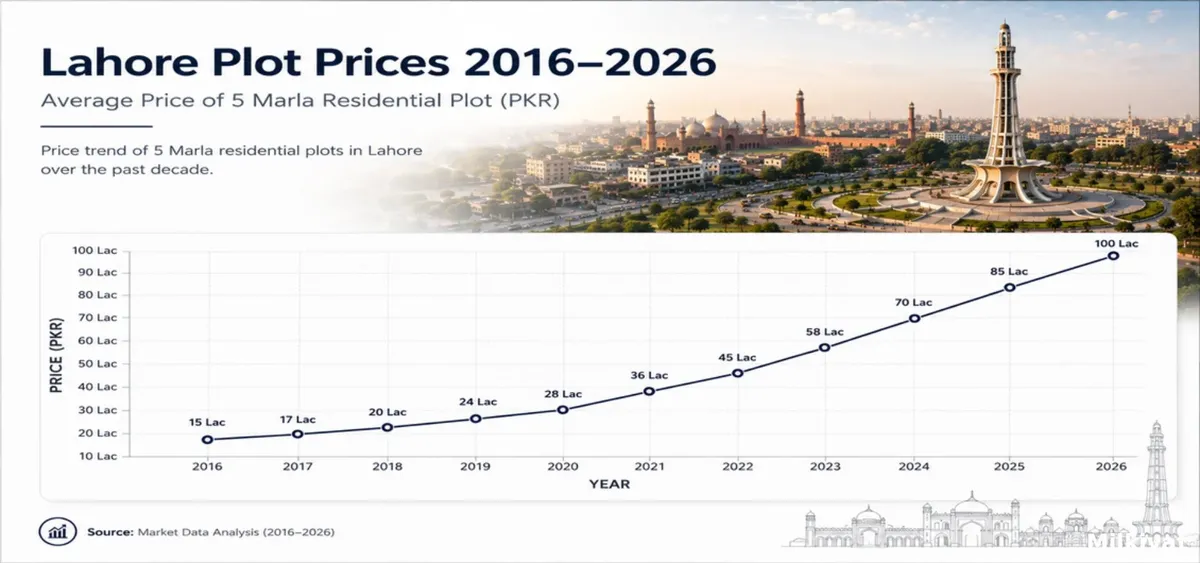
Lahore plot prices roughly doubled to tripled in rupee terms between 2016 and 2026. Over the same period Pakistan's Consumer Price Index rose from a base of 100 in 2015–16 to about 282, and the rupee fell from roughly 105 to 279 against the dollar. That means most Lahore plots barely matched inflation and lost value in dollar terms. The decade's real story is not "prices went up." It is that developed, possession-ready plots in liveable areas roughly held their purchasing power, while undeveloped files in far-flung phases destroyed it. Possession status, plot size and holding period mattered far more than the city-wide average.
The Data Problem Nobody Mentions
Before looking at any number, one thing has to be said plainly: Pakistan has no official repeat-sales house price index. There is no Case-Shiller for Lahore. What passes for "plot price data" in this market comes from four sources, and each has a flaw:
- Portal listing indices track asking prices, not closed transactions. In a slow market, sellers hold listings high while actual deals close 10–20% below. The index therefore understates downturns.
- FBR valuation tables are administrative values used for tax collection. They are revised periodically and deliberately sit below market. They tell you what the state thinks a property is worth, not what a buyer paid. The Lahore table was last revised by SRO 876(I)/2026 on 19 May 2026.
- DC / district collector rates lag even further behind.
- Dealer quotes are the most current source and the least verifiable.
So when anyone gives you an exact percentage for Lahore plot appreciation over ten years, treat it as an estimate assembled from listings and dealer consensus. The figures below are presented that way, indicative market ranges, not audited transaction records.
The Decade Split Into Four Phases
The ten-year chart is not one line going up. It is four very different markets stitched together.
Phase 1: The Documentation Freeze (2016–2019)
July 2016 brought the first FBR valuation tables for immovable property, and the market's reaction was immediate, transaction volumes fell while everyone waited to see how the new tax base would work. The 2018 restriction barring non-filers from buying property above a threshold added a second freeze. Prices in most established Lahore areas were flat to slightly negative in nominal terms across these three years, which, against 5–9% annual inflation, was a quiet real-terms loss of 15–25%.
This is the phase most investors forget. It sets up everything that followed.
Phase 2: The Cheap-Money Boom (2020 to mid-2022)
Then came the perfect storm on the upside. The State Bank cut the policy rate to 7% during COVID. A construction package waived source-of-funds questions. Remittances hit record levels as overseas Pakistanis redirected capital into property. Bank deposits paid almost nothing in real terms.
Lahore plot prices rose 40–90% in roughly 24 months, depending on the area. File markets in unbuilt DHA phases rose faster still; some doubled. This is the period that created the "property always goes up" folk wisdom now being applied to 2026.
Phase 3: The Correction (late 2022–2024)
The policy rate went to 22%. Headline inflation touched roughly 38% in mid-2023. The rupee slid past 300 at one point. Suddenly a T-bill paid over 20% risk-free, and an empty plot paid nothing at all.
Nominal prices in established, developed areas mostly moved sideways, which was itself a 40–50% real loss over two years. File markets did far worse. Some DHA files in undeveloped phases traded 30–50% below their 2022 peaks, and in a few cases across the wider DHA network, considerably more than that.
Phase 4: Recovery, Then a Reversal (2025–2026)
Inflation fell sharply through 2025 and the State Bank cut hard, taking the policy rate down to 10.5% by March 2026, roughly 1,150 basis points off the 22% peak.
Transaction taxes came down too. Dawn reported in June 2026 that property taxes for filers were roughly halved to revive the sector, with buyer withholding tax under Section 236K cut from 2.5% to a flat 1.25% and seller tax under 236C from 5.5% to a flat 2.75%. That followed the earlier round in which buyer withholding slabs were cut and the 7% Federal Excise Duty on property transactions was abolished. Section 7E, the annual tax on idle plots, was struck down and formally repealed with effect from 1 July 2026. Combined transaction cost for an active filer is now around 4%.
Then the direction changed. Inflation turned back up on energy costs, and at the 27 July 2026 meeting the State Bank raised the policy rate to 11.5%, with inflation running near 11%, the easing cycle is over for now. That matters more than the tax cuts: a plot appreciating 12% a year is barely beating a term deposit, and is returning close to zero in real terms.
The Numbers: Indicative Per-Marla Prices, 2016 vs 2026
Figures are indicative rupees per marla for standard residential plots, mid-range block quality within each area. Treat them as ranges, not quotes.
| Area | 2016 (approx./marla) | 2026 (approx./marla) | Nominal multiple |
|---|---|---|---|
| Gulberg III | Rs 45–60 lakh | Rs 1.2–1.7 crore | ~2.7x |
| Model Town | Rs 35–45 lakh | Rs 90 lakh–1.3 crore | ~2.6x |
| Johar Town | Rs 14–18 lakh | Rs 30–45 lakh | ~2.4x |
| Wapda Town / Valencia | Rs 8–11 lakh | Rs 20–28 lakh | ~2.4x |
| LDA City / peripheral schemes | Rs 3–5 lakh | Rs 7–11 lakh | ~2.1x |
| Bahria Town (developed sectors) | Rs 6–8 lakh | Rs 11–16 lakh | ~1.8x |
| DHA Phase 7 (possession) | Rs 7–9 lakh | Rs 12–16 lakh | ~1.7x |
| DHA Phase 6 (possession) | Rs 11–14 lakh | Rs 17–22 lakh | ~1.6x |
| Undeveloped DHA files (Ph. 10, 13) | — | — | Still below 2022 peak |
Phase-by-phase detail for the largest of these, which phases are developed, which are still file markets, and what the price gap between them means, is in our DHA Lahore Complete Area Guide 2026. All figures use the 225 sq ft marla standard.
The Inflation Test: The 2.8x Hurdle
Here is the single most useful number in this article.
Pakistan's Consumer Price Index is based on 2015–16 = 100. By February 2026 that index stood at 282.39, according to Pakistan Bureau of Statistics price data. In other words, the general price level is about 2.8 times what it was in the base year of our comparison.
Apply that as a hurdle rate:
- A plot that rose 2.8x in ten years exactly preserved your purchasing power. Zero real gain.
- 2.4x, Johar Town, Wapda Town, is roughly a 15% real loss.
- 1.6–1.8x — much of DHA's developed phases and Bahria Town, is roughly a 35–43% real loss.
- Only the top of the table, Gulberg and prime Model Town at 2.6–2.7x, came close to breaking even in real terms.
Read that list again. Almost no residential plot category in Lahore beat inflation over 2016–2026. A vacant plot also generates no rent, so there is no yield to add back, the total real return on an empty Lahore plot bought in 2016 and held to 2026 was, for most areas, negative. Our house vs plot comparison runs the same arithmetic on the twin cities and reaches the same conclusion about idle land: capital sitting in a vacant plot earns nothing while the deposit rate does the compounding.
This does not mean property was a bad decision for everyone. Someone who bought and built got a decade of housing or rental value out of the asset. Someone who bought a file and sat on it faces unforgiving arithmetic.
The Dollar Test
The rupee traded around 105 to the dollar in 2016. In 2026 it has been trading in the 277–282 range.
Convert the table above into dollars and the picture gets starker. A DHA Phase 6 plot at Rs 13 lakh per marla in 2016 was about $12,400. The same marla at Rs 19 lakh in 2026 is about $6,800, a 45% loss in dollar terms.
Even Gulberg, the best performer on the list, is roughly flat in dollars across the decade.
This matters most for overseas Pakistani buyers, who earn in foreign currency. If you remitted dollars into Lahore property in 2016 and sold in 2026, you very likely took a loss in your home currency, even though the rupee figure on your sale deed looked like a large gain.
The Decade's Real Dividing Line: Files vs Possession
If you take one lesson from 2016–2026, take this one.
Possession plots in developed, liveable areas roughly tracked inflation. Files in undeveloped phases did not.
A file is an allotment right to a plot that does not yet physically exist in developed, handed-over form. Files are cheap to enter, easy to trade and require no development charges up front, which is exactly why they attracted speculative money in 2020–2022 and exactly why they fell hardest in 2022–2024. There is no floor under a file price. No rental value, no build option, no end-user demand. When liquidity leaves, a file has nothing to fall back on.
Possession plots have a floor: someone can start building tomorrow. That end-user demand is what stopped developed DHA and Bahria sectors from falling in nominal terms even at the worst of the correction.
The gap between a possession plot and a non-possession file in the same phase remains wide in 2026, often 30–50%. That gap is not irrational — it is the market pricing development risk, timeline risk and liquidity risk, and the last decade proved that risk is real. DHA publishes a dated possession notice archive covering Phases 5 through 11; check the actual sector against it before accepting any seller's claim that a plot is "possession."
For private schemes, the equivalent check is legal status with the LDA, verify the scheme and the specific block against the authority's own approved-scheme record before token money changes hands, rather than relying on a developer's brochure. On the title side, our explainer on what Fard, Intiqal and Registry each actually prove covers the ownership chain you need to complete once you reach the transfer stage.
What Actually Outperformed
Three patterns hold across the full decade:
1. Smaller plots beat larger ones. Five-marla plots outperformed one-kanal plots almost everywhere. The reason is demand structure: the buyer pool for a Rs 90 lakh plot is many times larger than for a Rs 4 crore plot, and end-user demand is what supports prices in a downturn. Kanal plots were the worst-hit segment in 2022–2024.
2. Central, built-out, land-constrained areas beat new frontier developments. Gulberg and Model Town cannot expand. New supply in DHA, Bahria Town and along the Ring Road kept arriving throughout the decade. Scarcity is the only durable moat in a land market.
3. Infrastructure completion beat infrastructure announcement. The areas that gained most were those where a promised road, interchange or utility actually got delivered. Buying on the announcement and holding through a multi-year delay was, repeatedly, the losing trade of the decade.
What This Means for a 2026 Buyer
The 2026 market has genuine tailwinds: transaction taxes at roughly 4% for filers, Section 7E gone, improving volumes and continued remittance inflows. But ten years of data, plus a policy rate that has started climbing again, suggests four rules:
- Do not underwrite on nominal history. "It doubled in ten years" is a real loss when the CPI nearly tripled. Set your hurdle at inflation plus a risk premium, not at zero.
- Benchmark against the deposit rate. At 11.5%, cash is a real competitor. A plot has to clear that bar plus its transaction costs before it has earned anything.
- Prefer possession over files unless you are consciously taking a high-variance position with money you can leave untouched for five years or more.
- Check the paperwork before the price. Approval status, transfer history and NOC standing determine whether you own an asset or a dispute.
Current listings and area-level context for Lahore are on Milkiyat.com.
Frequently Asked Questions
Did Lahore plot prices really go up over 2016–2026? Yes, in rupees. Most areas rose between roughly 1.6x and 2.7x. But cumulative inflation over the same period was about 2.8x, so most of that increase was currency, not value.
Which Lahore area performed best over the decade? On indicative per-marla data, central land-constrained areas, Gulberg and Model Town, came closest to preserving real value, at roughly 2.6–2.7x nominal.
Why did DHA underperform on a percentage basis? DHA's developed phases entered 2016 at already-elevated prices after the 2013–2015 run, and DHA kept adding supply through new phases. Established areas with fixed supply had more proportional room to appreciate.
Is 2026 a good entry point? Transaction costs are the lowest in years and the correction has largely played out. But inflation has turned back up and the State Bank has resumed hiking. Buy on the specific asset's merits, possession, approval, location, buildability — rather than on a market-timing call.
What does it cost to transact in 2026? For an active filer, roughly 4% combined: 1.25% buyer advance tax under Section 236K and 2.75% seller advance tax under Section 236C, plus stamp duty and registration. Non-filers pay substantially more.
Where can I find official data instead of dealer estimates? The FBR publishes valuation tables by city, the Pakistan Bureau of Statistics publishes the CPI series used above, and the State Bank publishes policy rate history. None is a market price index, but together they give you the deflator you need to judge any price claim.
Sources and Further Reading
External
- Pakistan Bureau of Statistics — Price Statistics (CPI, base 2015–16 = 100)
- State Bank of Pakistan — Monetary Policy
- FBR — Valuation of Immovable Properties
- FBR — Lahore property valuation table
- DHA Lahore — Possession notices
- Dawn: Property tax halved for filers to revive realty sector (June 2026)
- Dawn: Tax relief for property buyers, but not for sellers (June 2025)
Internal
- DHA Lahore Complete Area Guide 2026
- House vs Plot Investment: Which Delivers Higher ROI
- Fard vs Intiqal vs Registry: What Proves Property Ownership
- Milkiyat.com — browse Lahore property
Price figures in this article are indicative market ranges compiled from listing data and dealer consensus, not audited transaction records. Pakistan has no official repeat-sales index. Verify current rates and legal status independently before transacting.