Guide
Gul Plaza Fire: How 1,043 Approved Shops Became 1,102, Then 1,153

By Maham Imtiaz
Real Estate AnalystVerified author
9 min read
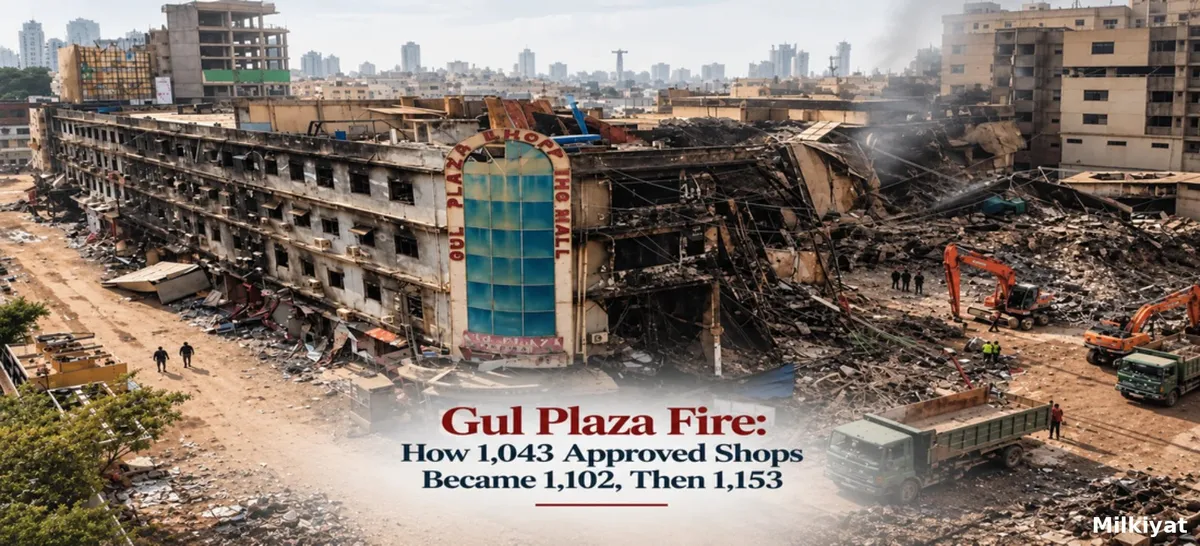
When fire swept through Gul Plaza on MA Jinnah Road on the night of 17 January 2026, it killed 80 people in a building that had been approved, regularised and reapproved over four decades. The paper trail shows a shopping centre whose approved shop count crept up at every stage, whose exits were cut from 16 to three in practice, and whose fire safety nobody had formally checked in years.
The case matters to anyone buying or renting a shop in an older Karachi market. Our guide on how to verify property in Karachi explains that the building layer of any purchase rests on SBCA's approved plan and completion record, and Gul Plaza shows how far a building can drift from its plan while still holding valid-looking approvals.
This guide follows Gul Plaza's approval history, computes how the shop count and exits changed, sets out what the judicial commission found, and turns the findings into checks for commercial buyers and tenants.
The approval trail, step by step
| Year | Event | Shops | What the record shows |
|---|---|---|---|
| 1979 | Original plan approved by KDA, NOC issued | Not traceable | SBCA holds only photocopies; it cannot confirm the floors originally approved |
| 1992 | Violations first noted | n/a | Show-cause notice issued |
| 1998 | Second floor sealed for building without approval, then revised plan approved | 1,043 | Basement, ground and three upper floors, no mezzanine; 16 exit points |
| 2003 | Regularisation under the 2001-02 amnesty scheme | 1,102 | Regularisation or completion certificate issued April 2003; last SBCA inspection February 2003 |
| 2005 | NOC reported for 1,102 shops | 1,102 | Basement and upper levels |
| January 2026 | Fire | 1,153 operating | Building also had a mezzanine level not in the 1998 plan |
These figures come from SBCA's reply to the judicial commission in March 2026 and the commission's findings published in August 2026. SBCA told the commission that it could not determine the exact number of shops operating before the fire; the commission put it at 1,153.
How the shop count grew
Approved to regularised. The 1998 revised plan showed 1,043 shops. The 2003 regularisation recognised 1,102, adding 59 shops that had been built beyond the plan.
Regularised to operating. By the time of the fire, 1,153 shops were operating, another 51 that had never been approved or regularised.
Floors that did not exist on paper. The 1998 plan had no mezzanine. By 2026 the building had a mezzanine level, and 30 bodies were found in a single mezzanine crockery shop where people had locked themselves in waiting for rescue.
Regularisation, which the Sindh Building Control Ordinance allows within limits through composition of deviations, turned an unauthorised building into an approved one in 2003. But nothing in the record shows SBCA returning after 2003 to check what came next.
The exits: 16 on paper, three in use
The 1998 plan provided 16 exit points. On the night of the fire, 13 of them were locked, and a grille over the rooftop exit blocked another escape route. The building had no emergency exits beyond these, no smoke alarms, no fire hoses or sprinklers, no extinguishers and no proper emergency lighting, with each passage lit by a single 12-volt light.
The Karachi Building and Town Planning Regulations 2002 set fire safety and exit requirements for buildings like Gul Plaza. The judicial commission found that the building's breaches of the Civil Defence rules also amounted to breaches of the fire safety provisions of these regulations, including Regulations 13.3 and 14.8.
What the judicial commission found
The Sindh government appointed Justice Agha Faisal of the Sindh High Court as a one-member commission on 4 February 2026. Its 78-page report found a systemic failure rather than a single cause.
| Body | Commission's finding |
|---|---|
| Building management | Knew of fire safety gaps and did not fix them; stored large amounts of flammable goods; locked exits |
| SBCA | Inspected only after complaints, despite powers to act against a known hazardous building |
| Deputy Commissioner South | Held institutionally responsible; no joint audit under the High Court's three-tier fire audit mechanism |
| Civil Defence | Flagged missing hydrants, hose reels, pumps, alarms, drills and rescue equipment in 2024 and 2025; no effective legal action followed |
| Electrical safety | No regular electrical inspection had been carried out as the law requires |
| Fire brigade | Notified late; effective firefighting began 35 to 40 minutes after the fire started, hampered by water shortages |
| Rescue | A window for large-scale rescue between about 11:15 and 11:30 pm was not used |
SBCA, for its part, told the commission that its monitoring obligation ended 20 days after completion, after which the builder and then the management committee were responsible, and that it had never assessed whether the structure was fire resistant. It said the building had never been declared dangerous before the fire.
In September 2026, police filed a fresh charge sheet holding the mall's management primarily responsible, citing inadequate firefighting equipment, no emergency lighting and locked gates or grilles. Our report on the Gul Plaza fire probe and commercial property safety covers that charge sheet in detail.
The aftermath for owners and traders
| Measure | Detail |
|---|---|
| Compensation per deceased family | Rs10 million announced by the Sindh government |
| Relief for traders | Rs7 billion package announced |
| Temporary stalls | 300 traders initially, then 350 at the Polo Ground baradari |
| Building | Sealed; demolition ordered in April 2026 with reconstruction to a revised design |
Shop owners in Gul Plaza now hold title to units in a building that is being demolished. Their recovery depends on the government's reconstruction plan, not on anything in their own sale deeds.
What the numbers show: Milkiyat.com findings
The shop count grew by about 10.5% beyond the approved plan. From 1,043 approved to 1,153 operating: 1,153 − 1,043 = 110 extra shops, or 110 ÷ 1,043 = about 10.5%.
- Approved to regularised: 1,102 − 1,043 = 59 shops, about 5.7%.
- Regularised to operating: 1,153 − 1,102 = 51 shops, about 4.6%.
Each usable exit served six times the shops it was designed for. Under the 1998 plan: 1,043 ÷ 16 = about 65 shops per exit. On the night of the fire, with 13 of 16 exits locked: 1,153 ÷ 3 = about 384 shops per exit, roughly 5.9 times the design ratio.
Most of the exits were locked. 13 ÷ 16 = about 81% of the approved exit points were unusable.
SBCA last inspected 23 years before the fire. From February 2003 to January 2026 is about 23 years with no recorded SBCA inspection.
Compensation for the dead totals about Rs800 million. Rs10 million × 80 = Rs800 million, separate from the Rs7 billion relief package for traders.
Lessons for shop buyers and tenants
| Gul Plaza failure | What to check before buying or renting |
|---|---|
| Shops built beyond the approved plan | Your shop number appears on the approved or regularised plan |
| Mezzanine not on the plan | Every floor you can see is on the plan |
| 13 of 16 exits locked | All exits on the plan are open and signposted |
| No sprinklers, hoses, alarms or extinguishers | Working fire equipment and a recent Civil Defence inspection |
| No electrical inspection | A recent electrical inspection certificate |
| Flammable stock everywhere | The market union's fire safety rules and enforcement |
| Management committee ignored warnings | Who manages the building and whether it holds fire drills |
Our guide to the SBCA completion certificate explains why a unit should be checked against the completed plan before any purchase.
Checklist before you pay
| Check | Where |
|---|---|
| Shop listed on the approved or regularised plan | SBCA |
| Floors and mezzanines match the plan | SBCA plan and site visit |
| Exits open and matching the plan | Site visit |
| Fire safety equipment working | Site visit and Civil Defence |
| Electrical inspection current | Electric Inspector |
| Building not on the dangerous list | SBCA |
| Active management committee with fire drills | Market union |
Frequently asked questions
Q1. When was the Gul Plaza fire and how many people died?
A. The fire broke out on 17 January 2026 on MA Jinnah Road, Karachi, and killed 80 people.
Q2. How many shops were approved at Gul Plaza?
A. SBCA's 1998 revised plan showed 1,043 shops. The 2003 regularisation recognised 1,102, and the judicial commission found 1,153 operating at the time of the fire.
Q3. Was Gul Plaza built according to its approved plan?
A. No. SBCA told the judicial commission that the building was constructed in violation of the approved plan, with violations first noted in 1992 and later regularised.
Q4. How many exits were open during the fire?
A. Of the 16 exit points in the 1998 plan, 13 were locked on the night of the fire.
Q5. Who did the judicial commission blame?
A. It found a systemic failure, faulting the building management, SBCA, the Deputy Commissioner South's office, and gaps in Civil Defence follow-up, electrical inspection and the emergency response.
Q6. What happens to Gul Plaza now?
A. The Sindh government ordered the building demolished in April 2026 and asked SBCA for a reconstruction plan with a revised design.
Q7. What should I check before buying a shop in an older Karachi market?
A. Confirm your shop and floor are on SBCA's approved plan, that every exit is open, that fire equipment works, and that the building has current Civil Defence and electrical inspections.
This guide is for general information. Investigations, court proceedings and reconstruction plans are ongoing, and buyers and tenants should confirm the status of any building with SBCA, Civil Defence and a qualified lawyer before paying.