Guide
Islamabad Cricket Stadium Near D-12: Project Facts, Risks & Real Estate Impact (2026 Guide)

By wajahat Ali
Real Estate Analyst
12 min read
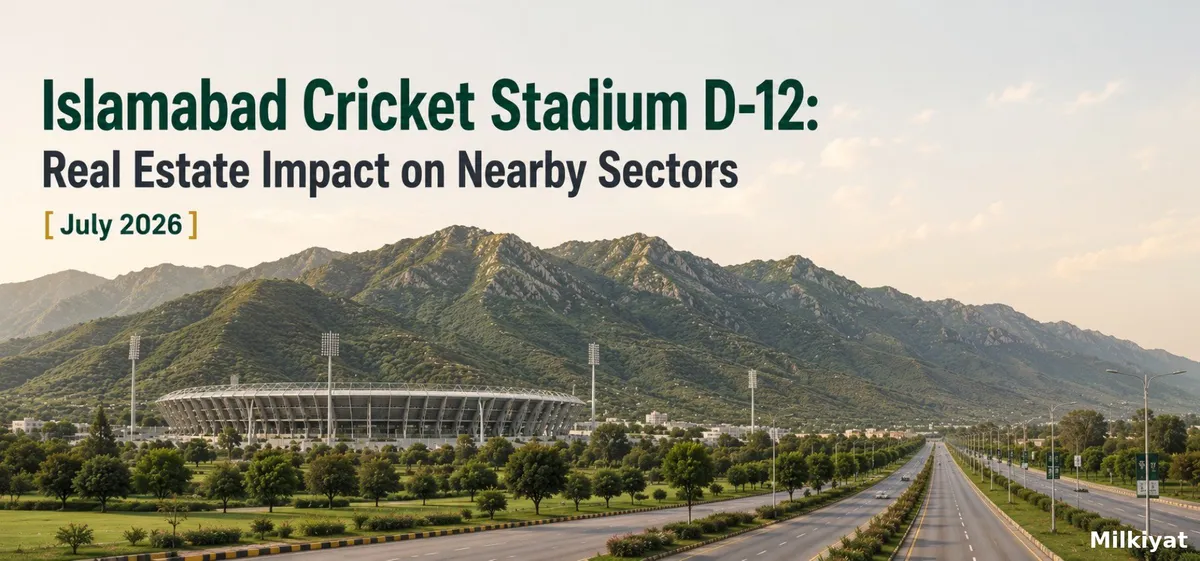
Islamabad has never had its own international cricket venue. For decades, the capital's cricket has lived next door at Rawalpindi Cricket Stadium a ground that shuts down half of Pindi every time an international side visits. That is now changing. The Capital Development Authority (CDA), working with the Pakistan Cricket Board (PCB), is building the capital's first purpose-built international cricket stadium near Sector D-12, along Iran Avenue in the Margalla foothills.
Property dealers across the D-12 and Margalla Road corridor are already selling the stadium as a price catalyst. Before you act on that pitch, here is what is verified, what has changed, what remains contested — and what the project realistically means for property in the surrounding sectors.
Islamabad Cricket Stadium D-12: Verified Project Facts (July 2026)
Where exactly is the stadium being built? The site sits near Sector D-12 on Iran Avenue, at the foothills of the Margalla Hills, on CDA-controlled land in the belt between D-12 and Shah Allah Ditta. CDA chose the location for its connectivity to the M-1 Motorway and Islamabad International Airport, a deliberate move to avoid the match-day gridlock that plagues Rawalpindi.
How big is the project? The stadium is planned on roughly 50 acres inside a larger proposed ~175-acre Olympic Village. That is a major expansion from the 25 acres CDA first offered PCB in 2023. Under the CDA–PCB arrangement, roughly 280 kanals will be leased long-term (a 99-year lease has been reported), with revenue shared 70:30 in PCB's favour.
What will it cost? Rs11.4 billion under the Engineering, Procurement and Construction (EPC) model. The originally approved PC-1 was Rs12 billion; design revisions brought the cost down.
Capacity and design. The current CDA figure is around 32,000 spectators, with an open Margalla Hills view, a design benchmarked against Dubai International Stadium, parking for roughly 10,000 vehicles located about one kilometre from the bowl, shuttle arrangements planned for match days, and a five-star hotel alongside so visiting teams stay on-site, a direct answer to the security-convoy problem that has shadowed international cricket in Pakistan since 2009. (An earlier December 2025 design document cited 25,000 seats and a three-tier bowl; the 32,000 figure has been consistent in CDA meeting reports through 2026 and should be treated as current).
Where does the tender stand right now? As of July 10, 2026, CDA had received revised designs and supplementary financial bids from the two shortlisted joint ventures — Habib Construction/ZKB-EA versus Lemar Builders/Kingcrete/BK Consultants — with financial bids due to be opened on the E-PAD portal within days. One group has prior experience linked to Peshawar's cricket stadium, the other to Lahore's Gaddafi Stadium. The contract had not been awarded at the time of writing.
The Timeline Has Slipped and the Real Opening Date Is Later Than You Think
In December 2025, officials promised groundbreaking by mid-January 2026, grey structure in six to eight months, and full delivery inside a year. None of that held. Bid evaluation was still underway in April 2026, technical qualification came in May, and financial bids were only being opened in mid-July.
More importantly: once the tender is awarded, construction is projected to take around two years not the twelve months in the original political messaging. Realistically, that puts a completed stadium in the 2028–29 window, assuming the contract is awarded in 2026 and nothing else intervenes.
This matters enormously for property decisions. Any dealer telling you the stadium opens "next year" is quoting a schedule that has already failed once. Price your entry against a 2028–29 delivery, not a 2027 one.
The Legal and Environmental Questions Nobody Is Pricing In
This is the part the plot-selling WhatsApp groups leave out.
Zone III status — partially resolved, partially not. The site falls within Zone III of the Islamabad Master Plan, where sports and recreational activities are permissible under the ICT Zoning Regulations 1992. That covers the stadium itself. But CDA will still require federal government approval for the allied works — the five-star hotel and commercial areas. The revenue-generating components of this project, the ones most relevant to nearby commercial property values, are the ones that still need a separate green light.
The Shakarparian precedent. CDA and PCB have been down this road before. A stadium project in Shakarparian, on land CDA provided, with PCB building at its own expense, was scrapped on the orders of the Supreme Court over the area's national park and Zone III status. The last Islamabad stadium project died in litigation after construction had started. Any investor treating the D-12 stadium as a certainty should remember that.
Wildlife board scrutiny still open. In January 2026, the Islamabad Wildlife Management Board (IWMB) formally asked CDA for the exact site layout and raised whether the site falls within, abuts, or overlaps the notified boundaries of Margalla Hills National Park or its 100-metre protected buffer under the Islamabad Nature Conservation and Wildlife Management Act, 2024. As of the May and July 2026 reporting, this question had not been publicly resolved. If the boundary determination goes against CDA, the Shakarparian scenario repeats.
None of this means the stadium won't be built , the project has strong federal backing, with Interior Minister Mohsin Naqvi in charge of both CDA and PCB. It means the project carries a genuine legal-risk discount that dealer pricing narratives conveniently ignore.
The Bigger Story: Margalla Road Extension Is the Real Property Catalyst
Here is the analysis most stadium-hype content misses entirely: the road infrastructure being built alongside the stadium will do more for property values than the stadium itself and it is on a much firmer footing.
Margalla Road currently dead-ends near D-12, forcing traffic from D-12, E-11, and the F/G sectors onto the congested Srinagar Highway and IJP Road to reach the motorway. The Margalla Road extension to the M-1 changes that: a six-lane, signal-free corridor from GT Road to the Sangjani area, with the Sangjani Interchange fast-tracked for completion by July 31, 2026 and the full extension targeted for December 2026. The Punjab government and NHA are executing the connecting segments to the M-1 near AWT.
Stadiums generate episodic, match-day demand. Roads permanently reprice land. Direct motorway access measured in minutes is a structural upgrade for D-12, E-11, C-12/C-13, and B-17 that holds regardless of what happens to the stadium in court or in tender rooms. If you are building an investment thesis around this corridor, the road is the foundation and the stadium is the bonus.
Real Estate Impact: Sector-by-Sector Analysis
D-12 Islamabad: Mature Sector, Commercial Upside, Match-Day Trade-Offs
D-12 is already one of Islamabad's most expensive developed sectors. Zameen's price index puts the average residential plot around PKR 9.8 crore as of May 2026, up roughly 3% year-on-year — with 5 marla plots around PKR 3.3 crore (up ~10% YoY, the strongest segment) and 1 kanal around PKR 12 crore.
That matters for the stadium thesis in two ways. First, D-12 prices already reflect the sector's fundamentals scarcity, Margalla views, wide CDA infrastructure. The stadium is an amenity added to a sector that was never cheap, so the marginal uplift is smaller than dealers imply. Second, D-12 is an end-user residential sector, and a 32,000-capacity venue with match-day security cordons next door is not an unambiguous positive for residents. The mitigations are real , parking sits a kilometre from the bowl with shuttle service, and the site is on Iran Avenue rather than inside the sector's street grid but buyers in the sub-sectors closest to the site should weigh match-day livability alongside capital gains.
Where D-12 gains most clearly: commercial plots. A stadium, an Olympic Village, and a five-star hotel generate sustained demand for food, retail, and short-stay accommodation, and D-12 Markaz is the nearest developed commercial hub. One caveat from the legal section above: the hotel and commercial components still need federal approval, so the full commercial ecosystem is not yet guaranteed.
D-13 Islamabad: Highest Theoretical Upside, Highest Risk
D-13 is undeveloped, and its FBR valuation was actually cut in April 2026 (from Rs16,000 to Rs11,200 per sq yard) as part of the 30–35% across-the-board Islamabad valuation reduction under SRO 644(I)/2026. Dealers are already marketing D-13 files on the stadium narrative.
Be careful. D-13's problems are the same as before the stadium announcement: no development, unresolved land status, and a file market where you buy paper, not possession. A stadium next door does not fix acquisition disputes. If the sector eventually develops, proximity to a stadium–Olympic Village complex and the extended Margalla Road will genuinely help — but "eventually" in Islamabad's D-series has meant decades. E-12's 37-year possession delay is the cautionary tale. Treat D-13 as a long-horizon land bank play with stadium optionality, not a two-year flip.
E-11 and the Margalla Road Corridor: The Rental and Hospitality Play
E-11 is the closest large, densely built sector with an active apartment and rental market. International fixtures, franchise tournaments, PCB regional and development camps, and hotel-overflow demand all favour short-stay and rental assets over vacant plots. If the stadium delivers, E-11 apartments and the guest-house segment along Margalla Road capture the recurring income effect event-driven demand, rather than a one-time price bump. E-11 also sits directly on the improved Margalla Road corridor, so it benefits from the road story even in a no-stadium scenario.
Shah Allah Ditta and the Western Fringe: Verify Before You Touch
CDA holds roughly 150 acres in the D-12/Shah Allah Ditta belt earmarked for sports development beyond the stadium parcel itself. If the Olympic Village materialises, this entire western fringe becomes an institutional-use zone, which typically lifts adjacent residential land while permanently capping how much of it can be privately developed. Much of the land here is informal or disputed tenure. Verify title through CDA's property verification system before touching anything a dealer calls "stadium-adjacent." This is where the worst of the hype-driven selling will concentrate.
The Honest Investment Read
What the stadium is: a credible, funded, federally backed project , formal CDA tender, two qualified bidders, financial bids opening, and political sponsorship from the minister who runs both CDA and PCB. This is the most serious attempt at an Islamabad stadium since Shakarparian.
What it is not: a done deal, an on-schedule project, or a reason to pay a "stadium premium" today. The contract is unawarded, construction will take about two years once it starts, the wildlife board's national park boundary question is unresolved, the hotel/commercial components need separate federal approval, and the Shakarparian Supreme Court precedent looms over any Zone III construction.
How to position, by risk appetite:
- Conservative: D-12 developed plots and D-12 Markaz commercial. You buy a sector that works with or without the stadium; the stadium and the Margalla Road extension are free upside.
- Income-focused: E-11 apartments and rental assets. Event-driven demand favours yield plays, and E-11 is where visiting demand will actually stay.
- Speculative: D-13 files — only with money you can park for 10+ years, only with clean, CDA-verifiable title.
- Avoid: anything marketed as stadium-adjacent in the informal Shah Allah Ditta belt without clean, CDA-verifiable title.
And the standing Milkiyat rule applies with extra force here: when a mega-project is announced, the first people to profit are the dealers who bought before the announcement and need you as their exit. The FBR's April 2026 valuation cuts have already handed buyers a genuine cost advantage across these sectors, use that, not the hype, as your entry logic.
Frequently Asked Questions
Where is the new Islamabad cricket stadium being built? Near Sector D-12 on Iran Avenue, at the foothills of the Margalla Hills, on about 50 acres within a proposed 175-acre Olympic Village between D-12 and Shah Allah Ditta.
How much will the Islamabad cricket stadium cost? Rs11.4 billion under the EPC model. The original PC-1 estimate was Rs12 billion, reduced after design revisions.
What is the seating capacity of the D-12 cricket stadium? Around 32,000 spectators per current CDA figures, with parking for about 10,000 vehicles located roughly one kilometre away. An earlier design document cited 25,000; the final figure will be confirmed when the winning design is announced.
When will the Islamabad cricket stadium be completed? No contract had been awarded as of mid-July 2026, and construction is projected at around two years after award — putting realistic completion in the 2028–29 window, despite earlier official claims of a one-year build.
Will the stadium increase property prices in D-12? D-12 commercial property is the clearest beneficiary. Residential upside is more modest because D-12 already trades at a premium (average plot ~PKR 9.8 crore, May 2026), and match-day security and traffic are a livability trade-off for the nearest sub-sectors.
Is D-13 a good investment because of the stadium? Only as a 10+ year speculative hold. D-13 remains undeveloped with unresolved land status, and its FBR valuation was cut in April 2026. The stadium does not fix possession risk.
Could the stadium project be cancelled? It carries real legal risk. The site is in Zone III (sports use is permitted, but the hotel and commercial components need federal approval), the wildlife board's Margalla Hills National Park boundary query is unresolved, and a previous CDA–PCB stadium at Shakarparian was scrapped by the Supreme Court.
Sources
- Dawn — CDA moves closer to awarding Rs11.4bn cricket stadium contract (July 2026): https://www.dawn.com/news/2014250
- ProPakistani — Rs11.4 billion Islamabad cricket stadium project advances (July 10, 2026): https://propakistani.pk/2026/07/10/rs-11-4-billion-islamabad-cricket-stadium-project-advances/
- Pakistan Today — Two JVs qualify for financial bidding stage (May 18, 2026): https://www.pakistantoday.com.pk/2026/05/18/islamabad-cricket-stadium-moves-closer-to-reality-as-two-firms-clear-technical-bids
- Pakistan Today — CDA begins bid evaluation; IWMB queries (April 6, 2026): https://www.pakistantoday.com.pk/2026/04/06/cda-to-begin-bid-evaluation-for-islamabad-cricket-stadium-project-today
- ProPakistani — PCB issues tender; two-year construction estimate, 280 kanals, 70:30 revenue split (January 1, 2026): https://propakistani.pk/2026/01/01/pcb-issues-tender-for-new-islamabad-cricket-stadium/
- Arab News — Islamabad's first cricket stadium on the way (December 20, 2025): https://www.arabnews.com/node/2626905
- Dawn — CDA sets July 30 deadline for Margalla Road extension (May 2026): https://www.dawn.com/news/1997850
- Dawn — PCB offered 25 acres near D-12 (2023, background): https://www.dawn.com/news/1750155
- CDA — Invitation to E-Bid, Construction of Cricket Stadium near Sector D-12: https://www.cda.gov.pk/public/tenders/invitation-to-e-bid-construction-of-cricket-stadium-near-sector-d-12-islamabad
- Zameen — D-12 residential plot price index (May 2026): https://www.zameen.com/index/buy/residential_plots/islamabad/d-12-160/