Guide
Which Islamabad and Rawalpindi Areas Are Most Vulnerable to Water Shortages?

By Bibi Masooma
Real Estate AnalystVerified author
16 min read
Short Answer
The areas of Islamabad and Rawalpindi most vulnerable to water shortages are generally those that depend heavily on groundwater, tube wells, limited supply networks or water sources affected by seasonal demand and maintenance. In Islamabad, some residential sectors can face greater water-supply pressure when major water sources, pumping systems or distribution networks are disrupted.
The Capital Development Authority (CDA) manages Islamabad’s water supply through a combination of surface-water sources and tube wells, making water availability in Islamabad an important consideration for residents and property buyers. Rawalpindi faces similar challenges, with supply reliability varying across different neighbourhoods and housing developments.
For property buyers, water availability should be assessed area by area and society by society. A developed locality may still experience water shortages if its primary water source, groundwater supply or distribution infrastructure is under pressure. Checking the property's water source, daily supply, storage capacity and backup arrangements can help buyers make a more informed investment decision.
Introduction
Water availability is becoming an increasingly important concern for residents, homebuyers and property investors in Islamabad and Rawalpindi. As the twin cities continue to grow, increasing residential demand is putting greater pressure on water sources, supply networks and groundwater reserves.
The Capital Development Authority (CDA) manages Islamabad’s water supply through a combination of surface water sources and groundwater, including Simly Dam, Khanpur Dam, water treatment facilities and tube wells. You can learn more about Islamabad’s water infrastructure through the CDA Water Supply & Engineering Wing.
The authority is also working on improving water management, groundwater recharge and the overall water-supply system. These initiatives are particularly important as the city’s population and water demand continue to increase. For official updates and ongoing development projects, readers can also check the CDA Official Website.
For property buyers, water availability in Islamabad and Rawalpindi should be considered alongside roads, schools, healthcare facilities and other essential services. A locality may have good infrastructure and strong property demand but can still face water-supply problems if its water sources or distribution network come under pressure.
CDA’s ongoing water-related projects and infrastructure improvements can also provide useful insight into how different parts of Islamabad may be affected by future water demand. Buyers can review relevant CDA water supply projects before making a property investment decision.
In this guide, we explore which areas of Islamabad and Rawalpindi are more vulnerable to water shortages, why water-supply problems occur, and what homebuyers and property investors should check before purchasing property in these areas.
Which Islamabad and Rawalpindi Areas Are Most Vulnerable to Water Shortages?
Water is rarely the first thing buyers ask about when comparing plots, houses or apartments in Islamabad and Rawalpindi, yet it can become one of the biggest sources of frustration after moving in. Water shortages in Islamabad and Rawalpindi are not limited to a single neighbourhood or one-time emergency. Supply pressure can increase during summer, periods of high demand, maintenance work and disruptions affecting major water sources.
However, water availability is not the same across the twin cities. Some areas depend more heavily on groundwater and tube wells, while others rely on piped supplies connected to major water sources. Private housing societies may also have their own wells, storage systems and backup arrangements, meaning conditions can vary significantly even between nearby localities.
For property buyers, understanding these differences is important before making a purchase. The table below provides a quick overview of the factors that can make an area more vulnerable to water shortages:
| Area Type | Main Water Concern | Vulnerability |
|---|---|---|
| Older Islamabad sectors | Pressure on existing supply networks during high demand | Moderate |
| Areas dependent on tube wells | Groundwater depletion and pumping limitations | High |
| Newer/developing areas | Limited infrastructure and incomplete supply networks | High |
| Private housing societies | Dependence on private wells and local water systems | Moderate to High |
| Low-lying or densely populated Rawalpindi areas | High demand and pressure on distribution networks | Moderate to High |
| Areas with reliable municipal connections and storage | Better access to established supply infrastructure | Lower |
In Rawalpindi, the Water and Sanitation Agency (WASA) is responsible for major water-supply and distribution services. Areas with ageing infrastructure, high population density or greater dependence on local groundwater sources can face additional pressure when demand rises.
This does not mean that every property in a particular sector or housing society will experience water shortages. Actual supply can depend on the specific street, block, connection, groundwater conditions, storage capacity and backup arrangements.
For buyers and investors, the key question is therefore not simply “Does this area have water?” but rather “How reliable is the water supply throughout the year?”
This guide examines where water shortage vulnerability is concentrated in Islamabad and Rawalpindi, the factors behind supply problems, and the checks buyers should complete before purchasing a property.
Why Islamabad's Water Shortage Is Structural, Not Occasional
Islamabad draws most of its piped water from two reservoirs Simly Dam and Khanpur Dam supplemented by a limited number of tubewells. Officials have repeatedly stated that the city's water demand has run well ahead of available supply for years, with reported gaps between demand and actual delivered supply during peak summer months and during scheduled maintenance shutdowns of supply canals.
A separate, longer-term issue compounds this: Islamabad has no natural source of groundwater recharge. Government documents note that groundwater is only present in isolated pockets in the city, and that these pockets are themselves depleting because water is extracted faster than it can be replenished naturally. CDA has run a rainwater-harvesting recharge-well program to partly address this, but the underlying imbalance remains.
Rawalpindi's older city core, by contrast, is served by WASA's long-established but ageing distribution network, drawing on a mix of dam allocation and tubewells a system that periodically becomes the subject of disputes with CDA over which city's tubewells can draw from shared groundwater near the Islamabad Expressway.
Islamabad's Key Water Sources
| Source | Role | Documented Pressure Point |
|---|---|---|
| Simly Dam | Primary reservoir feeding Islamabad's mains supply | Output drops sharply during low-rainfall periods |
| Khanpur Dam | Secondary reservoir shared with Rawalpindi | Annual LBC Canal cleaning suspends supply for weeks |
| Tubewells (various sectors) | Local supplementary supply, especially I-series | Disrupted by electricity load-shedding; linked to falling water table |
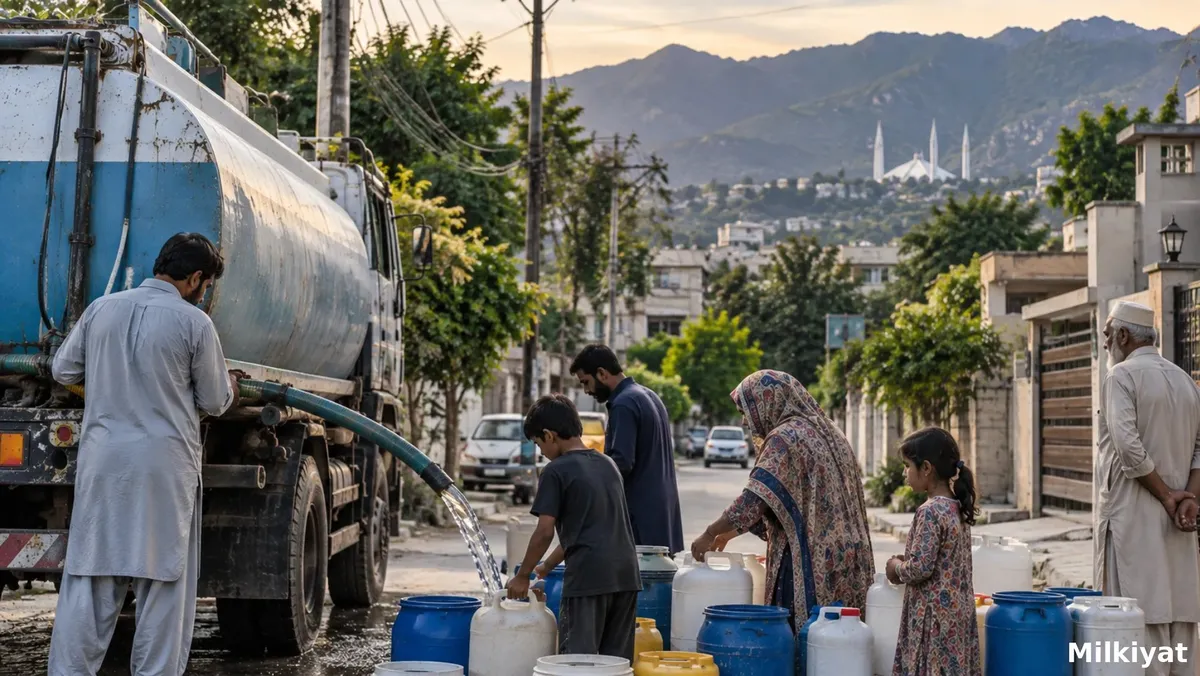
| Private tankers/bowzers | Emergency fallback for households and societies | Cost and availability fluctuate sharply during shortages |
I-8, I-9, I-10 and Nearby I-Series Sectors Face Higher Water-Supply Pressure
CDA officials have identified parts of Islamabad’s I-series sectors as recurring areas of water-supply pressure. I-8, I-9 and I-10 can be particularly affected where local supply depends on tube wells and groundwater pumping rather than a direct, continuous dam-fed mains connection.
Because tube wells require electricity to operate, power interruptions or pumping problems can reduce water pressure and affect supply continuity. During periods of high demand, especially in summer, residents in affected areas may also face longer supply gaps and increased reliance on water tankers.
However, water availability can vary from one block, street or property to another. Buyers should therefore check the property's actual water source, supply timings, underground storage capacity and backup arrangements before making a purchase.
| Area | Key Water Concern | What Buyers Should Check |
|---|---|---|
| I-8 | Local supply and pumping pressure | Daily supply and water pressure |
| I-9 | Groundwater and tube-well dependence | Summer availability and backup |
| I-10 | Higher demand and network pressure | Supply timings and storage |
| Nearby I-Series | Varying infrastructure by location | Specific property's water source |
What This Means for Property Buyers
If you are considering buying a house or plot in I-8, I-9 or I-10, water availability should be part of your due diligence. Ask the seller about the property's primary water source, average daily supply, underground storage and whether the household has ever needed tanker water.
It is also useful to speak directly with neighbours rather than relying only on the seller's claims. A property with a reliable water source and adequate storage can be significantly more practical than a similar property where residents regularly face interruptions.
SEO Keywords: I-8 water shortage, I-9 water shortage, I-10 water supply, Islamabad water shortage areas, Islamabad water crisis, water supply in I sectors Islamabad
G-11 and Peripheral Housing Schemes: Higher Water-Supply Risk
G-11 and some sectors beyond it can face greater water-supply vulnerability because groundwater availability is more limited in certain parts of this side of Islamabad. Government documentation on Islamabad’s groundwater conditions has highlighted areas where a dependable aquifer is not generally available, reducing the ability of residents to rely on groundwater when the main supply is interrupted.
This becomes particularly important in areas where there is limited alternative infrastructure. If the municipal supply is reduced, properties without a reliable private water source, adequate storage or backup arrangements may experience greater disruption.
Some peripheral and higher-end housing schemes on the outskirts of Islamabad can also face water-supply challenges. Despite having newer development and modern housing, certain schemes may depend heavily on private tube wells, groundwater extraction or tanker deliveries rather than a fully established municipal water network.
For property buyers, this is an important reminder that property quality and water security are not necessarily the same thing. A newly developed or premium housing scheme can still face water shortages if its water infrastructure has not kept pace with population growth.
| Area Type | Main Water-Supply Risk | What Buyers Should Check |
|---|---|---|
| G-11 | Limited groundwater backup in some locations | Main supply reliability and storage |
| Sectors beyond G-11 | Greater dependence on available local water sources | Water source and supply schedule |
| Peripheral housing schemes | Private tube wells and limited mains connectivity | Backup wells, storage and tanker dependence |
| Newer premium developments | Infrastructure may not match growing demand | Current and future water capacity |
Before buying property in these areas, buyers should ask whether the development has a dedicated water source, operational tube wells, underground storage tanks and a reliable backup system. Speaking with existing residents can also provide a more realistic picture of water availability during the summer months.
Old Rawalpindi’s WASA Network
Old Rawalpindi’s established urban core is served by a relatively extensive WASA Rawalpindi water-distribution network. Its water-supply vulnerability is different from areas that have limited municipal infrastructure. Instead, residents can face problems linked to ageing pipelines, changes in water allocation, operational issues with tube wells and reduced supply during scheduled maintenance affecting major water sources.
During periods of high demand or maintenance, some parts of Rawalpindi may experience lower water pressure or temporary interruptions. These disruptions can be more noticeable in densely populated neighbourhoods where demand on the existing distribution network is high.
For property buyers, the key point is that having a municipal water network does not automatically guarantee uninterrupted supply. Buyers should check the property's actual supply schedule, water pressure, storage capacity and availability of backup water.
Water Vulnerability Snapshot
| Area Type | Main Water Source | Key Vulnerability | Typical Response |
|---|---|---|---|
| I-8, I-9 and I-10 | Tube wells and local supply infrastructure | Power interruptions and pumping problems can affect supply | Tanker water or CDA bowser services where available |
| G-11 and sectors beyond | Mains supply with limited groundwater backup in some locations | Limited local groundwater fallback | Reliance on mains supply, storage and tankers |
| Peripheral housing schemes | Private tube wells and tanker supply in some developments | Greater dependence on private water arrangements | Private tanker purchase and local backup systems |
| Old Rawalpindi (WASA core) | WASA-managed supply, including surface water and tube wells | Ageing distribution infrastructure and operational disruptions | WASA supply schedules, storage and alternative arrangements |
| Mature F- and G-Sectors | Established municipal mains network | Supply pressure during maintenance or high-demand periods | Scheduled supply timings and household storage |
What the Snapshot Means for Buyers
The table shows that water vulnerability is not determined simply by whether an area is old, new, expensive or centrally located. The most important factors are the property's actual water source, reliability of the distribution network, groundwater availability and the quality of its backup arrangements.
Before purchasing a house or plot in Islamabad or Rawalpindi, buyers should ask about daily water availability, supply timings, tube-well dependence, underground storage and tanker requirements. These checks can help prevent unexpected water-related costs after moving into the property.
Reported Supply Gap During Shortage Periods
| Period/Event | Islamabad Demand vs Supply (as reported) | Notes |
|---|---|---|
| Routine dry-season shortage | Demand has been reported at roughly triple the available supply in some assessments | Reported by CDA-linked sources; varies by year and rainfall |
| Khanpur Dam canal maintenance | Rawalpindi supply reported to drop from ~19 MGD to ~6 MGD; Islamabad from ~9.6 MGD to ~4 MGD | Scheduled annually for canal cleaning, historically around January–February |
| Acute summer shortage (I-series sectors) | Supply secured against requirement gap reported by CDA officials during peak summer | Attributed mainly to load-shedding disrupting tubewell operation |
Figures above are as publicly reported by CDA and news sources at specific points in time; they fluctuate year to year and should be treated as indicative of the scale of the gap, not as current guaranteed numbers.
Household Adaptations by Area Type
| Area Type | Common Household Adaptation | Added Cost/Effort for Residents |
|---|---|---|
| I-series sectors | Rooftop/underground storage tanks, tanker top-ups | Recurring tanker cost during load-shedding periods |
| G-11 and beyond | Reliance on mains timing + storage | Scheduling water use around supply windows |
| Peripheral posh societies | Private tubewell plus tanker purchase | Higher per-tanker rates reported in acute shortages |
| Old Rawalpindi (WASA core) | Storage tanks buffering scheduled WASA supply timing | Lower reliance on private tankers overall |
What This Means for Buyers
Water reliability affects daily livability and, over time, rental appeal real estate advisors in Islamabad have noted that properties with a dependable water supply can command better rents than comparable units in less reliable areas. For buyers, the practical implication is not to avoid every affected sector outright, since most of Islamabad and Rawalpindi experiences some seasonal pressure, but to treat water supply as a specific due-diligence item rather than an assumption baked into the price.
Buyer Verification Checklist
| Check | How to Verify | Red Flag |
|---|---|---|
| Tanker frequency | Ask current residents how often tankers are needed in summer | Weekly or more frequent tanker reliance |
| Water source type | Confirm mains-fed vs tubewell-fed vs tanker-dependent by default | Advertised "water supply" that is actually tanker-only |
| Local water-table trend | Ask about recent borewell/tubewell performance in that specific street | Neighbours reporting new or deepened borewells recently |
| Scheduled shutdowns | Check CDA's official updates for recurring maintenance windows | No visible storage capacity to bridge known annual shutdowns |
| Storage tank presence | Note whether the house already has large storage tanks | Large tanks usually signal a known supply problem, not a solved one |
Bottom Line
No part of Islamabad or Rawalpindi is fully insulated from the twin cities' underlying water gap, but the risk is not evenly spread. I-series sectors and tubewell-dependent peripheral societies carry the highest documented exposure, while the mature F- and G-sector core and Old Rawalpindi's WASA-served areas tend to experience disruption in a more scheduled, predictable way. Buyers prioritising supply reliability should verify actual ground conditions in their target sector rather than relying on general assumptions about "Islamabad" as a whole.
FAQs
Which Islamabad sectors have the worst water shortages?
CDA officials have specifically pointed to I-8, I-9 and I-10 as recurring problem sectors, largely due to their dependence on tubewells affected by load-shedding.
Does Islamabad have any natural groundwater to fall back on?
Very little official documents note the city has no natural source of groundwater recharge, and areas like G-11 and beyond have no general aquifer at all.
Is Rawalpindi's water supply more reliable than Islamabad's?
Not necessarily more reliable, but different in character Rawalpindi's WASA network is older and more extensive, with disruptions tied more to pipe age, maintenance schedules and tubewell allocation disputes with CDA.
Do gated societies like Bahria Town or DHA have better water supply?
It varies by phase; some peripheral societies have reported more acute shortages than older sectors because they depend more heavily on tubewells and tanker delivery rather than an established mains connection.
Should water supply affect my decision to buy in a particular sector?
It's worth treating as a genuine due-diligence factor ask current residents about tanker frequency and check for known tubewell or groundwater issues in that specific location before finalising a purchase.
Internal Links
- What Is CDA? The Ultimate Investor’s Guide to Islamabad’s Capital Development Authority — Relevant for understanding CDA’s role in Islamabad’s development and property regulation.
-
CDA vs RDA Jurisdiction: Which Is Better for Your Investment in 2026? — Useful for buyers comparing properties across Islamabad and Rawalpindi.
-
Is TopCity-1 Under CDA or RDA? The Honest 2026 Investor’s Guide — Helpful for buyers evaluating peripheral developments and their regulatory status.
Official Source
- CDA Engineering Wing – Water Supply — Official information on Islamabad’s water-supply infrastructure, water production and distribution system.
For developments located near the city’s peripheral areas, Is TopCity-1 Under CDA or RDA? The Honest 2026 Investor’s Guide can provide additional context for buyers assessing the regulatory position of a housing development.