Guide
Shah Allah Ditta: Pakistan's Hidden Buddhist Treasure That's Changing Islamabad's Real Estate Forever

By Bibi Masooma
Real Estate AnalystVerified author
9 min read
1. Executive Context and Federal Policy Framework
The federal initiative to develop the Shah Allah Ditta Caves in Islamabad into an international Buddhist heritage site represents a structural realignment of Pakistan's national heritage management strategy. Announced during an executive site inspection by Federal Minister for National Heritage and Culture Aurangzeb Khan Khichi, the project transitions the site from a passively managed antiquity to an active locus of international cultural diplomacy and regional eco-tourism. Operative oversight has been assigned to the Directorate of Archaeology and Museums (DOAM), under the administrative direction of Secretary for National Heritage and Culture Asad Rehman Gilani. The project is strictly benchmarked for formal inauguration during the 3rd International Conference on the Buddhist Heritage of Pakistan.
The strategic imperatives driving this federal infrastructure investment operate across three primary policy domains:
First Domain — Cultural Diplomacy and Foreign Policy Monetization
Pakistan is building a high-security Buddhist pilgrimage corridor for East and Southeast Asian states — monetizing Gandhara civilization assets for soft-power projection and foreign exchange generation through religious tourism.
By upgrading physical access, security, and interpretive amenities at key Buddhist sites within the federal capital territory, the government seeks to establish a high-security pilgrimage corridor catering to East and Southeast Asian Buddhist states. This initiative aligns with executive priorities to leverage Gandhara civilization assets for international soft-power projection and foreign exchange generation through religious tourism.
Second Domain — Urban Spatial Regulation and Environmental Preservation
The site sits on the fragile boundary between Islamabad's expanding western grid and the protected Margalla Hills National Park — federal intervention now serves as a regulatory weapon against illegal quarrying and real estate encroachment.
The historical site at Shah Allah Ditta sits directly on the fragile geographic boundary separating Islamabad's expanding western sector grid from the protected Margalla Hills National Park. Federal intervention and formal site development serve as a regulatory barrier against aggressive real estate encroachment, unauthorized land sub-divisions, and illegal rock quarrying that have historically threatened the Margalla ridge. This dynamic is particularly relevant given the ongoing shifts in Islamabad's real estate market and the regulatory complexities surrounding Zone III boundaries.
Third Domain — Institutional Heritage Synthesis
Rather than treating the Shah Allah Ditta upgrade as an isolated capital project, the Ministry of National Heritage and Culture has integrated it into a broader institutional reform of the DOAM central gallery. This reform links federal capital archaeological sites with medieval martial history in Pothohar and ancient Neolithic civilizations in Balochistan, creating a unified national heritage framework.
2. Archaeological Stratigraphy and Trans-Regional Trade Routes
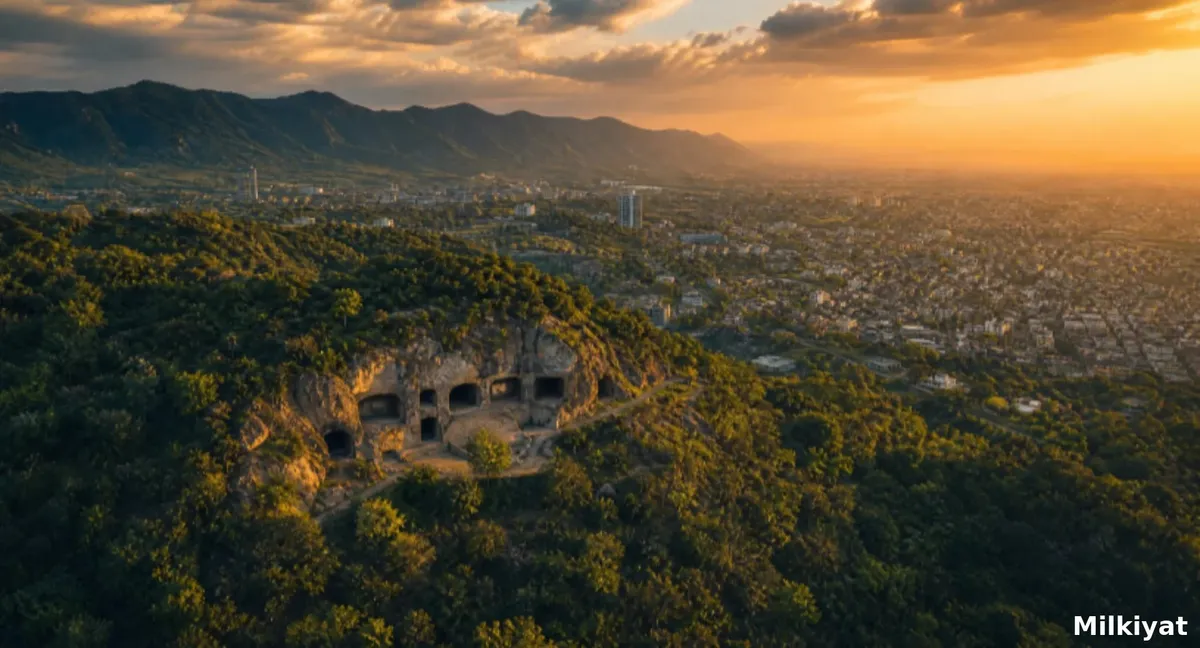
The archaeological site at Shah Allah Ditta presents a multi-layered cultural stratigraphy spanning approximately 2,400 years. Positioned at the southern base of the Margalla Hills in a natural valley 14 kilometers northwest of Islamabad, the site consists of two primary natural rock shelters composed of Kanjur stone — a porous, highly workable tufa limestone formation — flanking a perennial natural hot water spring. The site's geographic positioning made it a natural rest stop along the ancient transit corridor linking the Soan River basin with the Taxila Valley.
This site was visited by Alexander the Great in 326 BCE — the same pass his armies used to march toward Taxila.
| Epoch & Timeline | Material & Architectural Evidence | Primary Function & Regional Context |
|---|---|---|
| Early Gandharan (c. 4th BCE – 8th CE) | Kanjur stone extraction faces; adjacent Ban Faqiran Stupa complex. | Hermetic monastic retreat; raw material quarry for regional stupa construction. |
| Hindu Ascetic (Sadhu) (c. 8th CE – 1947 CE) | Mud plaster wall coatings; black/red Vishnu pigments; Sadhu ka Bagh. | Devotional shrine (Vishnu iconograph); monastic residence; pre-partition ritual space for local villagers. |
| Mughal & Sufi Dervish (c. 16th CE – 18th CE) | Limestone spring basin; lime mortar channels; dervish burials. | Waystation along the Gernaili Road; Sufi dervish retreat; water infrastructure for trans-regional caravans. |
| Colonial & Modern (19th CE – Present) | Losar Baoli stepwell; Nicholson Obelisk at Margalla Pass. | Strategic pass monitoring; state-protected antiquity; public archaeological site. |
The primary occupational layer belongs to the Gandhara Buddhist era, contemporaneous with the urban expansion of ancient Taxila (Takshashila). Monks utilized the natural rock shelters for meditation and ascetic retreat, drawn by the isolated topography and the permanent water source. The soft Kanjur stone surrounding the caves was systematically quarried during this period to construct sacred monuments across the ridge, most notably the Ban Faqiran Stupa complex situated two kilometers southwest at an elevation of 850 meters above sea level.
A hidden Buddhist stupa crowns a ridge nearly 850 meters above sea level, overlooking the historic divide between the Taxila and Soan valleys — one of Pakistan's most overlooked archaeological gems.
Following the decline of Buddhist institutional patronage in the 8th century CE, the caves were reoccupied by Hindu sadhus. The ascetics modified the natural cave interiors by applying multiple layers of mud plaster and whitewash over the stone surfaces. On the exterior facade of the eastern cave, artists executed murals using black pigment over a red-washed plaster backing, depicting Hindu iconographic motifs associated with Lord Vishnu. The surrounding area was developed into a cultivated orchard known as Sadhu ka Bagh, maintaining continuous religious function for local Hindu populations until Partition in 1947.
Buddhist monks carved these caves. Hindu ascetics painted Vishnu murals on the walls. Sufi dervishes built water tanks. Three religions, one site — 2,400 years of continuous sacred occupation.
During the Mughal period, the site acquired its current name from Shah Allah Ditta, a revered Punjabi Sufi dervish who established a spiritual residence at the caves. Muslim ascetics constructed formal water management structures, including a square catchment tank built of dressed limestone blocks laid in hydraulic lime mortar directly over the spring outflow.
Geographically, the site sits on a crucial historical transit branch of the Gernaili Road — the precursor to the Grand Trunk Road. This pass through the Margalla range was utilized by Alexander the Great in 326 BCE during his movement toward Taxila, by Sher Shah Suri in the 16th century (who ordered the construction of the nearby Losar Baoli stepwell to supply passing troops), and by Mughal imperial armies traveling between Kabul, Lahore, and Delhi.
3. Engineering Scope, Site Architecture, and Conservation Science
The physical execution of the upgrade at Shah Allah Ditta is governed by statutory standards following its declaration as a "Protected Antiquity" under the Antiquities Act 1975. The project requires a delicate balance between structural stabilization, delicate artwork restoration, and high-capacity visitor infrastructure.
| Domain | Technical Challenge | Engineering & Materials Intervention |
|---|---|---|
| Wall Painting Restoration | Heavy soot accumulation from ancient campfires over paintings. | Non-invasive organic solvent cleaning; micro-consolidation of mud plaster backing without chemical binding alteration. |
| Structural Masonry Preservation | Deterioration of Kanjur stone and Mughal limestone water tank. | Repointing using slaked lime mortar; removal of Portland cement patch repairs. |
| Hydrological Control | Sub-surface seepage causing freeze-thaw stone spalling. | Sub-grade drainage diversion channels; lime-lined runoff collection system. |
| Optical Stupa Linkage | Visual isolation of hilltop Ban Faqiran Stupa (2km away). | High-magnification weatherproof outdoor optical telescopes on low-vibration mounts. |
| Photometric Lighting | Thermal/UV degradation of historic surfaces. | Warm LED arrays (2700K–3000K) with zero UV/IR emission; indirect mountings. |
Centuries of carbon soot from ancient campfires had completely obscured Hindu murals on the cave walls — DOAM teams are now using non-invasive solvent treatments to reveal them without damaging a single pigment.
The conservation of the natural rock shelters requires specialized geochemical treatment. Centuries of continuous occupation by dervishes and travelers left dense coatings of carbon soot across the cave ceilings and walls, obscuring the historic Hindu murals. DOAM restoration teams are utilizing non-invasive solvent treatments to clear surface carbon without lifting the fragile black pigments or weakening the underlying mud plaster. Structural repairs to the cave facade and the Mughal-era water basin strictly mandate the use of traditional slaked lime mortar rather than modern Portland cement, which introduces soluble salts that fracture porous Kanjur stone through efflorescence.
Hydrological engineering forms a critical component of site stabilization. Water from the natural spring, while historically central to the site's sanctuary status, causes continuous sub-surface dampness that degrades the porous Kanjur stone through freeze-thaw cycles during winter months. The engineering intervention involves the installation of sub-grade drainage diversion channels and a lime-lined runoff collection system to manage water flow without altering the historical aesthetics of the Mughal catchment tank.
4. Real Estate Implications and the D-12 Corridor
The Shah Allah Ditta initiative is transforming the D-12 corridor from a speculative real estate frontier into a premium heritage-adjacent investment zone — legally compliant properties now carry an aesthetic premium of bordering a world-class heritage park.
The formalization of the Shah Allah Ditta site carries significant implications for the adjacent real estate markets, particularly Sector D-12 and the broader Margalla Road corridor. As federal authorities establish a protected, high-security perimeter around the heritage site, the boundary between urban development and the national park becomes rigidly enforced.
The regulatory hardening eliminates the speculative premium on unauthorized land sub-divisions — illegal plots pushing into the Margalla foothills are now effectively worthless.
This regulatory hardening eliminates the speculative premium previously attached to unauthorized land sub-divisions pushing into the Margalla foothills. Conversely, legally compliant properties within the CDA-demarcated zones of D-12 stand to benefit from the enhanced security, improved access infrastructure, and the aesthetic premium of bordering a world-class heritage park. The development of the nearby Islamabad Cricket Stadium further compounds this effect, transforming the D-12/Shah Allah Ditta belt into a major node for both cultural tourism and sports infrastructure. For investors tracking how Zone III and Zone IV regulations shape property values along the Margalla Hills corridor, the Shah Allah Ditta initiative represents a pivotal inflection point in Islamabad's heritage-adjacent real estate market.
References
Associated Press of Pakistan. "Shah Allah Ditta Caves to be developed into world-class Buddhist heritage site." August 2026. https://www.app.com.pk/national/shah-allah-ditta-caves-to-be-developed-into-world-class-buddhist-heritage-site/
Asian Studies. "3rd International Conference & Gandhara Culture and Tourism Festival." March 2026. https://www.asianstudies.org/events/3rd-international-conference-gandhara-culture-and-tourism-festival-islamabad-pakistan/
The Nation. "Buddhist legacy at Shah Allah Ditta holds huge cultural tourism potential." September 2025. https://www.nation.com.pk/08-Sep-2025/buddhist-legacy-at-shah-allah-ditta-holds-huge-cultural-tourism-potential
The Express Tribune. "Shah Allah Ditta caves – relic of ancient Buddhism." June 2022. https://tribune.com.pk/story/2360839/shah-allah-ditta-caves-relic-of-ancient-buddhism