Guide
Approved Layout Plan vs Approved Building Plan vs NOC: The Three Lahore Approvals Buyers Merge Into One

By Maham Imtiaz
Real Estate AnalystVerified author
11 min read
Short Answer
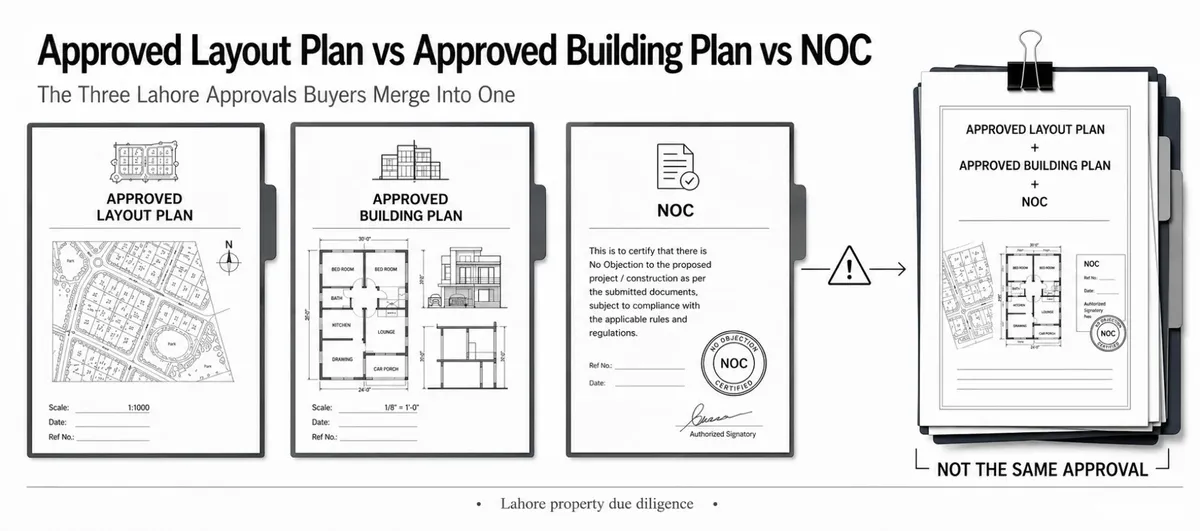
They are three separate approvals, issued at three different stages, to two different people. An Approved Layout Plan (LOP) is LDA's clearance of how a developer proposes to carve land into plots, roads and open spaces, it is a planning approval, not permission to sell. A scheme NOC (final approval) is what moves a scheme onto LDA's approved list and makes plot sale and transfer legitimate. An Approved Building Plan is a plot-level sanction issued to you, the owner, allowing construction on one specific plot to LDA's bylaws. A scheme can hold an LOP and still be listed as unapproved. A society can be fully approved and your house still be illegal because you never got a building plan sanctioned. When a dealer says "LDA approved," ask which of the three he means, and then read the document number yourself.
Why Buyers Merge Three Documents Into One Phrase
Lahore's plot market runs on one sentence: "Yeh society LDA approved hai." It is the single most repeated claim on banners along Raiwind Road, Bedian Road and the Ring Road periphery, and it is doing far too much work.
Behind that one phrase sit three approvals that have almost nothing in common. They are granted at different points in a scheme's life, they protect against different risks, and two of them are the developer's responsibility while the third is entirely yours. A buyer who treats them as interchangeable can pay a fully-approved price for a scheme that is still at planning stage, or build a house that no bank will mortgage and no serious buyer will pay full value for.
The confusion is profitable, which is why it survives. A developer holding only a layout approval is not lying when he shows you a stamped LDA drawing, he is simply letting you assume it means something it does not. Our detailed breakdown of LDA NOC vs LOP covers that specific trap in depth; this guide adds the third document most buyers never think about until construction day.
Approval One: The Approved Layout Plan (LOP)
An LOP is a map. Specifically, it is LDA's approval of the developer's proposed subdivision of a defined piece of land: where the plots sit, how wide the roads are, how much land is reserved for parks, graveyards, mosques, schools and commercial use, and how the scheme connects to the road network outside it.
What LDA is saying when it approves a layout plan is narrow: if you own this land, this is a technically acceptable way to divide it, and it does not conflict with the zoning applied to that area. That last point ties directly into the Lahore Master Plan and the Peri-Urban Structure Plan, which decides what land use is permissible on the city's edge in the first place.
What an LOP does not say is equally important:
- It does not confirm the developer has clean title to every khasra number inside the boundary.
- It does not confirm the developer has met the financial conditions LDA imposes before a scheme is finally approved.
- It does not authorise the sale, booking or advertisement of plots to the public.
- It does not guarantee the plot numbers being sold today will exist in the final sanctioned drawing.
That last point is where most money disappears. Layouts get revised. Blocks marketed at launch get merged, renumbered or dropped from later versions, and amenity land quietly becomes saleable plots. If your file references a block that is not on the currently sanctioned drawing, you own a receipt, not a plot.
Approval Two: The Scheme NOC (Final Approval)
The NOC is the approval that changes a scheme's legal status. In LDA's language it is the point at which a private housing scheme is finally approved, sponsor obligations met, land ownership demonstrated, required development milestones or securities in place, and the scheme added to the authority's public record of approved schemes.
Practically, three things change once the NOC is in hand:
Sale becomes legitimate. Plot sale, booking and marketing sit on a legal footing. Until then, LDA treats the scheme as unapproved regardless of how impressive the site office looks.
Transfer works normally. Society-level transfers and registry routes function as described in our guide to how property transfer works in Lahore, instead of stalling at the point where an official asks for the scheme's approval number.
Banks and utilities engage. Mortgage finance and formal utility connections generally follow approval status. Unapproved schemes get informal arrangements, and informal arrangements have a way of becoming the buyer's problem.
You can verify this yourself in minutes. LDA publishes a searchable register of approved private schemes and a matching list of illegal housing schemes. Search the exact scheme name, and note that approval is often granted for a specific area in a specific mouza, not for every acre now being sold under that brand. The method is set out step by step in how to verify a housing society with LDA, and the current picture of which Lahore schemes clear the bar is in our list of LDA approved housing societies in Lahore 2026.
Approval Three: The Approved Building Plan (Your Naqsha)
Here is the approval buyers almost never ask about at the time of purchase, because it does not belong to the developer at all. It belongs to whoever owns the plot.
An Approved Building Plan is LDA's sanction of the drawings for one specific structure on one specific plot: covered area, storeys, height, setbacks, basement, parking and use. You apply as the owner, with proof of title, a site plan and architect-prepared drawings, and you pay the prescribed fee challan. LDA's own application requirementspage lists separate categories for building plan approval in regular schemes, private schemes and control areas, a clue in itself that the process depends on where your plot sits.
Three points matter more than the paperwork:
The bylaws are fixed before you design. Ground coverage, floor area ratio, permissible storeys and setbacks are set by plot size band, not by budget or ambition. Our guide to the LDA building bylaws 2026 sets out those limits band by band, and it is cheaper to read them before your architect starts than after.
The sanction carries a building period. An approved plan is not permanent. Build within the period allowed or apply for an extension; LDA maintains a separate challan category for exactly this.
Construction is not the end of the process. After building, the plan is supposed to be closed out with a completion certificate. Most Lahore houses never get one, which is a slow-burning problem explained in LDA completion certificate: why your Lahore house probably does not have one.
If you are planning a build, run the numbers through the Lahore construction cost calculator using the covered area the bylaws actually permit — not the area the neighbour managed to build.
The Sequence, In Order
| Stage | Document | Issued to | What it permits | What it does not |
|---|---|---|---|---|
| 1 | Approved Layout Plan (LOP) | Developer | Planning of the subdivision | Sale, booking, construction |
| 2 | Scheme NOC / final approval | Developer | Legitimate plot sale and transfer | Construction on your plot |
| 3 | Approved Building Plan | Plot owner | Construction to sanctioned drawings | Occupation without completion |
| 4 | Completion certificate | Plot owner | Formal close-out of the build | — |
Read down that column of "what it does not." Every row is a gap someone has been paid to let you overlook.
Where the Merge Actually Costs Money
Paying stage-two prices for a stage-one scheme. Approved schemes trade at a premium for a reason: the approval risk has been removed. Pay that premium at layout stage and you have bought the risk and paid for its absence.
Buying a block outside the sanctioned boundary. Approval attaches to a defined area. Extensions marketed under the same society name may sit entirely outside it. Match your plot's block and mouza to the sanctioned drawing, not to the brochure map.
Building without a sanctioned plan. Unapproved construction is exposed to notices, penalties and, in serious cases, demolition of the offending portion. It also complicates every later transaction, mortgage, resale, inheritance.
Assuming commercial use is available. A residential plot on a busy road is not a commercial plot. Conversion is a separate, priced process covered in LDA commercialisation and land use conversion.
Discovering the plot is not under LDA at all. Plenty of land sold with a Lahore address falls under a cantonment board or a tehsil administration, each with its own rulebook, as set out in LDA vs Cantonment Board vs TMA. DHA is its own case again: its building control branch, not LDA, governs construction on DHA plots, which our DHA Lahore area guide explains in detail.
A Fifteen-Minute Check Before Any Token Payment
- Search the exact scheme name on LDA's approved schemes register, then on the illegal schemes list. Both, not one.
- Note the approved area and mouza, and confirm your block falls inside it.
- Ask the seller for the approval number and date, then match the block and plot number to the sanctioned drawing.
- Pull the title record through the Punjab Land Records Authority portal or an Arazi Record Centre and check for encumbrances.
- If you intend to build, confirm which authority sanctions building plans in that scheme and read the applicable rules from LDA's downloads section.
Fifteen minutes, no fee, no dealer involved. It is the cheapest due diligence available in Lahore.
Frequently Asked Questions
Q1. Is an approved layout plan enough to buy a plot safely?
A1. No. It clears the planning of the subdivision only. Until the scheme holds final approval and appears on LDA's approved register, sale is not on a firm legal footing and your plot number may not survive a layout revision.
Q2. My society is LDA approved. Do I still need a building plan?
A2. Yes. Scheme approval and building plan approval are separate. The society's NOC says the layout is legitimate; your building plan says your house is. One does not substitute for the other.
Q3. What happens if I build without an approved plan?
A3. You are exposed to notices and penalties, and you cannot obtain a completion certificate. The practical cost usually appears later, when a bank declines financing or a buyer discounts the property.
Q4. Does DHA fall under this process?
A4. No. DHA operates its own building control regime. Layout and construction approvals for DHA plots come from DHA, not LDA.
Q5. Can a scheme lose its approval?
A5. Approval can be suspended or withdrawn where sponsors breach conditions, and LDA publishes violation and hearing notices. Check status close to the transaction date, not once at the start.
Q6. How long is an approved building plan valid?
A6. It carries a building period rather than running indefinitely. If construction is not completed within it, an extension must be applied for through LDA's prescribed challan route.
Q7. Who is responsible for getting each approval?
A7. The developer holds the layout approval and the scheme NOC. The plot owner is responsible for the building plan and the completion certificate.
Final Word
Three approvals, three different questions. Is this land planned properly? Is this scheme legally allowed to sell it to me? Am I legally allowed to build on it? Each has its own document, its own issuing stage and its own way of failing.
Collapsing all three into "LDA approved" is not shorthand, it is the exact ambiguity a certain kind of seller depends on. Ask which approval, ask for its number, and check it yourself against LDA's public register before any money moves. For the wider market context around those checks, our Lahore property market guide 2026 and the budget-level comparison in what Rs 1 crore actually buys in Lahore show where approval risk is priced in, and where it very obviously is not.