News
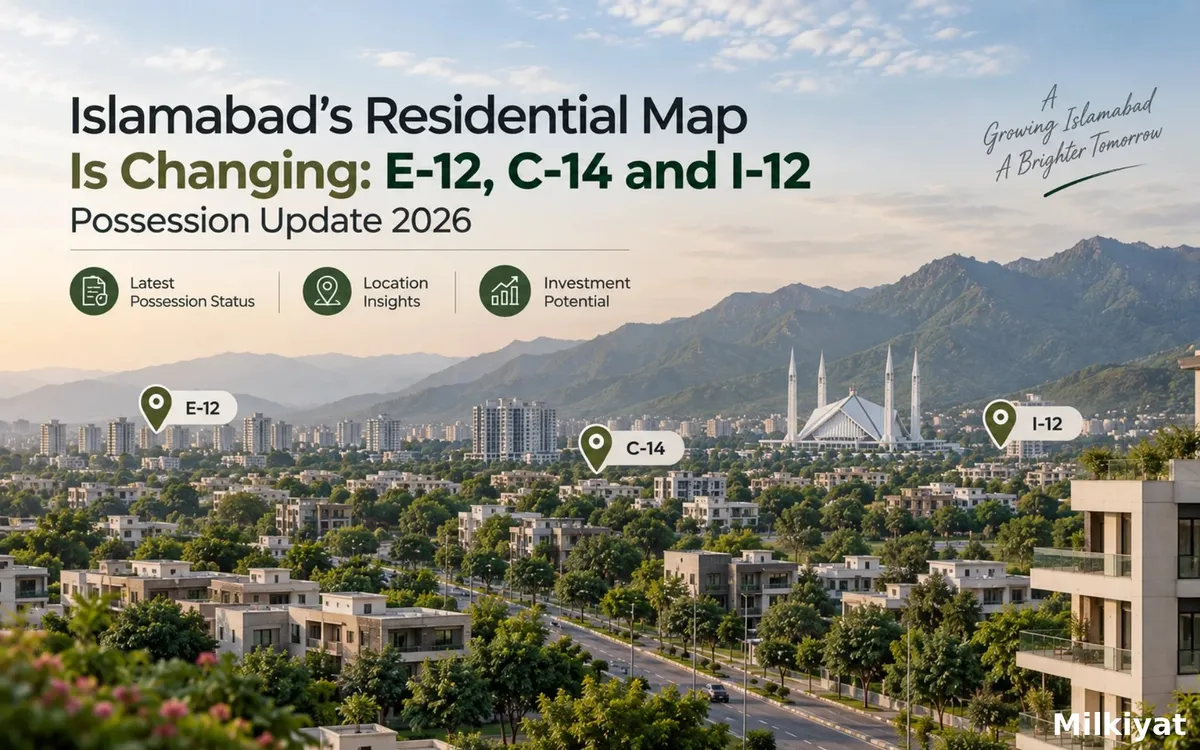
Islamabad's Residential Map Is Changing: E-12, C-14 and I-12 Possession Update 2026
Real Estate Analyst
Updated 10 min read
Quick answer: CDA is fast-tracking possession letters for over 7,200 developed plots across sectors E-12, C-14 and I-12. Development in I-12 and C-14 has passed 90%, while E-12 sits at roughly half complete. Six other sectors E-13, F-13, D-13, C-13, C-15 and C-16 — remain stalled, with CDA promising a dedicated review meeting to break the deadlock .
This story sits alongside Milkiyat's earlier deep-dive on the long wait inside Islamabad's C-14, C-15, C-16, E-12 and I-12 possession crisis. What follows is the mid-2026 progress update: what has moved, what has not, and what it means for your plot.
In a July 2026 meeting chaired by CDA Chairman Sohail Ashraf, officials confirmed a milestone that would have sounded impossible a year earlier: around 2,200 plots in E-12 and more than 5,000 plots in I-12 are now ready for possession, and most plots in C-14 have been developed and are ready for handover . The chairman instructed the engineering wing to issue possession letters without further delay and to contact plot owners directly .
The Senate Standing Committee on Housing and Works has directed NAB to investigate alleged annexation of Shamilaat and forest land in FGEHA Sky Gardens, also known as Green Enclave-II in Bhara Kahu, raising fresh concerns over the scheme’s unresolved land status
Punjab has launched land record services at Pakistan’s Embassy in Abu Dhabi and Consulate in Dubai, allowing overseas Pakistanis in the UAE to obtain Fards and access official Punjab property records without travelling to Pakistan.
Prime Minister Shehbaz Sharif has directed provinces and territories to survey properties that can qualify for financing under the Apna Ghar Scheme, with Islamabad selected as the pilot city for a new mortgage-eligible plot identification system.
The Federal Cabinet has approved the National Housing Policy 2025 and its Action Plan, introducing a new national framework focused on vertical housing, zoning compliance, energy efficiency, affordable housing finance and katchi abadi resettlement.
Real Estate Analyst
Updated 10 min read
Quick answer: CDA is fast-tracking possession letters for over 7,200 developed plots across sectors E-12, C-14 and I-12. Development in I-12 and C-14 has passed 90%, while E-12 sits at roughly half complete. Six other sectors E-13, F-13, D-13, C-13, C-15 and C-16 — remain stalled, with CDA promising a dedicated review meeting to break the deadlock .
This story sits alongside Milkiyat's earlier deep-dive on the long wait inside Islamabad's C-14, C-15, C-16, E-12 and I-12 possession crisis. What follows is the mid-2026 progress update: what has moved, what has not, and what it means for your plot.
In a July 2026 meeting chaired by CDA Chairman Sohail Ashraf, officials confirmed a milestone that would have sounded impossible a year earlier: around 2,200 plots in E-12 and more than 5,000 plots in I-12 are now ready for possession, and most plots in C-14 have been developed and are ready for handover . The chairman instructed the engineering wing to issue possession letters without further delay and to contact plot owners directly .
The Senate Standing Committee on Housing and Works has directed NAB to investigate alleged annexation of Shamilaat and forest land in FGEHA Sky Gardens, also known as Green Enclave-II in Bhara Kahu, raising fresh concerns over the scheme’s unresolved land status
Punjab has launched land record services at Pakistan’s Embassy in Abu Dhabi and Consulate in Dubai, allowing overseas Pakistanis in the UAE to obtain Fards and access official Punjab property records without travelling to Pakistan.
Prime Minister Shehbaz Sharif has directed provinces and territories to survey properties that can qualify for financing under the Apna Ghar Scheme, with Islamabad selected as the pilot city for a new mortgage-eligible plot identification system.
The Federal Cabinet has approved the National Housing Policy 2025 and its Action Plan, introducing a new national framework focused on vertical housing, zoning compliance, energy efficiency, affordable housing finance and katchi abadi resettlement.
That is a meaningful shift for a city that has not developed a single fully new residential sector since D-12 was completed in 2008 a gap that has directly fuelled Islamabad's affordable housing shortage and pushed prices upward for nearly two decades .
The sector at the centre of this story, E-12, carries perhaps the most painful file in CDA's history. Launched in 1989 with more than 4,000 allottees who were promised developed plots within two years, it instead sat incomplete for 37 years so long that many original allottees died waiting, and their heirs are now the ones collecting possession letters Read Milkiyat's full account of what E-12 allottees actually got after 37 years in our dedicated investigation: E-12 Islamabad Possession 2026: 37 Years Later, What Allottees Actually Got.
The three sectors closest to possession sit in very different parts of the capital, and location explains much of their investment appeal.
| Sector | Location | Connectivity |
|---|---|---|
| I-12 | Between the Islamabad Expressway and I-11 | Strong existing connectivity; serves the mid-tier housing market |
| C-14 | Zone II, near the Margalla foothills | Premium positioning with Margalla Hills views |
| E-12 | Central-eastern grid, close to the city's core | Long regarded as highly desirable — which is why the delay hurt so much |
I-12's proximity to the Islamabad Expressway and the established I-11 suburb gives it an edge for end-users who want to live near existing infrastructure rather than wait for a new neighbourhood to mature [3]. C-14 sits in Zone II against the Margalla foothills the kind of location Islamabadis pay a premium for. E-12's position near the heart of the planned city has long been considered one of its best features, and it is a large part of why its decades-long delay was such a persistent frustration for the families holding its files .
Progress varies sharply from sector to sector, and it is worth being specific rather than treating "CDA sectors" as one uniform story. The numbers below come directly from CDA's own briefings to officials this summer.
I-12 and C-14 are both past 90% development completion . In C-14, more than 95% of electricity supply arrangements are reportedly complete, with IESCO having issued demand notices for power connections, while streetlights, drainage, sewerage, landscaping and signage are being finalised .
E-12 is roughly half developed. CDA currently holds possession of land in nearly two of the sector's sub-sectors, while one sub-sector remains under adverse possession and another is partially occupied. Partial work such as road sub-base construction has been completed in three sub-sectors, but E-12/4 remains largely untouched, with no visible development .
I-15 has uneven progress. Three of its sub-sectors have completed development, but one remains stuck after a contractor abandoned the work halfway, alongside an unresolved possession issue .
This is the part of the map that has not changed much yet, and it deserves equal attention. CDA holds 13 acquired residential sectors in total, but eight of them remain stalled with little or no development activity, while limited progress continues only in C-14, I-12 and I-15 . The specific sectors still waiting are E-13, F-13, D-13, C-13, C-15 and C-16.
The holdup is not simply funding or planning it is largely legal. Compensation disputes, delayed balloting and unresolved built-up property (BUP) awards continue to block progress in these sectors . Under a significant Islamabad High Court ruling, affected landowners are now entitled to cash compensation rather than replacement plots for their built-up property a decision that could require CDA to pay out billions of rupees across these sectors before development can proceed .
For those following this legal angle closely, Milkiyat's investigation into the CDA & RDA file crackdown of 2026 explains how file holders across stalled schemes are being affected by the same compensation battles.
There is one potential workaround being discussed. Sources indicate CDA is considering developing one of its stalled sectors most likely D-13 through a public-private partnership, though nothing has been officially confirmed .
Plot values in Islamabad's CDA sectors follow a fairly predictable pattern: undeveloped "file" plots trade at a discount to developed, possession-ready land, and that gap narrows sharply the moment possession letters actually start being issued. Analysts expect a notable jump in market value in C-14 specifically as plots transition from file status to possession-ready land .
For E-12, C-14 and I-12 buyers, that pattern is worth watching closely over the coming months. For context on the broader valuation picture in the capital including the impact of FBR's revised rates on commercial investors — see our companion piece, Islamabad Property Valuation Cut 2026: What FBR's New Rates Mean for Commercial Investors.
For investors, the practical takeaway is a shift from speculative file-buying toward construction-backed sectors. The possession letter process for E-12, C-14 and I-12 marks a move from pure speculation to real, construction-led growth — with more than 7,200 plots ready for handover and clear direction from CDA's leadership to expedite the process .
That said, the stalled sectors should not be written off entirely. Long-term investors comfortable with legal and timeline risk may find an argument there too: historically, sectors that finally break their deadlock as E-12 appears to be doing now see the sharpest appreciation precisely because they were previously discounted for uncertainty. The risk-reward curve is simply steeper, and patience is measured in years, not months.
Rental demand in newly possession-ready sectors typically lags a year or two behind handover, simply because construction of homes takes time even after plots become legally transferable. Investors targeting E-12, C-14 or I-12 for rental income should plan around a multi-year horizon rather than expecting immediate yield. Expectation: the first construction cranes in C-14 are likely to appear within a year of possession letters being issued, with rental supply following 12–24 months after that.
CDA's own framing suggests this is a leadership-driven push rather than a routine administrative update. Officials say the current CDA management is determined to break the decades-long deadlock, and analysts believe successful completion of the E-12 project specifically could help restore investor confidence in CDA-backed housing schemes after years of criticism over stalled sectors .
Whether that momentum extends to the six sectors still waiting E-13, F-13, D-13, C-13, C-15 and C-16 depends heavily on how quickly the compensation and BUP disputes get resolved. CDA has indicated that development work in these sectors will be taken up in a dedicated future meeting , but as of mid-2026, no firm construction timeline has been announced for most of them.
| Advantages | Disadvantages |
|---|---|
| E-12, C-14 and I-12 are transitioning from file-stage to possession-stage historically a strong value-appreciation trigger | Six sectors remain legally and administratively stalled with no confirmed timeline |
| Strong existing connectivity: I-12 near the Islamabad Expressway, C-14 in Zone II against the Margalla foothills | Compensation and built-up property disputes could still delay handovers even in near-complete sectors |
| Clear, recent leadership commitment from CDA to accelerate handovers | Rental income typically lags possession by a year or more |
Buyers seeking near-term certainty should focus on I-12 and C-14, where development has passed the 90% mark and possession letters are actively being processed. Investors with a longer time horizon and higher risk tolerance might consider E-12, given its lower current development stage but strong underlying location and active CDA attention. The six fully stalled sectors are best suited to speculative, long-hold investors who understand the legal risk involved.
Before committing money to any plot marketed as "developed," keep three checks in mind. First, confirm current possession status directly with CDA status can vary sub-sector by sub-sector, as seen in both E-12 and I-15, where partially completed pockets sit beside stalled ones . Second, remember that built-up property compensation disputes can delay handovers even after a sector is publicly announced as near-complete. Third, verify whether the cash-compensation ruling from the Islamabad High Court affects any land parcel you are considering, since it can change the underlying ownership picture entirely .
Which Islamabad sectors are still stalled in 2026?
E-13, F-13, D-13, C-13, C-15 and C-16 remain largely stalled, out of CDA's 13 total acquired residential sectors. Eight of the 13 acquired sectors show little or no development activity .
Is E-12 in Islamabad fully developed now?
Not yet. Development is roughly half complete, though CDA is issuing possession letters for around 2,200 plots that are already developed, and has made the sector a clear priority .
Why did it take so long to develop E-12?
E-12 was launched in 1989, and development stalled for decades due to a combination of land possession disputes, adverse possession in some sub-sectors and limited CDA capacity. The last fully completed CDA sector was D-12, finished in 2008 .
Will the stalled sectors ever be developed?
CDA has indicated it will review development plans for the six stalled sectors in a future dedicated meeting, and is reportedly considering a public-private partnership for at least one sector (D-13). No confirmed construction timeline exists yet for most of them .
That is a meaningful shift for a city that has not developed a single fully new residential sector since D-12 was completed in 2008 a gap that has directly fuelled Islamabad's affordable housing shortage and pushed prices upward for nearly two decades .
The sector at the centre of this story, E-12, carries perhaps the most painful file in CDA's history. Launched in 1989 with more than 4,000 allottees who were promised developed plots within two years, it instead sat incomplete for 37 years so long that many original allottees died waiting, and their heirs are now the ones collecting possession letters Read Milkiyat's full account of what E-12 allottees actually got after 37 years in our dedicated investigation: E-12 Islamabad Possession 2026: 37 Years Later, What Allottees Actually Got.
The three sectors closest to possession sit in very different parts of the capital, and location explains much of their investment appeal.
| Sector | Location | Connectivity |
|---|---|---|
| I-12 | Between the Islamabad Expressway and I-11 | Strong existing connectivity; serves the mid-tier housing market |
| C-14 | Zone II, near the Margalla foothills | Premium positioning with Margalla Hills views |
| E-12 | Central-eastern grid, close to the city's core | Long regarded as highly desirable — which is why the delay hurt so much |
I-12's proximity to the Islamabad Expressway and the established I-11 suburb gives it an edge for end-users who want to live near existing infrastructure rather than wait for a new neighbourhood to mature [3]. C-14 sits in Zone II against the Margalla foothills the kind of location Islamabadis pay a premium for. E-12's position near the heart of the planned city has long been considered one of its best features, and it is a large part of why its decades-long delay was such a persistent frustration for the families holding its files .
Progress varies sharply from sector to sector, and it is worth being specific rather than treating "CDA sectors" as one uniform story. The numbers below come directly from CDA's own briefings to officials this summer.
I-12 and C-14 are both past 90% development completion . In C-14, more than 95% of electricity supply arrangements are reportedly complete, with IESCO having issued demand notices for power connections, while streetlights, drainage, sewerage, landscaping and signage are being finalised .
E-12 is roughly half developed. CDA currently holds possession of land in nearly two of the sector's sub-sectors, while one sub-sector remains under adverse possession and another is partially occupied. Partial work such as road sub-base construction has been completed in three sub-sectors, but E-12/4 remains largely untouched, with no visible development .
I-15 has uneven progress. Three of its sub-sectors have completed development, but one remains stuck after a contractor abandoned the work halfway, alongside an unresolved possession issue .
This is the part of the map that has not changed much yet, and it deserves equal attention. CDA holds 13 acquired residential sectors in total, but eight of them remain stalled with little or no development activity, while limited progress continues only in C-14, I-12 and I-15 . The specific sectors still waiting are E-13, F-13, D-13, C-13, C-15 and C-16.
The holdup is not simply funding or planning it is largely legal. Compensation disputes, delayed balloting and unresolved built-up property (BUP) awards continue to block progress in these sectors . Under a significant Islamabad High Court ruling, affected landowners are now entitled to cash compensation rather than replacement plots for their built-up property a decision that could require CDA to pay out billions of rupees across these sectors before development can proceed .
For those following this legal angle closely, Milkiyat's investigation into the CDA & RDA file crackdown of 2026 explains how file holders across stalled schemes are being affected by the same compensation battles.
There is one potential workaround being discussed. Sources indicate CDA is considering developing one of its stalled sectors most likely D-13 through a public-private partnership, though nothing has been officially confirmed .
Plot values in Islamabad's CDA sectors follow a fairly predictable pattern: undeveloped "file" plots trade at a discount to developed, possession-ready land, and that gap narrows sharply the moment possession letters actually start being issued. Analysts expect a notable jump in market value in C-14 specifically as plots transition from file status to possession-ready land .
For E-12, C-14 and I-12 buyers, that pattern is worth watching closely over the coming months. For context on the broader valuation picture in the capital including the impact of FBR's revised rates on commercial investors — see our companion piece, Islamabad Property Valuation Cut 2026: What FBR's New Rates Mean for Commercial Investors.
For investors, the practical takeaway is a shift from speculative file-buying toward construction-backed sectors. The possession letter process for E-12, C-14 and I-12 marks a move from pure speculation to real, construction-led growth — with more than 7,200 plots ready for handover and clear direction from CDA's leadership to expedite the process .
That said, the stalled sectors should not be written off entirely. Long-term investors comfortable with legal and timeline risk may find an argument there too: historically, sectors that finally break their deadlock as E-12 appears to be doing now see the sharpest appreciation precisely because they were previously discounted for uncertainty. The risk-reward curve is simply steeper, and patience is measured in years, not months.
Rental demand in newly possession-ready sectors typically lags a year or two behind handover, simply because construction of homes takes time even after plots become legally transferable. Investors targeting E-12, C-14 or I-12 for rental income should plan around a multi-year horizon rather than expecting immediate yield. Expectation: the first construction cranes in C-14 are likely to appear within a year of possession letters being issued, with rental supply following 12–24 months after that.
CDA's own framing suggests this is a leadership-driven push rather than a routine administrative update. Officials say the current CDA management is determined to break the decades-long deadlock, and analysts believe successful completion of the E-12 project specifically could help restore investor confidence in CDA-backed housing schemes after years of criticism over stalled sectors .
Whether that momentum extends to the six sectors still waiting E-13, F-13, D-13, C-13, C-15 and C-16 depends heavily on how quickly the compensation and BUP disputes get resolved. CDA has indicated that development work in these sectors will be taken up in a dedicated future meeting , but as of mid-2026, no firm construction timeline has been announced for most of them.
| Advantages | Disadvantages |
|---|---|
| E-12, C-14 and I-12 are transitioning from file-stage to possession-stage historically a strong value-appreciation trigger | Six sectors remain legally and administratively stalled with no confirmed timeline |
| Strong existing connectivity: I-12 near the Islamabad Expressway, C-14 in Zone II against the Margalla foothills | Compensation and built-up property disputes could still delay handovers even in near-complete sectors |
| Clear, recent leadership commitment from CDA to accelerate handovers | Rental income typically lags possession by a year or more |
Buyers seeking near-term certainty should focus on I-12 and C-14, where development has passed the 90% mark and possession letters are actively being processed. Investors with a longer time horizon and higher risk tolerance might consider E-12, given its lower current development stage but strong underlying location and active CDA attention. The six fully stalled sectors are best suited to speculative, long-hold investors who understand the legal risk involved.
Before committing money to any plot marketed as "developed," keep three checks in mind. First, confirm current possession status directly with CDA status can vary sub-sector by sub-sector, as seen in both E-12 and I-15, where partially completed pockets sit beside stalled ones . Second, remember that built-up property compensation disputes can delay handovers even after a sector is publicly announced as near-complete. Third, verify whether the cash-compensation ruling from the Islamabad High Court affects any land parcel you are considering, since it can change the underlying ownership picture entirely .
Which Islamabad sectors are still stalled in 2026?
E-13, F-13, D-13, C-13, C-15 and C-16 remain largely stalled, out of CDA's 13 total acquired residential sectors. Eight of the 13 acquired sectors show little or no development activity .
Is E-12 in Islamabad fully developed now?
Not yet. Development is roughly half complete, though CDA is issuing possession letters for around 2,200 plots that are already developed, and has made the sector a clear priority .
Why did it take so long to develop E-12?
E-12 was launched in 1989, and development stalled for decades due to a combination of land possession disputes, adverse possession in some sub-sectors and limited CDA capacity. The last fully completed CDA sector was D-12, finished in 2008 .
Will the stalled sectors ever be developed?
CDA has indicated it will review development plans for the six stalled sectors in a future dedicated meeting, and is reportedly considering a public-private partnership for at least one sector (D-13). No confirmed construction timeline exists yet for most of them .
